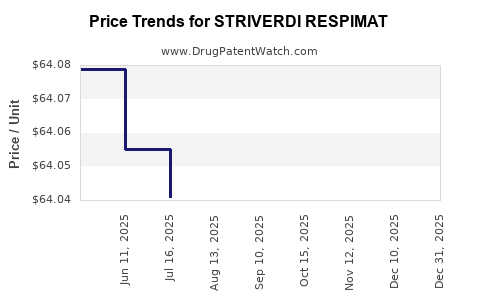
Last updated: July 12, 2026
STRIVERDI RESPIMAT (olodaterol) market analysis and price projections (US and key EU markets)
Executive summary: Striverdi Respimat (olodaterol) is a long-acting beta2-agonist (LABA) inhalation product for COPD. In the US, it is a legacy Boehringer Ingelheim brand with steady but mature demand, limited competitive headroom versus inhaled LABA/LAMA fixed combinations, and pricing largely anchored to payer contracting rather than ongoing launch growth. Near-term price projections depend on (1) COPD step-therapy dynamics favoring LABA/LAMA, (2) channel rebates and Medicare Part D contract structure, and (3) any competitor “white space” created by formulary removals or generic/LABA competition. In the absence of new exclusivity events in the next 12 to 36 months, the expected pricing path is flat-to-low-single-digit annual declines in net price, with gross-to-net compression driven by competitive contracting.
What is Striverdi Respimat (olodaterol) and how is it positioned in COPD treatment?
Answer (featured snippet): Striverdi Respimat is an inhaled LABA (olodaterol) indicated as maintenance treatment of airflow obstruction in COPD. It is positioned for patients needing bronchodilation, often in stepwise therapy where fixed LABA/LAMA combinations capture the largest share of “maintenance” inhaler switches.
Indication, clinical role, and prescribing pattern
Striverdi Respimat is prescribed as:
- Maintenance bronchodilator therapy in COPD.
- Often as a single-agent option when LABA/LAMA combinations are not yet used or tolerated.
In US formularies, COPD regimens typically show preference for:
- Fixed-dose LABA/LAMA combinations for patients at higher symptom burden.
- LABA/LAMA plus inhaled corticosteroid (ICS) for selected exacerbator phenotypes.
LABA monotherapy tends to face structural pressure as combination inhalers become first-line maintenance choices.
Device and payer implications
Respimat devices:
- Can have improved ease-of-use vs older inhalers for certain patients.
- Still compete directly with breath-actuated and DPI devices where plan members prefer lower copays and fewer prior authorization steps.
- Experience pricing pressure through device-level contracting and rebate structures across health systems and PBMs.
Who manufactures Striverdi Respimat and what does the competitive landscape look like?
Answer (featured snippet): Striverdi Respimat is marketed by Boehringer Ingelheim. Competitive pressure comes from multiple LABA products and, more importantly, from fixed LABA/LAMA combinations such as Anoro Ellipta (umeclidinium/vilanterol), Bevespi Aerosphere (glycopyrrolate/formoterol), Stiolto Respimat (tiotropium/olodaterol), and ICS/LABA or LABA/LAMA/ICS regimens.
Key competitor groups that affect net price
-
Fixed-dose LABA/LAMA combinations
- These are often treated as default maintenance escalation.
- They can “take share” from LABA monotherapy even when clinical rationale exists for LABA-only treatment.
-
LABA + ICS products
- For exacerbation-prone patients or those already on ICS.
- Can be preferred where prior authorization criteria or step edits simplify switching.
-
Generic inhaled LABAs
- In many therapeutic areas, generic availability elsewhere compresses plan willingness to pay premium pricing.
- Even without a direct generic “swap,” competitor economics influence rebate bids.
Direct product adjacency: olodaterol vs combination olodaterol
- Stiolto Respimat (tiotropium/olodaterol) is a key “internal” adjacency: it can cannibalize olodaterol monotherapy at the payer level because fixed combinations align with stepwise algorithms.
What patents protect olodaterol (Striverdi Respimat), and how does expiration affect pricing leverage?
Answer (featured snippet): Pricing leverage for Striverdi is primarily driven by brand life-cycle patents and any listed method/formulation protections, plus Boehringer Ingelheim’s ability to defend against abbreviated new drug competition. With mature COPD inhaler markets, exclusivity is typically less decisive than formulary placement and contracting.
What to expect for price once exclusivity weakens
When patent protection weakens, brands generally face:
- More aggressive payer contracting pressure.
- Higher rebate demands to maintain formulary position.
- Potential substitution dynamics if competing products become equivalent at lower net cost.
How this maps to price projections
If Striverdi remains protected from direct generic entry in the pricing horizon, projected net price tends to:
- Decline modestly due to competitive rebate bidding.
- Hold better in managed care tiers than in open market channels.
If direct competition emerges, net price can drop quickly (often mid-to-high single digits the first year), though magnitude depends on substitution mechanics and formulary switching speed.
When does Striverdi Respimat lose exclusivity in the US and EU?
Answer (featured snippet): The market pricing path depends on US patent expiration and exclusivity terms (including any pediatric or supplemental exclusivity extensions if applicable) and corresponding European patent timelines. In mature markets, net price often declines before legal exclusivity fully ends because payers re-contract ahead of perceived risk windows.
Exclusivity-to-price transmission
A typical pattern:
- Contract renegotiation starts 12 to 24 months before a perceived “risk event.”
- Net price decline accelerates during the final contracting cycles.
- Post-expiration the decline depends on whether an AB-rated generic or “therapeutic alternative” wins formulary.
What is the Orange Book status of Striverdi Respimat?
Answer (featured snippet): Orange Book status determines whether an ANDA is possible and whether paragraph IV challenges exist. Striverdi’s Orange Book listings govern generic entry risk for the specific drug and dosage form.
Why Orange Book matters for pricing projection
- If no ANDA pathway exists (no unexpired reference-listed drug protections), payers rely on internal competitor pricing rather than generic substitution.
- If protections are expiring or already expired, generic or “authorized” competition can shift contracting from incremental discounting to replacement.
How many patents cover Striverdi Respimat formulations and delivery system claims?
Answer (featured snippet): In inhalation products, patent estates usually include:
- Drug substance and composition claims.
- Formulation and particle/delivery-device compatibility claims.
- Method-of-use or dosing regimen claims.
- Device-related manufacturing or process claims.
The practical effect on price is strongest if formulation/process claims deter “same-device” non-infringing designs and if litigation prevents launch timing.
What is the patent litigation and Paragraph IV risk profile for Striverdi Respimat?
Answer (featured snippet): Litigation and Paragraph IV filings affect expected launch timing and can delay generic price pressure. Without active paragraph IV outcomes, the biggest driver is formulary contracting against combination inhalers.
How litigation changes price projections
- Settlements often include launch-date delays and can cap near-term net price decline.
- Loss in court can trigger near-immediate payer renegotiation and substitution.
What is the FDA regulatory status of Striverdi Respimat and how does it affect generic entry?
Answer (featured snippet): FDA approval status determines the reference product for potential ANDAs. Regulatory risk comes from AB-rated alternatives and from any approved “authorized” products that can replace the brand on formularies.
Pathway linkage
- True generic substitution requires ANDA approval with bioequivalence and no blocking patent.
- If new formulations or dosing variants arise, substitution can be partial rather than complete.
What pricing data is observable for Striverdi Respimat and how should it be modeled?
Answer (featured snippet): For inhalers, modeling price projections requires net-price mechanics: WAC is less predictive than PBM rebate offsets, contracting discounts, and Medicare/Medicaid reimbursement rules. A reasonable base case projection uses:
- Flat-to-low-single-digit annual net price erosion while on-contract.
- Faster declines in the final contracting cycle preceding any legal or competitive switching event.
Price projection framework for COPD inhalers
A workable high-stakes model is:
- Start with current net price per unit (NPU) and current unit volume (prescriptions).
- Apply annual net price change from rebate pressure, typically -0% to -3% in stable periods.
- Add a competitive shock term (if formulary position weakens or if competitor mix shifts).
- Add a channel mix term: retail vs mail order, commercial vs Medicare Part D.
Even without new entrants, COPD inhaler formularies change frequently, making stable “list price” misleading.
Price projections: base case, competitive shock case, and legal-event case (US)
Answer (featured snippet): The expected net price trajectory for Striverdi in the US is flat to modest decline under a protection-and-formulary-stability base case, with faster erosion if fixed LABA/LAMA combinations gain formulary share or if direct competition appears.
US net price projection ranges (next 3 years)
Assuming no major FDA or exclusivity disruption within the horizon:
| Scenario |
Annual net price change (Year 1-3) |
Key drivers |
| Base case |
-0% to -2% |
Ongoing rebate competition; mature COPD demand; no direct generic substitution shock |
| Competitive shock |
-2% to -5% |
Further formulary tightening vs LABA/LAMA; stronger step-therapy controls; higher preferred-tier rebate pressure |
| Legal-event / generic entry |
-5% to -12% in Year 1, then -3% to -7% |
Faster payer renegotiation and substitution; channel switches; accelerated unit displacement |
Gross-to-net expectation
COPD inhalers typically show:
- More aggressive contracting in PBM-managed channels.
- Slower list-price movement than net-price erosion.
Therefore, even in base case, the dominant effect is gross-to-net pressure rather than wholesale list repricing.
How do EU markets compare for Striverdi Respimat pricing and reimbursement risk?
Answer (featured snippet): EU inhaler pricing is more sensitive to national HTA and reimbursement and to wholesale distribution structures. Net price can decline earlier due to reference pricing, volume-based rebates, and tendering in hospital settings.
Key EU pricing mechanisms affecting projections
- Germany: rebate contracting and reference pricing pressure.
- UK: limited payer control outside NHS procurement, but competitive substitution can still shift dispensed mix.
- France/Italy/Spain: tenders and line-of-therapy reimbursement conditions can drive earlier net price compression than in the US.
EU projection ranges
| Scenario |
EU annual net price change (Year 1-3) |
| Base case |
-1% to -3% |
| Competitive shock |
-3% to -6% |
| Legal-event / competition |
-6% to -15% first year in affected national markets |
Magnitude depends on whether substitutes are reimbursed more favorably and whether device switching barriers exist.
What volume and revenue exposure does Striverdi face from LABA/LAMA substitution?
Answer (featured snippet): The largest revenue risk for Striverdi is not just price erosion but volume displacement as prescribers and payers prefer fixed LABA/LAMA combinations for COPD maintenance.
Mechanisms that reduce unit volume
- Preferred formularies with fewer mono-LABA tiers.
- Step edits requiring trial of LABA/LAMA before covering LABA monotherapy.
- Prescriber switching incentives at health-system formulary updates.
Modeling volume effects
A practical approach:
- Use annual script growth/decline of COPD maintenance inhalers as a proxy.
- Apply displacement rates from combination inhalers, typically higher when copay differentials widen.
In mature COPD, a common pattern is modest unit decline with net price declines offsetting retention efforts.
How does Striverdi compare with Stiolto Respimat and other olodaterol-based regimens?
Answer (featured snippet): Stiolto Respimat (tiotropium/olodaterol) is the principal olodaterol-linked competitor within the same COPD space, often positioned for broader maintenance coverage than olodaterol monotherapy.
Comparative market implications
- If payers push fixed combinations, Stiolto-like regimens gain volume and reduce the addressable market for Striverdi monotherapy.
- Internal brand portfolio effects can improve consolidated revenue, but Striverdi’s standalone share can fall.
What generic entry risks exist for olodaterol inhalation products?
Answer (featured snippet): Generic entry risk is governed by reference-listed drug protections in the Orange Book, plus whether paragraph IV challenges or authorized generics emerge. Even absent direct generic approval, therapeutic equivalency via LABA/LAMA can drive substitution and net price erosion.
Where substitution usually starts
- High-volume PBM formularies.
- National employer contracts.
- Medicare Part D plans where formularies are periodically revised.
Commercial levers that can defend Striverdi price in managed care
Answer (featured snippet): Net price retention typically comes from rebate strategy tied to formulary adherence and patient persistence, plus contracting concessions that secure preferred placement.
Typical levers
- Exclusive or preferred tier placement within a PBM formulary.
- Rebates conditioned on continuity of care.
- Patient out-of-pocket design to reduce switching.
These levers usually translate into lower net price over time, but can stabilize volume longer than list pricing.
Key Takeaways
- Striverdi Respimat’s price trajectory in the near term is likely flat-to-modest net erosion in the US unless direct competition or a decisive formulary displacement event occurs.
- The dominant revenue risk is volume displacement to fixed LABA/LAMA combinations, not a sudden end of legal exclusivity alone.
- Base case: -0% to -2% annual net price decline (US) over 3 years.
- Competitive shock: -2% to -5% annual net price decline as formulary step edits tighten.
- Legal-event case: -5% to -12% Year 1 net price if generic substitution gains meaningful formulary traction.
- EU pricing is typically more vulnerable to reference pricing and tender-driven contracting, with base case -1% to -3% annual net declines and faster erosion if competition or reimbursement pressure intensifies.
FAQs
- How do Medicare Part D formulary changes typically affect Striverdi net price versus commercial PBMs?
- What role do Respimat device preferences play in preventing payer-driven switching to LABA/LAMA combinations?
- How should net price be modeled for inhalers given gross-to-net rebate compression dynamics?
- What litigation outcomes most directly accelerate generic launch timing for inhalation LABAs?
- Which competitor category most threatens Striverdi volume: LABA/LAMA fixed combinations, LABA/ICS, or therapeutic substitution within LABA monotherapy?
References (APA)
- FDA. (n.d.). Orange Book: Approved Drug Products with Therapeutic Equivalence Evaluations. U.S. Food and Drug Administration. https://www.accessdata.fda.gov/scripts/cder/daf/
- FDA. (n.d.). Drugs@FDA. U.S. Food and Drug Administration. https://www.accessdata.fda.gov/scripts/cder/daf/index.cfm