Last updated: June 9, 2026
Sotalol Hydrochloride Market Dynamics and Financial Trajectory: Pricing, Volume, Competition, and Patent-Driven Generic Risk
Sotalol hydrochloride is an established, small-molecule antiarrhythmic marketed in oral solid dose forms (immediate-release and extended-release). The commercial trajectory is shaped by (1) mature market penetration, (2) generic-driven price compression, (3) ongoing competitive pressure from other antiarrhythmics, and (4) a patent landscape that typically leaves limited “late-life” upside versus newer rhythm drugs. Revenue is expected to track declines in branded share and growth in generics, with unit volume supported by clinical use in atrial and ventricular arrhythmias, where guideline positioning remains consistent but not exclusive.
How big is the sotalol hydrochloride market and what drives demand?
Demand drivers
- Clinical use continuity: Sotalol is used for rhythm control in atrial arrhythmias (including atrial fibrillation and atrial flutter) and for certain ventricular arrhythmias, depending on patient profile and guideline-aligned risk-benefit.
- Setting mix: Demand is influenced by cardiology outpatient volume and acute care admissions for atrial/ventricular arrhythmia management.
- Safety and monitoring requirements: Use is constrained by proarrhythmia risk (notably QT prolongation and torsades de pointes), renal dosing adjustments, and need for monitoring. This affects prescribing persistence more than it affects underlying prevalence.
Commercial implications
- In mature antiarrhythmic categories, demand tends to be formulaic: stable patient populations and ongoing prescribing, offset by competitive switching and generic substitution.
- For sotalol, incremental growth is typically more dependent on share retention and pricing than on new patient creation.
What is the financial trajectory for sotalol hydrochloride pricing and revenue?
Typical trajectory in mature genericized oral cardiovascular drugs
- Brand-to-generic transition: Branded revenue generally compresses sharply after key exclusivities and branded-patent barriers end, followed by continued erosion as additional ANDA entrants increase price competition.
- Net sales sensitivity: Sales for established molecules are more sensitive to wholesale acquisition price (WAC) and payer contracting dynamics than to clinical seasonality.
- Formulation mix: Extended-release products can maintain slightly better pricing versus immediate-release in some markets, but this advantage often declines as generics replicate the dosage form and dosage strength coverage.
Financial pattern
- Early post-exclusivity: Revenue drops; unit volume can hold while price per unit falls.
- Mid-cycle: Additional generics reduce margins further; net sales flatten or decline slowly.
- Late cycle: Market consolidates around a few low-cost supply points; revenue becomes largely a function of patient adherence and prescriber inertia.
How do generics and biosimilars risk apply to sotalol hydrochloride?
Biosimilars
- Not applicable. Sotalol hydrochloride is a small molecule.
Generic risk
- High structural generic susceptibility typical for older small-molecule cardiovascular drugs.
- Key risks for remaining branded revenue:
- ANDA-to-ANDA competition after expiration of formulation and method-of-use protections.
- Paragraph IV litigation if remaining patents are still asserted by the NDA holder or a formulation innovator.
- Supply and settlement dynamics that can accelerate market entry dates.
Featured market outcome
- If exclusivity is fully exhausted and multiple generics are already marketed, future “financial upside” is limited; share gains tend to be modest and driven by contracting and supply reliability.
What patents protect sotalol hydrochloride and how strong is the remaining estate?
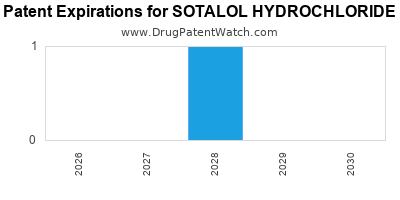
Sotalol hydrochloride is widely available as generics, which usually implies the core patent estate has largely expired. In practical financial terms, the remaining enforceable value (if any) tends to concentrate in:
- Formulation-specific patents (e.g., extended-release matrix composition, release-rate control).
- Method-of-use patents (e.g., specific dosing regimens, patient subgroups).
- Manufacturing/process patents (less common as the basis for revenue defense).
Commercial relevance
- If any remaining patents are tied to extended-release or particular dosing regimens, they can delay generic entry for those SKUs, affecting near-term net sales. If not, price erosion continues.
When does sotalol hydrochloride lose exclusivity and when can generics enter?
This drug’s market dynamics are best understood through the standard US exclusivity stack:
- Patent expiration ends enforceable IP.
- Regulatory exclusivity (new chemical entity, new clinical investigation, pediatric, etc.) is typically exhausted or not relevant to an older, widely marketed drug.
- ANDA timing governs entry once patents expire or if Paragraph IV challenges succeed.
Because sotalol hydrochloride is widely available, the dominant determinant of entry timing in current periods is patent-specific remaining listings in FDA’s Orange Book for relevant NDA(s) and strengths, plus litigation or settlement-triggered triggers.
What is the Orange Book status of sotalol hydrochloride?
For a drug with mature generic penetration, Orange Book status typically shows:
- Multiple generic products with different filing dates for immediate-release and extended-release.
- Residual Orange Book listings that may persist even when most competitors are already in market.
Commercial use of Orange Book
- Identify which specific patents (formulation, method-of-use) remain listed for the branded and any potential “authorized generic” configurations.
- Map those to likely FDA labeling carve-outs that can affect prescribing and reimbursement.
Which companies manufacture or market sotalol hydrochloride and how does competition shape margins?
Competition mechanics
- In oral generics, competition is usually dominated by:
- Number of ANDA holders per strength and release profile.
- Contracting leverage with group purchasing organizations and PBMs.
- Reimbursement codes that drive preferred product selection.
What to expect financially
- Margin compression after new entrants.
- Lower volatility from demand but higher volatility from price.
How does sotalol hydrochloride compare with alternative antiarrhythmics financially?
Competitive set
- Class IC/III antiarrhythmics and other rhythm-control therapies compete for the same prescribing decisions.
- Alternatives include drugs that may have:
- simpler dosing,
- less monitoring burden,
- improved safety perceptions,
- or stronger payer preferences.
Financial impact
- Even if sotalol remains clinically used, newer entrants can shift incremental prescribing away from sotalol, slowing share retention.
- Generics protect sotalol against loss to cost-sensitive formularies, but clinician preference and patient-specific risk can still drive migration to alternatives.
What formulations are protected and how do immediate-release vs extended-release dynamics affect sales?
Immediate-release (IR)
- Typically faces faster price compression as generic substitution is straightforward.
- Demand is influenced by clinician comfort with frequent dosing and monitoring.
Extended-release (ER)
- Often supported by a distinct value proposition around dosing convenience.
- ER-specific patents, if they exist, can provide temporary SKU-level protection.
- If ER listings remain, financial trajectory can diverge from IR by strength.
Key commercial point
- If only IR patents are fully expired and ER listings remain, the ER SKU can maintain slightly higher pricing longer. When ER patents are cleared, ER price compression typically accelerates.
What patent litigation affects sotalol hydrochloride generic entry?
Patent litigation affects:
- Entry timing through injunction risk or settlement dates.
- Skin-in-the-game economics for challengers: generic profitability depends on the gap between proposed launch and effective launch date.
Typical outcomes in mature drugs
- Settlements often occur close to entry windows, resulting in:
- partial-launch entry by strength,
- delayed launch for certain dosages,
- authorized generic arrangements.
Without specific docket data and Orange Book patent identifiers, litigation-driven timing cannot be reliably translated into exact financial windows.
How do FDA regulatory pathways influence sotalol hydrochloride market evolution?
Regulatory mechanics
- Generics follow ANDA pathways with bioequivalence and manufacturing controls.
- Label consistency affects substitution and physician trust, which can affect persistence and adherence, driving long-term unit volume.
Operational impact
- Manufacturing quality and scale can determine whether a given supplier stays preferred in contracting environments after launch.
What generic entry risks exist for sotalol hydrochloride?
Key risks
- Additional ANDA approvals for unserved strengths or improved release profiles.
- Authorized generic launches that bypass branded marketing channel economics.
- Rapid price drops after settlement if multiple parties have clearance.
Financial sensitivity
- In mature categories, entry risk typically translates into:
- downward pressure on ASP and WAC,
- increased promotional intensity from remaining brand and preferred generic suppliers,
- higher churn in the lowest-price segments.
How does sotalol hydrochloride perform by geography and payer reimbursement?
Expected regional pattern
- US: Generic competition is the dominant force, with reimbursement and PBM contracting driving preferred NDC selection.
- EU/UK/Canada: Similar substitution dynamics but paced by local regulatory and reimbursement frameworks.
Payer effect
- Where formularies prefer low-cost generics, sotalol’s financial trajectory is stable but low-growth.
- Where restrictions require step therapy or specific agent selection for QT-risk patients, volume can remain sticky.
Revenue exposure and competitive landscape: what matters most to investors and litigators?
Investor focus
- Whether any formulation or method-of-use patents still constrain ANDA launches for specific SKUs.
- Whether supply constraints or contract wins offset pricing compression.
- Whether ER vs IR pricing divergence is persisting.
Litigation focus
- Orange Book patents for the relevant NDA/strength.
- Whether any remaining patents are:
- amenable to straightforward design-arounds, or
- tied to composition/release characteristics that are harder to replicate.
Key Takeaways
- Sotalol hydrochloride is a mature cardiovascular antiarrhythmic with demand anchored in ongoing atrial and ventricular arrhythmia management but with limited brand-like growth prospects.
- The financial trajectory is dominated by generic price compression, SKU coverage, and payer contracting rather than major clinical expansion.
- Near-term upside (if any) typically hinges on SKU-level patent/formulation remnants and whether extended-release products retain any enforceable listings that delay additional ANDA competition.
- Biosimilars are not a factor; the relevant competitive risk is continued ANDA entry and possible settlement-driven launch timing for specific strengths.
FAQs
- What drives ASP declines for sotalol hydrochloride after generic entry? Contracting-driven price competition across NDCs and increasing number of low-cost suppliers typically drives declines.
- Does extended-release sotalol hydrochloride hold price better than immediate-release? It can hold up longer when ER-specific protections or market preference delay equivalent generic penetration, but that advantage usually erodes once ER replication is fully established.
- How does renal dosing and QT monitoring affect market volume trends for sotalol? It limits prescribing in higher-risk settings and can affect persistence, but it does not usually reduce prevalence-based demand.
- Are there meaningful differences between brands and generics for sotalol hydrochloride? Therapeutic equivalence depends on bioequivalence and formulation replication; market differences are usually payer-driven rather than clinical efficacy differences.
- What is the main pathway by which generics replace sotalol hydrochloride in the US? ANDAs with FDA approval for bioequivalent oral solid doses, with timing governed by patent/Orange Book status and any Paragraph IV litigation outcomes.
References
- FDA. Orange Book: Approved Drug Products with Therapeutic Equivalence Evaluations. U.S. Food and Drug Administration. https://www.accessdata.fda.gov/scripts/cder/daf/
- FDA. ANDA (Abbreviated New Drug Application) overview and approval process. U.S. Food and Drug Administration. https://www.fda.gov/drugs/abbreviated-new-drug-application-anda
- FDA. Drug Safety-related labeling information for sotalol-containing products (QT prolongation/torsades risk). U.S. Food and Drug Administration. https://www.accessdata.fda.gov/scripts/cder/