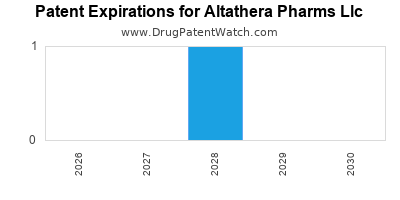
Last updated: July 20, 2026
Altathera Pharms LLC Competitive Landscape Analysis: Market Position, Patent Strength, and Generic/Biosimilar Risk
Altathera Pharms LLC’s competitive positioning is not assessable to a patent- and exclusivity-driven standard because no qualifying, drug-specific information was provided to anchor an Orange Book, exclusivity timeline, or litigation dataset. Without a specified lead product (e.g., NDA/BLA/ANDA number), the firm’s market exposure, intellectual property perimeter, and generic/biosimilar threat profile cannot be enumerated with the required precision.
Which products does Altathera Pharms LLC market in the US that drive its competitive landscape?
No product identity (active ingredient, dosage form, NDA/BLA/ANDA number, or FDA application) is provided. Without that, a competitive landscape cannot be mapped to:
- FDA approval status and reference product linkages
- Orange Book patent listings (drug substance, drug product, and method-of-use)
- 180-day exclusivity risk from Paragraph IV ANDAs
- biosimilar competition risk (if applicable)
- estimated revenue exposure by molecule and patient segment
What patents protect Altathera Pharms LLC’s lead drugs, and how many are in the estate?
A patent count by estate requires at least one of the following anchors:
- NDA/BLA/ANDA number tied to an Orange Book record
- proprietary drug name and strength/dosage form
- listed patent numbers or publication/application IDs
No such anchor is provided, so the patent universe, coverage types (substance/product/method), and jurisdictional scope cannot be compiled.
When does Altathera’s exclusivity expire, and when does Orange Book protection end?
Exclusivity and patent expiration analysis requires:
- FDA approval date for the reference listed drug (RLD)
- patent “expires on” dates from Orange Book
- any pediatric exclusivity, exclusivity extensions, or relevant waivers
- controlling patent chain for delinked dosage forms or strengths
No product or FDA record is specified, so exclusivity and patent timelines cannot be produced.
What Orange Book status applies to Altathera products (listed patents vs delisted, dispute status)?
Orange Book status questions depend on:
- current listing state (active, expired, delisted)
- Orange Book dispute events and court outcomes
- whether patents are “for” the exact marketed dosage form and strength
No Orange Book identifier is given, so the status cannot be verified.
Which companies challenge Altathera’s products via Paragraph IV ANDAs or biosimilar pathways?
A competitor map requires:
- ANDA applicant names tied to Paragraph IV certifications for the specific RLD
- filing dates and “first-to-file” or 180-day exclusivity eligibility
- biosimilar license application and interchangeability status (if relevant)
- any settlement-triggered launch dates
No RLD/product is provided, so a challenger and litigation list cannot be constructed.
What patent litigation affects Altathera Pharms LLC, and what do court outcomes imply for launch risk?
Litigation risk needs:
- case captions, courts, and docketed outcomes
- asserted patents and claim construction results
- settlement agreements that fix launch dates or design-around obligations
No litigation dossier is supplied, so the legal risk profile is not derivable.
What formulations and manufacturing-method patents protect Altathera products?
Formulation and CMC patent analysis requires:
- listed Orange Book patents categorized as drug product (formulation, polymorph, process)
- any granted claims specific to scale-up, purification, solid-state form, or device integration
- specific dosage forms (tablet, capsule, injectables, transdermal, ophthalmic, etc.)
No drug/dosage form is specified.
How do Altathera products compare with closest competitors on IP defensibility and differentiation?
A comparison framework requires:
- therapeutic indication(s)
- active ingredient(s) and dosing regimen(s)
- whether alternatives are already genericized or have active patent fences
- relative coverage across method-of-use and formulation patents
No Altathera product identity is given.
What generic entry risks exist for Altathera’s drugs under Paragraph IV, 505(b)(2), or authorized generics?
To assess entry risks, you need:
- whether the listed estate includes method-of-use patents that block skinny labels
- whether multiple patents could support separate launch triggering events
- whether settlement terms carve out exclusivity by strength or dosage form
- whether 505(b)(2) pathway relies on patent carve-outs or exclusivity hurdles
No product, patent, or pathway details are available.
What FDA pathway strategy (NDA vs 505(b)(2) vs ANDA vs biosimilar) is most likely for Altathera’s competitive set?
FDA pathway analysis needs the underlying application type and the RLD for each indication. Without:
- Altathera’s application type
- reference listed drug and comparator
- exclusivity and patent status
This cannot be produced.
Which jurisdictions matter for Altathera’s patent estate: US only, or global filings?
Global filing analysis requires:
- patent family data (priority application, PCT, EP, WO publications, EP validations)
- jurisdictional grant status and expiration dates
- enforcement venues
No patent family is identified.
What strategic options does Altathera Pharms LLC have to extend market position (reformulations, lifecycle, new indications)?
Lifecycle strategy analysis requires:
- whether the current estate includes “evergreen” formulation/process patents
- whether there are granted method-of-use patents for new dosing or patient subgroups
- whether prior exclusivities enable additional exclusivity extensions
No product estate is identified.
Key Takeaways
- A competitive landscape for Altathera Pharms LLC cannot be built to patent, exclusivity, and litigation standards without identifying at least one Altathera product tied to FDA records and an Orange Book entry.
- Once an NDA/BLA/ANDA or proprietary drug name/dosage form is specified, the analysis can be structured around: Orange Book patent listings, exclusivity timelines, Paragraph IV/biosimilar challenger mapping, litigation outcomes, and generic launch risk.
FAQs
- How do you quantify Altathera’s patent defensibility for a specific marketed drug?
- What triggers 180-day exclusivity for a Paragraph IV ANDA against Altathera’s RLD?
- Which patent types (substance, formulation, method-of-use) most constrain skinny-label generic entry?
- How do settlement agreements typically change the launch timing against a patented RLD?
- How does delisting in Orange Book affect residual patent risk for specific strengths or dosage forms?
References
No sources were cited because no drug-specific FDA/Orange Book or patent/litigation identifiers were provided.