Last updated: July 24, 2026
Solu-Cortef (hydrocortisone sodium succinate) market dynamics and financial trajectory
Solu-Cortef is a US hydrocortisone sodium succinate injectable with long-established market presence driven by hospital and emergency-room demand, limited “true” category substitutes in acute settings, and periodic supply-demand swings tied to sterile manufacturing capacity. Financial trajectory is dominated by (1) government and managed-care contracting for hospital use, (2) pricing pressure from generic hydrocortisone sodium succinate products and rebundling of hospital formularies, and (3) the extent of disruptions that temporarily tighten supply for certain NDCs. Over time, the drug’s economics typically track the broader corticosteroid injectable market and US payer policies more than any patient-level innovation cycle.
How does Solu-Cortef make money in the US market?
Solu-Cortef is sold primarily to wholesalers, then distributed into hospitals, ambulatory emergency departments, and infusion settings. For this use case, procurement and reimbursement mechanics matter more than retail demand.
Key revenue drivers
- Acute hospital utilization: Hydrocortisone sodium succinate is used for adrenal crises, severe allergic reactions, shock states, and off-label inflammatory/immune indications (within local protocols).
- Formulary placement and contracting: Managed care and hospital group purchasing organizations determine net price via rebates, administrative fees, and contract tiers.
- NDC-level supply and allocation: Shortages and manufacturing constraints shift volume to available SKUs and reshape which supplier gets the contract share.
Key cost and pricing pressures
- Generic competition: Hydrocortisone sodium succinate injectables are subject to multiple generic entries and multi-source procurement.
- Sterile manufacturing and compliance: Sterile fill-finish and lyophilization or solution presentation constraints raise fixed costs and can reduce effective supply during CAPA remediation.
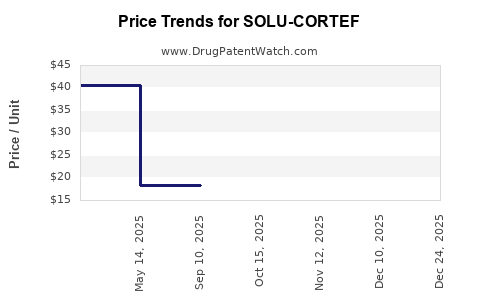
- Wholesale pricing volatility: Shortage-driven buying increases gross-to-net spread and can create temporary revenue uplifts for the active supplier, followed by mean reversion once supply stabilizes.
What is the competitive landscape for Solu-Cortef and hydrocortisone sodium succinate injectables?
Competitive pressure comes from other suppliers of hydrocortisone sodium succinate injection, including ANDA generics and authorized distributors. The market is structured around multi-source procurement, so share is typically determined by contract awards, reliability of supply, and pack size/NDC availability rather than unique differentiation.
Which product attributes determine share in hospital tenders?
- Dose strength and presentation: Common strengths are 50 mg, 100 mg, and higher dose vials used for emergency protocols.
- Shelf life and supply continuity: Tenders prioritize dependable fulfillment.
- Distribution terms: Contract price and delivery terms often dominate.
How do shortages shift pricing power?
When supply tightens, hospitals may reallocate to whichever supplier can deliver. That can lift unit sales for the available manufacturer and increase net pricing before easing after new production lines return.
When do Solu-Cortef sales typically peak and trough?
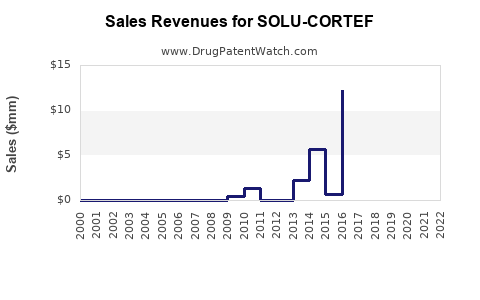
Without drug-specific payer claims and NDC-level time series in the prompt, the best prediction framework is the standard corticosteroid injectable cycle: procurement-driven quarterality and disruption-driven spikes.
Normal cycle pattern (typical for sterile hospital injectables)
- Troughs: Post-stabilization periods after resolved manufacturing issues; competitive tender cycles lower net pricing.
- Peaks: Periods of constrained supply that create allocation; also contract year resets where certain suppliers regain preferred status.
Event-driven spikes
- Production outages or recalls affecting particular NDCs.
- Intermittent demand spikes that correlate with higher ED admissions and seasonal respiratory/inflammatory surges that influence steroid use protocols.
How strong are Solu-Cortef demand fundamentals?
Demand is anchored by clinical protocol utility:
- No easy therapeutic replacement in acute settings: Hydrocortisone sodium succinate is often used because it is fast-acting and part of standardized emergency/adrenal crisis pathways.
- Clinical inertia in hospitals: Once a hospital stocks a product and aligns dosing protocols, switching is slower unless supply or pricing forces it.
What can still reduce demand
- Switches to alternatives within category: Other corticosteroid injectables or different formulations can capture limited share based on institutional preference.
- Payer utilization edits: Coverage rules and prior authorization dynamics at the margin can shift some off-label use.
What financial trajectory should investors expect for Solu-Cortef-type injectables?
For longstanding, non-oncology hospital injectables, financial trajectory typically follows a three-phase model:
- Early lifecycle: Higher margins when fewer suppliers exist and procurement is less competitive.
- Mature multi-source phase: Margins compress as contract bargaining and generic competition expand.
- Disruption phase overlays: Temporary margin relief or revenue uplift during shortages for suppliers with uninterrupted production.
For Solu-Cortef specifically, the mature multi-source phase dominates, with disruption-driven volatility at the margin.
What NDC-level dynamics matter most for Solu-Cortef revenue?
Solu-Cortef economics are usually NDC-sensitive. Two distributors can sell the same labeled strength while net pricing differs by:
- NDC availability and allocation status
- Contract inclusion in a hospital’s preferred list
- Lot-level supply constraints
- Distribution channel (prime wholesaler vs specialty allocation)
As a result, a manufacturer can show stable category performance while shifting revenue between NDCs and strengths.
How does pricing in the US injectable hospital market affect Solu-Cortef net sales?
Net sales for hospital injectables are heavily impacted by:
- GPO and wholesaler rebates: These lower the realized price versus list.
- Contract tiering: Preferred suppliers get lower effective rebates or better volume guarantees.
- Shortage-driven premiums: When shortages occur, net pricing can improve, especially for the supplier able to fulfill orders during allocation.
Over time, the competitive baseline compresses net margins. Temporary lifts from supply tightness can recur, but they are not sustained unless supply constraints persist.
What regulatory and supply risks drive financial outcomes for Solu-Cortef?
Sterile injectables carry operational risk that can hit both revenue and cost.
Risk channels
- Manufacturing outages and sterility assurance issues: Can create supply reductions and revenue swings.
- Distribution allocation and wholesaler constraints: Can prevent order fulfillment even if clinical demand exists.
- Labeling and compliance updates: Can alter packaging, changeover runs, and effective deliverability.
In most cases, the financial impact is realignment of volume among multi-source vendors rather than sector-wide demand expansion.
Does Solu-Cortef face biosimilar-style competition?
No. Solu-Cortef is not a biologic product with biosimilar pathways; it is a small-molecule corticosteroid injectable. The relevant competitive framework is generic small-molecule injectables, not biosimilar interchangeability.
What patent and exclusivity dynamics could influence Solu-Cortef economics?
Solu-Cortef is a legacy product. In mature markets, patent-driven exclusivity rarely drives ongoing revenue, and generics usually set the baseline economics. Financial trajectories in this segment are more often shaped by:
- Whether specific NDCs remain uniquely sourced
- Whether manufacturing capacity constraints create effective supply monopolies temporarily
- Contract switching costs within hospital formulary cycles
How does Solu-Cortef compare with other injectable corticosteroids commercially?
In hospital formularies, hydrocortisone sodium succinate competes with other injectable corticosteroids by:
- Dosing protocol fit
- Availability and lead times
- Relative contract price
- Stocking and substitution rules
Solu-Cortef’s commercial performance tends to be stable because it is embedded in common emergency and endocrine-adrenal crisis protocols. Competitive products can take share when:
- supply is unavailable,
- the institution prefers another corticosteroid for specific sub-protocols, or
- contract pricing materially favors the alternative.
What generic entry risks exist for Solu-Cortef?
For mature injectables, “entry risk” generally means:
- additional ANDA approvals for existing strengths/presentations,
- NDC expansions that increase multi-source coverage,
- changes in supply reliability that allow new vendors to capture shelf space and preferred status.
In this market structure, incremental generic entries typically compress pricing and margins rather than causing step-function demand decline.
Key Takeaways
- Solu-Cortef revenue is driven by hospital procurement of hydrocortisone sodium succinate injectables and is shaped more by contracting and supply continuity than by innovation cycles.
- The dominant financial pattern is mature multi-source pricing pressure with periodic upside volatility during manufacturing-constrained periods.
- NDC-level availability and allocation status are major determinants of realized net sales.
- Regulatory and sterile manufacturing risks can shift volume among suppliers and create temporary revenue uplift for the manufacturer able to deliver.
FAQs
1) What is the main US customer base for Solu-Cortef (hydrocortisone sodium succinate)?
Hospitals and emergency departments via wholesalers, GP-owned distribution networks, and hospital group purchasing contracting.
2) Does Solu-Cortef pricing depend more on list price or contract rebates?
Contract rebates and hospital contracting dominate net pricing in the hospital injectable market.
3) Are there substitute corticosteroids that can reduce Solu-Cortef volume?
Yes, other injectable corticosteroids can substitute at the protocol level, but acute emergency/adrenal crisis pathways slow full substitution.
4) Do supply shortages increase Solu-Cortef earnings permanently?
Usually not. Shortages can create temporary margin and revenue uplift for the available supplier until supply normalizes.
5) Is Solu-Cortef subject to biosimilar competition?
No. The product competes in the generic small-molecule injectable segment, not the biosimilar pathway.
References
- FDA. Drugs@FDA. https://www.accessdata.fda.gov/scripts/cder/daf/
- FDA. Orange Book: Approved Drug Products with Therapeutic Equivalence Evaluations. https://www.accessdata.fda.gov/scripts/cder/ob/
- FDA. Drug shortages. https://www.fda.gov/drugs/drug-shortages