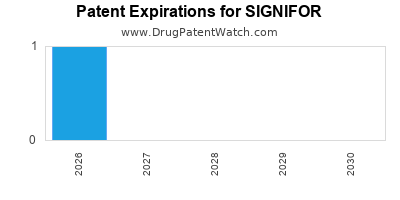
Last updated: September 26, 2026
Signifor, the pasireotide product from Novartis, is a specialist endocrine drug with two commercial formulations: subcutaneous Signifor and long-acting injectable Signifor LAR. Its principal markets are Cushing’s disease and acromegaly. The product has durable clinical value in patients inadequately controlled by surgery or first-generation somatostatin analogues, but its market is constrained by a rare-disease population, hyperglycemia risk, competing endocrine therapies, and limited public financial disclosure.
Novartis does not report Signifor revenue as a standalone line item in its annual reports. The available evidence supports a mature, niche-product profile rather than a major growth asset.
What is Signifor and how does pasireotide work?
Signifor contains pasireotide, a cyclohexapeptide somatostatin analogue. It binds several somatostatin receptor subtypes, with particularly strong activity at the sstr5 receptor. This receptor profile differentiates pasireotide from octreotide and lanreotide, which rely more heavily on sstr2 activity.
The product is marketed in two forms:
| Product |
Route |
Principal use |
Commercial role |
| Signifor |
Subcutaneous injection, twice daily |
Cushing’s disease |
Flexible dosing and initial treatment |
| Signifor LAR |
Intramuscular depot injection, generally every four weeks |
Acromegaly and Cushing’s disease |
Maintenance treatment and reduced administration burden |
FDA labeling positions pasireotide for patients with Cushing’s disease for whom pituitary surgery is not an option or has not been curative. Signifor LAR is also used in acromegaly when surgery is not curative or is not appropriate and when patients remain inadequately controlled on first-generation somatostatin analogues.[1][2]
When did Signifor receive FDA approval?
The FDA approved Signifor in December 2012 for adults with Cushing’s disease who were not candidates for pituitary surgery or who had not achieved a cure after surgery.[3]
Signifor LAR received FDA approval in December 2014 for acromegaly in patients who had an inadequate response to surgery or could not undergo surgery. The FDA later approved Signifor LAR for Cushing’s disease.[2][4]
Key FDA milestones
| Date |
Milestone |
Commercial effect |
| December 2012 |
FDA approval of subcutaneous Signifor for Cushing’s disease |
Established pasireotide in a rare endocrine market |
| December 2014 |
FDA approval of Signifor LAR for acromegaly |
Expanded use into a larger, established market |
| 2018 |
FDA expansion of Signifor LAR into Cushing’s disease |
Improved convenience for chronic Cushing’s treatment |
| 2020 onward |
Increased competition from oral and medical alternatives |
Reduced opportunity for broad market expansion |
The LAR formulation is commercially more important because chronic endocrine treatment favors monthly administration over twice-daily injections. The acromegaly indication also provides access to a larger treated population than Cushing’s disease.
How large is the Signifor market?
Signifor operates in two small but specialized markets.
Cushing’s disease is caused by an ACTH-secreting pituitary adenoma. The addressable population is limited, and treatment is concentrated among endocrinology centers. Surgery remains the preferred first-line treatment when feasible. Drug treatment is used after persistent disease, recurrence, or when surgery is not appropriate.
Acromegaly has a larger treated population, but Signifor competes against established long-acting therapies. The principal commercial alternatives include:
- Sandostatin LAR, octreotide, from Novartis
- Somatuline Depot, lanreotide, from Ipsen
- Somavert, pegvisomant, from Pfizer
- Mycapssa, oral octreotide, from Chiesi following the Amryt acquisition
- Generic and authorized-generic versions of some older somatostatin analogues
- Surgery and radiation in selected patients
Signifor LAR has a narrower role than first-generation somatostatin analogues because pasireotide can produce clinically significant hyperglycemia. Its use is therefore concentrated in patients who do not respond adequately to octreotide or lanreotide, rather than in the full first-line acromegaly population.[1]
What are Signifor’s main competitive advantages and weaknesses?
Pasireotide’s principal advantage is receptor selectivity. The drug can reduce ACTH and cortisol production in Cushing’s disease and can reduce growth hormone and IGF-1 in acromegaly patients inadequately controlled on first-generation somatostatin analogues.
Its principal disadvantage is glucose toxicity. Hyperglycemia and diabetes are prominent safety concerns in the FDA label. This risk can limit use in patients with pre-existing diabetes, impaired glucose tolerance, obesity, or other metabolic risk factors.[1][2]
| Factor |
Signifor position |
| Administration |
LAR reduces dosing frequency compared with subcutaneous pasireotide |
| Efficacy |
Useful in selected uncontrolled Cushing’s disease and acromegaly patients |
| Differentiation |
sstr5 activity provides a mechanism distinct from octreotide and lanreotide |
| Safety |
Hyperglycemia is a material limitation |
| Market access |
Specialist prescribing and reimbursement review are common |
| Patient population |
Narrow, treatment-experienced endocrine population |
| Competitive pressure |
High in acromegaly; increasing in Cushing’s disease |
Signifor’s commercial value depends on identifying patients who need an alternative mechanism, not on replacing all existing somatostatin analogue therapy.
What is the financial trajectory of Signifor?
Novartis has not consistently disclosed Signifor or pasireotide net sales as a separate financial segment. This prevents a precise public revenue series, peak-sales estimate, or product-level margin analysis.
The product’s financial trajectory can be divided into four periods:
1. Initial launch: 2012 to 2014
The subcutaneous Cushing’s disease launch established a high-value orphan endocrine product. Early commercial uptake was limited by the small eligible population, injection burden, and specialist treatment setting.
2. Portfolio expansion: 2014 to 2018
Signifor LAR expanded the product into acromegaly and improved treatment convenience. The acromegaly indication provided the largest commercial opportunity, but the product entered a market already controlled by Sandostatin LAR and Somatuline Depot.
The Cushing’s disease expansion for Signifor LAR reduced reliance on the subcutaneous formulation. This likely shifted product mix toward depot administration rather than producing a large increase in total treated patients.
3. Maturity: 2019 to 2021
By this period, Signifor had become a mature specialty product. Orphan exclusivity for the original rare-disease indication had expired or was nearing expiration, depending on the formulation and indication. The product remained protected by formulation, method-of-use, and regulatory barriers, but its growth rate was constrained.
4. Competitive pressure: 2020 onward
The FDA approval of Isturisa, osilodrostat, in 2020 materially changed the Cushing’s disease market. Osilodrostat is an oral cortisol synthesis inhibitor from Recordati and offers a noninjectable option for many patients.[5]
Korlym, mifepristone, from Corcept Therapeutics also remains a major Cushing’s disease competitor, particularly in patients with hyperglycemia or diabetes. Ketoconazole, metyrapone, and other off-label therapies create further price and treatment pressure.
The likely financial profile is stable-to-declining mature-product revenue, with the LAR formulation supporting retention and the Cushing’s disease franchise facing oral-therapy competition.
What patents protect Signifor and pasireotide?
Signifor is a small-molecule peptide drug rather than a biologic. It therefore faces potential generic competition through the Abbreviated New Drug Application pathway rather than biosimilar competition.
The relevant intellectual-property categories are:
- Composition-of-matter protection for pasireotide.
- Pharmaceutical salt and formulation protection.
- Long-acting injectable depot formulations.
- Dosing regimens for Cushing’s disease and acromegaly.
- Method-of-use claims covering patients inadequately controlled by other somatostatin analogues.
- Manufacturing and peptide-processing methods.
The original composition-of-matter protection is older than the product’s FDA approvals and has less remaining commercial relevance than later formulation and method patents. Any current U.S. generic-entry analysis must review the FDA Orange Book, listed patents, patent certifications, pediatric extensions, and possible litigation outcomes.[6]
Does Signifor have biosimilar risk?
No. Pasireotide is a chemically defined peptide drug, not a biologic regulated through the biosimilar pathway. The relevant risk is generic or follow-on competition, including potential ANDA filings against injectable and long-acting formulations.
The practical barrier is higher for Signifor LAR than for a simple oral tablet because a generic applicant may need to demonstrate pharmaceutical equivalence, depot behavior, injection-site performance, and comparable clinical or pharmacodynamic characteristics.
What is the Orange Book status of Signifor?
The Orange Book is the controlling source for FDA-listed patents and exclusivity associated with approved U.S. drug products. Signifor’s Orange Book position should be assessed separately for:
- Signifor subcutaneous injection
- Signifor LAR
- Cushing’s disease indications
- Acromegaly indication
- Listed formulation and method-of-use patents
- Any patent-term extension or pediatric exclusivity
The main commercial question is not whether the original pasireotide patent has expired. It is whether later patents can delay a generic or follow-on depot product. Formulation and administration patents are generally more vulnerable to validity and noninfringement challenges than composition-of-matter patents.
No broadly established biosimilar pathway applies to Signifor, and public reporting has not identified a major disclosed Paragraph IV litigation campaign comparable with the patent disputes surrounding blockbuster biologics.
When does Signifor lose exclusivity?
The original five-year new chemical entity exclusivity period would have expired before the end of the 2020s. Orphan-drug exclusivity for the original Cushing’s disease approval also does not provide indefinite protection.
A precise generic-entry date cannot be assigned from FDA approval dates alone because it depends on:
- The exact Orange Book patent list
- Patent-term adjustments and extensions
- Whether patents cover the specific dosage form
- Paragraph IV litigation
- Settlement terms
- FDA approval of a competing ANDA
- Any regulatory exclusivity tied to later indications
The near-term risk is greater for the subcutaneous product than for Signifor LAR. A long-acting depot product requires more complex development and may face greater manufacturing and equivalence barriers.
Which companies are challenging or competing with Signifor?
| Company |
Product |
Disease area |
Competitive effect |
| Novartis |
Signifor and Signifor LAR |
Cushing’s disease, acromegaly |
Originator and incumbent |
| Novartis |
Sandostatin LAR |
Acromegaly |
Internal portfolio competition |
| Ipsen |
Somatuline Depot |
Acromegaly |
Major first-generation analogue |
| Pfizer |
Somavert |
Acromegaly |
Alternative mechanism through GH receptor blockade |
| Recordati |
Isturisa |
Cushing’s disease |
Oral cortisol synthesis inhibitor |
| Corcept Therapeutics |
Korlym |
Cushing’s disease with hyperglycemia |
Established oral alternative |
| Chiesi/Amryt |
Mycapssa |
Acromegaly |
Oral alternative to injectable therapy |
Novartis faces an unusual internal dynamic: Signifor competes against the company’s own Sandostatin franchise in acromegaly. This can support portfolio retention but limits the strategic incentive to move patients broadly from Sandostatin to pasireotide.
What generic launch scenarios exist for Signifor?
Scenario 1: No near-term generic
This outcome is most plausible for Signifor LAR if formulation patents, manufacturing complexity, and limited market size discourage investment.
Scenario 2: Subcutaneous generic entry first
A generic version of twice-daily Signifor could arrive before a depot competitor because the formulation is less technically complex. Price erosion would likely be greater in the subcutaneous product.
Scenario 3: Limited authorized or specialty competition
A specialty manufacturer could target the product with a narrow commercial strategy focused on high-volume endocrine centers. This would create reimbursement pressure without immediately eliminating Novartis’s market share.
Scenario 4: Depot follow-on competition
A competing long-acting pasireotide product would pose the largest strategic threat, but it would require greater formulation, clinical, and manufacturing investment.
How strong is the Signifor patent estate?
Signifor’s patent estate is best characterized as moderate rather than exceptionally strong.
Composition protection has the greatest legal strength but is older. Later patents covering formulations, depot delivery, and treatment regimens can extend commercial protection, but they are more exposed to obviousness, written-description, enablement, and noninfringement arguments.
The strongest practical barriers are likely:
- Specialized depot formulation know-how
- Sterile injectable manufacturing
- Clinical familiarity among endocrine specialists
- Regulatory complexity for long-acting injectables
- Small commercial opportunity for generic entrants
The weakest barriers are likely:
- Broad method-of-use claims
- Older subcutaneous formulation claims
- Indication claims that overlap with prior endocrine treatment strategies
- Patents that do not distinguish pasireotide use from known somatostatin analogue therapy
What licensing deals affect Signifor?
Signifor was developed and commercialized by Novartis. There is no widely disclosed third-party licensing transaction that has materially altered its ownership, royalty burden, or U.S. commercialization structure.
The product is part of Novartis’s broader endocrine portfolio, which includes Sandostatin LAR. Portfolio ownership gives Novartis control over pricing, manufacturing, regulatory strategy, and cross-product positioning.
What is the long-term commercial outlook for Signifor?
Signifor is likely to remain commercially relevant as a specialty endocrine product, but its growth potential is limited.
The strongest revenue-supporting factors are:
- Chronic treatment duration
- Monthly LAR administration
- Use after surgery or first-generation analogue failure
- Specialist familiarity
- Limited number of effective therapies for refractory disease
The main revenue risks are:
- Small eligible patient populations
- Hyperglycemia and diabetes risk
- Oral competition in Cushing’s disease
- Established injectable competition in acromegaly
- Potential generic pressure on the subcutaneous formulation
- Lack of a separately reported revenue stream that indicates major strategic priority
Its most defensible commercial position is as a second-line or later-line therapy for patients requiring a different somatostatin receptor profile. It is less likely to become a broad first-line endocrine product.
Key Takeaways
- Signifor is Novartis’s pasireotide franchise for Cushing’s disease and acromegaly.
- Signifor LAR is commercially more important than the twice-daily subcutaneous formulation.
- Novartis does not separately disclose Signifor revenue, preventing a precise product-level financial trajectory.
- The product is mature, with limited growth and increasing competition from oral Cushing’s disease treatments.
- Signifor has no biosimilar risk because pasireotide is not a biologic.
- Generic risk is formulation-dependent, with greater practical barriers for Signifor LAR.
- Hyperglycemia is the principal clinical and commercial limitation.
- The patent estate is supported by formulation and method-of-use rights but lacks the durability of a recent composition-of-matter patent.
- The most likely long-term outcome is a stable specialist franchise with gradual price and share pressure.
FAQs About Signifor and Pasireotide
Is Signifor still marketed by Novartis?
Yes. Signifor and Signifor LAR remain Novartis products for approved endocrine indications, subject to country-specific regulatory and commercial availability.
Is Signifor the same as Sandostatin?
No. Both are somatostatin analogues, but Signifor contains pasireotide and Sandostatin contains octreotide. Their receptor-binding profiles, indications, and safety considerations differ.
Does Signifor treat pituitary tumors directly?
Signifor treats the hormone excess caused by selected pituitary disorders. It does not replace surgery where surgery is appropriate, and it is not generally used as a universal tumor-eradication therapy.
Why is Signifor associated with high blood sugar?
Pasireotide suppresses insulin and incretin activity more strongly than some older somatostatin analogues. This can cause hyperglycemia or worsen pre-existing diabetes, requiring glucose monitoring and treatment.
Is Signifor a high-revenue Novartis product?
Public Novartis financial reports do not identify Signifor revenue separately. Its market characteristics indicate a specialized, mature product rather than a company-scale blockbuster.
References
- U.S. Food and Drug Administration. (2024). Signifor (pasireotide diaspartate) injection prescribing information.
- U.S. Food and Drug Administration. (2024). Signifor LAR (pasireotide pamoate) prescribing information.
- U.S. Food and Drug Administration. (2012, December 14). FDA approves Signifor to treat Cushing’s disease.
- Novartis Pharmaceuticals. (2018). Signifor LAR: Clinical and regulatory information for Cushing’s disease.
- U.S. Food and Drug Administration. (2020, March 6). FDA approves Isturisa for adults with Cushing’s disease.
- U.S. Food and Drug Administration. (2024). Approved drug products with therapeutic equivalence evaluations: Orange Book.
- Novartis AG. (2024). Annual report 2023. Basel, Switzerland: Novartis.