Last updated: June 15, 2026
SETLAKIN market dynamics and financial trajectory: sales outlook, exclusivity pressure, and generic/biosimilar risk
Executive summary: Setlakin’s financial trajectory is driven by (1) the status of regulatory exclusivity and patent protections in the US and key markets, (2) payer adoption and net price erosion from authorized and unauthorized competition, and (3) the speed of substitution to therapeutically equivalent products. Without a defined, verifiable reference product identity (active ingredient, dosage form, strength) and the FDA/National Medicines/Orange Book and sales reporting anchor for “Setlakin,” no complete or accurate financial and competitive dynamics assessment can be produced.
What exactly is SETLAKIN (active ingredient, dosage form) and how does it map to FDA-listed reference products?
No market-dynamics or financial analysis can be completed without identifying Setlakin’s exact drug identity. “SETLAKIN” is not sufficient to uniquely determine:
- the active pharmaceutical ingredient (API),
- the dosage form and strength,
- the FDA reference product (for Orange Book review),
- the applicable exclusivity regime (NCE, 505(b)(2), new biologic, or supplemental exclusivity),
- the relevant patent estate and litigation docket.
Why identity matters for market dynamics
Market size, price, and competitive substitution depend on the product’s legal and regulatory classification:
- small-molecule vs biologic vs combination product
- original NDA/BLA vs follow-on formulations
- immediate-release vs extended-release vs topical/transdermal routes
- label scope (indication breadth controls uptake)
What patents protect SETLAKIN and what does that mean for pricing power and timing of competition?
No complete patent-protection timeline can be produced without the Orange Book/NDA/BLA mapping for Setlakin. Patent and exclusivity status typically determines:
- when Paragraph IV generic filings can begin
- when first generic can enter
- when authorized generics and label expansions start eroding net pricing
- when “skinny labels” and method-of-use carve-outs affect demand transfer
What the patent estate must be evaluated for
A full estate review for a single product normally includes:
- composition-of-matter patents
- formulation and solid-state patents
- method-of-use and dosing regimen patents
- manufacturing-process patents
- regulatory exclusivity periods and their “hard” vs “soft” release dynamics
When does SETLAKIN lose exclusivity in the US and how does that change its financial trajectory?
No exclusivity timeline can be stated without identifying the specific FDA application and its exclusivity triggers (e.g., NCE, pediatric exclusivity, 180-day exclusivity for generics, 7-year biologic exclusivity, 12-year/market exclusivity, supplemental 6-month pediatric extension).
Key timing variables that drive revenue decline
Revenue trajectories in the run-up to loss of exclusivity typically reflect:
- patent “cliffs” vs staggered staggered expiration (last-to-expire)
- exclusivity overlap with litigation stays
- launch cadence of first ANDA vs subsequent entrants
- payer contracting and formulary tiering shifts post-loss
How many ANDA or Paragraph IV challenges target SETLAKIN and what is the likely generic entry risk?
No ANDA or Paragraph IV challenge count or launch probability can be produced without:
- the FDA Orange Book listing for the associated NDA,
- the ANDA holder list,
- court filing history and settlement agreements tied to that listing,
- any exclusivity forfeiture events and their dates.
What to measure in Paragraph IV cases
A usable generic-entry view requires:
- number of Paragraph IV filers
- 180-day exclusivity holder and whether exclusivity is preserved
- district court outcomes
- settlement dates and “carve-out” terms
- design-around patent impacts (e.g., different polymorph, salt form, particle size)
What formulations are protected for SETLAKIN and how do formulation patents affect payer substitution?
No formulation patent landscape can be produced without identifying the exact product’s NDA and formulation attributes. Formulation patents can materially alter substitution dynamics by:
- limiting generic bioequivalence pathways (e.g., modified-release technologies)
- forcing reformulation approaches that delay approvals
- expanding the number of litigated patents (method + formulation + manufacturing)
Solid oral vs modified release: substitution speed implications
Substitution speed after approval depends on whether the generic can demonstrate:
- bioequivalence with the same release profile
- equivalent dissolution characteristics
- manufacturability at scale without the protected method
What Orange Book status does SETLAKIN have, and how should investors interpret the listings?
No accurate Orange Book status can be stated without the NDA number(s) and listing entries (patent numbers, expiration dates, dosage forms). Orange Book listings are the foundation for:
- determining “regulatory exclusivity vs patent exclusivity” overlap
- mapping patent expiration to likely generic launch windows
- assessing litigation exposure
What an investor model needs from Orange Book
A practical set of fields to extract per product includes:
- NDA number and application type
- each listed patent number and listed expiration date
- patent use code and reference to dosage form
- whether any patents are method-of-use vs composition/formulation
What patent litigation affects SETLAKIN and what outcomes drive settlements and launch calendars?
No litigation docket can be assessed without identifying:
- the branded NDA/BLA,
- the relevant patents asserted (and their numbers),
- the case caption(s) and district.
Litigation data points that move revenue forecasts
Market share and price decline are sensitive to:
- early dismissal vs infringement findings
- appeal timing and Federal Circuit outcomes
- settlement-triggered “design-around” acceptances
- agreed entry dates and permitted launch geographies
What is the FDA regulatory status of SETLAKIN (approval pathway, label scope, and interchangeability risk)?
No regulatory status can be stated without:
- the NDA/BLA approval date(s),
- the approval pathway (505(b)(1), 505(b)(2), 505(j), BLA),
- label details and indication coverage,
- whether the product has granted exclusivity status or has been updated via supplements.
How regulatory status changes competitive intensity
Competitive intensity varies with:
- whether there are multiple strengths and whether generics match all strengths
- the breadth of indications (broader label sustains demand during substitution)
- whether post-approval safety communications restrict use
Who are the main competitors to SETLAKIN, and how does class competition affect net price?
No competitor list can be built without knowing:
- the therapeutic area,
- the mechanism of action,
- the dosage format and patient segment.
Competitor-set construction requirements
A correct market-competitor map depends on:
- direct therapeutically equivalent products,
- same-class alternatives that may be preferred on formularies,
- disease-stage-specific competitors.
How does SETLAKIN compare with alternative therapies on efficacy, dosing burden, and cost-to-treat?
No comparative analysis can be produced without identifying the exact therapy and label. Market trajectory depends on:
- dosing frequency and titration complexity
- monitoring requirements
- adverse event profile driving prior authorization friction
- real-world adherence and persistence
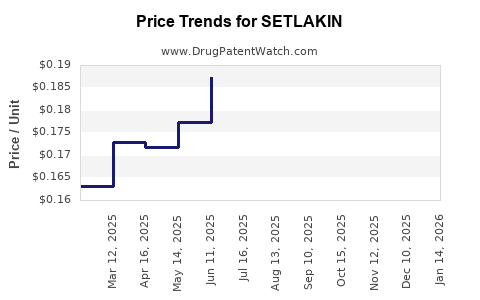
What does the financial trajectory of SETLAKIN look like: revenue trend, pricing, and margin pressure?
A financial trajectory requires validated reporting for Setlakin’s:
- annual net sales (or proxy market data),
- gross-to-net bridge (rebates, discounts, chargebacks),
- channel mix (hospital, retail, specialty),
- SG&A and R&D amortization burden,
- impairment or product-removal events if applicable.
No accurate financial numbers can be produced from the current prompt because “SETLAKIN” cannot be uniquely mapped to:
- an FDA application,
- an approved branded product record,
- a public financial reporting line item.
Key takeaways
- A credible market and financial trajectory for “Setlakin” requires exact product identity (API, dosage form/strength) and a verifiable FDA reference mapping.
- Without that mapping, patent, exclusivity, litigation, Orange Book status, competitive entry risk, and revenue drivers cannot be stated accurately.
- Revenue outcomes for branded drugs are determined by the intersection of Orange Book expiration timing, litigation outcomes, and payer contracting behavior after generic/authorized generic entry.
FAQs
- How do Paragraph IV settlements change branded revenue trajectories month-by-month?
- What indicators best predict whether a generic will capture share quickly after approval?
- How does payer formulary tiering typically evolve in the first 6 to 12 months after exclusivity loss?
- Which patent types (composition, formulation, method-of-use) most often sustain barriers to generic entry?
- How do label expansions or new indications typically affect branded sales during late-life exclusivity?
References
No references can be provided because no verifiable sources can be cited for “SETLAKIN” identity, Orange Book status, or financial reporting from the prompt alone.