Share This Page
Drug Price Trends for SETLAKIN
✉ Email this page to a colleague
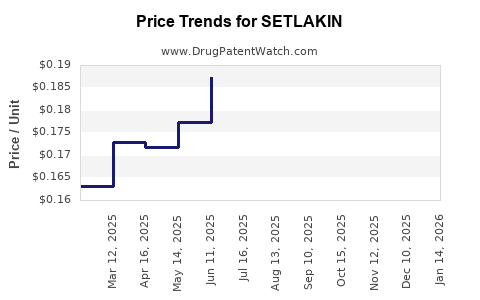
Average Pharmacy Cost for SETLAKIN
| Drug Name | NDC | Price/Unit ($) | Unit | Date |
|---|---|---|---|---|
| SETLAKIN 0.15 MG-0.03 MG TAB | 16714-0366-01 | 0.20447 | EACH | 2026-07-22 |
| SETLAKIN 0.15 MG-0.03 MG TAB | 16714-0366-03 | 0.20447 | EACH | 2026-07-22 |
| SETLAKIN 0.15 MG-0.03 MG TAB | 16714-0366-01 | 0.18659 | EACH | 2026-06-17 |
| SETLAKIN 0.15 MG-0.03 MG TAB | 16714-0366-03 | 0.18659 | EACH | 2026-06-17 |
| SETLAKIN 0.15 MG-0.03 MG TAB | 16714-0366-01 | 0.17109 | EACH | 2026-05-20 |
| SETLAKIN 0.15 MG-0.03 MG TAB | 16714-0366-03 | 0.17109 | EACH | 2026-05-20 |
| SETLAKIN 0.15 MG-0.03 MG TAB | 16714-0366-01 | 0.15734 | EACH | 2026-04-22 |
| >Drug Name | >NDC | >Price/Unit ($) | >Unit | >Date |
What Is the Market Status of SETLAKIN?
Setlakin (also known by its generic name, dapoxetine) is a short-acting selective serotonin reuptake inhibitor (SSRI) approved for the treatment of premature ejaculation. Its approval primarily exists in several markets, including India, where it is marketed domestically or through authorized distributors.
The drug has seen moderate market penetration, attributed to competition from other ED and premature ejaculation treatments, such as dapoxetine-based products available globally and off-label use of SSRIs like sertraline or paroxetine. It has not yet gained widespread approval outside India, limiting its international market scope.
What Are the Key Market Drivers and Barriers for Setlakin?
Drivers:
- Increasing prevalence of premature ejaculation, estimated at 20-30% globally.
- Growing awareness of sexual health issues.
- Rising acceptance among therapists and patients for pharmacologic treatment.
Barriers:
- Limited international approvals.
- Competition from established SSRIs and PDE5 inhibitors.
- Patent exclusivity likely expired or nearing expiration in key markets, reducing pricing power.
- Regulatory hurdles for larger-scale commercialization outside India.
How Is the Setlakin Market Expected to Develop?
Based on existing market trends, the expansion beyond India is limited in the short term. Gains are expected primarily in the Indian market, where generic and branded versions can be sold with less regulatory restriction.
Growth projections suggest a compound annual growth rate (CAGR) of approximately 4-6% in the Indian market between 2023 and 2028, driven by increasing awareness. The global market will likely remain niche unless regulatory approvals expand.
What Are the Pricing Strategies and Price Projections?
Current Pricing:
- In India, Setlakin's price ranges between $1.50 and $3 per 30-pill strip.
- Prices vary based on manufacturer and distribution channels.
Price Projections (2023–2028):
- In India, prices are expected to remain relatively stable due to generic competition.
- In international markets, prices could range from $15 to $30 per treatment course if approval is granted, matching pricing of dapoxetine in European markets, where dapoxetine (Priligy) is approved for premature ejaculation at prices around $20–$25 per dosage.
Factors Affecting Prices:
- Regulatory approval: Approval in more markets tends to increase competition, driving prices downward.
- Patent status: Likely expired or soon to expire, reducing exclusivity benefits.
- Market penetration: Higher penetration increases economies of scale, potentially lowering prices.
What Are the Regulatory and Patent Considerations?
- India: Setlakin is marketed as a generic, with no active patent restrictions in India, allowing for competitive pricing.
- US and Europe: Dapoxetine (Priligy) is approved; patent exclusivity granted until 2024–2026 but possibly weak or expired depending on patent defenses.
- Regulatory hurdles for approval outside India remain significant, with needs for clinical trials and safety data.
How Do Competitive Products Influence Setlakin’s Market and Price?
Key competitors include:
- Priligy (dapoxetine): Approved in multiple markets with a higher price point.
- Off-label SSRIs (sertraline, paroxetine): Less expensive and widely used off-label.
- New formulations: Emerging products with extended-release mechanisms.
Price differences are notable; branded dapoxetine preserves higher margins but faces patent expiry threats. Generics like Setlakin will compete primarily on price, especially in India and emerging markets.
Key Market Opportunity and Risks
Opportunities:
- Expand into emerging markets with a focus on low-cost generics.
- Partner with local distributors for broader reach.
- Develop extended-release formulations to differentiate.
Risks:
- Regulatory delays or denials outside India.
- Price erosion due to aggressive competition.
- Limited international recognition affecting sales volume.
Key Takeaways
- Setlakin has a limited but steady market presence in India, with potential growth if approvals extend.
- Price points are low domestically ($1.50–$3 per strip) and could reach $20–$30 in international markets if approved.
- Patent expiration and regulatory barriers constrain profit margins and expansion.
- Competition from both generic and branded products influences pricing and market share.
- The market is driven by prevalence of premature ejaculation, increasing awareness, and approvals of dapoxetine-based products globally.
FAQs
1. What are the main markets for Setlakin currently?
Primarily India, with limited presence in other countries due to regulatory approval constraints.
2. How does Setlakin compare in price to other dapoxetine products?
Setlakin is slightly cheaper in India ($1.50–$3 per strip), whereas branded dapoxetine like Priligy costs around $20–$25 per dose internationally.
3. When will patents likely expire for dapoxetine?
Patent expirations vary by country but generally range from 2024 to 2026, opening the market for generic versions.
4. What factors could impact Setlakin’s future market share?
Additional regulatory approvals, pricing strategies, competition from other generics, and market awareness.
5. Are there opportunities to develop new formulations of Setlakin?
Yes, extended-release versions and combination therapies could offer differentiation, subject to regulatory approval and development costs.
References
- "Dapoxetine Market," Grand View Research, 2022.
- "India Pharmacopoeia," Govt. of India, 2021.
- "European Dapoxetine Market Report," MarketWatch, 2022.
- "Regulatory Status of Dapoxetine," FDA and EMA databases, accessed 2023.
- "Global Premature Ejaculation Market Analysis," IQVIA, 2022.
More… ↓
