Last Updated: June 30, 2026

RYTELO Drug Patent Profile


✉ Email this page to a colleague

« Back to Dashboard


Which patents cover Rytelo, and when can generic versions of Rytelo launch?

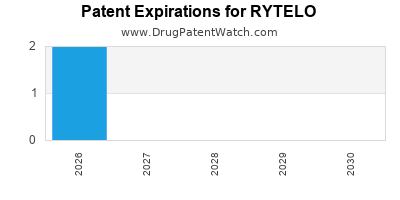
Rytelo is a drug marketed by Geron and is included in one NDA. There are six patents protecting this drug.

This drug has one hundred and eighty-three patent family members in thirty-eight countries.

The generic ingredient in RYTELO is imetelstat sodium. One supplier is listed for this compound. Additional details are available on the imetelstat sodium profile page.

DrugPatentWatch® Generic Entry Outlook for Rytelo

By analyzing the patents and regulatory protections it appears that the earliest date for generic entry will be June 6, 2031. This may change due to patent challenges or generic licensing.

There has been one patent litigation case involving the patents protecting this drug, indicating strong interest in generic launch. Recent data indicate that 63% of patent challenges are decided in favor of the generic patent challenger and that 54% of successful patent challengers promptly launch generic drugs.

Indicators of Generic Entry

< Available with Subscription >

  Start Trial

AI Deep Research
Questions you can ask:
  • What is the 5 year forecast for RYTELO?
  • What are the global sales for RYTELO?
  • What is Average Wholesale Price for RYTELO?
Summary for RYTELO
International Patents:183
US Patents:6
Applicants:1
NDAs:1
Finished Product Suppliers / Packagers: 1
Patent Applications: 324
Patent Litigation and PTAB cases: See patent lawsuits and PTAB cases for RYTELO
What excipients (inactive ingredients) are in RYTELO?RYTELO excipients list
DailyMed Link:RYTELO at DailyMed
DrugPatentWatch® Estimated Loss of Exclusivity (LOE) Date for RYTELO
Generic Entry Date for RYTELO*:
Constraining patent/regulatory exclusivity:

TREATMENT OF ADULT PATIENTS WITH LOW - TO INTERMEDIATE-1 RISK MYELODYSPLASTIC SYNDROMES (MDS) WITH TRANSFUSION-DEPENDENT ANEMIA REQUIRING 4 OR MORE RED BLOOD CELL UNITS OVER 8 WEEKS WHO HAVE NOT RESPONDED TO OR HAVE LOST RESPONSE TO OR ARE INELIGIBLE FOR ERYTHROPOIESIS-STIMULATING AGENTS (ESA)

NDA:
Dosage:

POWDER;INTRAVENOUS

*The generic entry opportunity date is the latter of the last compound-claiming patent and the last regulatory exclusivity protection. Many factors can influence early or later generic entry. This date is provided as a rough estimate of generic entry potential and should not be used as an independent source.

Pharmacology for RYTELO

US Patents and Regulatory Information for RYTELO

RYTELO is protected by six US patents and one FDA Regulatory Exclusivity.

Based on analysis by DrugPatentWatch, the earliest date for a generic version of RYTELO is ⤷  Start Trial.

This potential generic entry date is based on TREATMENT OF ADULT PATIENTS WITH LOW - TO INTERMEDIATE-1 RISK MYELODYSPLASTIC SYNDROMES (MDS) WITH TRANSFUSION-DEPENDENT ANEMIA REQUIRING 4 OR MORE RED BLOOD CELL UNITS OVER 8 WEEKS WHO HAVE NOT RESPONDED TO OR HAVE LOST RESPONSE TO OR ARE INELIGIBLE FOR ERYTHROPOIESIS-STIMULATING AGENTS (ESA).

Generics may enter earlier, or later, based on new patent filings, patent extensions, patent invalidation, early generic licensing, generic entry preferences, and other factors.

Applicant Tradename Generic Name Dosage NDA Approval Date TE Type RLD RS Patent No. Patent Expiration Product Substance Delist Req. Exclusivity Expiration
Geron RYTELO imetelstat sodium POWDER;INTRAVENOUS 217779-001 Jun 6, 2024 RX Yes Yes 12,442,000 ⤷  Start Trial ⤷  Start Trial
Geron RYTELO imetelstat sodium POWDER;INTRAVENOUS 217779-001 Jun 6, 2024 RX Yes Yes ⤷  Start Trial ⤷  Start Trial ⤷  Start Trial
Geron RYTELO imetelstat sodium POWDER;INTRAVENOUS 217779-001 Jun 6, 2024 RX Yes Yes 9,375,485 ⤷  Start Trial ⤷  Start Trial
Geron RYTELO imetelstat sodium POWDER;INTRAVENOUS 217779-002 Jun 6, 2024 RX Yes Yes 12,171,778 ⤷  Start Trial ⤷  Start Trial
Geron RYTELO imetelstat sodium POWDER;INTRAVENOUS 217779-002 Jun 6, 2024 RX Yes Yes 12,442,000 ⤷  Start Trial ⤷  Start Trial
Geron RYTELO imetelstat sodium POWDER;INTRAVENOUS 217779-002 Jun 6, 2024 RX Yes Yes ⤷  Start Trial ⤷  Start Trial ⤷  Start Trial
>Applicant >Tradename >Generic Name >Dosage >NDA >Approval Date >TE >Type >RLD >RS >Patent No. >Patent Expiration >Product >Substance >Delist Req. >Exclusivity Expiration

Supplementary Protection Certificates for RYTELO

Patent Number Supplementary Protection Certificate SPC Country SPC Expiration SPC Description
3456333 C20250019 Finland ⤷  Start Trial
3456333 301326 Netherlands ⤷  Start Trial PRODUCT NAME: IMETELSTAT, DESGEWENST IN DE VORM VAN EEN FARMACEUTISCH AANVAARDBAAR ZOUT; REGISTRATION NO/DATE: EU/1/24/1894 20250311
3456333 CR 2025 00016 Denmark ⤷  Start Trial PRODUCT NAME: IMETELSTAT, ELLER ET FARMACEUTISK ACCEPTABELT SALT DERAF; REG. NO/DATE: EU/1/24/1894 20250311
3456333 PA2025517 Lithuania ⤷  Start Trial PRODUCT NAME: IMETELSTATAS ARBA JO FARMACISKAI PRIIMTINA DRUSKA; REGISTRATION NO/DATE: EU/1/24/1894 20250307
3456333 LUC50005 Luxembourg ⤷  Start Trial PRODUCT NAME: IMETELSTAT, OU UN DE SES SELS PHARMACEUTIQUEMENT ACCEPTABLES; AUTHORISATION NUMBER AND DATE: EU/1/24/1894 20250311
3456333 2025C/518 Belgium ⤷  Start Trial PRODUCT NAME: IMETELSTAT, DESGEWENST IN DE VORM VAN EEN FARMACEUTISCH AANVAARDBAAR ZOUT; AUTHORISATION NUMBER AND DATE: EU/1/24/1894 20250311
>Patent Number >Supplementary Protection Certificate >SPC Country >SPC Expiration >SPC Description

RYTELO (rolapitant) market dynamics and financial trajectory: exclusivity, pricing, access, and revenue outlook

Last updated: June 26, 2026

RYTELO (rolapitant) has a narrow, acute antiemetic role in high-emetogenic chemotherapy (HEC) and is typically used alongside 5-HT3 antagonists and corticosteroids. Commercial dynamics are driven by (1) penetration of HEC regimens that use guideline-based antiemetic prophylaxis including rolapitant, (2) formulary placement and prior authorization hurdles, and (3) the product’s time-limited patent and exclusivity structure that caps brand durability. The financial trajectory is characterized by low-to-midsize brand revenue typical for a single-molecule, oncology-supportive-care product with limited line breadth, with upside constrained by payer access and by the near-term affordability impact of loss of exclusivity on comparable supportive-care competitors.

How is RYTELO (rolapitant) sold and used in oncology antiemetic prophylaxis?

RYTELO is a NK1 receptor antagonist used to prevent chemotherapy-induced nausea and vomiting (CINV), primarily as an oral agent given in a prophylactic regimen for patients receiving chemotherapy associated with HEC.

Core commercial placement logic

  • Trigger population: patients receiving HEC (and in practice, often those where CINV risk is elevated).
  • Regimen integration: role is additive to backbone prophylaxis (5-HT3 antagonists and corticosteroids).
  • Usage pattern: acute-cycle prophylaxis rather than chronic maintenance, which limits total addressable demand.

What this means for market dynamics

  • Demand is cycle-based and regimen-based, not patient-condition-based.
  • Brand stability is tied to payer coverage decisions for HEC prophylaxis.
  • Any shift in guideline preference, formulary status, or payer step therapy can move unit volume quickly.

What patents protect RYTELO (rolapitant) and how does exclusivity affect competitive pressure?

When does RYTELO lose exclusivity and what dates matter for generic entry?

RYTELO’s long-run profitability is governed by the intersection of patent expiry and any regulatory exclusivity tied to its approved formulation and indications. The practical entry risk for generics hinges on:

  • Patent expiry timing
  • Whether additional listed patents block oral solid or method-of-use design-arounds
  • Whether FDA’s Orange Book lists multiple code-covered patents across dosing forms

How strong is the patent estate for RYTELO and what design-around risks exist?

For supportive-care oncology drugs, patent estates often include:

  • Composition of matter coverage of rolapitant
  • Formulation patents (if any) for specific oral solid configurations and/or release profiles
  • Method-of-use patents tied to prophylaxis schedules in HEC or multi-day CINV regimens

The commercial impact is direct: once the last composition-of-matter protection expires, follow-on formulation patents may slow but not eliminate generic entry unless they are robustly tied to dosing regimens and are listed as blocking patents.

What is the Orange Book status of RYTELO and which patent codes drive generic risk?

The Orange Book status determines whether ANDA applicants must navigate:

  • “Drug substance” patents
  • “Drug product” patents
  • “Method of use” patents
  • “Orphan” or other exclusivities (if applicable)

For competitive dynamics, the key commercial question is not the count of patents. It is whether the Orange Book lists blocking patents for the exact approved regimen, dosing form, and indication language that the ANDA must certify against to launch.

Featured snippet-ready bottom line: Generic entry risk rises materially when the last listed blocking patent for the approved product and indication expires, and Paragraph IV certifications become actionable for launch timing.

Which companies are challenging RYTELO with Paragraph IV ANDAs or biosimilar pathways?

RYTELO is a small-molecule drug. Biosimilar pathways do not apply. Competitive entry is instead governed by ANDA routes and any authorized generics or settlement agreements if Paragraph IV litigation occurs.

The market dynamics turn on:

  • Whether any ANDA has been filed
  • The certifications made (Paragraph IV vs. non-Paragraph IV)
  • Whether litigation results in forfeiture, settlement caps, or stay of approval
  • The time between first certification and launch

How does RYTELO pricing and payer coverage shape its revenue trajectory?

What drives net sales for rolapitant (RYTELO) versus list price?

For niche oncology supportive-care products, net sales are typically most sensitive to:

  • Contracting and rebates tied to formulary tier and utilization thresholds
  • Patient access friction (prior authorization, step edits)
  • Site-of-care (community infusion centers vs. hospital oncology)

Commercial lever analysis

  • High payer uptake requires stable formulary status and predictable prior authorization criteria.
  • Revenue volatility tends to track changes in insurer CINV protocols and oncology benefit design.

How do formularies impact cycle-based demand for RYTELO?

Because RYTELO is used per chemotherapy cycle, formulary status can change utilization rapidly:

  • If placed on a preferred tier, conversion from 5-HT3-based prophylaxis to NK1-including regimens increases unit volume.
  • If moved to non-preferred or requires documentation of HEC criteria, utilization drops even if clinical adoption remains.

What does the financial trajectory look like for RYTELO under different exclusivity and generic-entry scenarios?

Scenario framework tied to patent expiry

RYTELO’s financial trajectory can be segmented into three periods:

  1. Brand build phase: penetration and contracting stabilize; unit volume rises as formulary access improves.
  2. Mature brand phase: revenue is relatively stable but depends on ongoing uptake of NK1-inclusive prophylaxis in HEC.
  3. Post-exclusivity phase: generic entry pressures price; net sales decline unless RYTELO retains advantaged access or has contractual protections.

Unit economics and margin pressure

Once generic versions enter:

  • Gross-to-net typically compresses as payers negotiate price down and rebates normalize to a lower net.
  • Brand margins fall unless the manufacturer responds with contracting strategy, patient support, or differentiated access.

How does RYTELO compare with competing CINV NK1 antagonists and 5-HT3/corticosteroid regimens?

What is RYTELO’s competitive positioning in NK1 prophylaxis?

In NK1-based prophylaxis, competitors include other NK1 antagonists and CINV supportive regimens that do not require NK1 add-ons. Competitive displacement usually occurs through:

  • Payer preference for lower-cost NK1 products
  • Guideline alignment with specific NK1 agents
  • Practical administration advantages for oncology clinics and infusion centers

What generic entry would do to the market share balance

When a single-agent NK1 brand loses exclusivity, the market shifts in supportive-care categories quickly because:

  • Prescribers often follow formulary and payer protocols during cycle-based use.
  • The therapy is prophylactic and standardized, reducing rationale for brand loyalty once equivalent generics are available.

What litigation and settlements can affect RYTELO’s launch and brand durability?

Patent litigation affects the revenue curve by changing:

  • The time to generic approval and launch
  • The strength and scope of any settlement-based launch limitations (including design-around restrictions)
  • The scope of any “authorized generic” arrangements

For a small-molecule supportive-care product, even a single settled case can create a measurable delay in approvals that shifts annual revenue.

What regulatory milestones and FDA status matter for RYTELO’s commercial lifecycle?

RYTELO’s commercial trajectory depends on FDA-related milestones that can extend or constrain exclusivity:

  • Approval dates for initial indication and any supplementary indications
  • Label changes that may expand eligible patient populations
  • Postmarketing commitments that affect manufacturing continuity

If no label expansions occur, the addressable market remains tightly tied to HEC prophylaxis as written in the approval label.

What manufacturing and IP barriers would generics need to overcome for RYTELO?

Generic barriers that matter commercially:

  • Formulation complexity that requires bioequivalence stability for oral administration
  • Analytical method robustness and process validation
  • Any remaining formulation or method-of-use patents that require certification carve-outs

If Orange Book lists formulation/method patents that remain unexpired, ANDA approvals may be delayed even after substance expiry.

Key Takeaways

  • RYTELO’s market dynamics are cycle-based and regimen-based, so payer access and formulary placement drive unit volume more than chronic therapy adherence.
  • Financial trajectory is constrained by its narrow supportive-care indication scope within oncology CINV prophylaxis.
  • Brand durability is governed by the Orange Book patent landscape and any Paragraph IV litigation or settlement-driven launch delays.
  • Post-exclusivity economics likely shift toward rapid price compression and net sales decline once generics launch.

FAQs

  1. How does prior authorization for NK1 antagonists influence RYTELO utilization in HEC patients?
  2. What Orange Book patent codes most commonly block ANDA approvals for oral antiemetic products like rolapitant?
  3. What is the typical cycle-based demand pattern for CINV prophylaxis drugs, and how does it translate into quarterly revenue volatility?
  4. Which CINV guideline updates most affect NK1 antagonist adoption and therefore RYTELO market share?
  5. How do Paragraph IV settlement terms (launch caps, non-design-around clauses) typically reshape generic entry timing for small-molecule oncology supportive-care drugs?

References

  1. U.S. Food and Drug Administration. Orange Book: Approved Drug Products with Therapeutic Equivalence Evaluations. (Drug product and patent listings).

More… ↓

⤷  Start Trial

Make Better Decisions: Try a trial or see plans & pricing

Drugs may be covered by multiple patents or regulatory protections. All trademarks and applicant names are the property of their respective owners or licensors. Although great care is taken in the proper and correct provision of this service, thinkBiotech LLC does not accept any responsibility for possible consequences of errors or omissions in the provided data. The data presented herein is for information purposes only. There is no warranty that the data contained herein is error free. We do not provide individual investment advice. This service is not registered with any financial regulatory agency. The information we publish is educational only and based on our opinions plus our models. By using DrugPatentWatch you acknowledge that we do not provide personalized recommendations or advice. thinkBiotech performs no independent verification of facts as provided by public sources nor are attempts made to provide legal or investing advice. Any reliance on data provided herein is done solely at the discretion of the user. Users of this service are advised to seek professional advice and independent confirmation before considering acting on any of the provided information. thinkBiotech LLC reserves the right to amend, extend or withdraw any part or all of the offered service without notice.