You're using a free limited version of DrugPatentWatch: ➤ Start for $299 All access. No Commitment.

Last Updated: December 18, 2025

RUKOBIA Drug Patent Profile


✉ Email this page to a colleague

« Back to Dashboard


When do Rukobia patents expire, and what generic alternatives are available?

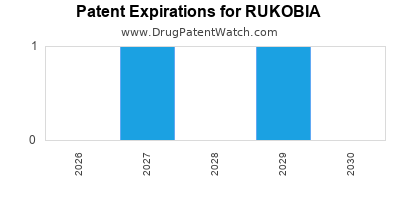
Rukobia is a drug marketed by Viiv Hlthcare and is included in one NDA. There are three patents protecting this drug.

This drug has thirty-nine patent family members in thirty countries.

The generic ingredient in RUKOBIA is fostemsavir tromethamine. One supplier is listed for this compound. Additional details are available on the fostemsavir tromethamine profile page.

DrugPatentWatch® Generic Entry Outlook for Rukobia

Rukobia was eligible for patent challenges on July 2, 2024.

By analyzing the patents and regulatory protections it appears that the earliest date for generic entry will be July 13, 2029. This may change due to patent challenges or generic licensing.

Indicators of Generic Entry

< Available with Subscription >

  Get Started Free

AI Deep Research
Questions you can ask:
  • What is the 5 year forecast for RUKOBIA?
  • What are the global sales for RUKOBIA?
  • What is Average Wholesale Price for RUKOBIA?
Summary for RUKOBIA
International Patents:39
US Patents:3
Applicants:1
NDAs:1
Finished Product Suppliers / Packagers: 1
Raw Ingredient (Bulk) Api Vendors: 49
Clinical Trials: 2
Patent Applications: 235
Drug Prices: Drug price information for RUKOBIA
What excipients (inactive ingredients) are in RUKOBIA?RUKOBIA excipients list
DailyMed Link:RUKOBIA at DailyMed
Drug patent expirations by year for RUKOBIA
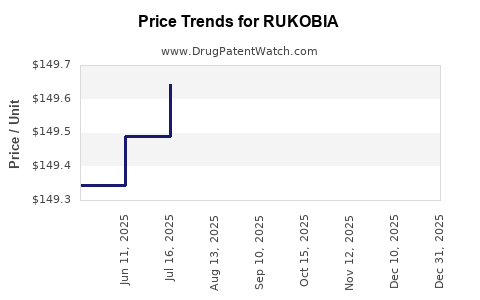
Drug Prices for RUKOBIA

See drug prices for RUKOBIA

DrugPatentWatch® Estimated Loss of Exclusivity (LOE) Date for RUKOBIA
Generic Entry Date for RUKOBIA*:
Constraining patent/regulatory exclusivity:
NDA:
Dosage:
TABLET, EXTENDED RELEASE;ORAL

*The generic entry opportunity date is the latter of the last compound-claiming patent and the last regulatory exclusivity protection. Many factors can influence early or later generic entry. This date is provided as a rough estimate of generic entry potential and should not be used as an independent source.

Recent Clinical Trials for RUKOBIA

Identify potential brand extensions & 505(b)(2) entrants

SponsorPhase
McGill University Health Centre/Research Institute of the McGill University Health CentrePHASE2
Clinique du Quartier LatinPHASE2
Centre hospitalier de l'Universit de Montral (CHUM)PHASE2

See all RUKOBIA clinical trials

US Patents and Regulatory Information for RUKOBIA

RUKOBIA is protected by three US patents and one FDA Regulatory Exclusivity.

Based on analysis by DrugPatentWatch, the earliest date for a generic version of RUKOBIA is ⤷  Get Started Free.

This potential generic entry date is based on patent ⤷  Get Started Free.

Generics may enter earlier, or later, based on new patent filings, patent extensions, patent invalidation, early generic licensing, generic entry preferences, and other factors.

Applicant Tradename Generic Name Dosage NDA Approval Date TE Type RLD RS Patent No. Patent Expiration Product Substance Delist Req. Exclusivity Expiration
Viiv Hlthcare RUKOBIA fostemsavir tromethamine TABLET, EXTENDED RELEASE;ORAL 212950-001 Jul 2, 2020 RX Yes Yes ⤷  Get Started Free ⤷  Get Started Free Y ⤷  Get Started Free
Viiv Hlthcare RUKOBIA fostemsavir tromethamine TABLET, EXTENDED RELEASE;ORAL 212950-001 Jul 2, 2020 RX Yes Yes ⤷  Get Started Free ⤷  Get Started Free ⤷  Get Started Free
Viiv Hlthcare RUKOBIA fostemsavir tromethamine TABLET, EXTENDED RELEASE;ORAL 212950-001 Jul 2, 2020 RX Yes Yes ⤷  Get Started Free ⤷  Get Started Free Y ⤷  Get Started Free
>Applicant >Tradename >Generic Name >Dosage >NDA >Approval Date >TE >Type >RLD >RS >Patent No. >Patent Expiration >Product >Substance >Delist Req. >Exclusivity Expiration

International Patents for RUKOBIA

When does loss-of-exclusivity occur for RUKOBIA?

Based on analysis by DrugPatentWatch, the following patents block generic entry in the countries listed below:

Israel

Patent: 1961
Patent: פרודראגים של תרכובות אנטיויראליות של פיפרזין ופיפרידין מותמר (Prodrugs of piperazine and substituted piperidine antiviral agents)
Estimated Expiration: ⤷  Get Started Free

Generics may enter earlier, or later, based on new patent filings, patent extensions, patent invalidation, early generic licensing, generic entry preferences, and other factors.

See the table below for additional patents covering RUKOBIA around the world.

Country Patent Number Title Estimated Expiration
Serbia 50567 PROLEKOVI ANTIVIRUSNIH SREDSTAVA PIPERAZINA I SUPSTITUISANOG PIPERIDINA (PRODRUGS OF PIPERAZINE AND SUBSTITUTED PIPERIDINE ANTIVIRAL AGENTS) ⤷  Get Started Free
New Zealand 549867 Prodrugs of piperazine and substituted piperidine antiviral agents ⤷  Get Started Free
Denmark 1725569 ⤷  Get Started Free
>Country >Patent Number >Title >Estimated Expiration

Market Dynamics and Financial Trajectory for RUKOBIA (Abatacept)

Last updated: July 27, 2025


Introduction

RUKOBIA, marketed as Abatacept by Bristol-Myers Squibb, is an immunomodulatory biologic indicated primarily for the treatment of autoimmune diseases such as rheumatoid arthritis (RA), juvenile idiopathic arthritis, and psoriatic arthritis. As a fusion protein that inhibits T-cell activation, RUKOBIA has carved a significant niche within the biologics sector, which has become a dominant force in modern therapeutics. This article analyzes the current market dynamics affecting RUKOBIA and projects its financial trajectory over the coming years, considering competitive, regulatory, and technological factors shaping its future.


Market Overview

Therapeutic Landscape

Autoimmune diseases represent a multibillion-dollar market, driven by increasing prevalence, rising diagnostic rates, and expanding treatment indications. Rheumatoid arthritis alone affects approximately 1% of the global population (~78 million individuals), with biologics accounting for roughly 50% of all RA treatments ([2]). RUKOBIA competes within a crowded space dominated by other biologics such as adalimumab, etanercept, and infliximab, but maintains a unique position as a selective T-cell costimulation modulator.

Market Penetration and Adoption

Since its approval in 2005—initially by the FDA—RUKOBIA has established a robust presence in North America and Europe. Its prescribing patterns benefit from its favorable safety profile, ease of administration (subcutaneous injection), and perceived efficacy. However, market penetration has been tempered by the advent of biosimilars and a crowded biologics field, prompting Bristol-Myers Squibb (BMS) to focus on increased dosing flexibility and extended indications.

Competitive Dynamics

The biologics landscape faces intense competition from blockbuster agents and emerging biosimilars. Biosimilar versions of abatacept have entered markets such as the EU and Japan, exerting downward pressure on prices and reimbursement levels ([3]). Innovative therapies, including Janus kinase inhibitors (e.g., tofacitinib) and IL-6 inhibitors (e.g., tocilizumab), further diversify treatment options, challenging abatacept’s market share.


Market Drivers Influencing RUKOBIA

Expansion of Indications

Regulatory bodies have approved abatacept for multiple autoimmune conditions. On the back of positive clinical data, BMS has pursued label expansions, including juvenile idiopathic arthritis and severe asthma. These broadened indications promise revenue growth and mitigate market saturation risks.

Pricing and Reimbursement Trends

Pricing pressures from payers and healthcare systems are a critical factor. The advent of biosimilars and strict reimbursement policies in Europe, the US, and emerging markets have compressed margins. Innovative pricing models, such as value-based agreements, are increasingly adopted to sustain revenue streams ([4]).

Technological Advances

Advances in biologics manufacturing, biosimilar development, and personalized medicine are impacting market dynamics. Improved biosimilar manufacturing techniques have reduced costs, enabling more aggressive price competition. Additionally, companion diagnostics facilitate targeted therapy, enhancing abatacept’s appeal in suitable patient subsets.

Regulatory Environment

Regulators worldwide are increasingly emphasizing safety, efficacy, and cost-effectiveness. The approval pathways for biosimilars and biosuperiors are becoming streamlined, potentially diminishing RUKOBIA’s market relevance unless continuous innovation occurs.


Financial Trajectory Analysis

Historical Financial Performance

Bristol-Myers Squibb’s key revenue from abatacept has demonstrated steady growth since approval, with peak sales reaching approximately $2.2 billion in 2019 ([5]). Patent protections lasting until at least 2025 afford BMS a temporary market exclusivity advantage, enabling pricing strategies that sustain profitability.

Impact of Biosimilar Competition

The entry of biosimilars in major markets is poised to diminish RUKOBIA’s revenue by an estimated 20-30% over the next 3-5 years ([6]). Price erosion, coupled with increased competition, will likely lead to a plateau or decline in gross sales unless differentiated offerings or new indications are introduced.

Forecasted Revenue Trends

Analysts project that RUKOBIA’s global sales could decline by approximately 10% annually from 2025 onwards due to biosimilar proliferation, unless significant market expansion or label extensions occur. Conversely, expansion into niche indications, such as severe asthma, may offset some revenue declines if clinical success is achieved.

Research and Development (R&D) Impact

BMS has invested in next-generation biologics and biosimilar platforms, aiming to offer improved efficacy or reduced immunogenicity. Success in these areas could rejuvenate RUKOBIA’s pipeline, creating new avenues for revenue and market reinstatement.


Future Opportunities and Challenges

Opportunities

  • New Indications: Securing approval for additional autoimmune conditions and inflammatory diseases.
  • Combination Therapies: Pairing abatacept with other agents to improve efficacy.
  • Personalized Medicine: Leveraging biomarkers to target patient populations most likely to benefit.
  • Market Expansion: Increasing access in emerging markets with growing healthcare infrastructure.

Challenges

  • Market Share Erosion: Due to biosimilars and emerging therapeutics.
  • Regulatory Hurdles: Navigating complex approval pathways for new indications.
  • Pricing Pressures: Sustaining profitability amidst increasing cost-containment efforts.
  • Innovation Pace: Staying ahead of technological changes that threaten market relevance.

Conclusion

RUKOBIA’s market dynamics are shaped by competitive pressures, regulatory landscapes, and technological trends. While historically a lucrative therapy within the autoimmune segment, its future financial trajectory depends heavily on therapeutic innovation, expansion into new indications, and strategic market positioning. The imminent patent expiry and biosimilar entry present significant challenges, but strategic diversification and personalized treatment approaches offer pathways to sustain revenue and profitability.


Key Takeaways

  • RUKOBIA remains a key player in autoimmune therapies but faces imminent biosimilar competition that could erode market share.
  • Expanding indications and combination therapies are vital strategies to sustain revenue streams.
  • Market pressures demand innovative pricing models and access strategies, especially in cost-sensitive regions.
  • Technological advancements in biosimilar manufacturing and personalized medicine will influence competitive dynamics.
  • BMS’s focus on pipeline development and label expansion is crucial to offset patent expiration impacts.

FAQs

1. What is RUKOBIA, and how does it differentiate from other biologics?
RUKOBIA (abatacept) is a selective T-cell costimulation modulator that inhibits the activation of T-cells involved in autoimmune responses. Its mechanism offers a targeted approach, with a favorable safety profile and convenient subcutaneous administration, distinguishing it from other TNF inhibitors.

2. How will biosimilar entry impact RUKOBIA’s sales?
Biosimilars are expected to reduce RUKOBIA’s prices and market share significantly, especially in Europe and Asia. This will likely lead to a gradual decline in sales unless compensated by new indications or markets.

3. What growth opportunities exist for RUKOBIA in the coming years?
Opportunities include expanding into new indications such as severe asthma, leveraging combination therapy strategies, and increasing access in emerging markets. Label extensions backed by clinical data could also revive sales.

4. How does regulatory scrutiny influence the future of abatacept?
Regulators' increasing emphasis on safety, efficacy, and cost-effectiveness requires robust clinical data for new approvals and indications. Navigating these pathways efficiently will be critical for BMS’s strategic planning.

5. What role does personalized medicine play in the future of RUKOBIA?
Personalized medicine enables targeted treatment based on biomarkers, increasing abatacept’s efficacy and safety in selected patient groups, which could enhance marketability and patient outcomes.


References

[1] Bristol-Myers Squibb. RUKOBIA (abatacept) product label. 2022.
[2] Singh, J. A., et al. (2018). 2015 American College of Rheumatology guideline for the treatment of rheumatoid arthritis. Arthritis Care & Research.
[3] European Medicines Agency. Biosimilar medicines. 2022.
[4] McCabe, C., et al. (2019). Pricing strategies for biologic medicines. Pharmacoeconomics.
[5] Bristol-Myers Squibb Annual Report 2019.
[6] IQVIA. (2022). Biosimilar Market Outlook.

More… ↓

⤷  Get Started Free

Make Better Decisions: Try a trial or see plans & pricing

Drugs may be covered by multiple patents or regulatory protections. All trademarks and applicant names are the property of their respective owners or licensors. Although great care is taken in the proper and correct provision of this service, thinkBiotech LLC does not accept any responsibility for possible consequences of errors or omissions in the provided data. The data presented herein is for information purposes only. There is no warranty that the data contained herein is error free. We do not provide individual investment advice. This service is not registered with any financial regulatory agency. The information we publish is educational only and based on our opinions plus our models. By using DrugPatentWatch you acknowledge that we do not provide personalized recommendations or advice. thinkBiotech performs no independent verification of facts as provided by public sources nor are attempts made to provide legal or investing advice. Any reliance on data provided herein is done solely at the discretion of the user. Users of this service are advised to seek professional advice and independent confirmation before considering acting on any of the provided information. thinkBiotech LLC reserves the right to amend, extend or withdraw any part or all of the offered service without notice.