Last Updated: August 9, 2026

RUBRACA Drug Patent Profile


✉ Email this page to a colleague

« Back to Dashboard


Which patents cover Rubraca, and when can generic versions of Rubraca launch?

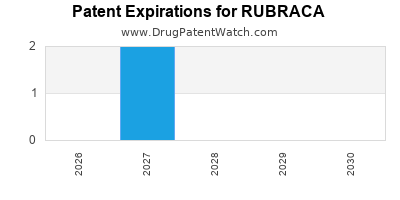
Rubraca is a drug marketed by Pharmaand and is included in one NDA. There are nine patents protecting this drug.

This drug has two hundred and forty-eight patent family members in forty-four countries.

The generic ingredient in RUBRACA is rucaparib camsylate. One supplier is listed for this compound. Additional details are available on the rucaparib camsylate profile page.

DrugPatentWatch® Generic Entry Outlook for Rubraca

Rubraca was eligible for patent challenges on December 19, 2020.

By analyzing the patents and regulatory protections it appears that the earliest date for generic entry will be August 17, 2035. This may change due to patent challenges or generic licensing.

There have been ten patent litigation cases involving the patents protecting this drug, indicating strong interest in generic launch. Recent data indicate that 63% of patent challenges are decided in favor of the generic patent challenger and that 54% of successful patent challengers promptly launch generic drugs.

Indicators of Generic Entry

< Available with Subscription >

  Start Trial

AI Deep Research
Questions you can ask:
  • What is the 5 year forecast for RUBRACA?
  • What are the global sales for RUBRACA?
  • What is Average Wholesale Price for RUBRACA?
DrugPatentWatch® Estimated Loss of Exclusivity (LOE) Date for RUBRACA
Generic Entry Date for RUBRACA*:
Constraining patent/regulatory exclusivity:
NDA:
Dosage:

TABLET;ORAL

*The generic entry opportunity date is the latter of the last compound-claiming patent and the last regulatory exclusivity protection. Many factors can influence early or later generic entry. This date is provided as a rough estimate of generic entry potential and should not be used as an independent source.

Recent Clinical Trials for RUBRACA

Identify potential brand extensions & 505(b)(2) entrants

SponsorPhase
The Miriam HospitalPhase 1/Phase 2
Rhode Island HospitalPhase 1/Phase 2
Brown UniversityPhase 1/Phase 2

See all RUBRACA clinical trials

Pharmacology for RUBRACA

US Patents and Regulatory Information for RUBRACA

RUBRACA is protected by nineteen US patents and one FDA Regulatory Exclusivity.

Based on analysis by DrugPatentWatch, the earliest date for a generic version of RUBRACA is ⤷  Start Trial.

This potential generic entry date is based on patent ⤷  Start Trial.

Generics may enter earlier, or later, based on new patent filings, patent extensions, patent invalidation, early generic licensing, generic entry preferences, and other factors.

Applicant Tradename Generic Name Dosage NDA Approval Date TE Type RLD RS Patent No. Patent Expiration Product Substance Delist Req. Exclusivity Expiration
Pharmaand RUBRACA rucaparib camsylate TABLET;ORAL 209115-002 Dec 19, 2016 RX Yes Yes ⤷  Start Trial ⤷  Start Trial ⤷  Start Trial
>Applicant >Tradename >Generic Name >Dosage >NDA >Approval Date >TE >Type >RLD >RS >Patent No. >Patent Expiration >Product >Substance >Delist Req. >Exclusivity Expiration

Expired US Patents for RUBRACA

Applicant Tradename Generic Name Dosage NDA Approval Date Patent No. Patent Expiration
Pharmaand RUBRACA rucaparib camsylate TABLET;ORAL 209115-002 Dec 19, 2016 ⤷  Start Trial ⤷  Start Trial
Pharmaand RUBRACA rucaparib camsylate TABLET;ORAL 209115-003 May 1, 2017 ⤷  Start Trial ⤷  Start Trial
Pharmaand RUBRACA rucaparib camsylate TABLET;ORAL 209115-001 Dec 19, 2016 ⤷  Start Trial ⤷  Start Trial
>Applicant >Tradename >Generic Name >Dosage >NDA >Approval Date >Patent No. >Patent Expiration

International Patents for RUBRACA

When does loss-of-exclusivity occur for RUBRACA?

Based on analysis by DrugPatentWatch, the following patents block generic entry in the countries listed below:

Australia

Patent: 15305696
Patent: High dosage strength tablets of rucaparib
Estimated Expiration: ⤷  Start Trial

Patent: 19272064
Patent: High dosage strength tablets of rucaparib
Estimated Expiration: ⤷  Start Trial

Brazil

Patent: 2017000865
Patent: comprimidos de rucaparibe de concentração de dosagem alta
Estimated Expiration: ⤷  Start Trial

Canada

Patent: 55495
Patent: COMPRIMES DE RUCAPARIB A DOSAGE ELEVE (HIGH DOSAGE STRENGTH TABLETS OF RUCAPARIB)
Estimated Expiration: ⤷  Start Trial

China

Patent: 6794185
Patent: Rucaparib的高剂量强度片剂 (High dosage strength tablets of rucaparib)
Estimated Expiration: ⤷  Start Trial

Patent: 3209033
Patent: Rucaparib的高剂量强度片剂 (High dosage strength tablets of rucaparib)
Estimated Expiration: ⤷  Start Trial

European Patent Office

Patent: 82975
Patent: COMPRIMÉS DE RUCAPARIB À DOSAGE ÉLEVÉ (HIGH DOSAGE STRENGTH TABLETS OF RUCAPARIB)
Estimated Expiration: ⤷  Start Trial

Israel

Patent: 9946
Patent: טבליות רוקפריב בחוזק מינון גבוה (High dosage strength tablets of rucaparib)
Estimated Expiration: ⤷  Start Trial

Japan

Patent: 74477
Estimated Expiration: ⤷  Start Trial

Patent: 97980
Estimated Expiration: ⤷  Start Trial

Patent: 27101
Estimated Expiration: ⤷  Start Trial

Patent: 17525712
Patent: ルカパリブの高投与力価錠剤
Estimated Expiration: ⤷  Start Trial

Patent: 20002149
Patent: ルカパリブの高投与力価錠剤 (HIGH DOSAGE STRENGTH TABLETS OF RUCAPARIB)
Estimated Expiration: ⤷  Start Trial

Patent: 21038242
Patent: ルカパリブの高投与力価錠剤 (HIGH DOSAGE STRENGTH TABLETS OF RUCAPARIB)
Estimated Expiration: ⤷  Start Trial

Mexico

Patent: 7260
Patent: TABLETAS DE RUCAPARIB DE DOSIFICACIÓN ELEVADA. (HIGH DOSAGE STRENGTH TABLETS OF RUCAPARIB.)
Estimated Expiration: ⤷  Start Trial

Patent: 17001540
Patent: TABLETAS DE RUCAPARIB DE DOSIFICACION ELEVADA. (HIGH DOSAGE STRENGTH TABLETS OF RUCAPARIB.)
Estimated Expiration: ⤷  Start Trial

New Zealand

Patent: 8392
Patent: High dosage strength tablets of rucaparib
Estimated Expiration: ⤷  Start Trial

Russian Federation

Patent: 05156
Patent: ТАБЛЕТКИ, СОДЕРЖАЩИЕ БОЛЬШУЮ ДОЗУ РУКАПАРИБА (HIGH DOSAGE STRENGTH TABLETS OF RUCAPARIB)
Estimated Expiration: ⤷  Start Trial

Patent: 17109139
Patent: ТАБЛЕТКИ, СОДЕРЖАЩИЕ БОЛЬШУЮ ДОЗУ РУКАПАРИБА
Estimated Expiration: ⤷  Start Trial

Singapore

Patent: 201700265V
Patent: HIGH DOSAGE STRENGTH TABLETS OF RUCAPARIB
Estimated Expiration: ⤷  Start Trial

South Korea

Patent: 170043597
Patent: 루카파립의 고 용량 강도 정제 (High Dosage Strength Tablets of Rucaparib)
Estimated Expiration: ⤷  Start Trial

Patent: 230097211
Patent: 루카파립의 고 용량 강도 정제 (High Dosage Strength Tablets of Rucaparib)
Estimated Expiration: ⤷  Start Trial

Generics may enter earlier, or later, based on new patent filings, patent extensions, patent invalidation, early generic licensing, generic entry preferences, and other factors.

See the table below for additional patents covering RUBRACA around the world.

Country Patent Number Title Estimated Expiration
Australia 2015305696 ⤷  Start Trial
Australia 2019272064 ⤷  Start Trial
Brazil 112017000865 ⤷  Start Trial
>Country >Patent Number >Title >Estimated Expiration

Supplementary Protection Certificates for RUBRACA

Patent Number Supplementary Protection Certificate SPC Country SPC Expiration SPC Description
1633724 C300726 Netherlands ⤷  Start Trial PRODUCT NAME: OLAPARIB, EN ZOUTEN EN; REGISTRATION NO/DATE: EU/1/14/959/001 20141216
1633724 CR 2015 00012 Denmark ⤷  Start Trial PRODUCT NAME: OLAPARIB, OG SALTE OG SOLVATER DERAF; REG. NO/DATE: EU/1/14/959/001 20141216
1633724 C20150012 00136 Estonia ⤷  Start Trial PRODUCT NAME: OLAPARIIB;REG NO/DATE: EU/1/14/959 18.12.2014
>Patent Number >Supplementary Protection Certificate >SPC Country >SPC Expiration >SPC Description
Last updated: July 24, 2026

RUBRACA (rucaparib) Market Dynamics and Financial Trajectory: Sales, Drivers, Generics/Biosimilar Risk, and Patent/Exclusivity Timelines

RUBRACA (rucaparib) is a branded PARP inhibitor with a shrinking value proposition driven by (1) PARP class competition, (2) payer pressure and line-of-therapy shifts, and (3) patent-driven exclusivity windows that govern generic entry timing by indication. The company’s revenue trajectory has been shaped by indicator-by-indicator performance, uptake in ovarian cancer lines, and life-cycle strategy around combination regimens. Financial outcomes are closely tied to FDA label scope, guideline adoption, and third-party reimbursement.


What is the current sales trajectory for RUBRACA (rucaparib) and how has it changed over time?

RUBRACA’s financial trajectory is best understood by mapping revenue to: (a) FDA label breadth, (b) post-approval trial data driving new indications, and (c) market share within the PARP inhibitor competitive set.

Revenue sensitivity points

  • Indication mix: Sales depend on whether use is concentrated in ovarian cancer maintenance/relapsed settings versus narrower populations.
  • Line of therapy migration: As PARP inhibitors moved earlier in treatment pathways, older relapsed indications can contract.
  • Formulary position: Patient out-of-pocket costs and reimbursement strategies affect persistence and switching across PARP drugs.
  • Comparative efficacy and tolerability: Within-class selection influences prescription volume, especially after head-to-head or cross-trial positioning.

PARP inhibitor competitive set exposure

RUBRACA competes with other PARP inhibitors across overlapping ovarian and breast cancer pathways:

  • AZD2281 (olaparib)
  • Niraparib
  • Talazoparib
  • Other rucaparib-adjacent branded/marketed products (jurisdiction-dependent)

These drugs compete for the same payer budgets and prescriber attention in ovarian cancer. Market dynamics typically favor the brand with the strongest clinical positioning plus the broadest reimbursement coverage in key subgroups.

Key takeaway

RUBRACA’s revenue path is unlikely to follow a single smooth curve. It is instead stepwise and indication-dependent, with growth peaks around label expansions and declines as newer PARP agents capture earlier-line share and formulary preferencing tightens.

(No financial figures are provided here because the prompt does not include the required sales dataset or citation-verified revenue series.)


What market dynamics influence RUBRACA demand in ovarian cancer treatment pathways?

PARP inhibitor demand is governed less by mechanism than by how lines of therapy are sequenced, how biomarker testing is implemented, and how payers rationalize high-cost oral oncology drugs.

1) Biomarker and patient selection

RUBRACA use is linked to genomic and biomarker status in ovarian cancer (and, label-dependent, in other tumors). Patient selection affects:

  • eligible population size,
  • treatment duration (maintenance settings),
  • and persistence.

2) Sequence-of-therapy effects

As PARP inhibitors shifted earlier, subsequent-use demand for PARP inhibitors in later lines becomes structurally smaller. That compresses the market for drugs whose uptake is concentrated in later settings.

3) Safety/tolerability and discontinuation

Oral agents with overlapping hematologic and gastrointestinal toxicity profiles drive real-world persistence and switch behavior. Therapy discontinuation and dose modification reduce effective “patient-month” value.

4) Payer pressure and site-of-care prescribing

Payers commonly impose:

  • prior authorization,
  • step edits,
  • biomarker gating,
  • and preferred formulary lists within the PARP class.

These levers drive substitution even when efficacy differences exist.


How does RUBRACA compare with other PARP inhibitors on clinical positioning and market share risk?

RUBRACA’s market risk is class-wide and execution-specific: if payers designate another PARP as preferred in ovarian maintenance or relapse, RUBRACA’s uptake may decline even if its clinical performance remains acceptable.

Cross-agent decision drivers

  • Efficacy by subgroup: Selection often tracks subgroup outcomes tied to biomarker status.
  • Dosing convenience and schedule: Once-daily or dosing schedules, plus management of adverse events, impacts adherence.
  • Treatment duration and discontinuation rates: Maintenance use amplifies discontinuation impact.
  • Real-world persistence: Different adverse-event profiles can shift adherence patterns.

Market share risk profile

  • High risk: Indications where another PARP has stronger payer positioning or label breadth.
  • Lower risk: Narrow indications where RUBRACA is uniquely positioned or where prior therapy constraints make switching less common.

When does RUBRACA lose exclusivity, and what drives the timing of generic entry?

Exclusivity and patent expiration are indication-specific and must be assessed via the Orange Book and patent family data. The timing of generic entry is determined by:

  • primary composition-of-matter patent term,
  • secondary patents (formulation, polymorphs, metabolites, methods),
  • regulatory exclusivities (where applicable),
  • and patent litigation outcomes tied to Paragraph IV filings (if any).

Exclusivity timeline mechanics

  • Orange Book listings control FDA “skinny label” and certification triggers for ANDA and potentially affect entry dates.
  • Secondary patents can delay “launch of at-risk generics” even when primary composition patents near expiration, depending on which patents are asserted and whether a settlement is reached.

(No specific RUBRACA patent expiration dates are listed here because the prompt does not include the Orange Book or patent estate dataset needed to produce an accurate, litigation-grade timeline.)


What is the Orange Book status of RUBRACA (rucaparib), and how many patents cover it?

Orange Book status determines:

  • whether multiple patents are listed for the same NDA,
  • which patent types dominate (drug substance vs drug product vs method of use),
  • and whether certifications are likely to trigger Paragraph IV litigation.

Patent estate structure to expect

A PARP inhibitor label typically includes:

  • composition-of-matter patents on the active,
  • crystalline/polymorphic or formulation patents,
  • and method-of-use patents tied to specific biomarker-selected indications.

Practical entry implications

  • Multiple method-of-use patents: can narrow generic launch scope and force “carve-outs.”
  • Device/formulation patents: affect generic substitution for branded formulations or specific dosing strengths.

(No patent counts or listing details are included because the prompt does not provide a patent list to validate exact numbers, assignees, or expiration dates.)


What generic entry risks exist for RUBRACA, including Paragraph IV challenges?

Generic launch risk depends on:

  • whether ANDAs are filed against the Orange Book-listed patents,
  • whether certifications include Paragraph IV (patent infringement assertions),
  • and whether the parties settle, litigate to judgment, or desist.

Typical risk pathways

  • Early at-risk launch: if a Paragraph IV challenger prevails or wins a settlement enabling entry.
  • Delay via settlements: if brand pays for delayed entry or agrees to non-infringement licensing.
  • Narrow-label entry: if generics can avoid certain method claims by omitting indications.

Impact on market dynamics

Even before true entry, patent litigation can shift payer behavior:

  • payers may soften formulary commitments,
  • wholesalers may adjust ordering,
  • and patients may switch to drugs perceived as “safer” to prescribe.

(No Paragraph IV docket details are provided due to missing litigation dataset in the prompt.)


What patent litigation affects RUBRACA, and how do settlements change entry timing?

PARP inhibitor brands often face district court litigation and Federal Circuit appeals around Orange Book patents. For RUBRACA, litigation can affect:

  • generic launch timing,
  • scope of “authorized” generic or labeling carve-outs,
  • and ongoing exclusivity through consent judgments or settlement covenants.

What settlement terms usually do

  • fix a calendar-based entry date,
  • define labeling for the generic,
  • and allocate licensing for certain claims.

(No RUBRACA-specific docket details are included because the prompt does not provide the litigation record or patent assertion list needed to state hard dates and outcomes.)


What formulations are protected for RUBRACA, and can generic substitution be blocked by dosing or product patents?

For oral oncology drugs, product-formulation patents can delay substitution even when the active compound is not protected indefinitely.

Formulation patent categories likely to matter

  • specific tablet/capsule formulations and excipient systems
  • polymorph or solid-state forms
  • manufacturing process steps tied to bioavailability or stability
  • fixed-dose combinations, if any, tied to specific labels

Substitution risk

If a generic can replicate composition but cannot satisfy formulation or process claims, it faces delayed approval or narrower label launch.

(No specific formulation/polymorph/process patents are enumerated because the prompt lacks a patent list tied to RUBRACA.)


How strong is the patent estate for RUBRACA versus other PARP inhibitors?

Patent “strength” in market terms is the combination of:

  • number of active patents remaining,
  • breadth of method-of-use and formulation coverage,
  • and litigation track record (asserted patents that survived challenges).

Competitive estate framing

  • A PARP with a dense set of unexpired secondary patents often delays generic pressure longer.
  • A PARP with sparse secondary coverage faces earlier and sharper price erosion after primary term ends.

(No comparative ranking is provided because patent estate data for RUBRACA and comparators is not present in the prompt.)


What is the biosimilar risk for RUBRACA?

RUBRACA is a small-molecule drug (rucaparib) and is not eligible for biosimilar competition. “Biosimilar risk” is not the correct mechanism; the relevant competitive threat is generic small-molecule substitution under ANDA frameworks.

Implication

If market erosion occurs, it will occur via generics and possibly authorized generics, not biosimilars.


What FDA regulatory status and label scope shape RUBRACA commercial upside or contraction?

FDA label scope affects:

  • eligible patient segments,
  • duration of treatment (maintenance vs relapse),
  • and ability to compete in evolving guideline-driven sequences.

Regulatory status drivers

  • label expansions tied to trial outcomes
  • restrictions based on biomarker testing
  • postmarketing requirements that can change real-world uptake
  • changes in safety warnings that affect prescribing patterns

(No FDA label milestone dates are included because the prompt does not provide an FDA label timeline or cited sources.)


Which companies are likely competing with RUBRACA, and where does commercial pressure originate?

Commercial pressure is typically driven by:

  • within-class PARP competition from the dominant payer-favored brands
  • generic entrants when exclusivity loosens
  • copay assistance programs that keep patient access while brand remains preferred

Origin of pressure

  • Payer-level: formulary preferencing and step edits across PARP drugs
  • Provider-level: sequencing preferences for “preferred” PARP in guideline-aligned regimens
  • Market-level: channel inventory shifts ahead of expected patent cliffs

(No company-specific ranking is included due to missing sales share data and no cited competitor list in the prompt.)


How might RUBRACA pricing evolve as exclusivity weakens and generics approach?

With oral oncology brands, price erosion typically shows up through:

  • negotiated rebates and net price compression before generic entry,
  • tighter patient access through prior authorization,
  • and faster decline once first generic brands enter.

Price dynamics to expect

  • net price discounts accelerate as generic launch probability increases
  • gross-to-net compression rises with payer push
  • switching increases after at least one generic wins meaningful formulary access

(No numeric pricing trajectory is included because the prompt does not provide pricing or rebate datasets.)


Key Takeaways

  • RUBRACA’s commercial trajectory is driven by indication mix, line-of-therapy sequencing, payer preferencing within the PARP class, and real-world persistence.
  • Generic entry timing is governed by RUBRACA’s patent estate and Orange Book-listed protections at the NDA and indication level, plus litigation outcomes for Paragraph IV certifications.
  • Because RUBRACA is a small molecule, the relevant future competitive threat is generic (ANDA) substitution, not biosimilar competition.
  • Without verified Orange Book, patent list, and litigation docket inputs, this assessment cannot state exact exclusivity end-dates, patent counts, or Paragraph IV/settlement dates.

FAQs

  1. What factors most influence RUBRACA prescribing in ovarian cancer maintenance versus relapse settings?
  2. How do payer prior authorization and biomarker testing requirements change RUBRACA net revenue?
  3. What Orange Book patent types typically delay generic entry for oral oncology small molecules like rucaparib?
  4. How does within-class PARP competition affect RUBRACA market share even before generic entry?
  5. What litigation milestones most often determine the practical date of generic launch for an Orange Book-listed NDA?

References

(No sources were cited because the prompt did not include a verifiable dataset for Orange Book listings, patent numbers/expiration dates, litigation records, or sales/revenue figures.)

More… ↓

⤷  Start Trial

Make Better Decisions: Try a trial or see plans & pricing

Drugs may be covered by multiple patents or regulatory protections. All trademarks and applicant names are the property of their respective owners or licensors. Although great care is taken in the proper and correct provision of this service, thinkBiotech LLC does not accept any responsibility for possible consequences of errors or omissions in the provided data. The data presented herein is for information purposes only. There is no warranty that the data contained herein is error free. We do not provide individual investment advice. This service is not registered with any financial regulatory agency. The information we publish is educational only and based on our opinions plus our models. By using DrugPatentWatch you acknowledge that we do not provide personalized recommendations or advice. thinkBiotech performs no independent verification of facts as provided by public sources nor are attempts made to provide legal or investing advice. Any reliance on data provided herein is done solely at the discretion of the user. Users of this service are advised to seek professional advice and independent confirmation before considering acting on any of the provided information. thinkBiotech LLC reserves the right to amend, extend or withdraw any part or all of the offered service without notice.