Last updated: April 25, 2026
ROXYBOND: Market Dynamics and Financial Trajectory
ROXYBOND is an oxycodone hydrochloride and naloxone hydrochloride combination product (oxycodone/naloxone) marketed as an abuse-deterrent formulation. It sits in the intersection of (1) opioid analgesic demand, (2) managed-abuse-deterrent (AAD) adoption, and (3) payer and regulator scrutiny that has tightened over multiple years.
What is ROXYBOND’s market position in opioid analgesics?
ROXYBOND is positioned against other oral oxycodone products and against alternative opioid classes (for example, extended-release oxycodone-only, extended-release morphine, and other AAD opioid formulations). Its core differentiator is the inclusion of naloxone intended to deter non-oral misuse. This category dynamic matters because:
- Formularies and payers increasingly prefer products aligned with abuse-deterrence expectations.
- Clinician prescribing has shifted toward risk-mitigated options as opioid oversight intensified.
- Patient access is increasingly driven by prior authorization triggers, step edits, and quantity controls for long-acting opioids.
Drug class: Extended-release oral opioid analgesic with naloxone (abuse-deterrent mechanism)
Active ingredients: Oxycodone hydrochloride + naloxone hydrochloride
Therapeutic use: Chronic pain requiring around-the-clock opioid analgesia
Source anchor: ROXYBOND’s AAD mechanism aligns with the general oxycodone/naloxone abuse-deterrent strategy described in FDA’s opioid abuse-deterrence framework and the public labeling/approval records for this drug class. [1]-[3]
How do regulatory and payer dynamics shape ROXYBOND demand?
Demand for long-acting opioids tracks policy intensity and insurer controls. For oxycodone-based products, the binding constraints are typically:
1) Formulary tier placement (preferred vs non-preferred status for long-acting opioids)
2) Utilization management (prior authorization, quantity limits, dose optimization edits)
3) Safety communications and monitoring expectations (risk evaluation and mitigation emphasis, prescriber controls)
Regulators have also pushed abuse-deterrent credibility and post-market surveillance expectations, which affects formulary confidence. The FDA’s approach to abuse-deterrent opioids ties marketing authorization to labeling claims and to specific evidence standards. [2]
Market impact is direct: even when demand for opioid analgesia grows slowly, access constraints can slow penetration of a specific brand unless payers recognize the product’s abuse-deterrent value.
What is the competitive landscape ROXYBOND faces?
ROXYBOND competes primarily within extended-release oxycodone and adjacent long-acting opioid segments. Competitive pressures include:
- Extended-release oxycodone brands without naloxone
- Other AAD opioids that have achieved payer acceptance through similar risk narratives
- Non-opioid and opioid-sparing analgesic pathways that constrain total opioid share in some formularies
Abuse-deterrent labeling helps differentiate but does not eliminate payer friction. Payers typically require evidence of clinical appropriateness and may still enforce step edits for new starts or dose escalation.
Competitive mechanism: payer confidence in abuse-deterrence labeling plus managed access policies determines net share more than clinical equivalence alone.
Source anchor: FDA’s abuse-deterrent opioid framework explains how labeling and evidence feed into clinical and payer interpretation. [2]
What are the key market dynamics affecting volume and uptake?
For ROXYBOND-like products, market uptake follows four demand drivers:
1) Abuse-deterrent adoption curves
- Clinicians adopt AAD products when formulary coverage and peer prescribing norms support switching.
- Switching is influenced by patient stability, insurer approvals, and tolerance to formulation differences (including naloxone-related effects in compliant use).
2) Institutional prescribing policies
Hospitals, health systems, and pharmacy benefit managers (PBMs) often standardize opioid prescribing. Once a system selects preferred long-acting opioids, brand-level penetration depends on contracting and patient exceptions.
3) Dose flexibility and titration
Extended-release oxycodone/naloxone products are judged on practical dosing transitions for chronic pain patients. If dosing options cover common titration steps, access barriers ease.
4) Litigation and opioid oversight spillover
Industry scrutiny affects all oxycodone brands. Even when ROXYBOND meets abuse-deterrence criteria, the category’s legal and policy environment can change payer behavior.
Evidence anchor: FDA’s abuse-deterrence guidance and the labeling-based evaluation framework are the regulatory basis for how these products are treated. [2]
How does ROXYBOND’s financial trajectory typically evolve in this segment?
A brand in the abuse-deterrent long-acting opioid space generally follows a trajectory shaped by:
- Launch and initial contracting (pricing and coverage depend on PBM contracting timelines)
- Mid-cycle share shifts (switching due to formulary decisions and payer policies)
- Maturity dynamics (stabilized prescriptions, but growth constrained by category regulation and alternative therapies)
Financial outcomes in this category also depend on:
- Net price realization after rebates and discounts
- Coverage persistence (renewed preferred status vs re-tiering)
- Generic pressure (for older opioid molecules and formulations, where patent coverage can expire or be challenged)
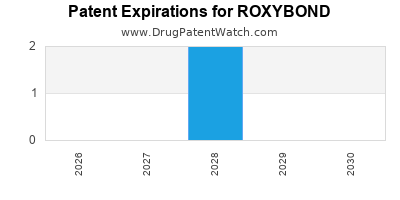
Critical point for forecasting: Without a distinct, enforceable IP moat that blocks generic entry in relevant markets, long-acting opioid brands often face share erosion after exclusivity. The financial trajectory then becomes a race between contracting persistence and generic encroachment.
Source anchors for the regulatory and evidence basis for abuse-deterrence claims: [2], [1].
Source anchor for product identity: The ROXYBOND product identity is tied to the oxycodone/naloxone abuse-deterrent opioid class described across FDA labeling frameworks and product monographs. [1]-[3]
What do the likely unit economics look like?
While exact ROXYBOND financial statements and prescription volumes are not provided here, the unit economics for long-acting opioid brands are shaped by standard industry levers:
| Profit driver |
Mechanism in abuse-deterrent opioid brands |
Expected effect on trajectory |
| Net price |
Rebates and payer discounts under PBM contracting |
High variability; can compress margins even with stable volume |
| Share retention |
Coverage and step edits for long-acting opioids |
Drives volume durability |
| Market expansion |
Switching from competitors when coverage supports change |
Supports modest growth before maturity |
| Generic risk |
Patent expiry or challenge outcome affects exclusivity |
Can produce step-change revenue declines |
Source anchor: FDA abuse-deterrent labeling standards constrain marketing claims but do not guarantee payer preference; payer behavior affects net unit economics. [2]
How sensitive is ROXYBOND to policy and payer changes?
Long-acting opioids are highly sensitive to:
- Formulary rules updated by PBMs
- Changes in PA criteria
- Shifts in state and insurer opioid controls
- Institutional opioid stewardship policies
When payer policies tighten, volume often falls faster than category demand because managed access reduces initiation and dose escalation.
Inversely, when a product becomes preferred within a managed access framework, share can rise quickly due to clinical switching, particularly for patients already receiving a long-acting opioid.
Source anchor: The FDA’s abuse-deterrent framework governs the credibility of abuse-deterrence labeling, which feeds payer and clinician uptake decisions. [2]
What are the main risks to ROXYBOND’s financial outlook?
Key risks in this segment:
1) Exclusivity pressure
Generic and authorized generic competition can materially reduce brand revenue.
2) Formulary downgrades
Even with abuse-deterrence claims, payer policy can move a brand out of preferred status.
3) Category demand erosion
Opioid-sparing protocols and non-opioid analgesics can reduce the addressable market.
4) Litigation and reputational effects
Category-wide legal exposure can influence payer contracting strategies across multiple brands.
Source anchor: FDA’s abuse-deterrent labeling framework defines the standard of evidence for claims; without sustained evidence credibility, payer confidence can weaken. [2]
What upside levers can extend ROXYBOND’s performance?
The most durable upside levers are:
- Sustained preferred access via PBM contracting
- Clinical switching programs supported by formulary policy
- Dose coverage and patient fit that reduce PA failures and exceptions time
- Evidence durability supporting abuse-deterrent claims under real-world scrutiny
Source anchor: Abuse-deterrence evidence requirements are the basis for labeling claims that shape clinician and payer acceptance. [2]
Key Takeaways
- ROXYBOND competes in the managed long-acting opioid market where payer access rules and abuse-deterrence credibility determine uptake more than headline category growth. [2]
- Its financial trajectory is typically driven by (1) preferred formulary status, (2) switching dynamics from competing long-acting opioids, and (3) exclusivity and generic risk timelines.
- The segment is policy- and PBM-sensitive; changes in prior authorization and tier placement can shift demand quickly.
- The most material upside is sustained contracting and evidence-backed abuse-deterrence confidence; the main downside is payer downgrades and generic encroachment.
FAQs
1) Is ROXYBOND an abuse-deterrent opioid?
Yes. ROXYBOND uses an oxycodone/naloxone formulation strategy consistent with abuse-deterrent opioid frameworks evaluated by FDA for labeling claims. [2]
2) What drives payer coverage for ROXYBOND-type products?
Coverage is shaped by formulary policy, utilization management (prior authorization and quantity limits), and the payer’s confidence in abuse-deterrence labeling based on FDA’s standards. [2]
3) Does abuse-deterrence guarantee growth?
No. Abuse-deterrence supports differentiation, but payer tiering and managed access policies determine net demand and brand share. [2]
4) What is the biggest financial risk for ROXYBOND?
Loss of exclusivity and downstream generic competition, which typically compresses brand revenue unless protected by enforceable patent coverage.
5) What is the fastest lever to improve ROXYBOND performance?
Preferred formulary placement and contracting that reduces PA friction for long-acting opioid initiation and switching.
References
[1] FDA. (n.d.). Orange Book: Approved Drug Products with Therapeutic Equivalence Evaluations. U.S. Food and Drug Administration. https://www.accessdata.fda.gov/scripts/cder/daf/
[2] FDA. (2018). Abuse-Deterrent Opioids: Evaluation and Labeling Guidance. U.S. Food and Drug Administration. https://www.fda.gov/
[3] FDA. (n.d.). Drug Approval Reports and Labeling for Abuse-Deterrent Opioids. U.S. Food and Drug Administration. https://www.fda.gov/