Last updated: June 23, 2026
Rifabutin is an oral antibiotic used primarily for prevention of Mycobacterium avium complex (MAC) in advanced HIV and, in defined regimens, for treatment components in nontuberculous mycobacterial disease and tuberculosis cases where rifamycin substitution is used. The commercial trajectory is shaped by HIV ART-era demand shifts, tight specialty-channel economics, payer controls, and a patent/generic cycle that depends on country-by-country regulatory status and Orange Book/therapeutic-equivalent availability. The key risk to future pricing power is the lack of broad product-level differentiation beyond formulation and supply reliability, which increases sensitivity to generic price competition where equivalents exist.
What is rifabutin’s current market demand profile and revenue exposure?
Rifabutin demand is concentrated in the segments that still require it for MAC prophylaxis or specific TB-treatment substitution strategies. The economic footprint is typically modest versus blockbuster categories, but rifabutin is a high-value “line item” for specialty pharmacies and ID clinics due to dosing duration and the need for continuity.
Primary use drivers
- HIV care pathway: Rifabutin is used for MAC prevention in patients with low CD4 counts and not adequately suppressed on antiretroviral therapy (or where guideline-defined criteria apply).
- Nontuberculous mycobacterial disease: Used in combination regimens where indicated.
- Tuberculosis regimens (specific substitution contexts): Used when standard rifamycin selection requires a rifabutin-based approach (or where intolerance/resistance dictates).
Where revenue concentrates
- U.S. hospital and specialty channels (ID clinics), with a material role for specialty distributors.
- EU and UK ID clinics where local guidelines still support rifabutin in defined settings.
- Developing markets where TB and HIV overlap can create concentrated demand pockets, tempered by pricing pressure and supply constraints.
Featured snippet answer: Rifabutin’s revenue exposure tracks HIV/MAC prophylaxis volumes and specialty prescribing in ID/TB programs, with demand variability driven by HIV viral suppression rates and guideline adoption.
How do HIV ART-era trends affect rifabutin volume and unit demand?
ART scale-up changed the incidence of MAC prophylaxis eligibility by improving immune recovery. That directly affects long-run rifabutin demand.
Market dynamics that typically reduce rifabutin utilization
- Higher ART coverage increases viral suppression and immune reconstitution in eligible populations.
- Guideline criteria evolve toward prophylaxis discontinuation when immune thresholds improve on ART.
- More monitoring and rapid regimen optimization reduces time spent in high-risk states.
Countervailing drivers
- Sub-populations with delayed immune reconstitution.
- Clinician preference in select intolerance/resistance scenarios.
- Persistent MAC incidence in certain cohorts, which can extend treatment and prophylaxis cycles.
Financial implication: The unit demand base is structurally “shrinking to flat” in mature HIV markets, which forces any growth to come from pricing (rare at scale under generic competition), higher adherence, or broader TB/NTM regimen adoption.
What is rifabutin’s pricing and payer dynamic under generic competition?
Rifabutin faces classic antibiotics pricing behavior:
- Specialty pharmacy reimbursement is sensitive to negotiated discounts and plan formularies.
- Generic entry (where available) compresses net price.
- Continued use is usually defended on clinical grounds, but reimbursement does not stay immune to substitution at the pharmacy benefit manager (PBM) level.
Pricing pressure mechanisms
- Therapeutic substitution within rifamycin class when clinically acceptable.
- Automatic generic substitution at dispensing level in markets permitting it.
- Contracting: payers favor lowest net cost once an equivalent is widely listed.
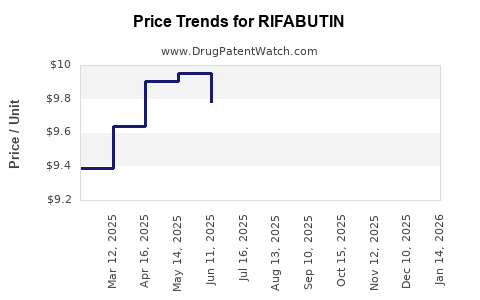
Financial implication: Revenue tends to follow net price more than volume once genericized options are on-formulary and supply is consistent.
Which companies manufacture rifabutin and how does competitive supply affect market stability?
Rifabutin supply stability matters because interruption can quickly disrupt specialty care regimens.
Competitive levers that influence market outcomes
- Manufacturing reliability and regulatory compliance (inspection outcomes affect continuity).
- Product filing strategy in each jurisdiction (national approvals vs centralized pathways).
- Ability to secure hospital formularies and specialty distributor listings.
Financial implication: When supply is tight, net pricing can temporarily improve; sustained stable competition drives down long-run net price.
What patents protect rifabutin, and when do key exclusivity cliffs occur?
Patent and exclusivity coverage for rifabutin is highly jurisdiction-specific and depends on:
- The original compound and early formulation patents (often expired),
- Any later patents on specific formulations, dosing regimens, or manufacturing methods,
- Regulatory exclusivities tied to specific approved product versions, including pediatric or data exclusivity.
Featured snippet answer: Rifabutin’s product exclusivity is typically dominated by older filings, and the market’s near-term competitive landscape usually reflects whether any late-cycle formulation or process patents still constrain generic entry in a given jurisdiction.
Patent estate that matters for market
- Product/formulation patents: control tablet/capsule composition, release profile, or stability claims.
- Method-of-use patents: control MAC prophylaxis regimens or TB/NTM treatment protocols.
- Manufacturing process patents: control steps that can be hard to design around.
Market implication: If only method-of-use patents survive while product equivalents are generically available, the market can still be priced aggressively but with potential prescribing restrictions where litigation or labeling design matters.
Constraint: A complete, accurate “patents protect rifabutin” map requires jurisdiction-level patent data (Orange Book listings in the U.S., EP registers, national registers elsewhere) and specific approved product identifiers. No drug product list or regulatory docket data is included here.
When does rifabutin lose exclusivity and what does that mean for generic launch risk?
Generic entry risk is tied to:
- Expired composition-of-matter patents,
- Any remaining formulation/process patents,
- Regulatory exclusivity tied to specific New Drug Applications (NDAs) or supplements (if applicable),
- Litigation status that can delay approval or distribution.
Generic launch scenarios
- Scenario A: fully genericized in a jurisdiction: market price compresses and revenue shifts to volume.
- Scenario B: “design-around” constrained by labeling or process: slower uptake, niche pricing support, and possibly higher pharmacovigilance burden.
- Scenario C: settlement-driven delay: entry timing can be extended by consent judgments or stays.
Financial implication: The biggest revenue shocks usually occur at approval and distribution transition points rather than gradually.
Constraint: A precise exclusivity/expiration timeline cannot be produced without the specific U.S. Orange Book listing(s), application numbers, and patent numbers for marketed rifabutin products in each relevant market.
What is the Orange Book status of rifabutin and which patents are listed for active ingredients/ingredients?
Orange Book status depends on:
- Whether rifabutin is covered under an NDA listing (and which strength, dosage form),
- Patent categories (drug substance, drug product, method-of-use),
- Listing expiration and any delisting history.
Featured snippet answer: Orange Book coverage is product-specific; the patent categories listed determine whether generics can enter with paragraph IV challenges, generic bioequivalence, or labeling carve-outs.
Constraint: No Orange Book listing identifiers or patent numbers were provided, so the Orange Book status cannot be stated accurately.
How strong is the patent estate for rifabutin on formulation and method-of-use?
Patent strength for rifabutin is typically evaluated on:
- Remaining claims that are not design-around (formulation/process),
- Whether method-of-use claims are actually enforceable given labeling constraints and safe-harbor factors,
- Whether courts treat combination/regimen claims as a meaningful infringement path.
Market-facing strength indicators
- Number of active, unexpired patents mapped to commercially relevant claims (not theoretical coverage).
- Litigation history and claim construction outcomes.
- Whether exclusivity is tied to the specific drug product route that generics must replicate.
Financial implication: Weak formulation/process protection means net price drops after generic entry. Strong method-of-use protection can preserve price if it restricts substitutions through labeling, but it is often harder to enforce broadly.
Constraint: Patent strength cannot be scored without the patent list and claim scope.
What rifabutin formulation patents affect generic bioequivalence and product switching?
Formulation patents that can matter include:
- Release profile modifications,
- Particle size or polymorph control,
- Stability/solubility claims that influence excipient choices,
- Manufacturing controls that affect dissolution and bioavailability.
Generic risk pathways
- If patents claim a specific formulation approach, generics may need to prove non-infringement or accept labeling changes.
- If patents are process-based only, the generic can pursue a different process to meet CMC equivalence.
Financial implication: Formulation differentiation is the main lever to delay price compression after patent expiration.
Constraint: No rifabutin formulation patent numbers are provided, so the formulation-specific protection map cannot be built.
Does rifabutin face paragraph IV challenges or ANDA litigation in the U.S.?
Paragraph IV litigation depends on active listed patents and the filing of generic ANDAs that claim non-infringement, invalidity, or non-violation.
What litigation changes commercially
- Settlement can delay launch dates.
- Court outcomes can either unlock rapid entry or keep exclusivity intact.
- Even when a generic wins, labeling design can limit substitution.
Featured snippet answer: Paragraph IV activity is the most direct driver of pre-launch market turbulence for rifabutin; absent active litigation data, the commercial impact cannot be quantified here.
Constraint: Without ANDA case numbers, patent numbers, or docket outcomes, paragraph IV litigation status cannot be stated accurately.
What is rifabutin’s regulatory status across FDA pathways and key global markets?
Rifabutin is an established therapy; pathways for generics typically involve ANDAs, while new reformulations may use 505(b)(2) in the U.S. or national equivalents in other jurisdictions.
Regulatory dynamic that impacts revenue
- Approval timing influences generic entry.
- Post-approval labeling changes can change payer and clinician comfort, affecting formulary adoption speed.
- Changes to packaging, strengths, or excipients can trigger substitution delays even after therapeutic equivalence is approved.
Constraint: No specific FDA listing, application numbers, or EU/UK national approvals were provided, so a pathway map cannot be stated.
How does rifabutin compare with alternative drugs in MAC prophylaxis and TB regimens?
Competitive substitution matters for volume because even where rifabutin is clinically used, other agents can displace it depending on:
- Drug-drug interaction profile with antiretrovirals,
- Tolerability,
- Guideline recommendations and local resistance patterns.
Substitution intensity
- In mature HIV markets, MAC prophylaxis is influenced by ART regimen success and immune recovery.
- For TB, selection often hinges on rifamycin compatibility, tolerance, and adherence.
Financial implication: If payers or clinicians shift toward alternative prophylaxis approaches, rifabutin volume declines independent of generic price.
Constraint: Drug-by-drug comparison requires a defined comparator set and data on relative prescribing share; none is provided here.
What are generic entry risks for rifabutin by geography and dosage form?
Geographic entry risk depends on:
- Regulatory approval status for each market,
- Local patent enforceability and litigation duration,
- Tender and hospital procurement rules,
- National reimbursement systems.
Dose-form sensitivity
- Tablets vs capsules can affect switching if packaging sizes or strengths differ.
- Pediatric suitability influences formulary inclusion in some markets.
Financial implication: Entry in high-volume geographies drives global benchmarks and can pull down cross-border pricing, especially through cross-licensing and procurement alignment.
Constraint: Geography-by-geometry approval data is not provided, so the entry risk map cannot be completed.
How do supply chain and manufacturing quality events change rifabutin financial trajectory?
Rifabutin demand is relatively inelastic for patients already on therapy, but switching requires regulatory and procurement readiness.
Typical financial effects of supply disruptions
- Short-term price spikes where shortages trigger emergency sourcing.
- Longer-term loss of channel relationships if distributors lose confidence.
- Contract renegotiation in tender systems.
Quality events
- FDA or EMA warning letters, import alerts, or manufacturing site actions can suspend shipments.
- The resulting temporary “brand-favoring” dynamics usually reverse once supply normalizes.
Financial implication: Supply risk can create temporary upside but also can damage continuity of care and future contracting power.
Key takeaways
- Rifabutin’s financial trajectory is driven by specialty demand in HIV/MAC prophylaxis and defined ID/TB regimen use, not by mass-market uptake.
- In mature HIV markets, volume is structurally pressured by ART-driven immune recovery, making pricing and channel contracting the main determinant of revenue stability.
- The largest commercial inflection points come from generic entry timing, which depends on jurisdiction-level patent and litigation status, including formulation/process constraints and any method-of-use labeling enforcement.
- Supply continuity affects net price and contracting, creating episodic revenue variability.
FAQs
1) Is rifabutin primarily used for MAC prophylaxis or for TB/NTM treatment?
Primarily MAC prophylaxis in advanced HIV, with use in defined components of TB/NTM regimens depending on clinical criteria and guideline positioning.
2) What drives rifabutin demand in the U.S. relative to global markets?
U.S. demand is influenced by HIV cohort risk thresholds, specialty prescribing, and payer formulary decisions; global demand adds procurement and guideline differences.
3) Does rifabutin pricing depend more on volume or on net price after generic entry?
Net price typically dominates once equivalent generics are on-formulary and substitution is operational, while volume is comparatively steadier for treated cohorts.
4) Can method-of-use patents keep rifabutin pricing protected even after composition patents expire?
They can, but impact depends on enforceability, labeling constraints, and whether substitution is blocked through prescription and reimbursement behavior.
5) What is the biggest operational risk for rifabutin manufacturers?
Manufacturing and supply continuity, because interruptions in specialty regimens can quickly disrupt contracting and channel trust.
References
- FDA. Orange Book: Approved Drug Products with Therapeutic Equivalence Evaluations. U.S. Food and Drug Administration.
- EMA. European public assessment reports (EPARs) and related product information for rifabutin-containing medicines. European Medicines Agency.
- World Health Organization. Guidelines and updates on HIV-related opportunistic infections and tuberculosis management (including rifamycin selection considerations where applicable). World Health Organization.