Last updated: August 12, 2026
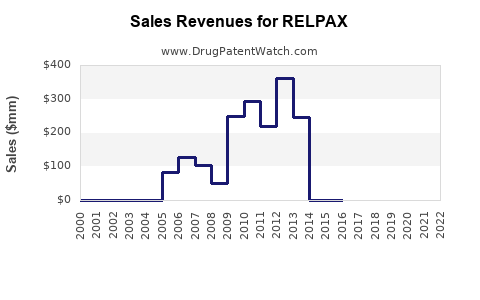
Relpax, Pfizer’s brand of eletriptan hydrobromide, is a mature prescription migraine product with limited remaining commercial value. FDA approval began in 2002, generic eletriptan entered the U.S. market in the mid-2010s, and Pfizer does not report Relpax revenue as a standalone product in its public financial filings. The product’s financial trajectory is therefore best characterized as a transition from branded launch growth to post-patent erosion and low-value legacy sales.
What is Relpax and how does it work?
Relpax is the brand name for eletriptan hydrobromide, an oral selective serotonin 5-HT1B/1D receptor agonist, commonly called a triptan. It is approved for the acute treatment of migraine with or without aura in adults. It is not indicated for migraine prevention.
Relpax is available in 20 mg and 40 mg tablets. The recommended starting dose is generally 40 mg, with a maximum daily dose of 80 mg under the FDA labeling framework. Its principal clinical differentiation was stronger 5-HT1B/1D receptor affinity and relatively favorable central nervous system penetration compared with some earlier triptans.
The product carries class-related cardiovascular warnings. It is contraindicated in patients with certain coronary, cerebrovascular, peripheral vascular, or uncontrolled hypertensive conditions and must not be used with ergot derivatives or another triptan within specified intervals.[1]
When did Relpax launch and lose market exclusivity?
| Milestone |
Date |
Commercial significance |
| U.S. FDA approval |
December 2002 |
Relpax entered the U.S. acute migraine market |
| Pfizer ownership |
2003 onward |
Pfizer obtained the product through its acquisition of Pharmacia |
| Mature branded-market period |
2000s to early 2010s |
Competed with branded triptans, especially Imitrex and Maxalt |
| Core patent expiry period |
Early-to-mid 2010s |
Removed the principal composition-of-matter barrier |
| U.S. generic entry |
Mid-2010s |
Initiated substantial price and volume substitution |
| Current commercial position |
2020s |
Legacy brand with limited strategic importance |
Relpax lost effective U.S. exclusivity after the expiration of its core patent estate and the approval of generic eletriptan products. Public FDA records identify generic eletriptan hydrobromide tablets from multiple manufacturers, including Teva Pharmaceuticals and other abbreviated new drug application sponsors.[2]
The precise economic impact of expiry was larger than the legal expiry date alone suggests. Once several generic suppliers entered, pharmacy benefit managers and wholesalers gained negotiating leverage. Relpax’s branded price became difficult to defend because generic eletriptan offered the same active ingredient, strength, dosage form, and route of administration.
What patents protect Relpax and eletriptan?
Relpax is no longer protected by a commercially meaningful U.S. patent barrier. The original eletriptan patent estate covered the active compound and related pharmaceutical uses. Those rights expired before or around the period when U.S. generic approvals became commercially relevant.
Composition-of-matter protection
The primary protection was directed to eletriptan and related chemical compounds in the triptan class. Composition patents typically provide the strongest exclusivity because generic applicants must either wait for expiry or challenge the patent through a Paragraph IV certification.
The core U.S. composition protection for eletriptan has expired. No current composition patent prevents routine generic substitution.
Formulation patents
Relpax is an immediate-release oral tablet rather than a complex delivery system. Formulation protection has limited strategic importance because generic applicants can generally develop conventional tablets without reproducing Pfizer’s inactive-ingredient profile, tablet appearance, or manufacturing process.
No publicly important extended-release, injectable, transdermal, or orally disintegrating Relpax formulation has become a major commercial barrier.
Method-of-use patents
Relpax’s principal FDA indication is acute migraine treatment. Method-of-use rights for that indication have either expired or do not create a material barrier to generic eletriptan distribution. Generic applicants can market the drug for the approved use after applicable patent and regulatory restrictions lapse.
Unlike products with narrow patented subpopulations, biomarker-defined uses, or complex dosing regimens, eletriptan has limited opportunity for durable method-of-use exclusivity.
What is the Orange Book status of Relpax?
The FDA Orange Book historically listed Relpax under NDA 021016. The relevant legal protections were associated with the original branded product and expired patent rights. The commercial result is that generic eletriptan tablets can be approved and substituted under state pharmacy laws, subject to individual product ratings and state substitution rules.[3]
The Orange Book does not create exclusivity by itself. It records FDA-approved products, therapeutic equivalence information, and listed patents. For Relpax, the practical conclusion is that Orange Book-listed protection no longer supports a meaningful branded monopoly.
Relpax also does not present a biosimilar issue. It is a synthetic small-molecule drug, not a biologic. Competitive risk comes from abbreviated new drug applications and generic substitution, not from biosimilar applications under the Public Health Service Act.
How did generic eletriptan change Relpax’s market dynamics?
Generic entry changed Relpax from a differentiated branded prescription into a price-sensitive commodity.
The principal effects were:
- Lower average selling prices.
- Reduced formulary preference for Relpax.
- Substitution toward generic eletriptan.
- Greater use of competing low-cost triptans.
- Lower return on brand-support and sales-force investment.
Relpax also faced a market with several already-generic triptans. Sumatriptan, rizatriptan, naratriptan, zolmitriptan, and frovatriptan created therapeutic alternatives before or around the time eletriptan became generic. The product therefore did not retain a large protected niche after patent expiry.
How does Relpax compare with competing migraine drugs?
| Product |
Active ingredient |
Drug class |
Market status |
Competitive position |
| Relpax |
Eletriptan |
Triptan |
Brand legacy product; generic available |
Limited differentiation after expiry |
| Imitrex |
Sumatriptan |
Triptan |
Brand and generic |
Large historical installed base |
| Maxalt |
Rizatriptan |
Triptan |
Brand and generic |
Strong historical oral triptan competitor |
| Frova |
Frovatriptan |
Triptan |
Generic-dominated |
Longer half-life, useful for some patients |
| Ubrelvy |
Ubrogepant |
CGRP receptor antagonist |
Branded |
Non-vasoconstrictive alternative |
| Nurtec ODT |
Rimegepant |
CGRP receptor antagonist |
Branded |
Acute and preventive positioning |
| Reyvow |
Lasmiditan |
5-HT1F agonist |
Branded |
Alternative for selected patients |
The most important strategic shift is the rise of CGRP-targeted drugs. Ubrogepant and rimegepant provide non-triptan options, particularly for patients who do not respond to triptans, cannot tolerate vasoconstrictive agents, or have cardiovascular contraindications. Their branded pricing and payer access remain different from generic eletriptan, but they reduce the long-term growth potential of the triptan category.[4]
Relpax retains clinical utility where patients respond well to eletriptan and have access to inexpensive generic treatment. That utility does not translate into substantial branded pricing power.
What is Relpax’s financial trajectory?
Pfizer does not disclose Relpax revenue, gross margin, prescription volume, or operating profit as separate line items in its annual reports. The company reports revenue by operating segment and selected products, but Relpax is not presented as a material standalone contributor in recent filings.[5]
The product’s likely financial trajectory has four phases:
Launch and adoption: 2002 to the late 2000s
Relpax entered a growing migraine market with a differentiated triptan profile and Pfizer’s commercial infrastructure. Sales benefited from physician familiarity with the triptan class and the expansion of prescription treatment for acute migraine.
Maturity: late 2000s to early 2010s
The product reached maturity as migraine prescribing became distributed across several triptans. Promotional differentiation narrowed, and payers increasingly emphasized generic alternatives.
Patent-loss erosion: mid-2010s
Generic eletriptan materially reduced the addressable branded revenue pool. Price erosion was likely more severe than volume erosion because patients could continue using the same active ingredient through generic products.
Legacy phase: late 2010s through the 2020s
Relpax is now economically similar to other off-patent branded medicines. Remaining revenue may come from brand-loyal prescribers, patients who request the original product, residual retail availability, and markets where generic substitution is incomplete. These channels are insufficient to support major Pfizer investment.
A reasonable commercial classification is:
- No longer a growth product.
- No meaningful patent-protected revenue.
- Low strategic priority for Pfizer.
- Persistent but declining demand for the active ingredient.
- Greater value in generic eletriptan than in the Relpax brand.
Which companies are challenging Relpax through generic competition?
Generic competition comes from ANDA sponsors rather than biosimilar developers. Public FDA drug databases identify approved generic eletriptan products from multiple manufacturers over time. The competitive set has included Teva Pharmaceuticals and other generic-drug companies operating under U.S. abbreviated approval pathways.[2]
The competitive threat is structurally high because:
- The product is an immediate-release tablet.
- The active ingredient is chemically defined.
- No device is required.
- No cold chain is required.
- Manufacturing technology is conventional.
- Clinical efficacy can be demonstrated through bioequivalence rather than a new efficacy trial.
- Several generic suppliers can compete on the same dosage strengths.
These characteristics reduce manufacturing and intellectual-property barriers.
Were there Paragraph IV challenges or Relpax patent settlements?
Generic applicants could use Paragraph IV certifications to challenge listed Relpax patents before their expiration. Publicly available product-level sources do not establish a commercially significant, ongoing Paragraph IV settlement that continues to restrict generic eletriptan access.
The absence of a current settlement barrier is consistent with the market outcome: generic eletriptan is available, Relpax patents are expired, and no branded exclusivity mechanism is materially delaying substitution.
What is the FDA regulatory status of Relpax?
Relpax remains an FDA-approved prescription medicine under its original NDA framework. The FDA-approved indication is acute treatment of migraine with or without aura in adults. Generic eletriptan tablets are approved through the ANDA pathway and are therapeutically equivalent to the relevant reference product when assigned an FDA substitutability rating.[1][2]
Regulatory risks are routine rather than transformational:
- Labeling updates for cardiovascular warnings.
- Manufacturing and quality compliance.
- Generic supply continuity.
- Product discontinuation or limited brand availability.
- Pharmacy-level substitution practices.
There is no biologic comparability issue, no REMS-driven barrier of major commercial significance, and no complex generic-device requirement.
What generic launch scenarios exist for Relpax?
The generic launch phase has already occurred in the United States. The relevant current scenarios are commercial rather than legal:
Base case
Generic eletriptan retains most price-sensitive demand, while Relpax remains a small branded niche. Pfizer records little or no separately material revenue.
Downside case for the brand
Additional generic suppliers or aggressive contracting produce further price compression and reduce brand availability. Patients shift to generic eletriptan or lower-cost triptans.
Stable legacy case
Relpax maintains limited demand among patients and physicians who prefer the original brand. Volume remains small, but the product stays commercially available in selected channels.
Upside case
A material branded rebound would require a new indication, major formulation improvement, payer-supported differentiation, or a licensing transaction. None is evident in the established product profile.
What licensing deals affect Relpax?
Relpax entered Pfizer’s portfolio through the company’s acquisition of Pharmacia. No major current licensing transaction has made Relpax a growth asset or restored branded exclusivity.
The product is not an attractive licensing target under normal pharmaceutical valuation criteria because:
- Core patent protection has expired.
- Generic substitutes are available.
- The dosage form is conventional.
- Competing triptans are widely available.
- CGRP therapies occupy the main innovation segment.
- Product-level revenue is not separately reported by Pfizer.
A transaction involving Relpax would more likely concern a regional commercial-rights transfer, legacy product portfolio sale, or generic supply arrangement than a strategic innovation license.
How strong is the Relpax patent estate?
| Factor |
Assessment |
| Core composition patent |
Expired |
| Formulation protection |
Limited commercial relevance |
| Method-of-use protection |
No material current barrier |
| Orange Book leverage |
Historical, not commercially decisive today |
| Generic substitution risk |
High |
| Biosimilar risk |
Not applicable |
| Manufacturing barrier |
Low to moderate |
| Geographic exclusivity |
Market-specific and largely exhausted in major markets |
| Current patent strength |
Weak |
The estate has residual historical importance but little present-day defensive value. Relpax does not have the patent characteristics associated with durable pharmaceutical cash flows, such as layered formulation patents, device claims, manufacturing complexity, or multiple unexpired indications.
What revenue exposure does Relpax create for Pfizer?
Relpax is unlikely to create material revenue exposure for Pfizer relative to the company’s major products. Pfizer’s financial performance is driven by large vaccines, oncology products, immunology medicines, hospital products, and other global brands. Relpax is not separately identified as a material product in recent Pfizer reporting.[5]
The financial implications are therefore asymmetric:
- Pfizer’s downside from further Relpax erosion is limited.
- Generic manufacturers gain a larger share of remaining eletriptan demand.
- Pharmacy benefit managers benefit from lower acquisition costs.
- Patients may gain lower out-of-pocket prices.
- Pfizer has little incentive to fund substantial new Relpax development.
Key Takeaways
- Relpax is Pfizer’s brand of eletriptan hydrobromide for acute migraine treatment.
- FDA approval dates to December 2002.
- Generic eletriptan entered the U.S. market in the mid-2010s.
- Core patent protection has expired, and no material current Orange Book barrier remains.
- Relpax is a small-molecule drug, so biosimilar risk does not apply.
- Generic substitution and competing low-cost triptans have driven post-expiry erosion.
- CGRP drugs, including ubrogepant and rimegepant, provide newer branded alternatives.
- Pfizer does not report Relpax revenue separately, preventing a product-level revenue series from public financial statements.
- The brand is best classified as a mature legacy asset with low current patent strength and limited strategic upside.
- The remaining commercial value lies primarily in generic eletriptan demand, not in the Relpax brand.
FAQs About Relpax Patents, Revenue, and Generic Competition
Is Relpax still sold in the United States?
Relpax remains an FDA-approved product, but its commercial presence is substantially smaller than during its branded exclusivity period. Generic eletriptan is the principal low-cost substitute.
What is the generic name for Relpax?
The generic name is eletriptan hydrobromide. Generic products are generally marketed as eletriptan hydrobromide tablets in 20 mg and 40 mg strengths.
Can a generic manufacturer launch eletriptan without Pfizer’s permission?
Yes. Once applicable patents and regulatory exclusivities expired, manufacturers could seek FDA approval through the ANDA pathway. An approved generic does not require a license from Pfizer to market the same active ingredient.
Does Relpax have pediatric exclusivity?
Relpax’s original U.S. exclusivity history included the regulatory protections applicable at the time of approval. Any pediatric extension associated with historical patents would have expired and does not create a current market barrier.
Is eletriptan commercially stronger than sumatriptan?
No broad commercial conclusion supports that view. Sumatriptan has a larger historical market presence and extensive generic availability. Eletriptan may be preferred by individual patients based on response, tolerability, onset, recurrence, and prescriber experience, but those factors do not create durable brand-level pricing power.
References
- U.S. Food and Drug Administration. (2023). Relpax: Prescribing information. https://www.accessdata.fda.gov/drugsatfda_docs/label/2023/021016s020lbl.pdf
- U.S. Food and Drug Administration. (n.d.). Drugs@FDA: FDA-approved drugs. https://www.accessdata.fda.gov/scripts/cder/daf/
- U.S. Food and Drug Administration. (n.d.). Approved drug products with therapeutic equivalence evaluations, Orange Book. https://www.fda.gov/drugs/drug-approvals-and-databases/approved-drug-products-therapeutic-equivalence-evaluations-orange-book
- American Headache Society. (2021). The American Headache Society consensus statement: Update on integrating new migraine treatments into clinical practice. Headache, 61(7), 1021-1039. https://doi.org/10.1111/head.14153
- Pfizer Inc. (2024). 2023 annual report. https://www.pfizer.com/investors/financial-reports/annual-reports-insurance-filings