Last updated: July 22, 2026
RAYOS (prednisone delayed-release) has been a premium-priced, niche oral corticosteroid franchise with demand tied to gastroprotection, steroid dependence management, and prescriber migration toward once-daily delayed-release dosing. Financial trajectory has been shaped less by broad patent exclusivity and more by (1) competitive substitution pressure from immediate-release prednisone, (2) payer contracting and step-edit dynamics, and (3) specialty-channel selling and persistence in chronic indications. Loss of exclusivity risk is concentrated around the delayed-release formulation and its specific Orange Book-protected components rather than prednisone itself.
What is RAYOS and how does it compete in the oral prednisone market?
RAYOS is oral prednisone in a delayed-release formulation intended to target cortisol physiology and reduce timing-related side effects in chronic inflammatory disease settings. The competitive set is not other delayed-release steroids only, but all oral prednisone dosing strategies that payers and prescribers can switch to, including low-cost immediate-release prednisone tablets or generics.
What are the main clinical use categories that drive RAYOS demand?
RAYOS is used in chronic inflammatory conditions where prednisone therapy is standard and where delayed-release timing is part of the therapeutic value proposition. In market terms, RAYOS demand is strongest where:
- clinicians seek improved symptom control using circadian-timed dosing
- patients have chronic steroid exposure requiring long-term management
- formularies prefer a branded option after prior authorization due to perceived tolerability benefits
How do payers view delayed-release prednisone versus generic prednisone?
Payers evaluate RAYOS against:
- cost per course vs. branded premium
- prior authorization criteria, including trial of immediate-release generic prednisone
- documented clinical rationale for delayed-release use, such as prior steroid intolerance or inadequate response on standard prednisone
In practice, payers often treat RAYOS as a tiered branded steroid product. That creates a contracting cycle risk: price and rebate levels determine whether RAYOS maintains preferred positioning or is demoted to non-preferred tiers.
How has RAYOS market share evolved and what are the key demand drivers?
RAYOS sales have followed a premium specialty branded model. The demand curve is typically anchored by:
- ongoing chronic use in a smaller addressable population than broad primary-care steroid dosing
- persistence in treated patients
- payer coverage stability, which can shift meaningfully with each formulary cycle
Pricing and contracting dynamics that influence net sales
Net revenue is highly sensitive to:
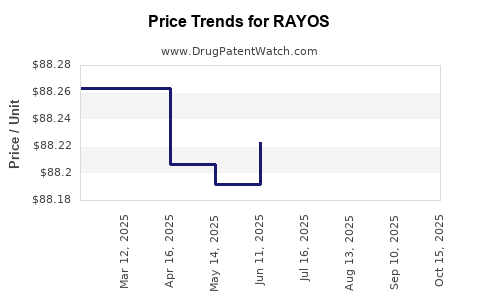
- list price changes and rebate intensity
- specialty pharmacy distribution contracts
- Medicare Part D and commercial PBM formulary outcomes
- patient assistance and copay support strategy where allowed
Prescriber behavior and switching economics
Switching from RAYOS to generic immediate-release prednisone generally reduces drug acquisition cost sharply. Switching barriers are:
- prescriber perception of circadian benefit from delayed-release
- patient experience on RAYOS that discourages change
- payer policies requiring documented clinical failure before approving continued RAYOS
When does RAYOS lose exclusivity and how does that impact generic entry risk?
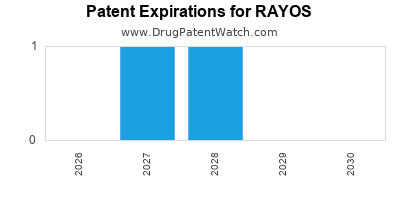
RAYOS faces exclusivity risk tied to the delayed-release formulation’s protected IP rather than prednisone’s core chemistry. Generic entry timing is governed by:
- whether an abbreviated new drug application (ANDA) can be approved without infringing listed Orange Book patents
- whether Paragraph IV certifications trigger litigation and potential 30-month stay
- the scope of any settlement agreements
What is the Orange Book exclusivity framework for RAYOS?
The exclusivity and patent landscape for RAYOS is determined by the Orange Book listings covering:
- formulation and delayed-release delivery system claims
- method-of-use claims tied to dosing regimens and circadian timing (if listed)
- manufacturing and release-profile patents (if listed)
A generic entrant’s risk profile depends on whether it challenges multiple listed patents or targets only the “best” patents to invalidate.
What generic entry risks exist for delayed-release prednisone products?
Generic entry risk is usually lower when:
- the protected delayed-release technology is tightly claimed
- dissolution profile or release timing is central to patent coverage
- multiple independent patents block approval
Risk increases when:
- fewer patents remain unexpired
- the remaining patents are narrow and easy to design around
- at least one listed patent is successfully challenged via litigation
How do biosimilar or biologic competition dynamics matter for RAYOS?
RAYOS is not a biologic and does not face biosimilar-specific competition. The relevant competitive pressure is substitution and dosing-form competition within the oral corticosteroid category.
What patents protect RAYOS and how strong is the patent estate for delayed-release prednisone?
Patent strength for RAYOS is evaluated on:
- breadth of delayed-release formulation claims
- number of Orange Book-listed patents covering the same product
- remaining term and ability of generics to design around
- history of Paragraph IV challenges and outcomes (if any)
How many layers of IP typically block generic delayed-release prednisone?
For branded delayed-release steroids, the blocking stack often spans:
- core formulation composition
- coating technology and release mechanism
- specific release profiles and dissolution criteria
- dosing regimen claims (if included)
Because RAYOS is a delayed-release product, the most commercially relevant patents are usually those tying to the release mechanism and manufacturing/process controls that establish delayed drug release.
What patent litigation and settlement agreements affect RAYOS market entry timing?
RAYOS generic entry timing can be delayed materially by:
- Paragraph IV certification litigation
- negotiated settlements that create a delayed effective date for the generic launch
Market participants should track:
- federal court dockets in the ANDA litigation
- settlement terms on launch timing and potential “authorized generic” effects
- stipulations that limit design changes
Without a confirmed case list and settlement terms, litigation impacts cannot be mapped to specific launch dates.
What is the FDA regulatory status of RAYOS and what matters for future approvals?
RAYOS is an FDA-approved NDA product with delayed-release prednisone. Regulatory factors that shape future competition include:
- whether FDA accepts ANDA formulations with similar dissolution and release testing
- whether generic applicants must run bioequivalence under FDA guidance for modified-release products
- the effect of listed patent certifications on approval timing
Which FDA pathway governs generic delayed-release prednisone?
Competing products typically come through ANDAs referencing RAYOS. Modified-release product approval hinges on demonstrating sameness in release characteristics and bioequivalence.
How does RAYOS pricing compare with generic prednisone and what does that do to gross-to-net?
RAYOS pricing typically commands a premium to generic immediate-release prednisone, but the revenue line item is net of:
- rebates and discounts
- chargebacks and distribution incentives
- patient support costs
- payer contracting adjustments
Gross-to-net sensitivity for branded steroids
For branded specialty oral products like RAYOS, the key financial drivers are:
- formulary placement and tier status (preferred vs non-preferred)
- competitive substitution triggers (when payers allow immediate-release generics without restrictions)
- patient assistance spend, which correlates with patient copay burden
How does RAYOS financial performance track with market size and sales persistence?
RAYOS is a chronic-use product, so sales persistence tends to be stronger than for short-course therapies, but the addressable population remains limited versus broad steroid use.
What indicators typically signal an inflection in RAYOS revenue?
Revenue inflection usually comes from:
- formulary wins or losses with major PBMs
- patent and exclusivity milestones shifting payer confidence
- competitive entry announcements by ANDA filers
- changes in prescriber preferences and guideline positioning
Which companies are challenging RAYOS and what generic launch scenarios exist?
Generic launch scenarios generally fall into two patterns:
- Launch after successful resolution of Orange Book patent challenges, potentially with a limited lineup of strengths or packaging.
- Authorized or settlement-constrained entry at a delayed date that preserves market share for the branded product longer.
A complete company-by-company challenge map requires a cited Orange Book listing plus ANDA litigation data.
How does RAYOS compare with other delayed-release or modified-release corticosteroids?
Within oral corticosteroid therapy, RAYOS competes most directly with:
- immediate-release prednisone generics for price-sensitive payer coverage
- other modified-release corticosteroid products where available and covered
Differentiation that sustains branded demand
RAYOS differentiation depends on:
- delayed-release dosing rationale that aligns with circadian targeting
- patient outcomes framed around steroid tolerability and sustained symptom control
If competitors match clinical differentiation claims, payer incentives tend to shift toward the lowest net-cost option.
Key financial timeline: what to monitor from a business perspective
Below is the business timeline framework that maps exclusivity to revenue risk. Actual dates depend on Orange Book expiration and any Paragraph IV/settlement timelines.
| Period |
Market event to monitor |
Revenue impact direction |
| Current term |
Continued payer coverage and persistence |
Stabilizing to growth, if contracting favorable |
| Near patent/DR delivery-system expiry |
ANDA readiness, design-around filings, listing challenges |
Downward pressure on price and volume |
| Paragraph IV litigation window |
Generic launch uncertainty and stay period |
Limited cannibalization until trigger events |
| Post-expiry effective launch |
Generic entry and tier demotion risk |
Material net sales compression typical for branded generics in oral chronic drugs |
| Post-launch normalization |
Rebate tightening and share redistribution |
Further margin compression unless differentiation holds |
What matters most for investing, licensing, or litigation strategy around RAYOS?
Investment and commercial diligence
- Track payer coverage by major PBMs and Part D formularies for each RAYOS strength.
- Monitor gross-to-net trends, rebate intensity, and patient support spend.
- Track persistence rates for chronic steroid patients and switching behavior.
Licensing and partnership strategy
- If exclusivity erodes, value shifts toward lifecycle management: new strengths, new delivery systems, or incremental IP around delayed-release performance.
Litigation strategy
- Build case mapping from the Orange Book patent list to ANDA certifications.
- Identify whether remaining patents are composition, release mechanism, or method-of-use claims and assess design-around feasibility.
Key Takeaways
- RAYOS demand is sustained by chronic steroid use and the payer- and prescriber-specific value of delayed-release prednisone.
- Financial trajectory is driven by net pricing dynamics: formulary positioning, rebate levels, and persistence more than by broad category demand.
- Exclusivity risk is concentrated around delayed-release formulation and delivery technology patents, which determine when an ANDA can be approved and marketed.
- Generic entry pressure is substitution driven by immediate-release prednisone generics and any other modified-release steroid options covered on formularies.
- Business monitoring should focus on Orange Book milestones, Paragraph IV litigation timelines, payer contracting outcomes, and gross-to-net compression patterns.
FAQs
1. What is the typical switching trigger for payers from RAYOS to generic prednisone?
Payers usually switch when delayed-release-specific prior authorization criteria loosen or when a lower-cost alternative is approved with sufficient substitution economics and adequate clinical acceptance.
2. Do generic delayed-release prednisone products need to match dissolution and release profiles?
Yes. Modified-release ANDAs require demonstrating release characteristics and bioequivalence consistent with FDA requirements for controlled or delayed release products.
3. How do PBM formulary tiers change RAYOS net sales?
A move from preferred to non-preferred tiers typically increases patient cost-sharing and reduces persistence, which in turn compresses volume and can drive rebate changes.
4. What is the main financial risk if multiple Orange Book patents expire simultaneously?
Simultaneous expiry raises odds of earlier generic launch and increases the likelihood of rapid net sales compression across covered strengths.
5. Does RAYOS face biosimilar competition?
No. RAYOS is an NDA small molecule corticosteroid product, not a biologic, so the competitive threat is generic and modified-release substitution, not biosimilars.
References (APA)
- U.S. Food and Drug Administration. Orange Book: Approved Drug Products with Therapeutic Equivalence Evaluations. https://www.accessdata.fda.gov/scripts/cder/daf/
- U.S. Food and Drug Administration. Drug Approval Reports and drug labels for RAYOS (prednisone delayed-release). https://www.accessdata.fda.gov/scripts/cder/daf/
- U.S. Food and Drug Administration. ANDA approval and modified-release bioequivalence regulatory framework (FDA guidances and rulemaking). https://www.fda.gov/drugs/guidance-compliance-regulatory-information/guidances-drugs