Last updated: July 27, 2026
Quinine sulfate is a long-established anti-malarial and off-label antipyretic/legitimating therapy with a market profile dominated by legacy generic supply, sporadic specialty demand, and periodic safety and supply shocks. Financial trajectory is typically characterized by low unit value, thin margins in mature generics, and limited upside unless a distinct formulation or constrained supply creates pricing events. In recent years, market behavior has been shaped less by patent-driven exclusivity and more by supply availability, FDA and state-level scrutiny, and substitution dynamics across antimalarials and symptomatic therapies.
How big is the quinine sulfate market, and what drives demand?
Short answer: Demand tracks malaria epidemiology, anti-malarial formulary access, and episodic demand for symptoms in endemic and high-risk traveler settings. In non-malarial indications, demand is more fragmented and frequently captured by alternative therapies.
Demand pillars that move volumes
-
Malaria prevention and treatment access
- Quinine sulfate demand is sensitive to malaria case burden in endemic regions and to traveler prophylaxis behavior.
- Replacement by artemisinin-based combination therapies (ACTs) for uncomplicated malaria reduces addressable treatment share in many markets.
-
Non-malarial symptomatic use
- In high-income markets, quinine sulfate use for nocturnal leg cramps and related “restless legs/cramp” symptom clusters has historically been inconsistent and increasingly constrained by safety messaging and shifting clinical preference toward alternatives.
- Demand in these segments is typically intermittent and small relative to anti-malarial channels.
-
Institutional procurement and substitution
- Mature generic status makes quinine sulfate sensitive to contract pricing and substitution decisions by hospital pharmacy and distributor channels.
- Procurement cycles can create sharp swings in short-term demand and inventory.
What are the biggest near-term demand risks?
- Substitution to newer antimalarials: ACTs and other regimens displace quinine in many treatment protocols.
- Safety communication spillover: Any renewed regulatory or labeling attention can reduce prescribing even where use is still allowed.
- Supply availability: Shortages or quality events can cause temporary rationing that shifts purchases across channels and delays reorder cycles.
What is the pricing and margin structure for quinine sulfate generics?
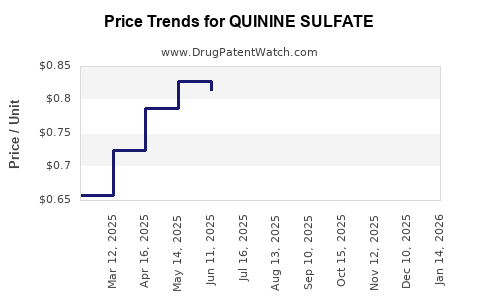
Short answer: Pricing is usually anchored to mature generic contracting, with margin compression driven by multiple supplier availability, distributor rebates, and periodic raw-material or manufacturing constraints.
Typical market mechanics
- Generic price erosion: Multiple ANDA entrants over time push down ASP/wholesale acquisition price versus branded history.
- Inventory-led pricing events: When supply tightens, buyers accept higher pricing briefly, then revert once supply normalizes.
- Portfolio switching: Buyers often keep quinine sulfate on formulary as a low-cost option but switch to alternatives when formulary rules or supply reliability change.
Where can pricing power still appear?
- Quality-constrained supply: If a limited number of GMP lines can produce the specific strength/dosage form, outages can create temporary pricing leverage.
- Channel substitution friction: Some procurement systems are slow to replace a long-standing SKU, especially when therapeutic interchange would require protocol updates.
How does FDA and regulatory oversight affect financial performance?
Short answer: Regulatory scrutiny impacts prescribing, demand, and procurement confidence, even when the product remains on-label for certain uses and in off-label practice.
Key regulatory factors that translate into money
- Labeling and safety communications: Any changes that narrow acceptable use for certain indications reduce demand in those segments.
- Manufacturing compliance: FDA warning letters, import alerts, or quality inspection outcomes can cut supply and temporarily raise wholesale prices.
- Drug shortage dynamics: If quinine sulfate appears on shortage lists or experiences constrained production, revenue can spike per unit but total volume can remain limited.
Orange Book and patent relevance to commercial trajectory
Quinine sulfate is typically treated as a mature generic product where the principal financial drivers are:
- supply chain reliability,
- generic competition intensity,
- and regulatory access to manufacturing markets,
rather than patent exclusivity or new formulation monopolies.
What patents protect quinine sulfate, and does the patent estate influence exclusivity?
Short answer: Quinine sulfate’s commercial trajectory is largely not driven by current patent exclusivity in most markets, because the active ingredient and basic therapeutic uses date to earlier eras and the market is dominated by generics.
How patent status typically affects the market
- Active ingredient has legacy status: New entrant barriers are typically regulatory and manufacturing quality rather than patent.
- If any formulation or method-of-use patents exist in particular product lines, their economic impact is usually limited to specific dosage forms (for example, specialty liquid preparations) and to the time remaining on those patents.
Practical implication for financial modeling
- Revenue forecasts should model supply and competition more than generic entry delay.
- Where niche formulations exist, upside comes from limited supplier capability rather than patent blockade.
When does quinine sulfate lose exclusivity, and what generic entry risks exist?
Short answer: For quinine sulfate, the market is commonly in a post-exclusivity state in most geographies where generics have been available for years. “Loss of exclusivity” is usually a non-event for the active ingredient itself, with the larger risks being manufacturing outages and regulatory entry barriers.
What generic launch risks still matter?
- ANDA approval lead times
- Even after patent expiry, entrants must pass quality and bioequivalence requirements.
- CMC and site readiness
- Many failed launches occur at the manufacturing readiness stage.
- Supply contracts and distributor relationships
- New products struggle to displace incumbents without contract placement.
What formulation types and strengths drive competitive advantage?
Short answer: Competitive outcomes are usually determined by dosage form availability and supply continuity: tablets, oral solids, and in some cases liquid preparations.
Formulation and commercial relevance
- Oral solid supply consistency tends to support steady institutional demand.
- Liquid or pediatric-appropriate forms can be more vulnerable to manufacturing disruptions and therefore can experience more noticeable pricing volatility.
- Stability and packaging configuration influences distributor willingness to stock.
How do procurement, shortages, and logistics shape revenue swings?
Short answer: Quinine sulfate revenue often reflects shortage-driven reorder cycles and contract repricing more than organic growth.
Supply chain variables that move the P&L
- API availability and cost: Input costs can briefly affect pricing and margins.
- Batch release timing: Regulatory release delays shift shipments and revenue recognition timing.
- Transportation and inventory positioning: Bulk inventory reduces near-term shortages but increases working-capital needs.
Which companies are the most relevant suppliers, and how does competition affect market share?
Short answer: The quinine sulfate market is dominated by established generic manufacturers and labelers with stable manufacturing sites and distributor relationships.
What to look for in a competitive scoreboard
- Number of active suppliers per dosage form and strength.
- Evidence of recurring shortages or stockouts tied to specific labelers.
- Distributor availability and contract placement frequency.
Competitive dynamic that matters most
- The firm that can keep uninterrupted supply generally captures the largest share during shortage periods even if its baseline pricing is not the lowest.
How does quinine sulfate compare with alternative anti-malarials in market economics?
Short answer: ACTs and other anti-malarials typically command different pricing, margins, and formulary position, with quinine sulfate facing displacement in many treatment guidelines.
Economic comparison lens
- Protocol fit: ACTs fit current guidelines for uncomplicated malaria; quinine sulfate is more constrained to specific scenarios depending on region and resistance patterns.
- Contracting model: ACTs may be procured through international tenders and government programs, while quinine sulfate often participates through different procurement channels.
- Substitution: When alternatives are available at acceptable cost, quinine demand can drop quickly.
What does the financial trajectory look like for U.S. vs international markets?
Short answer: U.S. tends to be mature and competition-heavy; international tends to be more procurement-tender and shortage-sensitive, with larger volatility tied to endemic malaria dynamics and supply disruptions.
U.S. trajectory characteristics
- Low growth profile with recurring price pressure.
- Demand concentrated in specific institutional and travel-related channels.
- Revenue sensitivity to short-term supply events.
International trajectory characteristics
- Volume can be meaningful where quinine remains part of treatment protocols.
- Revenues are exposed to government procurement cycles and tender timing.
- Regulatory and quality disruptions can have outsized impact due to concentrated procurement.
What commercial upside exists, and what caps growth?
Short answer: Upside is usually episodic, driven by supply constraint, procurement shifts, or renewed demand spikes. Growth is capped by ongoing substitution, competition, and safety-driven prescribing friction.
Where upside can realistically come from
- Manufacturing capacity expansions that reduce shortage frequency.
- Contract award cycles after competitors experience compliance or supply interruptions.
- Limited patent or exclusivity effects only if specific dosage forms or branded-like formulations still have enforceable exclusivity.
What caps upside
- Generic competition intensity.
- Long-term guideline displacement by ACTs.
- Safety messaging that reduces off-label or historical symptom uses.
Key timelines and how to model quinine sulfate revenues
Short answer: Model quinine sulfate financials around supply and contract cycles, with malaria epidemiology as a secondary driver.
Timeline framework (annual)
- Q1-Q2: Inventory resets, distributor ordering based on prior stockouts.
- Q2-Q3: Pricing stabilizes if supply is normal; risk increases if manufacturing events occur.
- Q4: Tender and contract renewals drive remaining-year variability.
Indicators to track for revenue inflection
- FDA shortage signals and quality inspection outcomes.
- Wholesale distributor availability for each strength/dosage form.
- Malaria case burden trends in key endemic regions.
- Evidence of formulary changes in major hospital systems.
Key Takeaways
- Quinine sulfate is a mature, generics-led market where the main financial drivers are supply continuity, procurement cycles, and regulatory safety or quality signals.
- Long-term growth is constrained by substitution to ACT-based regimens for malaria and by safety-driven prescribing shifts for non-malarial symptom uses.
- Revenue volatility is more likely shortage- and contract-driven than patent-driven.
- Competitive advantage is typically the ability to deliver uninterrupted supply for specific dosage forms and strengths.
FAQs
- Why does quinine sulfate experience price spikes even without patent changes?
- How do FDA shortage listings typically impact quinine sulfate wholesale volumes?
- What dosage forms of quinine sulfate are most vulnerable to manufacturing disruption?
- How does malaria epidemiology translate into quarterly quinine sulfate demand changes?
- What is the typical substitution pattern between quinine sulfate and ACTs in clinical practice?
References (APA)
- U.S. Food and Drug Administration. (n.d.). Drug shortages database. FDA.
- U.S. Food and Drug Administration. (n.d.). Orange Book: Approved Drug Products with Therapeutic Equivalence Evaluations. FDA.
- World Health Organization. (n.d.). Malaria treatment guidelines and updates. WHO.