Share This Page
Drug Price Trends for QUININE SULFATE
✉ Email this page to a colleague
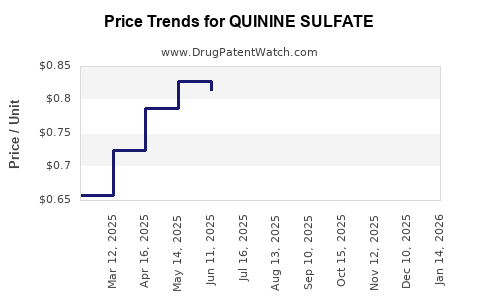
Average Pharmacy Cost for QUININE SULFATE
| Drug Name | NDC | Price/Unit ($) | Unit | Date |
|---|---|---|---|---|
| QUININE SULFATE 324 MG CAPSULE | 00093-3002-56 | 0.72001 | EACH | 2026-06-17 |
| QUININE SULFATE 324 MG CAPSULE | 50742-0238-30 | 0.72001 | EACH | 2026-06-17 |
| QUININE SULFATE 324 MG CAPSULE | 68180-0560-06 | 0.72001 | EACH | 2026-06-17 |
| QUININE SULFATE 324 MG CAPSULE | 00093-3002-56 | 0.75557 | EACH | 2026-05-20 |
| QUININE SULFATE 324 MG CAPSULE | 68180-0560-06 | 0.75557 | EACH | 2026-05-20 |
| QUININE SULFATE 324 MG CAPSULE | 50742-0238-30 | 0.75557 | EACH | 2026-05-20 |
| QUININE SULFATE 324 MG CAPSULE | 68180-0560-06 | 0.73629 | EACH | 2026-04-22 |
| >Drug Name | >NDC | >Price/Unit ($) | >Unit | >Date |
Quinine Sulfate Market Analysis and Price Projections
Quinine sulfate, a crystalline alkaloid derived from the bark of the cinchona tree, has maintained a persistent role in pharmaceuticals despite the advent of synthetic antimalarials. Its efficacy against Plasmodium falciparum, particularly in severe or complicated malaria, and its use in treating nocturnal leg cramps sustain its market presence. However, price volatility, driven by raw material availability and global health demand, presents a key factor for market participants. Projections indicate a stable to slightly increasing demand, with price fluctuations primarily linked to supply chain dynamics.
What is the Current Global Market Size for Quinine Sulfate?
The global market for quinine sulfate is not precisely delineated by readily available, granular data that separates it as a distinct entity from broader antimalarial or alkaloid markets. However, estimates place the combined market for cinchona bark derivatives, including quinine and quinidine, in the tens of millions of dollars annually. The demand for quinine sulfate is primarily dictated by its essential use in treating malaria and its off-label application for nocturnal leg cramps.
The World Health Organization (WHO) recommends quinine sulfate as a first-line treatment for severe malaria in regions where artemisinin-based combination therapies (ACTs) are not readily available or effective [1]. This recommendation directly influences procurement volumes by national health ministries and international aid organizations.
The market can be segmented by application:
- Antimalarial: This is the primary driver of demand. Regions with a high prevalence of malaria, particularly in sub-Saharan Africa and parts of Asia and South America, represent the largest consumer base.
- Nocturnal Leg Cramps: While a significant indication for prescribing quinine sulfate in developed countries, this application represents a smaller fraction of the overall global volume compared to antimalarial use.
The supply side is heavily dependent on the cultivation and harvesting of cinchona trees, predominantly in South America (Peru, Ecuador) and parts of Asia (Indonesia, India) [2]. This agricultural dependency introduces inherent supply chain risks.
What are the Key Drivers of Quinine Sulfate Demand?
The demand for quinine sulfate is influenced by several interconnected factors:
Malaria Prevalence and Treatment Guidelines
The continued prevalence of malaria, especially in endemic regions, is the most significant driver. While synthetic drugs have reduced the reliance on quinine sulfate in some areas, it remains critical for:
- Severe and Complicated Malaria: Quinine sulfate is a WHO-recommended treatment for severe Plasmodium falciparum malaria, particularly when rapid parasite clearance is paramount and resistance to other agents is a concern [1].
- Drug Resistance: Emerging resistance to other antimalarial drugs can lead to a resurgence in the use of quinine sulfate.
- Accessibility and Cost: In low-resource settings, the availability and cost-effectiveness of quinine sulfate can make it a more accessible option for malaria treatment compared to newer, more expensive therapies.
A report by the WHO indicated that in 2022, there were an estimated 249 million malaria cases worldwide, resulting in 608,000 deaths [3]. This persistent burden directly translates to a sustained demand for effective treatments, including quinine sulfate.
Nocturnal Leg Cramp Treatment
Quinine sulfate is also prescribed to alleviate painful nocturnal leg cramps. Although concerns regarding its safety profile for this indication have led to regulatory restrictions in some markets (e.g., the U.S. Food and Drug Administration’s 2010 recommendation against its use for cramps due to serious adverse events) [4], it remains a treatment option in other regions. The prevalence of leg cramps in older adults and individuals with certain medical conditions contributes to this demand.
Raw Material Availability and Cultivation
The supply of cinchona bark directly impacts the availability and price of quinine sulfate. Factors affecting cultivation include:
- Climate and Environmental Conditions: Cinchona trees are sensitive to specific climatic conditions, making certain regions more suitable for cultivation. Unfavorable weather patterns can disrupt harvests.
- Agricultural Practices: Yields are influenced by planting density, harvesting techniques, and disease management in cinchona plantations.
- Geopolitical Stability: The stability of regions where cinchona is cultivated can affect the consistent supply of raw material.
Regulatory Landscape
While not a primary demand driver, regulatory decisions regarding its approved uses and safety warnings influence prescribing patterns and market access. For instance, stricter warnings for its use in leg cramps can dampen demand in specific therapeutic categories.
What are the Primary Challenges in the Quinine Sulfate Market?
Several challenges impact the production, supply, and pricing of quinine sulfate:
Supply Chain Volatility of Cinchona Bark
The primary challenge is the dependence on cinchona bark, a natural product.
- Limited Geographic Concentration: Cinchona cultivation is concentrated in a few countries, making the supply chain vulnerable to localized issues such as disease outbreaks affecting trees, political instability, or changes in agricultural policy.
- Harvesting Cycles: Cinchona bark harvesting is a seasonal activity, and the time required for trees to mature and yield bark impacts supply.
- Price Fluctuations of Raw Material: The price of unprocessed cinchona bark can fluctuate significantly based on harvest yields, global demand, and speculative trading, directly impacting the cost of downstream quinine sulfate production. For example, a poor harvest in Peru in a given year can lead to a substantial increase in bark prices, which then translates to higher quinine sulfate costs.
Competition from Synthetic Antimalarials
The development and widespread adoption of synthetic antimalarial drugs, particularly Artemisinin-based Combination Therapies (ACTs), have significantly reduced the market share of quinine sulfate in many areas. ACTs offer faster parasite clearance, better tolerability, and in some cases, improved safety profiles [5]. This competition exerts downward pressure on demand, especially in regions where access to ACTs is improving.
Safety Concerns and Regulatory Restrictions
For its use in leg cramps, quinine sulfate has faced scrutiny and regulatory action due to its association with serious adverse events, including thrombocytopenia, arrhythmias, and even fatalities [4]. While its use in severe malaria is well-established and continues under strict medical supervision, these safety concerns limit its broader application and can influence market perception.
Quality Control and Standardization
Ensuring consistent quality and purity of quinine sulfate, derived from a natural source, can be a challenge. Variations in alkaloid content in different cinchona bark batches can necessitate rigorous standardization processes by manufacturers, adding to production costs.
Environmental Factors
Climate change and environmental degradation in cinchona-producing regions can impact crop yields and the sustainability of raw material supply.
What are the Price Trends and Projections for Quinine Sulfate?
Price trends for quinine sulfate are characterized by significant volatility, primarily driven by the supply of cinchona bark.
Historical Price Movements
Historically, the price of quinine sulfate has been subject to sharp increases following periods of low cinchona bark harvests. For instance, during periods of drought or crop disease in South America, the price of bulk quinine sulfate has been observed to rise by as much as 20-30% within a single year. Conversely, abundant harvests can lead to price stabilization or modest declines.
The price of pharmaceutical-grade quinine sulfate (e.g., USP or EP grade) is considerably higher than the price of raw cinchona alkaloids. A typical price range for bulk pharmaceutical-grade quinine sulfate can fluctuate between $150 to $350 per kilogram, though this can surge significantly during supply shortages.
Key Factors Influencing Future Pricing
- Cinchona Bark Supply: This remains the paramount factor. Projections are highly sensitive to anticipated harvest yields in key producing countries like Peru and Ecuador. Any disruption, whether due to weather, political factors, or disease, will likely lead to price increases.
- Global Malaria Burden: Sustained high malaria incidence, particularly in areas with limited access to alternative treatments, will maintain baseline demand and support price levels.
- Demand for Leg Cramp Treatment: While restricted in some markets, continued use in other regions will contribute to overall demand and influence pricing.
- Production Costs: The cost of extraction, purification, and quality control processes for quinine sulfate are subject to global economic conditions, including energy prices and labor costs.
- Inventory Levels: Stockpiles held by manufacturers and distributors can buffer short-term price fluctuations, but significant supply deficits will eventually be reflected in higher prices.
Price Projection Outlook
Given the inherent uncertainties in agricultural supply chains and the persistent need for malaria treatment, quinine sulfate prices are projected to remain volatile. A stable to slightly increasing price trend is anticipated over the next 3-5 years, punctuated by potential spikes corresponding to adverse supply events.
- Baseline Scenario (3-5 years): Modest increase of 2-5% annually, driven by rising production costs and stable demand.
- Scenario A (Supply Disruption): Potential for price increases of 15-25% or more within a 6-12 month period following a significant decline in cinchona bark harvest.
- Scenario B (Improved Agricultural Yields): Potential for price stabilization or a slight decrease of 1-3% if harvests are exceptionally strong and global demand remains constant.
The price of finished pharmaceutical products containing quinine sulfate will also be influenced by formulation complexity, packaging, and regulatory approvals in specific markets.
What is the Competitive Landscape for Quinine Sulfate Production?
The production of quinine sulfate involves a vertically integrated supply chain, from cultivation of cinchona bark to the manufacturing of the active pharmaceutical ingredient (API). The competitive landscape is characterized by:
Raw Material Suppliers
The upstream segment comprises cinchona bark cultivators and traders. Key producing regions are located in:
- South America: Peru and Ecuador are historically major suppliers.
- Asia: Indonesia and India also have significant cinchona plantations.
This segment is often fragmented, with many smallholder farmers and larger plantation operators.
API Manufacturers
These companies extract and purify quinine sulfate from cinchona bark. Production is concentrated in countries with established pharmaceutical manufacturing capabilities and access to raw materials. Key players include:
- Companies in India: India is a significant producer of quinine sulfate API, leveraging its pharmaceutical manufacturing expertise and import of cinchona bark from South America or cultivating it locally.
- Companies in China: China also plays a role in the global supply chain, with some API production.
- European Manufacturers: Some specialized European pharmaceutical ingredient manufacturers also produce quinine sulfate.
Specific company names are not consistently published due to the proprietary nature of API production and supply agreements. However, companies focusing on natural product extraction and APIs are generally involved.
Pharmaceutical Formulators
These companies purchase quinine sulfate API and formulate it into finished dosage forms, such as tablets and injectable solutions. This segment is broader and includes generic drug manufacturers as well as some branded pharmaceutical companies, particularly for malaria treatment in endemic regions.
Key Competitive Dynamics
- Vertical Integration: Some larger API manufacturers may have direct relationships or ownership stakes in cinchona cultivation to ensure raw material supply and cost control.
- Quality and Regulatory Compliance: Manufacturers must adhere to stringent Good Manufacturing Practices (GMP) and meet pharmacopoeial standards (e.g., USP, EP, BP) to supply regulated markets. This is a significant barrier to entry.
- Cost Competitiveness: Producers in regions with lower manufacturing costs and secure raw material access tend to have a competitive advantage.
- Supply Chain Reliability: The ability to consistently deliver API, even during periods of raw material scarcity, is a critical differentiator.
The competitive landscape is thus shaped by the ability to secure consistent, quality raw materials and efficiently process them into compliant APIs, alongside market access for finished products.
Key Takeaways
- Quinine sulfate's market is sustained by its critical role in treating severe malaria and its use for nocturnal leg cramps, though the latter faces regulatory scrutiny.
- Demand is directly linked to malaria prevalence in endemic regions, influenced by WHO treatment guidelines and evolving drug resistance patterns.
- The supply chain is highly dependent on cinchona bark, a natural product with inherent volatility due to agricultural factors, climate, and geopolitical stability.
- Competition from synthetic antimalarials, particularly ACTs, moderates demand growth for quinine sulfate as an antimalarial.
- Price projections indicate continued volatility, with potential for significant upward spikes driven by cinchona bark supply disruptions, alongside a baseline trend influenced by production costs and steady demand.
- The competitive landscape for API production is concentrated among manufacturers in India and China, with a focus on quality, regulatory compliance, and cost efficiency.
Frequently Asked Questions
-
What is the primary regulatory concern surrounding quinine sulfate? The primary regulatory concern relates to its safety profile when used for treating nocturnal leg cramps, with some health authorities recommending against its use due to the risk of serious adverse events.
-
How does climate change potentially impact the quinine sulfate market? Climate change can disrupt cinchona tree cultivation through altered weather patterns, increasing the risk of unpredictable harvests and exacerbating supply chain volatility for cinchona bark.
-
Are there significant generic manufacturers of quinine sulfate API? Yes, there are several generic API manufacturers, particularly in India, that produce quinine sulfate, contributing to market competition based on price and supply reliability.
-
What is the typical shelf life of quinine sulfate API and finished products? The shelf life of quinine sulfate API and finished pharmaceutical products typically ranges from 2 to 5 years, depending on storage conditions and specific formulation.
-
Does the demand for quinine sulfate fluctuate seasonally? While malaria transmission can have seasonal patterns in certain regions, leading to potential minor fluctuations in demand, the overall demand for quinine sulfate is more heavily influenced by chronic malaria burden and unpredictable supply chain events rather than short-term seasonality.
Citations
[1] World Health Organization. (2023). Guidelines for the treatment of malaria (3rd ed.). Geneva: World Health Organization. [2] G. R. D. M. (2018). Cinchona alkaloids and their synthetic derivatives. In The Chemistry of Heterocyclic Compounds, Volume 77. John Wiley & Sons. [3] World Health Organization. (2023). World malaria report 2023. Geneva: World Health Organization. [4] U.S. Food and Drug Administration. (2010, October 15). FDA Drug Safety Communication: Quinine sulfate. Retrieved from [FDA website] (Note: Direct link might change; search for "FDA Quinine sulfate safety communication 2010" for current access). [5] World Health Organization. (2021). Artemisinin-based combination therapies (ACTs). Retrieved from [WHO website] (Note: Direct link might change; search for "WHO ACTs" for current access).
More… ↓
