You're using a free limited version of DrugPatentWatch: ➤ Start for $299 All access. No Commitment.

Last Updated: December 12, 2025

PYLERA Drug Patent Profile


✉ Email this page to a colleague

« Back to Dashboard


AI Deep Research
Questions you can ask:
  • What is the 5 year forecast for PYLERA?
  • What are the global sales for PYLERA?
  • What is Average Wholesale Price for PYLERA?
Summary for PYLERA
Drug patent expirations by year for PYLERA
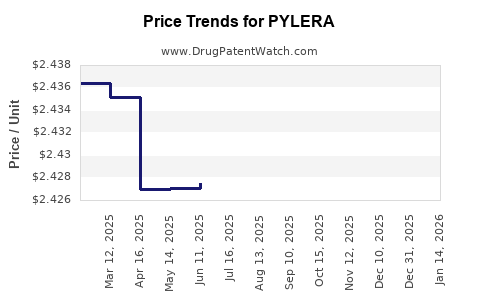
Drug Prices for PYLERA

See drug prices for PYLERA

Recent Clinical Trials for PYLERA

Identify potential brand extensions & 505(b)(2) entrants

SponsorPhase
Manuel Coelho da RochaPHASE4
University of CoimbraN/A
Centro Hospitalar e Universitário de Coimbra, E.P.E.N/A

See all PYLERA clinical trials

Paragraph IV (Patent) Challenges for PYLERA
Tradename Dosage Ingredient Strength NDA ANDAs Submitted Submissiondate
PYLERA Capsules bismuth subcitrate potassium; metronidazole; tetracycline hydrochloride 140 mg/125 mg/ 125 mg 050786 1 2014-08-12

US Patents and Regulatory Information for PYLERA

Applicant Tradename Generic Name Dosage NDA Approval Date TE Type RLD RS Patent No. Patent Expiration Product Substance Delist Req. Exclusivity Expiration
Labs Juvise PYLERA bismuth subcitrate potassium; metronidazole; tetracycline hydrochloride CAPSULE;ORAL 050786-001 Sep 28, 2006 AB RX Yes Yes ⤷  Get Started Free ⤷  Get Started Free ⤷  Get Started Free
>Applicant >Tradename >Generic Name >Dosage >NDA >Approval Date >TE >Type >RLD >RS >Patent No. >Patent Expiration >Product >Substance >Delist Req. >Exclusivity Expiration

Expired US Patents for PYLERA

Market Dynamics and Financial Trajectory for PYLERA (Bismuth-based Quadruple Therapy)

Last updated: July 28, 2025

Introduction

PYLERA, a prescription medication primarily used for the eradication of Helicobacter pylori (H. pylori) infections, is a bismuth-based quadruple therapy combining bismuth subsalicylate, metronidazole, tetracycline, and a proton pump inhibitor (PPI). As a cornerstone in gastric pathogen management, PYLERA’s market status and financial outlook are shaped by evolving clinical practices, regulatory trends, competitive landscape, and broader healthcare economic factors.

Market Overview

The global H. pylori eradication market is anticipated to expand significantly, driven by rising prevalence of gastric ulcers, gastritis, and associated gastric cancers. According to industry analyses, the market is projected to reach approximately USD 4.5 billion by 2027, growing at a CAGR of around 6% from 2022 (source: Market Research Future).

PYLERA holds a substantial share within this sector, particularly in regions where bismuth-based therapies are preferred due to rising antibiotic resistance to standard triple therapy. Its efficacy in cases resistant to traditional regimens has reinforced its clinical necessity, maintaining its relevance amid shifting treatment algorithms.

Market Drivers

  1. Increasing Antibiotic Resistance: Declining effectiveness of standard clarithromycin- and levofloxacin-based therapies compels clinicians to adopt bismuth-based quadruple regimens, bolstering demand for PYLERA.

  2. Guideline Endorsements: Recommendations from leading gastroenterological societies, such as the American College of Gastroenterology (ACG), advocate for bismuth quadruple therapy in cases of initial treatment failure or resistance, further supporting PYLERA’s market position.

  3. Regulatory Approvals & Expanding Indications: PYLERA’s approval in multiple regions, alongside potential new indications—for instance, its role in addressing gastric microbiota—could enhance market penetration.

  4. Patient Compliance & Safety Profiles: Simplified regimens with clearer safety profiles improve adherence, promoting ongoing utilization.

Market Challenges

  • Antimicrobial Resistance Variability: Though resistance to clarithromycin and metronidazole is rising, tetracycline-preserved regimens like PYLERA remain effective, but continued resistance development could threaten its long-term dominance.
  • Regulatory and Patent Landscape: Patent expirations and generic alternatives introduce pricing pressures, reducing profit margins.
  • Side-Effect Profiles & Patient Preferences: Gastrointestinal side effects and dosing complexity may hinder prescription rates, especially in outpatient settings.

Competitive Landscape

While PYLERA retains a prominent role, the market faces competition from:

  • Combination Regimens with Novel Antibiotics: Emerging therapies incorporating novel agents or probiotics aim to improve eradication rates and tolerability.
  • Other Bismuth-containing Formulations: Variations of bismuth-based therapies, sometimes over-the-counter, challenge PYLERA’s exclusive market share.
  • Non-bismuth-based Therapies: Sequential, concomitant, and hybrid therapies are gaining traction where resistance profiles permit.

Major pharmaceutical companies investing in alternative regimens or new formulations impact PYLERA’s growth trajectory, necessitating strategic adaptation.

Financial Trajectory

Historically, PYLERA has demonstrated consistent revenue contributions within the H. pylori treatment segment. Market sales are influenced by:

  • Regional Adoption: High in regions with regulated, reimbursed healthcare systems such as North America and Europe; emerging markets display rapid growth potential due to increasing healthcare infrastructure.
  • Pricing Strategies: Given its patent status and brand positioning, PYLERA commands premium pricing, though genericization could compress margins.
  • Market Expansion: Efforts to increase prescriber awareness and clinical guideline integration facilitate incremental sales growth.

Projections for PYLERA’s revenue growth indicate a moderate CAGR of approximately 3-4% over the next five years, driven by geographic expansion and improved treatment guidelines. However, the advent of generic versions and increasing competition could significantly impact profitability.

Regulatory & Economic Considerations

Regulatory agencies’ compliance and approval processes remain pivotal; delays or restrictions could dampen financial outlooks. Additionally, healthcare payer policies influence reimbursement levels and patient access, directly affecting sales.

Economic factors such as healthcare spending, inflation, and cost-effectiveness analyses impact prescribing patterns. The rising emphasis on value-based care necessitates demonstrating superior efficacy and safety profiles to sustain market share and justify premium pricing.

Future Outlook and Strategic Implications

To capitalize on the growing demand, stakeholders should:

  • Invest in clinical research to demonstrate superior eradication rates, especially amid resistant strains.
  • Strategize for potential patent expirations by developing new formulations or combination products.
  • Expand into emerging markets with tailored pricing and educational initiatives.
  • Monitor resistance patterns, integrating molecular diagnostics for personalized therapy selections.

Key Takeaways

  • Market growth for PYLERA hinges on increasing antibiotic resistance, evolving treatment guidelines, and expansion into emerging markets.
  • Competitive pressures require continuous innovation and strategic marketing to defend market share.
  • Financial prospects suggest moderate growth, with profitability sensitive to patent status, regulatory landscape, and healthcare policies.
  • Long-term success depends on adaptability to resistance trends, proactive expansion strategies, and commitment to clinical efficacy.

Concluding Remarks

PYLERA remains a vital component within the H. pylori eradication landscape. Its financial trajectory will largely be shaped by its ability to withstand resistance, navigate a competitive therapy environment, and leverage evolving clinical guidelines. Stakeholders who anticipate these dynamics and adapt accordingly will position themselves favorably in this evolving market.


FAQs

1. What factors influence PYLERA’s market growth?
PYLERA’s growth depends on rising antibiotic resistance, guideline endorsements favoring bismuth-based therapies, regional healthcare infrastructure, and patent/status of generic versions.

2. How does antibiotic resistance impact PYLERA’s effectiveness?
Since PYLERA includes multiple antibiotics, resistance to key components—like metronidazole—may reduce eradication success, necessitating ongoing monitoring and potential regimen adjustments.

3. What are the main competitive threats to PYLERA?
Emerging therapy regimens, new antibiotics, and over-the-counter bismuth formulations pose competitive challenges, potentially reducing PYLERA’s market share.

4. How might patent expirations affect PYLERA’s financial trajectory?
Patent expiry could lead to increased generic competition, reducing prices and profit margins, unless new formulations or indications are developed.

5. What strategies can preserve PYLERA’s market position?
Investing in clinical research, expanding into emerging markets, optimizing pricing strategies, and developing next-generation formulations can support its market presence.


References

[1] Market Research Future, “Helicobacter pylori Market Forecast to 2027.”
[2] American College of Gastroenterology, Practice Guidelines for H. pylori Management.
[3] GlobalData Healthcare, “Antibiotic Resistance Patterns in Gastroenterology,” 2022.

More… ↓

⤷  Get Started Free

Make Better Decisions: Try a trial or see plans & pricing

Drugs may be covered by multiple patents or regulatory protections. All trademarks and applicant names are the property of their respective owners or licensors. Although great care is taken in the proper and correct provision of this service, thinkBiotech LLC does not accept any responsibility for possible consequences of errors or omissions in the provided data. The data presented herein is for information purposes only. There is no warranty that the data contained herein is error free. We do not provide individual investment advice. This service is not registered with any financial regulatory agency. The information we publish is educational only and based on our opinions plus our models. By using DrugPatentWatch you acknowledge that we do not provide personalized recommendations or advice. thinkBiotech performs no independent verification of facts as provided by public sources nor are attempts made to provide legal or investing advice. Any reliance on data provided herein is done solely at the discretion of the user. Users of this service are advised to seek professional advice and independent confirmation before considering acting on any of the provided information. thinkBiotech LLC reserves the right to amend, extend or withdraw any part or all of the offered service without notice.