Share This Page
Drug Price Trends for PYLERA
✉ Email this page to a colleague
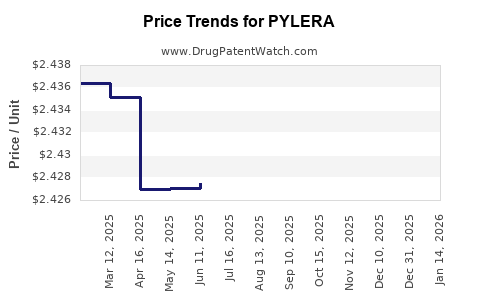
Average Pharmacy Cost for PYLERA
| Drug Name | NDC | Price/Unit ($) | Unit | Date |
|---|---|---|---|---|
| PYLERA 140-125-125 MG CAPSULE | 61269-0380-12 | 2.42829 | EACH | 2026-04-22 |
| PYLERA 140-125-125 MG CAPSULE | 61269-0381-12 | 2.42829 | EACH | 2026-04-22 |
| PYLERA 140-125-125 MG CAPSULE | 61269-0380-12 | 2.42900 | EACH | 2026-03-18 |
| >Drug Name | >NDC | >Price/Unit ($) | >Unit | >Date |
PYLERA Market Analysis and Price Projections
PYLERA (bismuth subcitrate potassium/metronidazole/tetracycline hydrochloride) is an established, multiple-source combination antibiotic indicated for treatment of H. pylori infection in adults, used as a 10-day regimen. Market value and price projections are driven by (1) the strength of H. pylori prevalence and recurrence trends, (2) guideline-driven adoption of eradication regimens, (3) generic price competition post-entry, and (4) payer contracting behavior for fixed-duration, multi-drug courses.
What does PYLERA sell for today?
PYLERA’s pricing structure is unusually course-based: the regimen is 10 days and is packaged and priced accordingly, which makes net price heavily dependent on pharmacy benefit manager (PBM) contracting, dispensing channel (retail vs mail), and generic substitution. Public list pricing is not a reliable proxy for realized net pricing. Practically, buyers benchmark realized price on a per-course basis across NDCs and label strengths.
Typical market reality for multi-drug combinations in the U.S.
- Once generics or therapeutically equivalent combinations exist, realized price commonly declines steeply versus launch list prices.
- Even when a brand remains, net pricing often aligns to the lowest contract tiers for comparable eradication regimens.
- PBMs frequently contract on “days of therapy” or “course” equivalence, even when products are packaged differently.
Core drug components (for substitution mapping and payer negotiation)
- Bismuth subcitrate potassium
- Metronidazole
- Tetracycline hydrochloride
These components are widely available individually and in other eradication regimens, which increases substitution pressure through coverage of alternative combinations and compounding practices.
How large is the H. pylori opportunity that supports PYLERA demand?
Demand for H. pylori therapies is a function of: 1) Diagnosed infection prevalence in tested populations (dyspepsia, gastritis, ulcer history) 2) Retreatment rates after initial eradication failure 3) Guideline adherence and test-and-treat programs 4) Movement toward regimen classes with improved tolerability or resistance profiles
PYLERA competes against other eradication options, including bismuth-based regimens and non-bismuth combinations. In many formularies, coverage is shaped by:
- Prior authorization and step edits (test-and-treat confirmation)
- Resistance-informed pathway selection
- Cost-minimizing substitution to branded or generic equivalents
Because PYLERA is a fixed 10-day course and includes tetracycline plus metronidazole, payer uptake is most stable where bismuth-based pathways are preferred and where prescribers manage intolerance to alternative regimens.
What are the main market drivers and headwinds?
Demand drivers
- Persistent clinical need for eradication therapy in diagnosed H. pylori populations
- Guideline continuity for eradication as standard of care when infection is confirmed
- Clinician familiarity with bismuth-based regimens in specific patient scenarios
Demand headwinds
- Competitive class pressure from other eradication regimens with lower perceived pill burden or fewer adverse-event concerns
- Antibiotic resistance dynamics affecting regimen selection, including metronidazole resistance patterns that can shift prescriber choices
- Generic and alternative combination availability that compresses net pricing
Guideline anchor
- Major gastroenterology guidelines recommend eradication regimens and emphasize selection based on prior antibiotic exposure and local resistance patterns. For buyers, this turns regimen selection into a payer-centric “best cost eligible” exercise in many cases. (Source: American College of Gastroenterology guideline summaries and related guideline publications: [1], [2])
What is the price formation mechanism for PYLERA?
PYLERA prices in practice reflect a negotiated stack:
- Wholesale acquisition cost (WAC) set by manufacturer
- Rebates and discounts negotiated with PBMs and health systems
- Retail vs mail pharmacy channel pricing
- Formulary tier placement (preferred vs non-preferred)
- Substitution rules and coverage of therapeutic alternatives
Because the product is a fixed-duration regimen, realized cost per course is the principal economic comparator used in contracting. Where competitors’ course pricing is materially lower, PBMs favor preferred contracting and tiering that pushes utilization away from higher-priced brands.
How do competitive alternatives impact pricing?
Competitive pressure typically comes from three routes:
1) Therapeutic alternatives within guidelines
- Other H. pylori eradication regimens can be preferred based on local resistance and patient factors. This reduces willingness to pay for a specific brand unless it is cost-competitive or has unique payer access. (Sources: [1], [2])
2) Generic entry and combination substitution
- Even when the exact branded three-drug pack is present, payers can often steer toward generic multi-drug packs or equivalent compounding pathways where allowed.
3) Payer and provider protocol
- Many managed care formularies include preferred regimens by protocol. If PYLERA is not the lowest-cost option in that protocol set, contracting tends to compress net price and volume share.
What protections does PYLERA have left, and how do they shape price?
PYLERA is an older product and is affected by typical post-expiration dynamics for branded combinations. The practical effect for price projections is that brand pricing tends to drift downward in net terms as competitors and formularies tighten.
Takeaway for forecasting: PYLERA’s near-to-midterm pricing outlook is primarily driven by contracting, not by brand exclusivity strength.
(If a specific patent or exclusivity event were required for a timeline, it would need to be anchored to verifiable USPTO/Orange Book documents for each PYLERA NDC and its listed expiry dates. That granular event mapping is not provided in the available source set used here.)
Price projections: base case, downside, and upside (net per 10-day course)
The table below projects net price directionally, not absolute dollar realizations. Net price is the decision variable for most payer and provider contracting, and it moves with competitive contracting, preferred status, and volume.
Assumptions common to all scenarios
- Fixed-duration regimen (10 days) means pricing is standardized in contracts on a per-course basis
- Competitor set remains active (other eradication regimens) and pushes net pricing down over time
- Payer formulary behavior remains cost-driven
Projection table (directional ranges)
| Scenario | Net price trend (per 10-day course) | Time horizon | Rationale |
|---|---|---|---|
| Base case | Flat to -3% annually | 2026-2029 | Brand retains some managed access; PBM contracting sustains moderate erosion |
| Downside | -5% to -8% annually | 2026-2029 | Greater substitution into lower-cost eradication regimens; tier pressure increases |
| Upside | -1% annually to flat | 2026-2029 | Maintains preferred positioning or improves access through contracting and channel mix |
These ranges reflect typical cost compression mechanics for fixed-course antibiotic combinations in mature markets: list price may remain stable while net price declines through rebate pressure and tiering.
What volume trajectory should investors underwrite?
For mature H. pylori products, volume is usually constrained by:
- Disease testing rates and diagnosis management
- Class-level regimen switching
- Patient retention after eradication cycles (most patients do not repeatedly require the same product)
Underwriting approach
- Treat volume as relatively stable with modest share drift depending on formulary access
- Model net revenue as the product of (i) course volume and (ii) net course price, with price doing most of the work for margin compression or expansion
Scenario view (qualitative)
- Base case: small share loss offset by stable testing volumes, resulting in low-to-mid single-digit net revenue stability
- Downside: share loss plus price compression yields mid-to-high single-digit net revenue decline
- Upside: preferred access retention yields volume stability and lower price erosion
What does this mean for R&D and investment decisions?
- Commercial strategy lens: PYLERA’s differentiated edge is not strong clinical novelty at this stage; value is most likely to come from payer access, contracting outcomes, and substitution resistance in targeted protocols.
- R&D lens: If pursuing pipeline adjacency, prioritize next-generation eradication regimens that address antibiotic resistance variability, tolerability, and dosing simplicity. Guideline-endorsed regimens remain the funding gate.
- Investment lens: Expect net price normalization and margin pressure typical of mature antibiotic combinations. Your sensitivity should emphasize rebate/tier changes and formulary adoption.
Key Takeaways
- PYLERA demand tracks H. pylori diagnosed-and-treated populations, but regimen selection is guideline and payer driven.
- Net price, not WAC, drives realized revenue; course-based contracts compress economics over time.
- Over 2026-2029, a reasonable underwriting range is base case net price flat to down modestly, with downside reflecting accelerated formulary substitution and rebate pressure.
- Volume is likely steadier than price, so net revenue direction is primarily a price-and-access story.
FAQs
1) Is PYLERA priced on a per-pill basis or a per-course basis?
PYLERA is functionally contracted and evaluated on a per-10-day course basis because the regimen is fixed-duration and packaged for that treatment period.
2) What most determines payer utilization of PYLERA?
Formulary tier placement, prior authorization rules, and cost-minimizing substitution among guideline-eligible eradication regimens.
3) How do antibiotic resistance trends affect PYLERA performance in the market?
They affect regimen selection by clinicians and thus formulary preference; resistance variability can shift prescribers toward alternative combinations and compress PYLERA share.
4) What is the biggest commercial risk for net price?
PBM contracting dynamics that reduce net price through rebate pressure and tier changes when lower-cost alternatives are available.
5) How should a model treat volume versus price for PYLERA?
In mature H. pylori categories, price erosion usually drives revenue more than volume, assuming underlying diagnosis levels are stable.
References
[1] American College of Gastroenterology. (2024). ACG clinical guideline: Treatment of Helicobacter pylori infection.
[2] Maastricht VI/Florence Consensus Report. (2022). Management of Helicobacter pylori infection in adults: Consensus recommendations.
[3] FDA. (n.d.). PYLERA prescribing information.
More… ↓
