Last updated: August 12, 2026
Prilosec OTC is a mature U.S. consumer-health brand based on omeprazole 20 mg, a proton-pump inhibitor used for frequent heartburn. Its financial trajectory has shifted from prescription blockbuster economics to an established, lower-growth over-the-counter model. The brand retains recognition and shelf presence, but generic omeprazole, private-label products, H2 blockers, newer proton-pump inhibitors, retailer bargaining power, and limited category growth constrain pricing and margins.
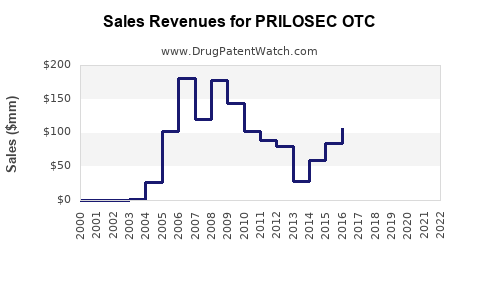
Standalone Prilosec OTC revenue is not publicly disclosed. The brand’s commercial value must be assessed through category position, distribution, pricing, consumer awareness, and the economics of the broader consumer-health portfolio rather than reported product-level sales.
What is Prilosec OTC and how does it generate revenue?
Prilosec OTC contains omeprazole delayed-release 20 mg tablets. The FDA approved the prescription product in 1989 and approved the nonprescription switch in 2003 for adults with frequent heartburn occurring at least two days per week. The standard OTC regimen is one 20 mg tablet daily for 14 consecutive days.[1]
The product generates revenue through:
- Branded retail sales at mass merchants, pharmacies, supermarkets, club stores and e-commerce channels.
- Multi-count packages, including 14-tablet and 42-tablet formats.
- Retailer and pharmacy distribution agreements.
- Price premiums over store-brand omeprazole.
- Repeat purchasing by consumers who self-manage recurring heartburn.
Prilosec OTC is not a prescription reimbursement product. Its financial performance is therefore driven by household penetration, retail velocity, promotional activity, shelf placement, pricing, and consumer switching.
Who owns and markets Prilosec OTC?
Prilosec OTC was commercialized in the United States through a consumer-health arrangement involving AstraZeneca and Procter & Gamble. Public product labeling has identified Procter & Gamble as the brand company or distributor, while manufacturing and supply-chain functions can involve third-party contractors.[2]
The relevant economic distinction is between:
- Brand ownership and consumer marketing.
- Regulatory sponsorship and labeling.
- Manufacturing and packaging.
- Licensing or royalty rights connected to the original AstraZeneca product.
Neither Procter & Gamble nor AstraZeneca reports a current standalone Prilosec OTC revenue line in public financial statements. Product-level sales, gross margin and royalty payments are therefore unavailable from SEC filings.
How has the financial trajectory changed from prescription Prilosec to Prilosec OTC?
Prilosec’s financial history has three phases.
| Period |
Commercial phase |
Financial characteristics |
| 1989-2001 |
Prescription growth |
Rapid uptake as a leading proton-pump inhibitor; high prescription pricing and physician-driven demand |
| 2001-2003 |
Prescription generic entry and OTC preparation |
Generic omeprazole pressure reduced prescription exclusivity economics |
| 2003-present |
Consumer-health maturity |
Larger consumer market, lower unit prices, high retail competition and limited product differentiation |
Prescription Prilosec was one of the largest pharmaceutical products of its era. AstraZeneca reported peak annual global sales for the Prilosec franchise in the multibillion-dollar range before generic competition and substitution by Nexium.[3] The prescription product’s economic decline was driven by patent expiry, authorized-generic competition, generic omeprazole, and conversion of patients to other acid-suppression products.
The 2003 OTC switch extended the commercial life of the molecule. It did not recreate prescription-era economics. OTC omeprazole sells at a lower price per dose, faces private-label competition, and requires ongoing retail promotion. The switch nevertheless expanded access to self-care consumers and created a new revenue stream after prescription exclusivity had eroded.
What is the current financial outlook for Prilosec OTC?
The outlook is stable to low growth rather than high growth. The principal drivers are:
- Continued prevalence of recurring heartburn.
- Consumer familiarity with the Prilosec name.
- Broad retail availability.
- Premium pricing versus store brands.
- Growth in e-commerce and club-store purchasing.
The principal constraints are:
- Generic and private-label omeprazole.
- Retailer pressure on branded prices.
- Consumer migration to famotidine and other H2 blockers.
- Competition from Nexium 24HR and Prevacid 24HR.
- FDA-labeled limits on 14-day self-treatment.
- Consumer concerns about long-term proton-pump inhibitor use.
- Limited ability to claim meaningful clinical superiority over generic omeprazole.
The brand’s likely economic profile is cash-generative but mature. Revenue growth depends more on price, promotional execution and distribution than on prescription expansion.
How large is the U.S. OTC heartburn market?
The U.S. OTC heartburn category includes proton-pump inhibitors, H2 blockers, antacids and combination products. Public syndicated-market estimates differ because suppliers report sales by channel, product form and category definition. No single government data source reports a definitive Prilosec OTC market share.
The category has several structural characteristics:
| Factor |
Effect on Prilosec OTC |
| Frequent heartburn prevalence |
Supports recurring demand |
| OTC self-care access |
Expands the addressable population |
| Generic omeprazole |
Caps brand pricing |
| Private-label retail brands |
Increases substitution risk |
| H2 blocker availability |
Creates a lower-cost alternative |
| Retail consolidation |
Increases buyer power |
| E-commerce |
Improves access but raises price transparency |
| 14-day label limitation |
Restricts continuous-use positioning |
Prilosec OTC competes in a category where consumers often compare active ingredient, dose and price. Brand equity helps at the point of purchase, but the product’s active ingredient is widely available without meaningful formulation differentiation.
How does Prilosec OTC compare with Nexium 24HR, Prevacid 24HR and generic omeprazole?
| Product |
Active ingredient |
Typical OTC positioning |
Main competitive issue |
| Prilosec OTC |
Omeprazole 20 mg |
Established heartburn brand |
Generic substitution and mature demand |
| Nexium 24HR |
Esomeprazole 20 mg |
Premium proton-pump inhibitor |
Brand premium and related-molecule differentiation |
| Prevacid 24HR |
Lansoprazole 15 mg |
Alternative proton-pump inhibitor |
Lower awareness relative to leading brands |
| Store-brand omeprazole |
Omeprazole 20 mg |
Value alternative |
Direct active-ingredient substitution |
| Pepcid AC |
Famotidine |
Faster-onset or as-needed heartburn relief |
Different mechanism and consumer use pattern |
| Tums and other antacids |
Calcium carbonate or other antacids |
Immediate symptom relief |
Shorter-acting alternative |
Prilosec OTC’s strongest competitive advantage is brand recognition. Its weakest point is the absence of a durable ingredient-level distinction from generic omeprazole.
What FDA regulatory status does Prilosec OTC have?
Prilosec OTC is an FDA-approved nonprescription drug. It is not a biologic and does not face biosimilar competition. Generic manufacturers do not file biosimilar applications for omeprazole; they use abbreviated or OTC pathways appropriate to the product and regulatory framework.
The FDA label directs consumers to:
- Take one tablet before eating in the morning.
- Use the product for 14 days.
- Avoid taking more than one tablet daily.
- Seek medical advice for persistent or recurring symptoms.
- Follow warnings involving alarm symptoms, drug interactions and certain medical conditions.[1]
The regulatory model limits the manufacturer’s ability to market Prilosec OTC as a treatment for every form of gastroesophageal reflux disease. The approved consumer indication is narrower than broad physician-directed acid suppression.
What is the Orange Book status of Prilosec OTC?
The Orange Book primarily identifies approved prescription drug products and their listed patents or exclusivities. A nonprescription product marketed under an OTC monograph or OTC-specific approval framework is not analyzed in the same way as a prescription drug with Orange Book-listed patents.
Prilosec OTC therefore does not have a conventional current Orange Book exclusivity profile comparable to a branded prescription drug. The relevant commercial barriers are brand equity, regulatory compliance, manufacturing quality, distribution, packaging and retail execution.
What patents protect Prilosec OTC?
The original omeprazole patent estate protected the active pharmaceutical ingredient and related pharmaceutical preparations during the prescription era. Those core rights expired years ago. Generic omeprazole entered the U.S. market after the original prescription exclusivity period ended, eliminating meaningful compound-level exclusivity.[4]
The current Prilosec OTC position is not based on an active, high-value compound patent. Potential IP categories include:
- Historical omeprazole compound patents.
- Formulation and enteric-coating patents.
- Manufacturing and process patents.
- Packaging and trade-dress rights.
- Trademarks covering the Prilosec name and logo.
- Regulatory rights associated with the approved OTC label.
What formulations are protected by Prilosec OTC?
The product uses delayed-release tablets. Omeprazole is acid-labile, so the dosage form requires protection through an enteric or otherwise delayed-release system. This technology protects delivery performance, not the underlying molecule.
Generic manufacturers can develop bioequivalent delayed-release omeprazole products. Formulation IP may create development or manufacturing complexity, but it is not a strong barrier where multiple suppliers have commercialized equivalent dosage forms.
The most durable brand protection is trademark and consumer recognition, not exclusivity over omeprazole chemistry.
When did Prilosec lose exclusivity?
Prilosec lost its core prescription exclusivity in the early 2000s. The exact timing of commercial exposure depended on individual patent rights, pediatric or regulatory extensions, generic settlements and authorized-generic arrangements. By the time of the 2003 OTC switch, the molecule was already moving from a protected prescription franchise to a post-exclusivity consumer product.[3][4]
The key timeline is:
| Date |
Event |
| 1989 |
FDA approval of prescription Prilosec |
| 2001-2002 |
Generic and patent-related pressure on prescription omeprazole |
| 2003 |
FDA approval of Prilosec OTC |
| 2003 onward |
Expansion into self-care heartburn market |
| 2010s onward |
Intensified competition from private-label omeprazole and other OTC acid reducers |
Are there Paragraph IV challenges involving Prilosec OTC?
Paragraph IV litigation principally concerns abbreviated new drug applications for prescription products with Orange Book-listed patents. It is not the principal mechanism governing ordinary OTC monograph competition.
Historical Paragraph IV disputes involving prescription omeprazole affected the commercial value of the Prilosec franchise before and around the transition to OTC. Those disputes reduced prescription exclusivity but did not create a current barrier to retail sales of generic omeprazole.
No current OTC-specific Paragraph IV strategy provides Prilosec OTC with meaningful protection against store-brand competition. The commercial threat is substitution, not a new generic litigation wave.
What patent litigation and settlement agreements affect Prilosec OTC?
The important litigation was historical and centered on prescription omeprazole patents, generic entry and AstraZeneca’s broader acid-suppression franchise. The commercial outcomes included generic availability, erosion of prescription pricing and increased pressure to develop consumer-health revenue.
Current material litigation risk is more likely to arise from:
- Product liability claims involving long-term proton-pump inhibitor use.
- Consumer-protection claims involving advertising or labeling.
- Manufacturing and quality disputes.
- Retail supply and licensing disagreements.
- Trademark or counterfeit-product enforcement.
A settlement involving prescription omeprazole should not be treated as evidence of current exclusivity for Prilosec OTC. The OTC product’s market position is primarily operational and brand-based.
Which companies challenge Prilosec OTC commercially?
The main competitive pressure comes from manufacturers and retailers selling equivalent or near-equivalent products:
- Private-label omeprazole suppliers.
- Generic-drug manufacturers such as Perrigo and other OTC suppliers.
- Haleon, through Nexium 24HR and other consumer-health products.
- Kenvue, through Pepcid and related heartburn brands.
- Retail pharmacy chains and mass merchants with store-brand products.
- E-commerce sellers competing on price and package size.
Retailers have strong negotiating leverage because omeprazole is widely available and consumers can switch products with limited search costs. A retailer can replace branded shelf space with a private-label equivalent without removing the therapeutic category from its stores.
What manufacturing and IP barriers remain?
Manufacturing barriers are moderate. A supplier must produce a stable delayed-release omeprazole tablet, meet FDA current good manufacturing practice requirements, demonstrate the applicable regulatory performance and maintain reliable packaging and supply.
The principal barriers are:
- Enteric-release manufacturing capability.
- Stability control for an acid-sensitive active ingredient.
- FDA compliance and quality systems.
- Retailer qualification.
- National distribution.
- Consumer advertising and brand support.
- Trademark protection.
These barriers can delay entry for smaller companies, but they do not prevent established generic and private-label suppliers from competing.
What generic launch scenarios exist for Prilosec OTC?
The most likely market scenarios are:
Base case: stable branded niche
Prilosec OTC retains a meaningful premium because consumers recognize the name and trust the product. Unit volume grows slowly or declines modestly, while promotions and package-size changes manage revenue.
Downside case: private-label migration
Retailers increase store-brand shelf allocation, consumers trade down, and online price comparison accelerates. Prilosec OTC revenue declines faster than the overall heartburn category.
Upside case: category expansion
Greater consumer awareness of frequent-heartburn treatment, stronger e-commerce distribution or successful premium packaging supports modest growth. The upside remains limited because the active ingredient is mature and widely available.
A generic launch is not the central future event because generic omeprazole already exists. The continuing risk is incremental share loss and price compression.
What is the geographic coverage of Prilosec OTC?
Prilosec OTC is principally a U.S. consumer-health brand. Omeprazole is sold globally under multiple brand names, dosage forms and regulatory classifications, but the U.S. Prilosec OTC franchise should not be equated with global omeprazole sales.
Geographic value is strongest in the U.S. because:
- The Prilosec name has established consumer recognition.
- OTC heartburn treatment is a large retail category.
- The brand has national distribution.
- U.S. consumers commonly purchase acid reducers without a prescription.
International markets may use Losec, generic omeprazole or local brands rather than Prilosec OTC.
How strong is the Prilosec OTC patent estate?
The patent estate is weak as a current exclusivity asset and moderate as a formulation and operating asset.
| Asset |
Current strength |
| Omeprazole compound patent |
Expired |
| Prescription product exclusivity |
Expired |
| OTC formulation exclusivity |
Limited or expired for core technology |
| Trademark and brand equity |
Material |
| Manufacturing know-how |
Moderate |
| Retail distribution |
Material but contestable |
| Regulatory compliance systems |
Moderate |
| Biosimilar protection |
Not applicable |
Prilosec OTC is commercially defensible, but not because competitors are blocked by a live compound patent. The franchise depends on brand trust, distribution, marketing, retailer relationships and quality execution.
Key Takeaways
- Prilosec OTC is a mature omeprazole 20 mg consumer-health brand launched after the 2003 FDA prescription-to-OTC switch.
- Its standalone revenue is not publicly disclosed.
- The original prescription-era patent protection has expired, and generic omeprazole is widely available.
- Current value comes from brand recognition, retail distribution and pricing discipline.
- Private-label omeprazole is the largest direct commercial threat.
- Orange Book exclusivity and biosimilar risk are not central to the OTC product.
- The financial trajectory is likely stable to declining in units, with revenue dependent on pricing, promotions, package sizes and channel mix.
- Manufacturing and delayed-release technology create operational barriers but do not prevent competition.
- Prilosec OTC’s strongest asset is its trademark and consumer awareness, not its active patent estate.
FAQs About Prilosec OTC Market and Financial Performance
Is Prilosec OTC still protected by a patent?
No current compound-level patent provides meaningful exclusivity for Prilosec OTC. The commercial franchise relies mainly on trademark, distribution and brand equity.
Does AstraZeneca still receive revenue from Prilosec OTC?
Historical commercialization involved AstraZeneca and Procter & Gamble, but current product-level royalty economics are not separately disclosed in public filings.
Is generic omeprazole the same as Prilosec OTC?
Generic omeprazole products use the same active ingredient, generally at the same 20 mg OTC strength, but may differ in inactive ingredients, tablet design, packaging and manufacturer.
Can consumers use Prilosec OTC indefinitely?
The FDA label directs consumers to a 14-day course and advises medical consultation for persistent or recurring symptoms. The label does not position the product as unrestricted long-term self-treatment.[1]
Is Nexium 24HR a stronger patent threat than generic omeprazole?
No. Nexium 24HR is primarily a branded commercial competitor based on esomeprazole. Generic omeprazole creates the more direct price and substitution threat because it uses the same active ingredient.
References
- U.S. Food and Drug Administration. (2003). Prilosec OTC: Omeprazole delayed-release tablets, 20 mg, Drug Facts label.
- Procter & Gamble. (2024). Prilosec OTC product labeling and consumer information.
- AstraZeneca PLC. (2003). Annual report and financial statements 2002-2003.
- U.S. Food and Drug Administration. (2024). Approved drug products with therapeutic equivalence evaluations, Orange Book.