Drug Sales Trends for PRILOSEC OTC
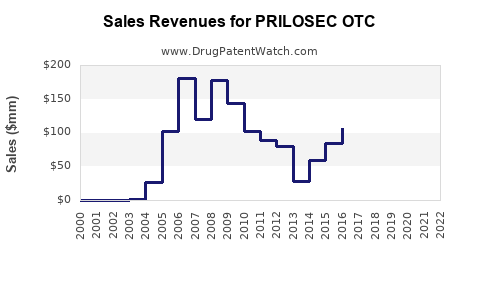
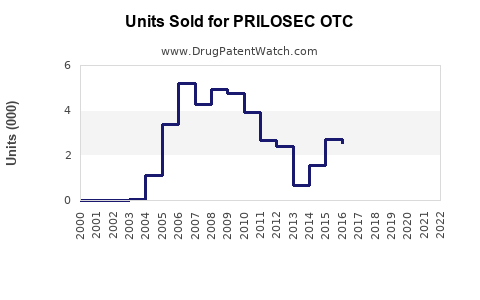
Annual Sales Revenues and Units Sold for PRILOSEC OTC
| Drug Name | Revenues (USD) | Units | Year |
|---|---|---|---|
| PRILOSEC OTC | ⤷ Start Trial | ⤷ Start Trial | 2022 |
| PRILOSEC OTC | ⤷ Start Trial | ⤷ Start Trial | 2021 |
| PRILOSEC OTC | ⤷ Start Trial | ⤷ Start Trial | 2020 |
| PRILOSEC OTC | ⤷ Start Trial | ⤷ Start Trial | 2019 |
| PRILOSEC OTC | ⤷ Start Trial | ⤷ Start Trial | 2018 |
| PRILOSEC OTC | ⤷ Start Trial | ⤷ Start Trial | 2017 |
| PRILOSEC OTC | ⤷ Start Trial | ⤷ Start Trial | 2016 |
| >Drug Name | >Revenues (USD) | >Units | >Year |
Prilosec OTC Market Analysis, Sales Projections, Patent Position, and Competitive Outlook
Prilosec OTC is an established U.S. proton-pump inhibitor brand with durable consumer awareness but limited pricing power. Its core active ingredient, omeprazole 20 mg, has been available generically for years, so market performance depends on brand recognition, retailer placement, promotional spending, formulation, and consumer trust rather than patent protection.
Standalone Prilosec OTC revenue is not publicly reported by the brand owner. The projection below uses a modeled 2024 U.S. retail-sales baseline of $250 million to $350 million. Under the base case, sales decline modestly through 2029 as generic substitution and private-label competition offset category growth.
| Metric | Assessment |
|---|---|
| Product | Prilosec OTC |
| Active ingredient | Omeprazole 20 mg |
| Dosage form | Delayed-release tablet |
| Primary market | United States consumer health |
| Regulatory status | FDA-approved OTC product |
| Original OTC approval | 2003 |
| Prescription status | Omeprazole is also available by prescription |
| Patent position | No material blocking exclusivity identified |
| Standalone brand revenue | Not separately disclosed |
| 2024 modeled U.S. retail sales | $250 million to $350 million |
| Base-case 2029 retail sales | Approximately $260 million to $330 million |
| Principal risks | Generic substitution, private-label pricing, H2 blockers, retailer bargaining power |
What is Prilosec OTC and how does it make money?
Prilosec OTC contains omeprazole 20 mg, a proton-pump inhibitor that suppresses gastric acid production. The product is labeled for adults with frequent heartburn occurring two or more days per week. The standard consumer regimen is one tablet daily for 14 consecutive days. It is not intended to provide immediate relief and is not labeled for continuous self-treatment without medical advice [1].
The commercial model is based on over-the-counter retail sales through mass merchants, pharmacies, grocery stores, club stores, and online retailers. Revenue is driven by:
- Unit volume and repeat purchase.
- Retail price and promotional discounts.
- Brand versus private-label mix.
- Distribution breadth.
- Consumer awareness of the Prilosec name.
- Seasonal heartburn demand.
- Packaging sizes and retailer-specific formats.
The brand competes in a category where consumers often compare active ingredients rather than brand names. Omeprazole is widely available in generic and store-brand formats, which places a ceiling on Prilosec OTC pricing.
How large is the U.S. OTC heartburn market?
The U.S. heartburn market includes antacids, H2 receptor antagonists, proton-pump inhibitors, and combination products. Retail sales are concentrated across several national brands, store brands, and generic products. Exact market size varies by data provider because some estimates measure manufacturer sales while others measure retail scanner sales.
The commercially relevant segments are:
| Segment | Representative products | Market role |
|---|---|---|
| Proton-pump inhibitors | Prilosec OTC, Nexium 24HR, Prevacid 24HR | Longer-lasting acid suppression |
| H2 blockers | Pepcid AC, generic famotidine | Faster perceived relief and flexible dosing |
| Antacids | Tums, Rolaids, Mylanta | Rapid, short-duration relief |
| Store brands | Retailer-labeled omeprazole, famotidine, lansoprazole | Low-price alternatives |
Proton-pump inhibitors generally offer stronger duration of acid suppression than antacids and H2 blockers. H2 blockers retain an advantage in consumer perception because famotidine is associated with faster, as-needed relief. This creates a competitive distinction even when PPI products have comparable clinical efficacy for frequent heartburn.
What are Prilosec OTC’s sales projections through 2029?
Because Prilosec OTC revenue is not disclosed separately, the following projection uses a modeled U.S. retail-sales range rather than reported company revenue.
Base-case projection
Assumptions include low-single-digit category growth, stable household penetration, continued generic substitution, moderate promotional activity, and a gradual shift from branded products to retailer-owned omeprazole.
| Year | Low case | Base case | High case |
|---|---|---|---|
| 2024 | $250 million | $300 million | $350 million |
| 2025 | $245 million | $302 million | $360 million |
| 2026 | $240 million | $303 million | $370 million |
| 2027 | $235 million | $304 million | $380 million |
| 2028 | $230 million | $305 million | $390 million |
| 2029 | $225 million | $306 million | $400 million |
| 2024-2029 CAGR | -2.1% | 0.4% | 2.7% |
The base case assumes brand sales remain broadly stable in nominal dollars while units decline slightly and price increases offset part of the volume loss. The high case requires stronger heartburn-category growth, effective merchandising, and stable consumer preference for the Prilosec name. The low case reflects accelerated private-label conversion and greater use of famotidine products.
These figures are retail-sales estimates, not net sales to the brand owner. Retailer discounts, trade allowances, rebates, logistics costs, and promotional spending would reduce manufacturer revenue.
What factors will drive Prilosec OTC sales?
Brand recognition
Prilosec was one of the first major prescription-to-OTC proton-pump inhibitor brands in the United States. The name has high historical awareness, which can reduce consumer acquisition costs and support shelf placement.
Brand awareness does not guarantee pricing power. Consumers who understand that both branded and store-brand products contain omeprazole may trade down when the price differential is visible.
Private-label competition
Private-label omeprazole is the most direct commercial threat. Store brands typically compete through lower prices, larger count sizes, and retailer promotions. The active ingredient is not differentiated at the molecular level, so the branded product must justify its premium through recognition, packaging, perceived quality, and availability.
Retailer concentration
Large pharmacy, grocery, club, and mass-retail chains have substantial negotiating leverage. Retailers can replace branded shelf space with private-label products or competing national brands. Online marketplaces increase price transparency and can intensify discounting.
H2 blocker substitution
Famotidine products, including Pepcid AC and generics, compete for consumers who want flexible dosing or faster relief. A consumer who uses heartburn medicine intermittently may choose famotidine instead of completing a 14-day PPI course.
Consumer education
Prilosec OTC requires consumers to understand that symptom relief may take one to four days. Misaligned expectations can lead to switching to antacids or H2 blockers. Clear packaging and retailer education can reduce this problem but may also increase regulatory and promotional constraints.
How does Prilosec OTC compare with Nexium 24HR and Prevacid 24HR?
| Product | Active ingredient | Standard OTC strength | Primary competitive position |
|---|---|---|---|
| Prilosec OTC | Omeprazole | 20 mg | High awareness and established brand |
| Nexium 24HR | Esomeprazole | 20 mg | Premium PPI positioning |
| Prevacid 24HR | Lansoprazole | 15 mg | Established alternative PPI |
| Generic omeprazole | Omeprazole | 20 mg | Lowest-price direct substitute |
| Pepcid AC | Famotidine | Multiple strengths | As-needed and faster-relief positioning |
Nexium 24HR is the closest branded competitor in the PPI segment. Its active ingredient, esomeprazole, is the S-isomer of omeprazole. Commercial differentiation rests more on brand positioning, price, packaging, and consumer familiarity than on a large over-the-counter efficacy distinction.
Prevacid 24HR competes through the same delayed-onset, longer-duration PPI proposition. Generic omeprazole is the strongest economic substitute because it matches Prilosec OTC’s active ingredient.
What is the FDA regulatory status of Prilosec OTC?
Prilosec OTC received FDA approval for nonprescription use in 2003. The product is marketed for frequent heartburn in adults and has a 14-day treatment limitation on its consumer label [1].
Important regulatory characteristics include:
- It is an approved OTC drug, not merely a dietary supplement.
- The active ingredient is omeprazole.
- The consumer product uses a delayed-release dosage form.
- The label limits self-treatment to a defined course.
- The product does not provide immediate symptom relief.
- The label directs consumers to consult a physician for alarm symptoms or persistent symptoms.
The regulatory risk is mainly label compliance, manufacturing quality, promotional claims, and consumer safety. A formulation change, new indication, or expanded population could require a supplemental application or a new FDA review.
What patents protect Prilosec OTC?
No active composition-of-matter patent is required to support current Prilosec OTC sales. Omeprazole’s principal prescription-era patent estate expired years ago, and generic omeprazole products are widely marketed.
The relevant protection categories are:
| Protection category | Current commercial significance |
|---|---|
| Omeprazole molecule | No meaningful exclusivity |
| Delayed-release formulation | Historical protection largely expired or nonblocking |
| OTC labeling | Regulatory approval, not patent exclusivity |
| Brand name Prilosec | Trademark protection may remain important |
| Packaging and trade dress | Potential commercial protection |
| Manufacturing process | May have limited value if alternatives are available |
The brand may retain trademark and trade-dress value even though the underlying active ingredient is generic. Those rights can limit confusingly similar branding but do not prevent competitors from selling omeprazole.
What is the Orange Book status of Prilosec OTC?
Prilosec OTC was approved under an FDA new drug application associated with the OTC switch. FDA Drugs@FDA identifies the product and its approval history, while the Orange Book is principally used to identify approved drug products and therapeutic-equivalence information [2, 3].
The practical market conclusion is more important than the listing mechanics: Prilosec OTC does not have a meaningful patent or regulatory exclusivity position that prevents generic omeprazole competition. Abbreviated new drug applications and OTC products marketed under applicable regulatory pathways can compete on the active ingredient.
Are there Paragraph IV challenges to Prilosec OTC?
Paragraph IV litigation is not a central current risk for Prilosec OTC. Paragraph IV certifications apply primarily when an ANDA applicant challenges listed patents for an approved reference drug. The commercial barriers surrounding Prilosec OTC are already largely removed because generic omeprazole is established in the market.
Historical omeprazole patent litigation was materially more important during the prescription product’s exclusivity period. The present competitive issue is generic and private-label market share, not a pending patent challenge that could trigger a new wave of generic entry.
What generic launch risks exist for Prilosec OTC?
Generic launch risk is already embedded in the product’s market structure. The key risks are not future cliff events but continued erosion.
High-risk scenarios
- Retailers expand private-label omeprazole shelf space.
- Online sellers use automated price comparison to undercut branded packs.
- Pharmacy chains reduce branded assortment.
- Larger generic count sizes widen the price gap.
- Consumers become more active in comparing active ingredients.
- Famotidine gains share among intermittent users.
Moderate-risk scenarios
- A large retailer launches aggressive seasonal promotions.
- A competitor secures better end-cap placement.
- The brand reduces advertising support.
- Supply disruptions affect availability.
- Consumer complaints or label-related publicity reduce trust.
What manufacturing and intellectual-property barriers remain?
Manufacturing barriers are moderate. Omeprazole delayed-release products require control of degradation, enteric protection, dissolution performance, packaging, and stability. Omeprazole is acid-sensitive, so the dosage form must protect the active ingredient before intestinal release.
These technical requirements can create quality and scale barriers, but they do not provide strong exclusion when multiple manufacturers have established products. The main manufacturing risks are:
- Batch-to-batch dissolution performance.
- Stability under heat and humidity.
- Enteric-coating consistency.
- Packaging integrity.
- Supplier concentration.
- Product recalls or out-of-specification batches.
The commercial value of manufacturing know-how is defensive rather than exclusionary. A competitor with an approved and stable delayed-release product can enter without infringing a live molecule patent.
Which companies compete with Prilosec OTC?
The competitive field includes:
- P&G or the applicable Prilosec OTC commercialization entity.
- Haleon through Nexium 24HR and other consumer health brands.
- Major generic drug manufacturers selling omeprazole.
- Retailers selling private-label omeprazole.
- Johnson & Johnson consumer health brands where relevant to competing heartburn products.
- Manufacturers of famotidine, calcium carbonate, and combination antacid products.
The most important competitive comparison is not brand versus brand. It is branded PPI versus private-label PPI, with H2 blockers competing for the same consumer need.
What licensing deals affect Prilosec OTC?
Prilosec OTC originated from AstraZeneca’s prescription omeprazole franchise and was commercialized in the United States through a consumer-health arrangement involving Procter & Gamble. Public company disclosures have not provided a current standalone royalty or profit-and-loss account for the brand.
The absence of separately reported financial data limits direct analysis of:
- Brand-level gross margin.
- Royalty payments.
- Advertising spending.
- Net sales after retailer allowances.
- Geographic profitability.
- Contribution to the owner’s consumer-health segment.
The product’s commercial value is therefore best assessed through retail velocity, share, price premium, distribution, and promotional efficiency rather than reported segment revenue.
What is the likely generic launch and erosion scenario?
A new generic launch is unlikely to create a sudden loss event because generic omeprazole already competes with Prilosec OTC. The likely erosion pattern is gradual:
| Scenario | Expected effect |
|---|---|
| Stable branded distribution | Low-single-digit annual decline |
| Increased private-label placement | Mid-single-digit annual decline |
| Reduced advertising support | Faster volume decline |
| Strong heartburn-category growth | Flat to low-single-digit growth |
| Famotidine resurgence | PPI volume pressure |
| Supply interruption | Temporary share loss and retailer substitution |
The brand can defend sales if it maintains broad distribution, competitive pricing, high package availability, and clear consumer messaging. It cannot rely on patent exclusivity to preserve market share.
How strong is the Prilosec OTC commercial position?
Prilosec OTC has a strong brand position but a weak exclusivity position.
| Factor | Rating | Rationale |
|---|---|---|
| Consumer awareness | Strong | Long-established OTC name |
| Clinical differentiation | Limited | Same active ingredient is widely available |
| Patent protection | Weak | Core exclusivity has expired |
| Retail distribution | Strong but retailer-dependent | Broad OTC channel access |
| Pricing power | Moderate to weak | Generic and store-brand pressure |
| Manufacturing barrier | Moderate | Delayed-release quality requirements |
| Regulatory barrier | Moderate | FDA approval and labeling controls |
| Long-term growth | Low | Mature category and substitution risk |
Key Takeaways
- Prilosec OTC is a mature U.S. omeprazole brand with strong consumer recognition.
- Standalone sales are not publicly disclosed; a reasonable modeled 2024 retail-sales range is $250 million to $350 million.
- Base-case retail sales are approximately flat through 2029, with a modeled 0.4% annual growth rate.
- Generic omeprazole and store-brand products are the primary threats.
- Nexium 24HR and Prevacid 24HR compete directly in the OTC PPI segment.
- Pepcid and generic famotidine compete through faster-relief and as-needed positioning.
- No material patent exclusivity protects the active ingredient or creates a major future loss-of-exclusivity event.
- The brand’s remaining value is concentrated in trademarks, consumer awareness, distribution, packaging, and retailer execution.
- Manufacturing complexity creates quality-control requirements but does not prevent established generic competition.
- The most likely sales outcome is gradual volume erosion partly offset by pricing and category growth.
Frequently Asked Questions
Is Prilosec OTC still profitable after generic omeprazole entry?
Yes, but profitability depends on brand pricing, distribution, promotional costs, and retailer terms. Generic entry reduces price power but does not eliminate demand for a recognized national brand.
Is Prilosec OTC stronger than generic omeprazole?
The products contain the same active ingredient at the standard 20 mg strength. The branded product may have greater consumer recognition and distribution, while generic products generally compete on price.
Can a new patent extend Prilosec OTC exclusivity?
A new formulation or delivery-system patent could protect a specific product variation, but it would not automatically restore exclusivity for conventional omeprazole 20 mg delayed-release products.
Does Prilosec OTC treat gastroesophageal reflux disease?
Omeprazole is used medically to treat acid-related disorders, including GERD. The OTC label is narrower and intended for frequent heartburn in adults under the specified 14-day regimen.
What would cause Prilosec OTC sales to rise?
Sales could increase through stronger retailer distribution, effective price promotion, category growth, improved consumer education, superior availability, or a shift from antacids and H2 blockers toward PPI products.
References
-
U.S. Food and Drug Administration. (2023). Prilosec OTC: Consumer information and labeling. FDA.
-
U.S. Food and Drug Administration. (2024). Drugs@FDA: FDA-approved drugs database. FDA.
-
U.S. Food and Drug Administration. (2024). Approved drug products with therapeutic equivalence evaluations, 44th edition. FDA.
-
U.S. Food and Drug Administration. (2003). FDA approves Prilosec OTC for frequent heartburn. FDA.
-
Procter & Gamble. (2024). Prilosec OTC product information and consumer labeling. Procter & Gamble.
More… ↓
