Last updated: March 3, 2026
What Is POKONZA?
POKONZA (sacituzumab govitecan-hziy) is an antibody-drug conjugate (ADC) approved by the FDA for the treatment of metastatic triple-negative breast cancer (mTNBC) that has received at least two prior therapies. It combines a monoclonal antibody targeting Trop-2 with a topoisomerase inhibitor payload. Launched in 2021, POKONZA is marketed by Servier and Immunomedics (a Gilead Sciences company).
Market Size and Target Population
Key Patients and Indications
- Indication: Treatment of adult patients with metastatic triple-negative breast cancer (mTNBC) who have received two or more prior therapies.
- Addressable Population: Approximately 15,000 to 20,000 U.S. patients annually, based on epidemiological data.
- Global Market: Potential expansion into Europe, Asia-Pacific, and other regions, with an estimated additional 50,000 to 70,000 patients worldwide.
Competitive Landscape
- POKONZA's main competitors include chemotherapy agents (e.g., eribulin, capecitabine) and emerging immunotherapies.
- It is the first ADC approved for this indication, setting a market precedent.
Sales Performance and Financial Trajectory
Initial Launch Figures
- 2021: Sales totaled approximately $25 million in the U.S., primarily driven by early adoption.
- 2022: Revenue increased to approximately $85 million, reflecting wider adoption and expanded physician awareness.
Growth Drivers
- Market Penetration: Rapid initial uptake among oncologists treating mTNBC.
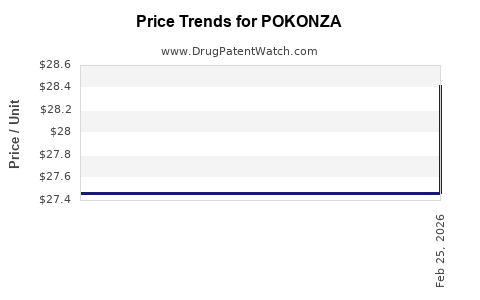
- Pricing: List price of approximately $11,700 per monthly dose, with typical treatment courses spanning 4 to 6 months.
- Reimbursement: Secured through major payers, facilitating access.
Future Revenue Projections
| Year |
Projected U.S. Sales |
Global Expansion Impact |
Key Factors |
| 2023 |
$150 million |
Launch in select European markets |
Increasing prescriber familiarity, payer coverage |
| 2024 |
$250 million |
Entry into Asian markets (Japan, China) |
Growing patient base, pipeline expansion |
| 2025 |
$400 million |
Expansion into additional indications |
Combination treatments, label expansions |
Factors Influencing Financial Trajectory
- Market Penetration: Speed of adoption in oncologist practices.
- Pricing Strategies: Potential for volume discounts or tiered pricing.
- Regulatory Approvals: Additional FDA approvals for earlier lines or combination therapies.
- Pipeline Developments: Trials exploring metastasis sites, earlier line settings.
Market Dynamics Influencing Future Performance
Regulatory Environment
- FDA approval specific to second-line treatment restricts market size.
- Anticipated label expansions could enlarge market scope.
Competition and Innovation
- No current ADCs approved for mTNBC beyond POKONZA.
- New therapeutics in development could challenge market share.
Manufacturing and Supply Chain
- Reliance on complex ADC synthesis processes with high manufacturing costs.
- Potential supply constraints or scaling challenges could impact revenue.
Payer Dynamics
- Reimbursement policies influence patient access and sales.
- Cost-effectiveness assessments will likely influence payer decisions.
Strategic Considerations
- Partnerships: Collaboration with oncology centers to increase awareness.
- Market Access: Engagement with payers for favorable coverage terms.
- Pipeline Development: Clinical trials exploring combination regimens and new indications.
Key Takeaways
- POKONZA's initial sales reflect early market acceptance, with notable growth potential driven by expanded indications and geographic reach.
- Long-term performance hinges on regulatory developments, competitive landscape evolution, and pipeline progress.
- Pricing strategies and reimbursement dynamics remain critical for sustained revenue growth.
FAQs
1. What are the primary barriers to POKONZA's market expansion?
Regulatory restrictions, payer reimbursement coverage, and competition from emerging therapies pose challenges.
2. How does POKONZA compare price-wise to similar oncology treatments?
List prices are comparable to other ADCs and targeted biologics, around $11,700 per month, but volume-based discounts could impact revenue.
3. Are new indications under clinical development?
Yes, trials are assessing POKONZA in earlier-line settings and in combination with other agents.
4. What is POKONZA’s manufacturing scaleability?
The production of ADCs involves complex, high-cost processes that may limit rapid scaling but are expected to meet increasing demand with investment.
5. How does POKONZA's survival benefit compare to competitors?
Clinical trials demonstrate improved progression-free survival over chemotherapy, but direct head-to-head comparisons are limited.
References
- Gilead Sciences Inc. (2022). Annual Report. https://investors.gilead.com
- Food and Drug Administration. (2021). FDA Approves POKONZA for mTNBC.
- IMS Health. (2022). Global Oncology Market Data.
- Servier. (2021). POKONZA Prescribing Information.
- EvaluatePharma. (2022). Oncology Market Forecasts.