Last updated: September 7, 2026
Penicillin V potassium is a mature, off-patent oral antibiotic with minimal brand value, low pricing power, and broad generic supply. Its commercial outlook is driven by prescription volume, procurement contracts, manufacturing reliability, and periodic antibiotic shortages rather than innovation or exclusivity. No active U.S. composition patent or meaningful Orange Book patent estate protects the molecule. Product-level revenue is generally not disclosed because sales are fragmented across generic manufacturers.
What is the current market position of penicillin V potassium?
Penicillin V potassium, also called phenoxymethylpenicillin, is an oral narrow-spectrum penicillin. It is supplied primarily as 250 mg and 500 mg tablets and as powder for oral solution. The product is used for susceptible streptococcal infections, selected pneumococcal infections, fusospirochetal oral infections, and prevention of recurrence of rheumatic fever, subject to labeling and clinical judgment.[1]
The U.S. market has the characteristics of a mature generic antibiotic:
| Market factor |
Penicillin V potassium position |
| Product type |
Small-molecule oral generic |
| Therapeutic category |
Narrow-spectrum penicillin antibiotic |
| U.S. brand position |
No material active branded franchise |
| Patent protection |
No meaningful active composition patent |
| FDA pathway |
Abbreviated New Drug Applications and legacy approvals |
| Dosage forms |
Tablets and oral solution |
| Primary buyers |
Retail pharmacies, hospitals, clinics, public purchasers |
| Pricing power |
Low |
| Substitution risk |
High from penicillin alternatives and other antibiotics |
| Revenue disclosure |
Usually not reported separately by manufacturers |
| Main commercial risk |
Supply interruption and low-margin manufacturing |
The drug remains clinically relevant because penicillin continues to be recommended for group A streptococcal pharyngitis. CDC guidance identifies penicillin or amoxicillin as preferred treatments for confirmed group A streptococcal pharyngitis.[2] Penicillin V potassium also remains important where a narrow-spectrum oral penicillin is clinically preferred over broader-spectrum antibiotics.
How large is the penicillin V potassium market?
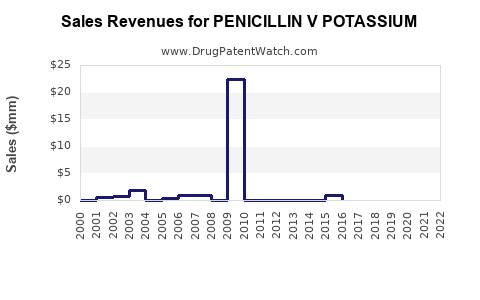
No authoritative public source reports a consolidated global or U.S. revenue figure for penicillin V potassium alone. Generic manufacturers usually combine the product with broader antibiotic portfolios, and prescription databases may group tablet strengths, oral solution, and multiple National Drug Codes under separate product records.
The market is best characterized as a low-value, unit-driven segment:
- Demand is recurring but limited by the narrow range of indications.
- Treatment courses are generally short, restricting revenue per patient.
- Multiple manufacturers compete on price.
- Pharmacies and health systems can substitute among approved suppliers.
- Public-health demand can rise during outbreaks of streptococcal disease or supply disruptions affecting alternatives.
The financial trajectory is therefore structurally mature rather than growth-oriented. Volume can remain stable while nominal revenue declines because generic prices fall. Short-term revenue spikes can occur when a competitor exits the market or when wholesalers build inventory during a shortage. Those increases are usually temporary and do not create durable pricing power.
What is the FDA regulatory status of penicillin V potassium?
Penicillin V potassium is an FDA-approved generic active ingredient marketed in several dosage forms. FDA labeling covers tablets and oral solution products, with dosing adjusted by infection type, patient age, renal function, and clinical circumstances.[1]
FDA regulatory characteristics
| Regulatory issue |
Status |
| FDA approval pathway |
Primarily ANDA-based generic approvals |
| Reference product |
Historical penicillin V potassium products and approved reference listings |
| Prescription status |
Prescription medicine |
| Controlled substance status |
Not a controlled substance |
| Pediatric use |
Labeling includes pediatric dosing provisions |
| Oral solution |
Approved product format, commonly supplied as powder for reconstitution |
| Therapeutic equivalence |
Product-specific and manufacturer-specific in FDA records |
| New chemical entity exclusivity |
None |
| Orphan exclusivity |
None identified |
| Pediatric exclusivity |
No material current exclusivity associated with the active ingredient |
FDA’s Orange Book identifies approved drug products, therapeutic-equivalence information, and any applicable listed patents or exclusivity. For an old generic antibiotic such as penicillin V potassium, the commercial significance of the Orange Book is primarily product substitution and approval status, not patent control.[3]
What patents protect penicillin V potassium?
No active U.S. composition-of-matter patent protects penicillin V potassium. The compound was developed and commercialized many decades ago, placing any original patent rights far beyond their enforceable term.
Potentially relevant intellectual property can arise in three areas:
| IP category |
Commercial relevance |
| Composition patent |
Expired |
| Basic therapeutic-use patent |
Expired or commercially irrelevant |
| Tablet or liquid formulation patent |
No material current barrier identified for standard products |
| Manufacturing process patent |
Any historical rights are expired; process know-how may remain confidential |
| Packaging or reconstitution system |
Usually limited and unlikely to block generic supply |
| Brand or trade dress |
May protect names or packaging, not the active ingredient |
The absence of a meaningful patent estate means a manufacturer can enter if it satisfies FDA requirements for chemistry, manufacturing, controls, bioequivalence, stability, labeling, and current good manufacturing practices.
When does penicillin V potassium lose exclusivity?
Penicillin V potassium lost practical market exclusivity decades ago. There is no relevant future loss-of-exclusivity date comparable to a branded product with an active composition patent.
Exclusivity timeline
| Event |
Approximate status |
| Original penicillin V development |
Mid-20th century |
| Original patent protection |
Expired decades ago |
| U.S. generic availability |
Established for many years |
| Current regulatory exclusivity |
None of commercial significance |
| Future patent cliff |
None |
| Generic launch risk |
Continuous, subject to FDA approval and manufacturing economics |
The key distinction is between legal exclusivity and supply concentration. The drug has no meaningful legal exclusivity, but the number of commercially reliable suppliers can narrow if manufacturers discontinue low-margin products. That can create temporary shortages without restoring patent-based pricing power.
Are there Paragraph IV challenges involving penicillin V potassium?
A conventional Paragraph IV patent challenge is not a central commercial issue for penicillin V potassium. Paragraph IV certifications matter when an ANDA applicant seeks approval before expiration of listed patents covering a reference product. Penicillin V potassium lacks a commercially important current Orange Book patent barrier.
Accordingly:
- No patent-related delay is expected to govern ordinary generic entry.
- ANDA applicants do not need to defeat a valuable active ingredient patent to enter.
- The principal approval risks involve bioequivalence, manufacturing controls, facility compliance, stability, and product-specific FDA deficiencies.
- Litigation exposure is materially lower than for branded medicines with active formulation or method-of-use patents.
What formulations are protected by penicillin V potassium patents?
Standard penicillin V potassium formulations have limited patent defensibility. The common products are immediate-release tablets and oral solution prepared from powder. These dosage forms use established excipients and conventional manufacturing methods.
Tablet formulation
The tablet market is the more stable commercial segment. Tablets have lower handling complexity, longer shelf-life, and simpler distribution. Competition is typically based on:
- acquisition cost;
- wholesaler availability;
- bottle size;
- tablet strength;
- supply consistency; and
- formulary or purchasing-contract status.
Oral solution
The oral solution is commercially more vulnerable to supply disruption. Manufacturers must manage:
- powder stability;
- reconstitution instructions;
- flavoring and palatability;
- container-closure integrity;
- expiration dating after reconstitution;
- pediatric demand; and
- pharmacy preparation requirements.
These factors can create manufacturing and quality barriers without creating enforceable market exclusivity. Process know-how may differentiate suppliers operationally, but it does not prevent a qualified competitor from developing an equivalent product.
Which companies compete in the penicillin V potassium market?
Competition is fragmented across generic manufacturers, contract manufacturers, wholesalers, and regional suppliers. Product availability changes as companies discontinue low-volume presentations or transfer ANDAs.
The competitive set can include generic suppliers such as Teva, Hikma, Rising Pharmaceuticals, NorthStar Rx, and other FDA-approved or authorized distributors depending on the dosage form and active NDC listings. Manufacturer participation should be verified against current FDA NDC and Drugs@FDA records because commercial availability is not static.[4][5]
No company has a durable molecule-level monopoly. Competitive advantage comes from:
- maintaining an FDA-compliant manufacturing site;
- securing active pharmaceutical ingredient supply;
- preserving reliable inventory;
- offering both tablet strengths;
- supporting oral-solution demand;
- winning Medicaid, hospital, and group-purchasing contracts; and
- avoiding discontinuation after margin compression.
What is the financial trajectory for penicillin V potassium?
The financial profile is low revenue per prescription and limited strategic value. The product can generate useful portfolio revenue for a generic company but is unlikely to materially affect the financial results of a diversified pharmaceutical manufacturer.
Revenue drivers
Revenue is influenced by:
- annual prescription volume;
- average selling price;
- tablet-versus-liquid mix;
- payer and procurement channel;
- competitor exits;
- manufacturing utilization;
- raw-material costs; and
- temporary shortages of competing antibiotics.
Margin profile
Gross margin is pressured by the product’s low price and the cost of maintaining validated manufacturing capacity. Oral solution adds production and packaging complexity. A manufacturer may rationalize the product if net pricing falls below the cost of production, quality oversight, inventory, and distribution.
The financial trajectory can be summarized as follows:
| Period |
Expected market behavior |
| Historical |
Declining branded value and transition to generic supply |
| Mature generic phase |
Price compression and fragmented volume |
| Shortage periods |
Temporary price and volume increases |
| Long term |
Stable clinical demand, low nominal growth, possible supplier exits |
| Investment profile |
Defensive supply product, not an innovation asset |
There is no credible basis for assigning a high-growth valuation to penicillin V potassium alone. A manufacturer’s value derives from portfolio scale, manufacturing efficiency, and supply reliability rather than the molecule’s intellectual property.
What patent litigation affects penicillin V potassium?
No major active U.S. patent litigation is associated with a meaningful penicillin V potassium patent estate in the public FDA framework. The product lacks the patent characteristics that typically generate Hatch-Waxman litigation, such as:
- a recently approved reference product;
- an active composition patent;
- a listed extended-release formulation patent;
- a protected combination product; or
- a commercially significant method-of-use patent.
Potential disputes are more likely to concern manufacturing quality, product liability, procurement contracts, antitrust conduct, or supply obligations than patent validity or infringement.
What generic launch risks exist?
Generic entry is legally straightforward but operationally dependent on FDA compliance and commercial economics.
Primary launch risks
- FDA deficiencies involving analytical methods, stability, or manufacturing controls.
- Failure to demonstrate bioequivalence for the proposed dosage form.
- API sourcing or impurity-control problems.
- Limited demand relative to fixed manufacturing costs.
- Price erosion after multiple supplier approvals.
- Difficulty securing distribution for a low-value product.
- Shortage-related scrutiny if a supplier becomes a major source.
- Product discontinuation after margin deterioration.
The risk is therefore asymmetric. Entry barriers are low in legal terms, but sustaining supply can be difficult because the product may not justify dedicated capacity.
How does penicillin V potassium compare with amoxicillin?
Amoxicillin has a broader clinical market and stronger commercial demand. It is used across respiratory, ear, sinus, urinary, skin, and dental indications, while penicillin V potassium has a narrower role.
| Attribute |
Penicillin V potassium |
Amoxicillin |
| Spectrum |
Narrow |
Broader |
| Common use |
Streptococcal pharyngitis and selected infections |
Broad outpatient antibiotic use |
| Commercial volume |
Lower |
Higher |
| Substitution pressure |
High |
High, but larger demand base |
| Formulations |
Tablets and oral solution |
Capsules, tablets, chewables, suspension |
| Revenue potential |
Low |
Higher generic-market volume |
| Stewardship position |
Attractive when clinically appropriate |
Used more broadly, depending on indication |
Penicillin V potassium can retain clinical demand because narrow-spectrum therapy is preferred when appropriate. That clinical advantage does not translate into strong pricing power.
What is the geographic market outlook?
The drug has broad international utility because it is inexpensive, orally administered, and established in clinical practice. Market economics differ by region:
- In the United States, private-label generic competition and pharmacy substitution dominate.
- In Europe, national reimbursement and tender systems place strong pressure on price.
- In lower-income markets, procurement contracts and API access are more important than brand recognition.
- In public-health systems, continuity of supply can matter more than manufacturer differentiation.
Geographic expansion does not create a new patent opportunity. It creates incremental volume subject to local registration, pharmacopoeial standards, procurement rules, and manufacturing documentation.
Key Takeaways
- Penicillin V potassium is a mature, off-patent oral antibiotic.
- No meaningful active U.S. composition patent or regulatory exclusivity protects the molecule.
- Orange Book relevance is limited to approved products and therapeutic-equivalence information.
- Paragraph IV litigation and patent-based launch delays are not major commercial risks.
- The market is low-priced, fragmented, and volume-driven.
- Tablet products are operationally simpler than oral solution.
- Revenue is rarely disclosed at the molecule level and is unlikely to be material for diversified manufacturers.
- The main financial risks are price erosion, supplier exits, API disruption, and FDA manufacturing issues.
- Demand should remain clinically durable but commercially modest.
- Competitive advantage depends on reliable supply, low-cost manufacturing, and distribution access.
FAQs
Is penicillin V potassium still profitable for generic manufacturers?
It can provide portfolio revenue, but profitability depends on manufacturing scale, procurement pricing, and supply reliability. The product is unlikely to generate substantial standalone earnings.
Does penicillin V potassium have an Orange Book patent expiration date?
No commercially important current patent expiration date governs generic entry. The original patent protection expired decades ago.
Can a new company launch penicillin V potassium without a patent license?
Yes, provided the company obtains the required FDA approval and complies with manufacturing, bioequivalence, labeling, and quality requirements.
Why can penicillin V potassium experience shortages if multiple generics exist?
Manufacturers may discontinue low-margin products, leaving fewer reliable suppliers. API shortages, facility issues, quality investigations, and limited production capacity can then disrupt distribution.
Is penicillin V potassium a biosimilar-risk product?
No. It is a small-molecule generic, not a biologic. Biosimilar legislation and biologic exclusivity rules do not govern its market entry.
References
-
U.S. Food and Drug Administration. (n.d.). Penicillin V potassium prescribing information. Drugs@FDA and approved product labeling. https://www.accessdata.fda.gov/scripts/cder/daf/
-
Centers for Disease Control and Prevention. (2024). Clinical guidance for group A streptococcal pharyngitis. https://www.cdc.gov/group-a-strep/hcp/clinical-guidance/strep-throat.html
-
U.S. Food and Drug Administration. (2024). Approved drug products with therapeutic equivalence evaluations: Orange Book. https://www.fda.gov/drugs/drug-approvals-and-databases/approved-drug-products-therapeutic-equivalence-evaluations-orange-book
-
U.S. Food and Drug Administration. (2024). Drugs@FDA: FDA-approved drugs. https://www.accessdata.fda.gov/scripts/cder/daf/
-
U.S. Food and Drug Administration. (2024). National Drug Code Directory. https://www.fda.gov/drugs/drug-approvals-and-databases/national-drug-code-directory