PARSABIV Drug Patent Profile
✉ Email this page to a colleague
Which patents cover Parsabiv, and what generic alternatives are available?
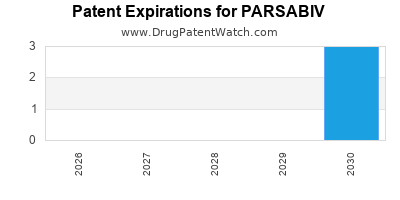
Parsabiv is a drug marketed by Kai Pharms Inc and is included in one NDA. There are eight patents protecting this drug and one Paragraph IV challenge.
The generic ingredient in PARSABIV is etelcalcetide. There is one drug master file entry for this compound. One supplier is listed for this compound. Additional details are available on the etelcalcetide profile page.
DrugPatentWatch® Generic Entry Outlook for Parsabiv
Parsabiv was eligible for patent challenges on February 7, 2021.
By analyzing the patents and regulatory protections it appears that the earliest date
for generic entry will be June 27, 2034. This may change due to patent challenges or generic licensing.
There have been six patent litigation cases involving the patents protecting this drug, indicating strong interest in generic launch. Recent data indicate that 63% of patent challenges are decided in favor of the generic patent challenger and that 54% of successful patent challengers promptly launch generic drugs.
Indicators of Generic Entry
AI Deep Research
Questions you can ask:
- What is the 5 year forecast for PARSABIV?
- What are the global sales for PARSABIV?
- What is Average Wholesale Price for PARSABIV?
Summary for PARSABIV
| US Patents: | 8 |
| Applicants: | 1 |
| NDAs: | 1 |
| Finished Product Suppliers / Packagers: | 1 |
| Raw Ingredient (Bulk) Api Vendors: | 24 |
| Clinical Trials: | 4 |
| Drug Prices: | Drug price information for PARSABIV |
| Patent Litigation and PTAB cases: | See patent lawsuits and PTAB cases for PARSABIV |
| What excipients (inactive ingredients) are in PARSABIV? | PARSABIV excipients list |
| DailyMed Link: | PARSABIV at DailyMed |

DrugPatentWatch® Estimated Loss of Exclusivity (LOE) Date for PARSABIV
Generic Entry Date for PARSABIV*:
Constraining patent/regulatory exclusivity:
NDA:
Dosage:
SOLUTION;INTRAVENOUS |
*The generic entry opportunity date is the latter of the last compound-claiming patent and the last regulatory exclusivity protection. Many factors can influence early or later generic entry. This date is provided as a rough estimate of generic entry potential and should not be used as an independent source.
Recent Clinical Trials for PARSABIV
Identify potential brand extensions & 505(b)(2) entrants
| Sponsor | Phase |
|---|---|
| Prim. Priv. Doz. Dr. Daniel Cejka | Phase 2 |
| Amgen | Phase 2 |
| Amgen | Phase 3 |
Pharmacology for PARSABIV
| Drug Class | Calcium-sensing Receptor Agonist |
| Mechanism of Action | Increased Calcium-sensing Receptor Sensitivity |
Paragraph IV (Patent) Challenges for PARSABIV
| Tradename | Dosage | Ingredient | Strength | NDA | ANDAs Submitted | Submissiondate |
|---|---|---|---|---|---|---|
| PARSABIV | Injection | etelcalcetide | 2.5 mg/0.5 mL 5 mg/mL 10 mg/2 mL | 208325 | 2 | 2021-02-08 |
US Patents and Regulatory Information for PARSABIV
PARSABIV is protected by eight US patents.
Based on analysis by DrugPatentWatch, the earliest date for a generic version of PARSABIV is ⤷ Start Trial.
This potential generic entry date is based on patent 9,820,938.
Generics may enter earlier, or later, based on new patent filings, patent extensions, patent invalidation, early generic licensing, generic entry preferences, and other factors.
| Applicant | Tradename | Generic Name | Dosage | NDA | Approval Date | TE | Type | RLD | RS | Patent No. | Patent Expiration | Product | Substance | Delist Req. | Exclusivity Expiration |
|---|---|---|---|---|---|---|---|---|---|---|---|---|---|---|---|
| Kai Pharms Inc | PARSABIV | etelcalcetide | SOLUTION;INTRAVENOUS | 208325-001 | Feb 7, 2017 | RX | Yes | Yes | 8,999,932 | ⤷ Start Trial | Y | Y | ⤷ Start Trial | ||
| Kai Pharms Inc | PARSABIV | etelcalcetide | SOLUTION;INTRAVENOUS | 208325-003 | Feb 7, 2017 | RX | Yes | Yes | 9,701,712 | ⤷ Start Trial | Y | Y | ⤷ Start Trial | ||
| Kai Pharms Inc | PARSABIV | etelcalcetide | SOLUTION;INTRAVENOUS | 208325-003 | Feb 7, 2017 | RX | Yes | Yes | 8,377,880 | ⤷ Start Trial | Y | Y | ⤷ Start Trial | ||
| Kai Pharms Inc | PARSABIV | etelcalcetide | SOLUTION;INTRAVENOUS | 208325-001 | Feb 7, 2017 | RX | Yes | Yes | 9,820,938 | ⤷ Start Trial | Y | ⤷ Start Trial | |||
| Kai Pharms Inc | PARSABIV | etelcalcetide | SOLUTION;INTRAVENOUS | 208325-001 | Feb 7, 2017 | RX | Yes | Yes | 10,344,765 | ⤷ Start Trial | Y | ⤷ Start Trial | |||
| Kai Pharms Inc | PARSABIV | etelcalcetide | SOLUTION;INTRAVENOUS | 208325-002 | Feb 7, 2017 | RX | Yes | Yes | 8,377,880 | ⤷ Start Trial | Y | Y | ⤷ Start Trial | ||
| Kai Pharms Inc | PARSABIV | etelcalcetide | SOLUTION;INTRAVENOUS | 208325-003 | Feb 7, 2017 | RX | Yes | Yes | 9,278,995 | ⤷ Start Trial | Y | ⤷ Start Trial | |||
| >Applicant | >Tradename | >Generic Name | >Dosage | >NDA | >Approval Date | >TE | >Type | >RLD | >RS | >Patent No. | >Patent Expiration | >Product | >Substance | >Delist Req. | >Exclusivity Expiration |
EU/EMA Drug Approvals for PARSABIV
| Company | Drugname | Inn | Product Number / Indication | Status | Generic | Biosimilar | Orphan | Marketing Authorisation | Marketing Refusal |
|---|---|---|---|---|---|---|---|---|---|
| Amgen Europe B.V. | Parsabiv | etelcalcetide | EMEA/H/C/003995Parsabiv is indicated for the treatment of secondary hyperparathyroidism (SHPT) in adult patients with chronic kidney disease (CKD) on haemodialysis therapy. | Authorised | no | no | no | 2016-11-11 | |
| >Company | >Drugname | >Inn | >Product Number / Indication | >Status | >Generic | >Biosimilar | >Orphan | >Marketing Authorisation | >Marketing Refusal |
International Patents for PARSABIV
When does loss-of-exclusivity occur for PARSABIV?
Based on analysis by DrugPatentWatch, the following patents block generic entry in the countries listed below:
Argentina
Patent: 6773
Patent: FORMULACIÓN LÍQUIDA ESTABLE
Estimated Expiration: ⤷ Start Trial
Australia
Patent: 14302122
Patent: Stable liquid formulation of AMG 416 (Velcalcetide)
Estimated Expiration: ⤷ Start Trial
Brazil
Patent: 2015032615
Patent: formulação líquida estável de amg 416 (velcalcetida)
Estimated Expiration: ⤷ Start Trial
Canada
Patent: 16222
Patent: FORMULATION LIQUIDE STABLE D'AMG 416 (VELCALCETIDE) (STABLE LIQUID FORMULATION OF AMG 416 (VELCALCETIDE))
Estimated Expiration: ⤷ Start Trial
Chile
Patent: 15003738
Patent: Formulación líquida estable de amg-416 (velcalcetida)
Estimated Expiration: ⤷ Start Trial
China
Patent: 5764487
Patent: AMG 416(VELCALCETIDE)的稳定的液体制剂 (STABLE LIQUID FORMULATION OF AMG 416 (VELCALCETIDE))
Estimated Expiration: ⤷ Start Trial
Patent: 4376970
Patent: Etelcalcetide (AMG 416)的稳定的液体制剂 (Stable liquid formulations of Etelcalcetide (AMG 416))
Estimated Expiration: ⤷ Start Trial
Costa Rica
Patent: 160002
Patent: FORMULACIÓN ESTABLE LÍQUIDA DE ETELCALCETIDE (AMG 461)
Estimated Expiration: ⤷ Start Trial
Patent: 160061
Patent: FORMULACIÓN ESTABLE LÍQUIDA DE ETELCALCETIDE (AMG 461)
Estimated Expiration: ⤷ Start Trial
Croatia
Patent: 0171092
Estimated Expiration: ⤷ Start Trial
Cyprus
Patent: 20811
Estimated Expiration: ⤷ Start Trial
Denmark
Patent: 13318
Estimated Expiration: ⤷ Start Trial
Eurasian Patent Organization
Patent: 0220
Patent: УСТОЙЧИВАЯ ЖИДКАЯ КОМПОЗИЦИЯ, СОДЕРЖАЩАЯ AMG-416 (ЭТЕЛКАЛЦЕТИД) (STABLE LIQUID FORMULATION OF AMG 416 (VELCALCETIDE))
Estimated Expiration: ⤷ Start Trial
Patent: 1690099
Patent: УСТОЙЧИВАЯ ЖИДКАЯ КОМПОЗИЦИЯ, СОДЕРЖАЩАЯ AMG-416 (ВЕЛКАЛЬЦЕТИД)
Estimated Expiration: ⤷ Start Trial
European Patent Office
Patent: 13318
Patent: FORMULATION LIQUIDE STABLE D'AMG 416 (VELCALCÉTIDE) (STABLE LIQUID FORMULATION OF AMG 416 (VELCALCETIDE))
Estimated Expiration: ⤷ Start Trial
Patent: 46017
Patent: FORMULATION LIQUIDE STABLE D'AMG 416 HCL (ETELCALCETIDE) (STABLE LIQUID FORMULATION OF AMG 416 HCL (ETELCALCETIDE))
Estimated Expiration: ⤷ Start Trial
Patent: 78433
Patent: FORMULATION LIQUIDE STABLE D'AGONISTES PEPTIDIQUES DE SENSIBILISATEUR DE RECEPTEUR DE CALCIUM (STABLE LIQUID FORMULATION OF CALCIUM SENSING RECEPTOR PEPTIDE AGONISTS)
Estimated Expiration: ⤷ Start Trial
Hong Kong
Patent: 22557
Patent: 的穩定的液體製劑 (STABLE LIQUID FORMULATION OF AMG 416 (VELCALCETIDE) AMG 416(VELCALCETIDE))
Estimated Expiration: ⤷ Start Trial
Hungary
Patent: 34209
Estimated Expiration: ⤷ Start Trial
Israel
Patent: 3210
Patent: פורמולציה רוקחית יציבה של amg416(וולקלצטיד) (Stable liquid formulation of amg 416(velcalcetide))
Estimated Expiration: ⤷ Start Trial
Japan
Patent: 27708
Estimated Expiration: ⤷ Start Trial
Patent: 16523916
Patent: 安定な液体製剤
Estimated Expiration: ⤷ Start Trial
Jordan
Patent: 17
Patent: تركيبة سائلة مستقرة ل " AMG 416 " (فيلكالسيتيد) (STABLE LIQUID FORMULATION OF AMG 416 (VELCALCETIDE))
Estimated Expiration: ⤷ Start Trial
Lithuania
Patent: 13318
Estimated Expiration: ⤷ Start Trial
Malaysia
Patent: 0276
Estimated Expiration: ⤷ Start Trial
Mexico
Patent: 15017952
Estimated Expiration: ⤷ Start Trial
Montenegro
Patent: 818
Estimated Expiration: ⤷ Start Trial
Morocco
Patent: 724
Patent: Formulation liquide stable d'amg 416 (velcalcétide)
Estimated Expiration: ⤷ Start Trial
New Zealand
Patent: 5403
Estimated Expiration: ⤷ Start Trial
Peru
Patent: 160549
Estimated Expiration: ⤷ Start Trial
Patent: 210413
Estimated Expiration: ⤷ Start Trial
Philippines
Patent: 015502816
Estimated Expiration: ⤷ Start Trial
Poland
Patent: 13318
Estimated Expiration: ⤷ Start Trial
Portugal
Patent: 13318
Estimated Expiration: ⤷ Start Trial
Serbia
Patent: 238
Estimated Expiration: ⤷ Start Trial
Singapore
Patent: 201510647T
Estimated Expiration: ⤷ Start Trial
Slovenia
Patent: 13318
Estimated Expiration: ⤷ Start Trial
South Africa
Patent: 1600238
Estimated Expiration: ⤷ Start Trial
South Korea
Patent: 2231957
Estimated Expiration: ⤷ Start Trial
Patent: 160043954
Patent: 에텔칼세타이드(AMG 416)의 안정한 액체 제형 (STABLE LIQUID FORMULATION OF AMG 416(VELCALCETIDE))
Estimated Expiration: ⤷ Start Trial
Spain
Patent: 33989
Estimated Expiration: ⤷ Start Trial
Taiwan
Patent: 1542239
Estimated Expiration: ⤷ Start Trial
Patent: 35874
Estimated Expiration: ⤷ Start Trial
Tunisia
Patent: 15000569
Estimated Expiration: ⤷ Start Trial
Ukraine
Patent: 5373
Estimated Expiration: ⤷ Start Trial
Uruguay
Patent: 636
Estimated Expiration: ⤷ Start Trial
Generics may enter earlier, or later, based on new patent filings, patent extensions, patent invalidation, early generic licensing, generic entry preferences, and other factors.
See the table below for additional patents covering PARSABIV around the world.
| Country | Patent Number | Title | Estimated Expiration |
|---|---|---|---|
| Argentina | 096773 | ⤷ Start Trial | |
| Australia | 2014302122 | ⤷ Start Trial | |
| Brazil | 112015032615 | ⤷ Start Trial | |
| Canada | 2916222 | ⤷ Start Trial | |
| Chile | 2015003738 | ⤷ Start Trial | |
| China | 105764487 | ⤷ Start Trial | |
| China | 114376970 | ⤷ Start Trial | |
| >Country | >Patent Number | >Title | >Estimated Expiration |
Supplementary Protection Certificates for PARSABIV
| Patent Number | Supplementary Protection Certificate | SPC Country | SPC Expiration | SPC Description |
|---|---|---|---|---|
| 2459208 | PA2017007 | Lithuania | ⤷ Start Trial | PRODUCT NAME: ETELKALCETIDAS ARBA JO DRUSKA, ISKAITANT ETELKALCETIDO HIDROCHLORIDA; REGISTRATION NO/DATE: EU/1/16/1142 20161111 |
| 2459208 | 300864 | Netherlands | ⤷ Start Trial | PRODUCT NAME: ETELCALCETIDE; REGISTRATION NO/DATE: EU/1/16/1142/001-012 20161115 |
| 2459208 | 122017000021 | Germany | ⤷ Start Trial | PRODUCT NAME: ETELCALCETID ODER EIN SALZ DAVON, EINSCHLIESSLICH ETELCALCETIDHYDROCHLORID; AUTHORISATION NO/DATE: EU/1/16/1142 20161111 |
| 2459208 | C20170006 00208 | Estonia | ⤷ Start Trial | PRODUCT NAME: ETELKALTSETIID;REG NO/DATE: EU/1/16/1142 15.11.2016 |
| 2459208 | CA 2017 00006 | Denmark | ⤷ Start Trial | PRODUCT NAME: ETELCALCETID ELLER ET SALT DERAF, INKLUSIV ETELCALCETIDHYDROCHLORID; REG. NO/DATE: EU/1/16/1142/001-012 20161115 |
| 2459208 | 8/2017 | Austria | ⤷ Start Trial | PRODUCT NAME: ETELCALCETID ODER EIN SALZ DAVON EINSCHLIESSLICH ETELCALCETID HYDROCHLORID; REGISTRATION NO/DATE: EU/1/16/1142 (MITTEILUNG) 20161115 |
| 2459208 | LUC00008 | Luxembourg | ⤷ Start Trial | PRODUCT NAME: ETELCALCETIDE, OU UN SEL EQUIVALENT, Y COMPRIS LE CHLORHYDRATE D'ETELCALCETIDE (PARSABIV); AUTHORISATION NUMBER AND DATE: EU/1/16/1142 20161115 |
| >Patent Number | >Supplementary Protection Certificate | >SPC Country | >SPC Expiration | >SPC Description |
More… ↓
DrugChatter Q&A for PARSABIV
Make Better Decisions: Try a trial or see plans & pricing
Drugs may be covered by multiple patents or regulatory protections. All trademarks and applicant names are the property of their respective owners or licensors. Although great care is taken in the proper and correct provision of this service, thinkBiotech LLC does not accept any responsibility for possible consequences of errors or omissions in the provided data. The data presented herein is for information purposes only. There is no warranty that the data contained herein is error free. We do not provide individual investment advice. This service is not registered with any financial regulatory agency. The information we publish is educational only and based on our opinions plus our models. By using DrugPatentWatch you acknowledge that we do not provide personalized recommendations or advice. thinkBiotech performs no independent verification of facts as provided by public sources nor are attempts made to provide legal or investing advice. Any reliance on data provided herein is done solely at the discretion of the user. Users of this service are advised to seek professional advice and independent confirmation before considering acting on any of the provided information. thinkBiotech LLC reserves the right to amend, extend or withdraw any part or all of the offered service without notice.
ISSN: 2162-2639

Privacy and Cookies
Terms & Conditions
Site Map
DrugPatentWatch Alternatives
LOE / Major Patent Expirations 2026 - 2027
NCE-1 Patent Challenge Dates 2026 - 2027
Friedman, Yali. "DrugPatentWatch" DrugPatentWatch, thinkBiotech, 2026, www.DrugPatentWatch.com.
See Primary Research Papers Citing DrugPatentWatch