Last updated: July 29, 2026
OXAYDO (oxycodone hydrochloride; abuse-deterrent extended-release opioid) has had weak commercial momentum versus other ER oxycodone products. Its financial trajectory has been constrained by opioid-category contracting demand, payer and formulary pressure, and competitive substitution within the extended-release oxycodone class. From an IP and regulatory standpoint, the product’s exclusivity stack and Orange Book status define the timing and likelihood of generic erosion, with Paragraph IV litigation and entry pathways shaping near- and mid-term revenue risk.
What is OXAYDO (oxycodone HCl) and what is its commercial positioning?
Answer: OXAYDO is an extended-release (ER) oral oxycodone formulation in the opioid analgesic class, marketed with abuse-deterrent positioning. Commercial positioning has relied on payer acceptance in ER opioid segments and on differentiation claims tied to abuse-deterrent design. Demand has been pressured by broader opioid utilization management and substitution across ER oxycodone competitors.
Product specifics that drive market behavior
- Therapeutic class: opioid analgesic; ER schedule II product (oxycodone).
- Formulation type: ER oral oxycodone designed for sustained analgesia.
- Key market driver: ER oxycodone share is determined more by formulary status and cost per morphine milligram equivalent (MME) than by incremental clinical differentiation.
Where OXAYDO competes
OXAYDO competes with ER oxycodone brands and authorized generics within payer step therapy and preferred drug lists. Market share movement in this segment typically tracks:
- formulary removals or restriction edits,
- contracting outcomes tied to net pricing,
- and substitution by lower net-cost alternatives (including generics).
How is the opioid ER market evolving and what does that mean for OXAYDO?
Answer: The ER opioid market has faced structural demand headwinds from opioid stewardship policies, declining new prescriptions for opioids, tighter day supply limits, and payer-driven restriction. These trends reduce the addressable volume for all ER oxycodone brands, including OXAYDO.
Demand and utilization trends affecting branded ER opioids
- Formulary tightening: payers increasingly use prior authorization (PA), quantity limits, or requirement for prior therapy.
- Shift away from higher-cost brands: even where ER therapy remains, payers favor lower net-cost options.
- Class substitution: when a branded ER opioid is restricted, prescribers frequently switch within the same class.
Competitive implications for OXAYDO
When the total category “pie” shrinks and brand-to-generic substitution accelerates, weaker brands tend to lose share faster. OXAYDO’s market dynamics therefore hinge on whether it maintains:
- preferred status on commercial formularies,
- coverage without PA escalation,
- and net pricing resilience versus lower-cost ER competitors.
What are the price and net revenue dynamics for OXAYDO?
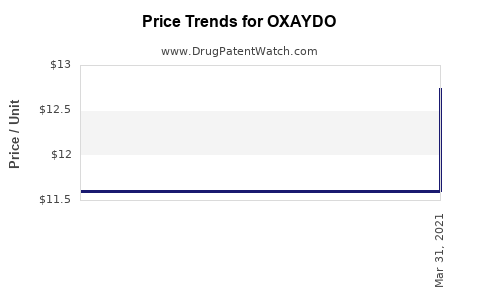
Answer: Branded ER opioxcodone products typically show declining net pricing over time due to discounting, contract pressure, and generic reference pricing. OXAYDO’s financial trajectory should be evaluated against category net price trend and formulary placement effects rather than gross list price alone.
Net pricing mechanics in ER oxycodone
- PBM contracting: price concessions drive net revenue and can swing sharply after formulary status changes.
- Reference pricing and AWP-relative benchmarks: as generics/authorized generics strengthen, branded products face additional contracting pressure.
- Mix effects: even if units hold, net sales can erode if higher-rebate channels grow.
What that implies for financial trajectory
If OXAYDO experienced any formulary degradation or increased utilization management, the expected outcome is:
- unit softness (lower volume growth or declines),
- net price compression (larger rebates/discounts),
- and margin pressure (higher SG&A per unit for maintaining coverage).
How does OXAYDO’s exclusivity and patent estate shape its revenue timeline?
Answer: OXAYDO’s revenue headroom depends on the expiration of listed Orange Book patents and any pediatric exclusivity, marketing exclusivity, and patent terms for specific formulations, manufacturing, and/or use. Generic entry risk accelerates as the last eligible exclusivity or enforceable patent barrier approaches.
Key timeline logic used in branded opioid commercialization
Branded ER opioids often face a “cliff” when:
- listed patents expire (or are invalidated/unenforceable),
- exclusivity periods end,
- and follow-on generics secure FDA approval and launch.
Patent and exclusivity status: what to check
For OXAYDO, the critical business question is not just “when patents expire,” but:
- which patents are listed for each dosage strength,
- whether there are multiple protection layers (composition, formulation, method of manufacturing, and method of use),
- whether any patents are still enforceable against FDA-approved generic products at launch.
What is the Orange Book status of OXAYDO and how does it affect generic entry timing?
Answer: Orange Book listings determine the timing of ANDA approvals and the risk of launch prior to patent expiry. For OXAYDO, the number and expiration dates of listed patents govern how long generics must wait or litigate to enter.
Business interpretation of Orange Book listings
- Many listed patents: increases litigation surface area and can delay or segment entry by strength.
- Few listed patents: can shorten the wait and increase generic probability of a near-term launch wave after expiration.
- Multiple patent “clusters” expiring at different dates: can cause staggered entry and revenue taper rather than a single-step collapse.
Launch-risk mapping framework
OXAYDO revenue risk is highest in periods where:
- the most protective patents expire soon,
- any paragraph IV litigation is active with a near-term scheduled decision,
- or exclusivity periods are close to ending.
What Paragraph IV challenges and ANDA litigation risks exist for OXAYDO?
Answer: Generic entry for OXAYDO depends on whether ANDA filers submitted Paragraph IV certifications and whether the cases are resolved by settlement, dismissal, or final judgment. These outcomes determine launch dates and “design-around” feasibility.
How Paragraph IV outcomes translate into financial impacts
- Favorable branded outcomes: sustain the revenue window; may trigger delayed generic launches.
- Favorable generic outcomes: compress the time-to-erosion for OXAYDO and force pricing responses.
- Settlement agreements: often produce early entry at defined dates in exchange for a dismissal; settlement terms drive the commercial calendar.
Key litigation documents that move revenue
- court schedules (Markman, summary judgment),
- settlement effective dates,
- permitted launch-to-date constraints (carve-outs by strength or dosage form),
- and any stipulations on patent non-infringement or invalidity.
How strong is the patent estate for OXAYDO across formulations and methods?
Answer: The strength of OXAYDO’s patent estate determines whether generics can launch via “same formulation” at expiry or whether they must navigate formulation and manufacturing IP barriers. Patent estate strength is measured by:
- diversity of claims (composition vs formulation vs method),
- legal survivability (prior court outcomes),
- and how many patents remain unexpired at key points in time.
What formulation and manufacturing protection typically covers
For ER opioids, formulation protection often targets:
- specific release profiles,
- abuse-deterrent mechanisms,
- polymer/ excipient selections controlling dissolution and/or integrity after manipulation.
Manufacturing patents often focus on:
- process parameters,
- granulation or compression methods controlling ER performance.
How does OXAYDO compare with other extended-release oxycodone products on market dynamics?
Answer: OXAYDO’s market performance should be benchmarked against ER oxycodone brands and authorized generics on three axes: net pricing, formulary coverage durability, and generic substitution speed after patent/exclusivity events.
Comparison factors that determine relative financial trajectory
- Preferred tier placement: brands with stable preferred status maintain higher unit share.
- Net-to-list ratio: stronger contracting can soften revenue erosion; weaker contracting accelerates decline.
- Generic timing: a shorter remaining exclusivity/patent horizon relative to competitors accelerates share loss.
Practical takeaway for competitive planning
If OXAYDO’s remaining exclusivity timeline is shorter than competing ER oxycodone brands, it should be treated as higher revenue-risk in long-range planning. Conversely, if OXAYDO holds longer remaining enforceable patents or has fewer generic launches, it can retain a comparatively longer commercial tail.
What are the FDA regulatory and labeling factors that influence OXAYDO sales?
Answer: FDA labeling, including abuse-deterrent claims and approved indications/dosing, affects prescriber comfort and payer policies. Any label or risk-management changes can shift utilization and coverage outcomes.
Regulatory factors that matter commercially
- Risk evaluation and mitigation strategy (if applicable): affects prescribing workflow and patient onboarding.
- Label restrictions or REMS-related prescribing burdens: can reduce uptake.
- Dosage strength breadth: wider strength portfolios can capture more patient segments, improving share stability if protected.
What generic entry risks exist for OXAYDO by dosage strength and jurisdiction?
Answer: Generic entry risk is dosage-strength specific in Orange Book frameworks and depends on certification and patent coverage per strength. Jurisdiction scope is driven by whether ANDA filers target US market launch and whether patents have enforceable coverage.
US launch mechanics that influence revenue exposure
- ANDA approval does not equal immediate launch.
- Launch timing depends on:
- patent expiry,
- litigation outcomes,
- settlement terms,
- and operational readiness.
Geographic exposure
For most branded opioid products, near-term financial exposure concentrates in the US due to:
- the Orange Book framework,
- the ANDA/Paragraph IV process,
- and US payer contracting cycles.
How does OXAYDO’s financial trajectory likely evolve around exclusivity and patent expiry?
Answer: The dominant revenue pattern in ER opioids is gradual erosion beginning months before launch, followed by faster share loss once generics launch, with lingering brand revenue sustained only by formulary inertia, patient-specific prescribing, and contractual mitigations.
Revenue trajectory shapes
- Pre-launch taper: slower unit growth or declines as prescribers and payers prepare for lower-cost options.
- Launch shock: sharp unit drop after generic market entry.
- Post-launch stabilization: residual brand sales persist if there is continued payer coverage in certain segments.
Financial planning implications
- expect worsening net sales decline rates as the last remaining enforceable barriers near expiry,
- forecast margin compression driven by higher rebate demands during transition periods.
Key datapoints to quantify OXAYDO’s trajectory (what matters in models)
Answer: For a financial and market-dynamics model, the inputs that most directly explain OXAYDO performance are coverage status and generic timeline, not only gross volume.
Model inputs to track
- Unit trends (scripts and tablets/kg equivalent by strength)
- Net sales (rebates and discounts effect)
- WAC/AWP vs net price gap changes
- Formulary tier movement (PA adoption, restriction broadening)
- Generic launch events (by strength)
- Litigation/settlement dates tied to launch permissions
Key Takeaways
- OXAYDO’s commercial performance is structurally constrained by opioid-category utilization management and competition within ER oxycodone.
- Revenue trajectory is primarily driven by formulary access and net pricing compression rather than list price.
- Orange Book patent listings and any Paragraph IV litigation outcomes define the generic launch calendar and the slope of revenue erosion.
- Financial models should treat OXAYDO as high sensitivity to exclusivity/patent expiry timing, with strongest revenue risk concentrated in the 6–24 months preceding the final enforceable barrier.
FAQs
- When do OXAYDO patents expire and which listed Orange Book patents control generic entry?
- Do ANDA Paragraph IV challenges to OXAYDO include settlements that change launch dates?
- Which OXAYDO strengths are most vulnerable to generic substitution based on Orange Book coverage?
- How does OXAYDO net pricing typically change after major formulary restrictions in commercial plans?
- How does OXAYDO’s abuse-deterrent positioning affect payer coverage and competitive substitution to generics?
References (APA)
- U.S. Food and Drug Administration. Orange Book: Approved Drug Products with Therapeutic Equivalence Evaluations. https://www.accessdata.fda.gov/scripts/cder/daf/
- U.S. Food and Drug Administration. Drug Approval Package and related labeling for OXAYDO. https://www.accessdata.fda.gov/scripts/cder/daf/