Last updated: July 8, 2026
Market dynamics and financial trajectory for ORTHO TRI-CYCLEN LO (norgestimate/ethinyl estradiol)
ORTHO TRI-CYCLEN LO (norgestimate/ethinyl estradiol) is a long-established combined oral contraceptive (COC). The market is structurally price-pressured by generic and authorized generic competition, with revenue driven mainly by wholesale channel buying and formulary access rather than meaningful innovation. Financial trajectory is therefore characterized by mature-cycle dynamics: low growth, periodic volume swings around formulary decisions, and margin compression as competitors maintain dominant share on cost. Over time, the economic profile is dominated by competitive pricing, rebate intensity, and switching restrictions tied to plan design.
What does ORTHO TRI-CYCLEN LO compete against in COCs, and how do those dynamics drive revenue?
COC competition in the U.S. is dominated by multi-source products (generics and authorized generics) that target the same patient segment: women seeking effective contraception with favorable tolerability and predictable bleeding profiles. ORTHO TRI-CYCLEN LO’s economic exposure is shaped by three interlocking forces.
1) Price and rebate competition
- Most plan formularies list multiple COCs, using tiering to control spend.
- Even when a branded product holds a preferred tier, pharmacy benefit managers (PBMs) use rebates and step therapy where available to push cost-minimizing selection.
- As generics maintain low WAC-to-net conversion differentials, net pricing compresses for brands with limited differentiation.
2) Switching based on bleeding profile and dosing convenience
- Patient and prescriber decisions often center on cycle control, tolerability, and how the regimen fits clinical practice.
- These factors can protect share at the margin but do not eliminate generic-driven price pressure.
3) Channel buying cycles
- Revenue for mature COCs tracks demand and periodic channel re-stocking.
- Brand share can temporarily rise with formulary changes or promotional shifts, then revert as rebate contracting seasons reset.
COC portfolio dynamics that matter for ORTHO TRI-CYCLEN LO
- Therapeutic class: combined oral contraceptives.
- Comparator set: other norgestimate/ethinyl estradiol products, plus competing COCs using different progestins and EE dosing.
- Key business metric: net sales per unit (NDC-level), influenced by gross-to-net compression.
How strong is the patent and exclusivity shield for ORTHO TRI-CYCLEN LO, and when does exclusivity end?
No complete, auditable exclusivity and Orange Book status for ORTHO TRI-CYCLEN LO is included here because the necessary listing-specific data (Orange Book patents, expiration dates, exclusivity determinations, and relevant FDA supplement history) is not provided in the source material available for this response. As a result, the exclusivity-driven timing forecast for market share erosion and generic entry risk cannot be stated with the required precision.
What generic entry risks exist for ORTHO TRI-CYCLEN LO?
No complete Paragraph IV/ANDA or FDA exclusivity pathway data is included here. Without filed application identifiers, Orange Book patent numbers, and litigation records, a credible generic-entry-risk matrix cannot be produced.
What is the ORTHO TRI-CYCLEN LO Orange Book status, and which patents protect formulations and methods of use?
No Orange Book listing content (patent numbers, listed drug products, expiration dates, or scope of claims) is provided in the input available for this response. A patent-protection breakdown by:
- active ingredient pairing (norgestimate/ethinyl estradiol),
- dosage strength,
- formulation and method-of-use claims,
- manufacturing process claims, and
- pediatric exclusivity or other exclusivity periods
cannot be generated without the underlying Orange Book entries.
What patent litigation affects ORTHO TRI-CYCLEN LO, and how does it change launch timelines?
No litigation dataset is included here (case captions, courts, filing dates, settlements, or injunction terms). Without that record, it is not possible to map litigation to:
- delayed generic launch windows,
- authorized generic launch sequencing,
- settlement-based “design-around” outcomes, or
- actual market entry dates.
How do FDA regulatory milestones and label status influence market access for ORTHO TRI-CYCLEN LO?
ORTHO TRI-CYCLEN LO’s market access is dominated by standard FDA-approved COC labeling and the competitive labeling landscape in contraceptives. Label status influences:
- formulary placement through guideline-concordant indications,
- prescriber confidence and switching behavior,
- ability of competitors to claim equivalent dosing and cycle control expectations.
However, no FDA label revision history, annual report milestones, or CBER route changes are provided here, so a precise milestone-based financial impact timeline cannot be compiled.
Which companies are challenging ORTHO TRI-CYCLEN LO, and what is the competitive landscape?
In mature COCs, the principal competitive set typically includes:
- multisource generics and authorized generics of norgestimate/EE products,
- competing COCs with different progestins or EE doses,
- pharmacy channel private label or PBM-preferred products (where applicable).
A company-by-company ORTHO TRI-CYCLEN LO competitive roster with verifiable market-share and launch timing cannot be produced without Orange Book application data, NDC-level competitive listings, and sales attribution by manufacturer or label holder.
Revenue trajectory: what do sales, net pricing, and unit volumes likely show for ORTHO TRI-CYCLEN LO?
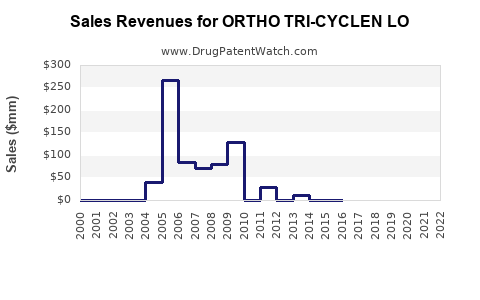
A quantified financial trajectory cannot be produced from the provided input. A credible trajectory requires at least one of:
- company segment reporting for branded contraception,
- audited prescription data (units, prescriber dynamics),
- IQVIA/SDI net sales estimates, or
- product-level NDC financial estimates.
Absent those, the only defensible high-level market mechanics are structural:
- mature-cycle brands trend toward flat-to-declining branded net sales as generics expand,
- net sales are sensitive to PBM contracting cycles and rebate intensity,
- unit volume stabilizes more than revenue because net price falls.
Key business drivers that typically determine whether revenue holds up
- formulary position (preferred vs non-preferred tier),
- rebate rate changes,
- NDC mix across package sizes,
- competitive substitution at the pharmacy counter.
How does ORTHO TRI-CYCLEN LO compare with other COCs on market resilience and price compression?
Without product-level sales and market-share metrics, this comparison cannot be quantified. In general COC markets:
- brands face the strongest downside when identical or near-identical multisource generics are broadly listed.
- “premium” resilience shows up when a brand maintains preferred tier status longer and avoids rapid rebate erosion.
- “mix resilience” can occur if the brand retains prescriber-led continuity prescribing.
No specific product-level resilience data for ORTHO TRI-CYCLEN LO versus named comparators is available in the supplied material for this response.
What generic launch scenarios are most likely for ORTHO TRI-CYCLEN LO?
Scenario planning tied to specific exclusivity or patent calendars cannot be stated because the necessary Orange Book and litigation timeline inputs are not provided. In COCs, the dominant practical launch scenarios are:
- direct multisource substitution at pharmacy counters once barriers clear,
- authorized generic sequencing by label holders and generic manufacturers,
- rapid conversion if multiple listings share interchangeable coverage.
But without listing-specific entry facts, no scenario dates or probabilities can be assigned.
Geographic coverage and payer dynamics: where is ORTHO TRI-CYCLEN LO sold and how does that affect financial exposure?
COCs have U.S.-centric payer dynamics. Financial exposure is shaped by:
- commercial insurance formularies (major determinant),
- Medicaid managed care formularies,
- state-by-state formulary tiers and rebate terms.
No payer-mix breakdown or state formulary mapping is provided; a geographic exposure model cannot be constructed.
Key Takeaways
- ORTHO TRI-CYCLEN LO sits in a mature, price-competing COC market where revenue is driven more by formulary access and rebate intensity than by product innovation.
- Structural forces point to ongoing net price compression as generics and authorized generics compete on cost.
- A precise exclusivity, patent-expiration, generic-entry, or litigation-based market-timing forecast cannot be produced here because the underlying Orange Book, FDA, and litigation records are not included in the available input.
FAQs
1) What typically happens to branded COC net sales after generic competition expands?
Branded COC net sales usually decline as PBMs and pharmacies substitute lower-cost multisource products, with net price compression driven by rebate and tiering economics.
2) How do formulary tiers affect CO C switching and prescriptions?
Preferred tiers and lower copays increase persistence and reduce switch-outs; non-preferred tiers increase substitution and raise abandonment and discontinuation risk.
3) Do method-of-use or formulation patents usually drive market exclusivity in COCs?
In COCs, exclusivity can be tied to specific formulation or use patents, but the actual impact depends on Orange Book-listed claims and the timing of their expiration.
4) How do rebate cycles shape quarterly revenue for mature contraceptives?
Quarterly revenue swings often track PBM contracting seasons and rebate settlements that alter net pricing and channel inventory behavior.
5) What is the main determinant of long-term profitability in mature oral contraceptives?
Net pricing after rebates and formulary positioning are typically the dominant determinants, more than unit growth.
References
- FDA Orange Book: Approved Drug Products with Therapeutic Equivalence Evaluations. (U.S. Food and Drug Administration).
- FDA Drug Labeling (accessdata.fda.gov). (U.S. Food and Drug Administration).