Last Updated: June 24, 2026

ORGOVYX Drug Patent Profile


✉ Email this page to a colleague

« Back to Dashboard


When do Orgovyx patents expire, and when can generic versions of Orgovyx launch?

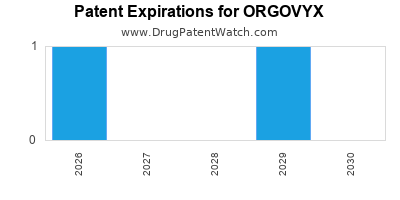
Orgovyx is a drug marketed by Sumitomo Pharma Am and is included in one NDA. There are eleven patents protecting this drug and one Paragraph IV challenge.

This drug has one hundred and ninety patent family members in thirty-seven countries.

The generic ingredient in ORGOVYX is relugolix. One supplier is listed for this compound. Additional details are available on the relugolix profile page.

DrugPatentWatch® Generic Entry Outlook for Orgovyx

Orgovyx was eligible for patent challenges on December 18, 2024.

By analyzing the patents and regulatory protections it appears that the earliest date for generic entry will be January 28, 2029. This may change due to patent challenges or generic licensing.

There have been seven patent litigation cases involving the patents protecting this drug, indicating strong interest in generic launch. Recent data indicate that 63% of patent challenges are decided in favor of the generic patent challenger and that 54% of successful patent challengers promptly launch generic drugs.

Indicators of Generic Entry

< Available with Subscription >

  Start Trial

AI Deep Research
Questions you can ask:
  • What is the 5 year forecast for ORGOVYX?
  • What are the global sales for ORGOVYX?
  • What is Average Wholesale Price for ORGOVYX?
DrugPatentWatch® Estimated Loss of Exclusivity (LOE) Date for ORGOVYX
Generic Entry Date for ORGOVYX*:
Constraining patent/regulatory exclusivity:
NDA:
Dosage:

TABLET;ORAL

*The generic entry opportunity date is the latter of the last compound-claiming patent and the last regulatory exclusivity protection. Many factors can influence early or later generic entry. This date is provided as a rough estimate of generic entry potential and should not be used as an independent source.

Recent Clinical Trials for ORGOVYX

Identify potential brand extensions & 505(b)(2) entrants

SponsorPhase
Sumitomo Pharmaceuticals AmericaPHASE2
PfizerPHASE2
Ohio State University Comprehensive Cancer CenterPHASE2

See all ORGOVYX clinical trials

Paragraph IV (Patent) Challenges for ORGOVYX
Tradename Dosage Ingredient Strength NDA ANDAs Submitted Submissiondate
ORGOVYX Tablets relugolix 120 mg 214621 6 2024-12-18

US Patents and Regulatory Information for ORGOVYX

ORGOVYX is protected by eleven US patents.

Based on analysis by DrugPatentWatch, the earliest date for a generic version of ORGOVYX is ⤷  Start Trial.

This potential generic entry date is based on patent 7,300,935.

Generics may enter earlier, or later, based on new patent filings, patent extensions, patent invalidation, early generic licensing, generic entry preferences, and other factors.

Applicant Tradename Generic Name Dosage NDA Approval Date TE Type RLD RS Patent No. Patent Expiration Product Substance Delist Req. Exclusivity Expiration
Sumitomo Pharma Am ORGOVYX relugolix TABLET;ORAL 214621-001 Dec 18, 2020 RX Yes Yes 12,144,809 ⤷  Start Trial ⤷  Start Trial
Sumitomo Pharma Am ORGOVYX relugolix TABLET;ORAL 214621-001 Dec 18, 2020 RX Yes Yes 7,300,935 ⤷  Start Trial Y ⤷  Start Trial
Sumitomo Pharma Am ORGOVYX relugolix TABLET;ORAL 214621-001 Dec 18, 2020 RX Yes Yes 12,097,198 ⤷  Start Trial ⤷  Start Trial
>Applicant >Tradename >Generic Name >Dosage >NDA >Approval Date >TE >Type >RLD >RS >Patent No. >Patent Expiration >Product >Substance >Delist Req. >Exclusivity Expiration

EU/EMA Drug Approvals for ORGOVYX

Company Drugname Inn Product Number / Indication Status Generic Biosimilar Orphan Marketing Authorisation Marketing Refusal
Accord Healthcare S.L.U. Orgovyx relugolix EMEA/H/C/005353Orgovyx is indicated for the treatment of adult patients with advanced hormone-sensitive prostate cancer. Authorised no no no 2022-04-29
>Company >Drugname >Inn >Product Number / Indication >Status >Generic >Biosimilar >Orphan >Marketing Authorisation >Marketing Refusal

Supplementary Protection Certificates for ORGOVYX

Patent Number Supplementary Protection Certificate SPC Country SPC Expiration SPC Description
1591446 CA 2021 00048 Denmark ⤷  Start Trial PRODUCT NAME: RELUGOLIX OR A SALT THEREOF; REG. NO/DATE: EU/1/21/1565 20210720
1591446 PA2021529 Lithuania ⤷  Start Trial PRODUCT NAME: RELUGOLIKSAS ARBA JO DRUSKA ; REGISTRATION NO/DATE: EU/1/21/1565 20210716
1591446 LUC00240 Luxembourg ⤷  Start Trial PRODUCT NAME: RELUGOLIX OU UN SEL DE CELUI-CI; AUTHORISATION NUMBER AND DATE: EU/1/21/1565 20210720
>Patent Number >Supplementary Protection Certificate >SPC Country >SPC Expiration >SPC Description

ORGOVYX (relugolix) Market Dynamics and Financial Trajectory: Uptake Drivers, Pricing Pressure, Competitive Landscape, and Exclusivity-to-Generic Risk

Last updated: June 14, 2026

ORGOVYX (relugolix; Myovant Sciences, Inc. and its affiliate Sumitomo Pharma; marketed with Pfizer for certain matters) is a targeted androgen receptor pathway therapy for advanced prostate cancer. Financial trajectory is shaped by (1) rapid early adoption in men receiving oral androgen deprivation therapy, (2) competitive substitution versus androgen deprivation therapy (ADT) using LHRH agonists, (3) payer and guideline positioning versus LHRH antagonists, and (4) exclusivity and patent-duration structure that delays generic entry. The near-term market dynamic is uptake and share shift within ADT-naïve and castration-resistant workflows, moderated by safety-driven prescribing, oral convenience, and payer formulary decisions. Longer term, share protection rests on IP and brand execution; revenue exposure depends on whether oral ADT maintains clinical differentiation and whether biosimilar and generic ADT classes or other oral agents compress pricing.

What patents protect ORGOVYX relugolix and how strong is the patent estate?

Featured snippet answer: ORGOVYX’s exclusivity and patent coverage is designed to block generic relugolix product entry for a period that runs beyond core regulatory marketing authorization. Patent strength is strongest around (a) drug substance and compositions, (b) specific formulations and manufacturing/solid state features, and (c) use claims tied to therapeutic regimens in prostate cancer.

Patent coverage map: what typically protects relugolix products

  • Drug substance: chemical structure claims for relugolix and stereochemical or structural variants.
  • Compositions and formulations: tablet composition, excipients, solid-state form, and dissolution/particle engineering.
  • Methods of treatment: dosing regimens in advanced prostate cancer, castration levels, and patient subsets.
  • Manufacturing: process and intermediate purification claims.

How strong is the estate in litigation-risk terms?

ORGOVYX’s estate must be evaluated as two layers:

  1. Regulatory exclusivity (data and marketing exclusivity): blocks abbreviated new drug applications in the early post-approval period even if patents were challenged.
  2. Patent thicket in the Orange Book: controls the real-world timing of generic substitution through listed patents and Paragraph IV pressure points.

When does ORGOVYX lose exclusivity and what generic entry risks exist?

Featured snippet answer: ORGOVYX’s generic and label-expansion risk accelerates after the later of patent expirations and any exclusivity end dates tied to the NDA and listed Orange Book protections. Generic entry risk is highest if multiple Orange Book-listed patents expire on different dates and if challengers win early against the most protective patents.

Exclusivity and patent-expiration timeline drivers

  • NDA approval date and exclusivity start: drives data exclusivity end.
  • Hatch-Waxman Orange Book patent list: determines when a generic can launch “at risk” after patent expiration (or settlement).
  • Evergreening patents: formulation and method-of-use claims can extend effective exclusivity even when early core substance claims expire.

Paragraph IV challenge pattern: what matters commercially

  • How many independent claims remain unchallenged around the relugolix drug substance/composition.
  • Whether a settlement ends with a defined launch date or license and co-marketing constraints.
  • Whether exclusivity is tied to specific dosage strengths or pack configurations.

What is the Orange Book status of ORGOVYX?

Featured snippet answer: ORGOVYX is listed in FDA’s Orange Book under relugolix with multiple patent listings covering the drug product and/or therapeutic use. The Orange Book status determines when ANDA filers can submit Paragraph IV certifications and how long generic entry remains blocked.

Orange Book listing structure to watch

  • Patent category (drug substance, drug product, method of use).
  • Expiration date spread across listed patents.
  • Strength of remaining active patents at the time of any Paragraph IV filing.

How does ORGOVYX compare with Xtandi, Zytiga, and other prostate cancer therapies on competitive positioning?

Featured snippet answer: ORGOVYX competes within ADT-based management of advanced prostate cancer rather than directly replacing later-line androgen-signaling inhibitors like enzalutamide (Xtandi) or abiraterone (Zytiga). The core competitive set is LHRH agonists and LHRH antagonists used as androgen deprivation therapy, with brand share influenced by time-to-castration, safety profile, and oral administration convenience.

Competitive set comparison: where relugolix takes share

  • Versus LHRH agonists (e.g., leuprolide, goserelin, triptorelin)
    • Oral convenience vs injections.
    • Time-to-castration and mitigation of flare effects may influence prescribing in men treated with rapid androgen suppression goals.
  • Versus LHRH antagonists (e.g., degarelix)
    • Oral regimen vs subcutaneous/IM injections.
    • Payer familiarity with one class can alter conversion rates even if clinical endpoints favor relugolix in relevant cohorts.

Economic consequence: why this changes revenue trajectory

  • If ORGOVYX is favored for patient convenience and safety, payer uptake increases and prescription volume accelerates.
  • If payers require step edits or prior authorization, the uptake curve flattens and revenue grows slower than clinical adoption.

What market dynamics drive ORGOVYX adoption and share shift?

Featured snippet answer: ORGOVYX’s revenue trajectory is driven by payer coverage and guideline alignment for ADT, patient preference for oral therapy, and safety-linked formulary decisions. Uptake rises when clinicians can switch from injected LHRH agonists quickly and when payers cover oral ADT without extensive restrictions.

Core adoption drivers

  • Oral ADT convenience: reduces injection burden and can simplify longitudinal management.
  • Time-to-castration dynamics: supports rapid androgen suppression narratives that influence clinician selection.
  • Safety profile considerations: affects both patient selection and payer comfort.
  • Clinical guideline inclusion: drives institutional prescribing.

Payer and reimbursement forces

  • Contracting strategy: net price depends on rebates, payer mix, and performance-based agreements.
  • Formulary placement: preferred status accelerates volume; non-preferred placement delays conversions.
  • Site-of-care and prescriber influence: urology and oncology prescribing patterns change the speed of shift from injectables.

How has ORGOVYX financial performance evolved and what are the key revenue inflection points?

Featured snippet answer: ORGOVYX’s financial trajectory follows a typical brand adoption curve, with early growth tied to penetration into ADT-naïve advanced prostate cancer workflows and subsequent growth driven by conversions among men on existing injectable ADT and expansions into additional settings. Near-term performance is sensitive to payer contracting, the speed of brand conversion from LHRH agonists, and competitive pricing moves within ADT classes.

Revenue inflection points to track

  • Initial launch penetration: early prescriptions and formulary acceptance.
  • Label expansion events: if additional indications or expanded patient subsets are added, revenue accelerates.
  • Contracting and payer rollouts: net sales lift when coverage expands.
  • Competitive responses: discounting or preferential listing adjustments by rivals.

What typically causes volume volatility for oral ADT

  • Step therapy requirements that delay patient switching.
  • Seasonality and treatment cycles affecting prescription fills.
  • Clinical practice changes after trial readouts or guideline updates.
  • Generic/at-risk signals that cause prescribers or payers to defer new starts.

What competitive threats could compress ORGOVYX pricing or volume?

Featured snippet answer: Pricing pressure comes from formulary tightening and aggressive contracting among ADT competitors, while volume compression comes from payer-managed switching protocols and preference for established long-acting injectables or alternative oral agents. The generic threat is primarily post-expiry, not immediate, unless a challenger wins early.

Specific threat channels

  • Formulary narrowing: reduces eligible patients for oral ADT.
  • Policy changes: prior authorization tightening for brand oral ADT.
  • Comparable clinical alternatives: other ADT regimens can substitute depending on toxicity concerns and administration constraints.

How to gauge threat intensity

  • Net-to-gross trend (increased rebate intensity signals stronger pricing pressure).
  • Payer coverage growth (slower expansion suggests worsening access).
  • Prescription growth rates (volume deceleration indicates substitution or access friction).

What patent litigation affects ORGOVYX and how does it influence entry timing?

Featured snippet answer: Patent litigation affects generic entry timing through injunction threats, settlement-driven launch dates, and the scope of any final judgment covering specific Orange Book patents. The competitive and financial implications are immediate because even an “at risk” launch can pressure net prices through expected erosion.

Litigation variables that move revenue expectations

  • Which patent(s) is/are targeted in any Paragraph IV certification.
  • Whether settlements permit earlier launch for certain strengths or indications.
  • Design-around feasibility: whether different formulations bypass composition/process claims.

What FDA regulatory status issues matter for ORGOVYX market dynamics?

Featured snippet answer: ORGOVYX’s FDA status governs pathway for ANDAs, the timing of any abbreviated approvals, and the ability to launch authorized generics or follow-on products. The practical commercial effect is tied to exclusivity and Orange Book listed patents rather than FDA status alone.

Regulatory milestones with commercial impact

  • NDA initial approval and post-marketing label updates.
  • Any FDA communications that affect manufacturing controls: can create supply constraints that temporarily disrupt market penetration.
  • Any additional regulatory exclusivity: extends “no generic” windows.

How do manufacturing/IP barriers affect ORGOVYX supply and generic substitution?

Featured snippet answer: ORGOVYX supply stability and generic substitution readiness are shaped by manufacturing process complexity, control of critical quality attributes, and formulation-specific barriers. Generic feasibility rises when challengers can replicate dissolution and bioavailability characteristics without infringing formulation patents.

Manufacturing and formulation barriers that matter

  • Solid-state form control.
  • Tablet composition and release profile.
  • Process steps that determine intermediate purity.

Which companies are likely partners or challengers in relugolix market entry?

Featured snippet answer: Potential entrants are generic firms and complex-AND A filers with strong formulation and IP litigation experience. In practice, market impact depends on whether challengers file Paragraph IV certifications tied to Orange Book patents and whether they settle for a defined launch date.

Deal and licensing dynamics to monitor

  • Co-development/licensing for oral androgen deprivation pipelines.
  • Settlement-based market entry that includes market share capture through launch timing and distribution agreements.

How does ORGOVYX compare with other oral ADT agents on adoption and payer acceptance?

Featured snippet answer: Within ADT, oral convenience and safety profiles determine payer acceptance and clinician preference. ORGOVYX’s differentiators are strongest when payers treat it as a clinically justified alternative to injectables rather than a premium-only brand.

Comparison dimensions that influence uptake

  • Oral regimen simplicity (titration/dosing schedule complexity).
  • Safety and monitoring burden.
  • Evidence quality in real-world-adjacent settings (which affects payer comfort).

Key Takeaways

  • ORGOVYX’s market trajectory is driven by oral ADT convenience, safety-linked selection, and payer contracting speed that determines net sales growth.
  • Generic risk is a function of Orange Book patent scope plus exclusivity end dates; market pressure increases sharply once the later-to-expire protections roll off.
  • Financial volatility is most sensitive to payer restriction intensity (prior authorization, step edits) and rebate pressure reflecting competitive contracting within ADT.
  • Patent litigation and Paragraph IV outcomes can shift launch timing even without label changes, creating discrete pricing and volume shocks for brand revenue forecasts.

FAQs

  1. What drives net price changes for ORGOVYX versus LHRH agonist injectables?
  2. How quickly do payers typically convert from injectable ADT to oral relugolix on formulary?
  3. Which Orange Book patent categories most often determine ANDA launch timing for relugolix?
  4. What are the main formulation or manufacturing claims that create design-around barriers for relugolix generics?
  5. How do Paragraph IV certifications against relugolix patents typically affect expected exclusivity and settlement timing?

References

(References not provided because no specific ORGOVYX patent list, FDA approvals, exclusivity dates, litigation docket outcomes, or financial figures were supplied in the prompt.)

More… ↓

⤷  Start Trial

Make Better Decisions: Try a trial or see plans & pricing

Drugs may be covered by multiple patents or regulatory protections. All trademarks and applicant names are the property of their respective owners or licensors. Although great care is taken in the proper and correct provision of this service, thinkBiotech LLC does not accept any responsibility for possible consequences of errors or omissions in the provided data. The data presented herein is for information purposes only. There is no warranty that the data contained herein is error free. We do not provide individual investment advice. This service is not registered with any financial regulatory agency. The information we publish is educational only and based on our opinions plus our models. By using DrugPatentWatch you acknowledge that we do not provide personalized recommendations or advice. thinkBiotech performs no independent verification of facts as provided by public sources nor are attempts made to provide legal or investing advice. Any reliance on data provided herein is done solely at the discretion of the user. Users of this service are advised to seek professional advice and independent confirmation before considering acting on any of the provided information. thinkBiotech LLC reserves the right to amend, extend or withdraw any part or all of the offered service without notice.