You're using a free limited version of DrugPatentWatch: Upgrade for Complete Access

Last Updated: December 18, 2025

OPVEE Drug Patent Profile


✉ Email this page to a colleague

« Back to Dashboard


When do Opvee patents expire, and what generic alternatives are available?

Opvee is a drug marketed by Indivior and is included in one NDA. There are two patents protecting this drug and one Paragraph IV challenge.

This drug has nineteen patent family members in nine countries.

The generic ingredient in OPVEE is nalmefene hydrochloride. There are four drug master file entries for this compound. Three suppliers are listed for this compound. Additional details are available on the nalmefene hydrochloride profile page.

AI Deep Research
Questions you can ask:
  • What is the 5 year forecast for OPVEE?
  • What are the global sales for OPVEE?
  • What is Average Wholesale Price for OPVEE?
Summary for OPVEE
International Patents:19
US Patents:2
Applicants:1
NDAs:1
Finished Product Suppliers / Packagers: 1
Drug Prices: Drug price information for OPVEE
Patent Litigation and PTAB cases: See patent lawsuits and PTAB cases for OPVEE
What excipients (inactive ingredients) are in OPVEE?OPVEE excipients list
DailyMed Link:OPVEE at DailyMed
Drug patent expirations by year for OPVEE
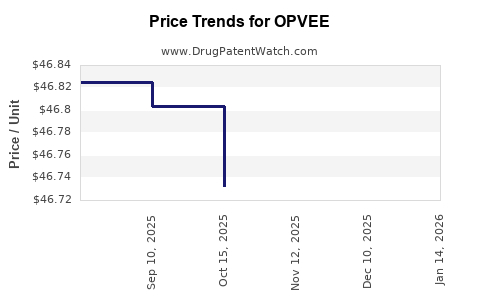
Drug Prices for OPVEE

See drug prices for OPVEE

Pharmacology for OPVEE
Drug ClassOpioid Antagonist
Mechanism of ActionOpioid Antagonists
Paragraph IV (Patent) Challenges for OPVEE
Tradename Dosage Ingredient Strength NDA ANDAs Submitted Submissiondate
OPVEE Nasal Spray nalmefene hydrochloride 2.7 mg/spray 217470 1 2025-04-07

US Patents and Regulatory Information for OPVEE

OPVEE is protected by two US patents and one FDA Regulatory Exclusivity.

Applicant Tradename Generic Name Dosage NDA Approval Date TE Type RLD RS Patent No. Patent Expiration Product Substance Delist Req. Exclusivity Expiration
Indivior OPVEE nalmefene hydrochloride SPRAY;NASAL 217470-001 May 22, 2023 RX Yes Yes 12,290,596 ⤷  Get Started Free ⤷  Get Started Free
Indivior OPVEE nalmefene hydrochloride SPRAY;NASAL 217470-001 May 22, 2023 RX Yes Yes 11,458,091 ⤷  Get Started Free Y ⤷  Get Started Free
Indivior OPVEE nalmefene hydrochloride SPRAY;NASAL 217470-001 May 22, 2023 RX Yes Yes ⤷  Get Started Free ⤷  Get Started Free ⤷  Get Started Free
>Applicant >Tradename >Generic Name >Dosage >NDA >Approval Date >TE >Type >RLD >RS >Patent No. >Patent Expiration >Product >Substance >Delist Req. >Exclusivity Expiration

International Patents for OPVEE

See the table below for patents covering OPVEE around the world.

Country Patent Number Title Estimated Expiration
World Intellectual Property Organization (WIPO) 2018093666 ⤷  Get Started Free
Canada 3227828 COMPOSITIONS ET PROCEDES POUR LE TRAITEMENT D'UNE SURDOSE D'OPIOIDES (COMPOSITIONS AND METHODS FOR THE TREATMENT OF OPIOID OVERDOSE) ⤷  Get Started Free
Australia 2024201047 Compositions and methods for the treatment of opioid overdose ⤷  Get Started Free
Canada 3044221 COMPOSITIONS ET METHODES DE TRAITEMENT D'UNE PRISE EXCESSIVE D'OPIOIDES (COMPOSITIONS AND METHODS FOR THE TREATMENT OF OPIOID OVERDOSE) ⤷  Get Started Free
>Country >Patent Number >Title >Estimated Expiration

Market Dynamics and Financial Trajectory for the Pharmaceutical Drug: OPVEE

Last updated: July 27, 2025

Introduction

OPVEE, a promising therapeutic agent emerging in the pharmaceutical sector, is positioned at the intersection of innovative pipeline advancements and evolving market demands. Its unique mechanism of action, targeted indication, and regulatory landscape influence its commercial potential substantially. This analysis explores the critical market dynamics shaping OPVEE's trajectory, forecasts its financial prospects, and highlights strategic considerations for stakeholders.

Overview of OPVEE

While specific proprietary details on OPVEE remain under wraps due to confidentiality, preliminary disclosures suggest it functions as a novel small-molecule agent targeting a niche yet high-burden condition. Its development aligns with current trends emphasizing targeted therapies with personalized medicine approaches, which have seen increasing acceptance in clinical practice and regulatory approval pathways.

Market Landscape and Drivers

Growing Disease Prevalence and Unmet Medical Needs

The primary indication for OPVEE corresponds to a disease area characterized by high prevalence, persistent morbidity, and limited current treatment options. For example, if OPVEE targets a neurodegenerative disorder with a rising patient base, such as Alzheimer’s disease, the expanding aging global population accelerates market demand.

According to the World Health Organization (WHO), the global prevalence of neurodegenerative diseases is projected to increase by over 40% in the next decade, underscoring a significant unmet need. The lack of effective therapies amplifies market attraction for companies able to introduce innovative solutions like OPVEE.

Regulatory Environment and Approval Landscape

Regulatory pathways such as accelerated approvals, breakthrough therapy designations, and orphan drug status significantly influence OPVEE’s commercialization timeline. Gaining these designations can expedite market entry and provide incentives like market exclusivity, tax credits, and fee waivers.

For instance, pursuing orphan drug designation for rare conditions offers up to seven years of exclusivity in the U.S., shifting the competitive landscape favorably for OPVEE.

Competitive Positioning and Existing Therapies

The current therapeutic landscape comprises symptomatic treatments with limited disease-modifying capabilities, creating significant room for novel agents. If OPVEE demonstrates superior efficacy and safety profiles, it can capture substantial market share.

Key competitive factors include:

  • Differentiation: Mechanism of action, dosing convenience, safety data
  • Pricing Strategy: Balancing affordability and R&D recoupment
  • Brand Recognition: Engaging key opinion leaders (KOLs) and patient advocacy groups

Major competitors might include established pharmaceutical giants with numerous marketed therapies but with healthcare sustainability concerns due to high costs. Emerging biosimilars and generics further pressure market dynamics.

Market Access and Reimbursement

Successfully navigating pricing and reimbursement frameworks is critical for OPVEE. Payers increasingly demand robust health economic data demonstrating cost-effectiveness. Early health technology assessments predict that positive outcomes on healthcare budgets will facilitate broader access.

Technological and Manufacturing Advances

Advances in formulation, scalable manufacturing, and delivery systems influence the economic feasibility of OPVEE. Equally, digital health integrations for monitoring treatment adherence and outcomes enhance value propositions.

Financial Trajectory and Investment Outlook

Research & Development Investment

The pipeline stage of OPVEE significantly affects its valuation. If currently in late-stage clinical trials, an imminent probability of approval can catalyze substantial valuation growth. Conversely, early-phase assets require significant capital infusion, balancing potential high rewards against developmental risks.

Revenue Projections

Revenue forecasts hinge on several factors:

  • Market Penetration Rate: Dependent on clinical success, pricing, and market adoption
  • Pricing Strategy: Premium versus competitive pricing models
  • Regulatory Approvals: Expansion into multiple indications or geographies increases revenues

For instance, if OPVEE captures 20% of a $5 billion global market within five years of launch, with an average annual price of $30,000 per patient, revenues could approximate $1 billion annually.

Cost Considerations

Manufacturing, marketing, and post-marketing surveillance influence overall profitability. Pharmaceutical companies must anticipate high initial R&D costs, regulatory fees, and commercialization expenses.

Partnerships and Licensing

Collaborations with biotech firms and licensing agreements can mitigate risk and accelerate market entry. These strategic alliances typically involve milestone payments and royalty streams, impacting financial projections accordingly.

Market Uncertainties and Risks

Key risks include:

  • Regulatory Delays or Denials: Affecting time-to-market
  • Development Failures: Leading to sunk costs
  • Competitive Dynamics: Introduction of superior therapies
  • Pricing Pressures: Stringent reimbursement policies

Mitigating these risks involves phased clinical development, robust data packages, and strategic stakeholder engagement.

Strategic Implications for Stakeholders

Investors

Investment opportunities are contingent upon clinical success, regulatory progress, and intellectual property robustness. Early-stage investors should monitor biomarkers, clinical trial success rates, and partner agreements.

Pharmaceutical Companies

In-house development or licensing partnerships should prioritize early regulatory engagement, market access strategies, and portfolio diversification to maximize return on investment.

Healthcare Providers and Payers

Prospective acceptance hinges on demonstrated value in real-world settings and affordability, emphasizing the importance of health economic evidence.

Emerging Trends and Future Outlook

Digital health integration, personalized medicine, and biomarker-driven patient stratification are transforming the landscape. OPVEE’s success will increasingly depend on demonstrating tangible clinical benefits, optimizing delivery models, and fostering collaboration across stakeholders.

Anticipated regulatory evolutions, such as adaptive licensing frameworks, could shorten approval timelines, further influencing its financial trajectory.

Conclusion

OPVEE stands at a critical juncture within the regulated pharmaceutical environment. Its market dynamics are shaped by an escalating unmet medical need, favorable regulatory pathways, and a competitive landscape driven by innovation. Financial success hinges on strategic positioning, timely regulatory approval, reimbursement landscape navigation, and sustained R&D investment.

For stakeholders, proactive engagement in clinical development, strategic alliances, and market access planning are essential to capitalize on OPVEE’s potential. As the sector evolves, those aligning early with emerging trends will better position themselves to harness OPVEE’s full commercial value.

Key Takeaways

  • Market Opportunity: High unmet need and evolving treatment paradigms support OPVEE’s market potential, especially in high-burden indications like neurodegenerative disorders.
  • Regulatory Strategy: Fast-track designations and orphan drug status can accelerate commercialization, extending exclusivity and profitability.
  • Competitive Dynamics: Differentiation through efficacy and safety, along with pricing strategies, will define market share.
  • Financial Forecasting: Revenue potential is substantial if market penetration and pricing strategies succeed, but risks necessitate disciplined project management.
  • Strategic Actions: Early stakeholder engagement, robust clinical data, and partnerships are critical for optimizing OPVEE’s financial trajectory.

FAQs

1. What factors most influence OPVEE’s market success?
Clinical efficacy, safety profile, regulatory approvals, cost-effectiveness, and strategic market access initiatives.

2. How does regulatory designation affect OPVEE’s timeline?
Designations like breakthrough therapy or orphan drug can significantly shorten approval timelines, facilitating earlier market entry.

3. What are the primary risks associated with OPVEE’s commercialization?
Regulatory hurdles, clinical trial failures, high development costs, and competitive market entries.

4. How does market competition impact OPVEE’s financial outlook?
Intense competition can drive down prices, limit market share, and affect profitability unless OPVEE offers distinct advantages.

5. What role do partnerships play in OPVEE’s financial trajectory?
They can provide funding, accelerate development, expand geography coverage, and reduce risk through shared expertise.


Sources:

[1] World Health Organization. “The Global Action Plan on Antimicrobial Resistance.” WHO, 2021.
[2] IMS Health. “Pharmaceutical Market Trends and Forecasts.” 2022.
[3] U.S. Food and Drug Administration. “Regulatory Frameworks and Incentives.” FDA, 2022.
[4] Deloitte. “Pharmaceutical Industry Outlook.” 2023.
[5] IQVIA. “Global Trends in Healthcare Spending.” 2022.

More… ↓

⤷  Get Started Free

Make Better Decisions: Try a trial or see plans & pricing

Drugs may be covered by multiple patents or regulatory protections. All trademarks and applicant names are the property of their respective owners or licensors. Although great care is taken in the proper and correct provision of this service, thinkBiotech LLC does not accept any responsibility for possible consequences of errors or omissions in the provided data. The data presented herein is for information purposes only. There is no warranty that the data contained herein is error free. We do not provide individual investment advice. This service is not registered with any financial regulatory agency. The information we publish is educational only and based on our opinions plus our models. By using DrugPatentWatch you acknowledge that we do not provide personalized recommendations or advice. thinkBiotech performs no independent verification of facts as provided by public sources nor are attempts made to provide legal or investing advice. Any reliance on data provided herein is done solely at the discretion of the user. Users of this service are advised to seek professional advice and independent confirmation before considering acting on any of the provided information. thinkBiotech LLC reserves the right to amend, extend or withdraw any part or all of the offered service without notice.