You're using a free limited version of DrugPatentWatch: Upgrade for Complete Access

Last Updated: March 26, 2026

ONPATTRO Drug Patent Profile


✉ Email this page to a colleague

« Back to Dashboard


Which patents cover Onpattro, and when can generic versions of Onpattro launch?

Onpattro is a drug marketed by Alnylam Pharms Inc and is included in one NDA. There are thirteen patents protecting this drug.

This drug has two hundred and forty-eight patent family members in thirty-one countries.

The generic ingredient in ONPATTRO is patisiran sodium. One supplier is listed for this compound. Additional details are available on the patisiran sodium profile page.

DrugPatentWatch® Generic Entry Outlook for Onpattro

Onpattro was eligible for patent challenges on August 10, 2022.

By analyzing the patents and regulatory protections it appears that the earliest date for generic entry will be August 10, 2032. This may change due to patent challenges or generic licensing.

There have been five patent litigation cases involving the patents protecting this drug, indicating strong interest in generic launch. Recent data indicate that 63% of patent challenges are decided in favor of the generic patent challenger and that 54% of successful patent challengers promptly launch generic drugs.

Indicators of Generic Entry

< Available with Subscription >

  Start Trial

AI Deep Research
Questions you can ask:
  • What is the 5 year forecast for ONPATTRO?
  • What are the global sales for ONPATTRO?
  • What is Average Wholesale Price for ONPATTRO?
Summary for ONPATTRO
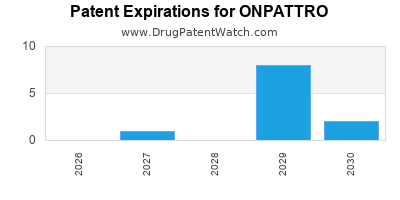
Drug patent expirations by year for ONPATTRO
Drug Prices for ONPATTRO

See drug prices for ONPATTRO

DrugPatentWatch® Estimated Loss of Exclusivity (LOE) Date for ONPATTRO
Generic Entry Date for ONPATTRO*:
Constraining patent/regulatory exclusivity:
NDA:
Dosage:
SOLUTION;INTRAVENOUS

*The generic entry opportunity date is the latter of the last compound-claiming patent and the last regulatory exclusivity protection. Many factors can influence early or later generic entry. This date is provided as a rough estimate of generic entry potential and should not be used as an independent source.

Recent Clinical Trials for ONPATTRO

Identify potential brand extensions & 505(b)(2) entrants

SponsorPhase
Austin Neuromuscular CenterEarly Phase 1
Alnylam PharmaceuticalsEarly Phase 1

See all ONPATTRO clinical trials

US Patents and Regulatory Information for ONPATTRO

ONPATTRO is protected by thirteen US patents and one FDA Regulatory Exclusivity.

Based on analysis by DrugPatentWatch, the earliest date for a generic version of ONPATTRO is ⤷  Start Trial.

This potential generic entry date is based on patent 8,168,775.

Generics may enter earlier, or later, based on new patent filings, patent extensions, patent invalidation, early generic licensing, generic entry preferences, and other factors.

Applicant Tradename Generic Name Dosage NDA Approval Date TE Type RLD RS Patent No. Patent Expiration Product Substance Delist Req. Exclusivity Expiration
Alnylam Pharms Inc ONPATTRO patisiran sodium SOLUTION;INTRAVENOUS 210922-001 Aug 10, 2018 RX Yes Yes 8,802,644 ⤷  Start Trial Y ⤷  Start Trial
Alnylam Pharms Inc ONPATTRO patisiran sodium SOLUTION;INTRAVENOUS 210922-001 Aug 10, 2018 RX Yes Yes 8,741,866 ⤷  Start Trial ⤷  Start Trial
Alnylam Pharms Inc ONPATTRO patisiran sodium SOLUTION;INTRAVENOUS 210922-001 Aug 10, 2018 RX Yes Yes 8,168,775 ⤷  Start Trial Y Y ⤷  Start Trial
>Applicant >Tradename >Generic Name >Dosage >NDA >Approval Date >TE >Type >RLD >RS >Patent No. >Patent Expiration >Product >Substance >Delist Req. >Exclusivity Expiration

Expired US Patents for ONPATTRO

Applicant Tradename Generic Name Dosage NDA Approval Date Patent No. Patent Expiration
Alnylam Pharms Inc ONPATTRO patisiran sodium SOLUTION;INTRAVENOUS 210922-001 Aug 10, 2018 8,334,373 ⤷  Start Trial
Alnylam Pharms Inc ONPATTRO patisiran sodium SOLUTION;INTRAVENOUS 210922-001 Aug 10, 2018 9,943,538 ⤷  Start Trial
Alnylam Pharms Inc ONPATTRO patisiran sodium SOLUTION;INTRAVENOUS 210922-001 Aug 10, 2018 8,895,718 ⤷  Start Trial
>Applicant >Tradename >Generic Name >Dosage >NDA >Approval Date >Patent No. >Patent Expiration

International Patents for ONPATTRO

When does loss-of-exclusivity occur for ONPATTRO?

Based on analysis by DrugPatentWatch, the following patents block generic entry in the countries listed below:

Australia

Patent: 09307677
Estimated Expiration: ⤷  Start Trial

Patent: 15249072
Estimated Expiration: ⤷  Start Trial

Patent: 17225110
Estimated Expiration: ⤷  Start Trial

Patent: 19216630
Estimated Expiration: ⤷  Start Trial

Patent: 21203272
Estimated Expiration: ⤷  Start Trial

Patent: 23248138
Estimated Expiration: ⤷  Start Trial

Patent: 25271184
Estimated Expiration: ⤷  Start Trial

Brazil

Patent: 0919732
Estimated Expiration: ⤷  Start Trial

Canada

Patent: 39895
Estimated Expiration: ⤷  Start Trial

Patent: 18487
Estimated Expiration: ⤷  Start Trial

Patent: 22620
Estimated Expiration: ⤷  Start Trial

China

Patent: 2186978
Estimated Expiration: ⤷  Start Trial

Patent: 3937793
Estimated Expiration: ⤷  Start Trial

Patent: 6834291
Estimated Expiration: ⤷  Start Trial

Croatia

Patent: 0150796
Estimated Expiration: ⤷  Start Trial

Patent: 0180093
Estimated Expiration: ⤷  Start Trial

Cyprus

Patent: 16944
Estimated Expiration: ⤷  Start Trial

Patent: 20174
Estimated Expiration: ⤷  Start Trial

Patent: 19005
Estimated Expiration: ⤷  Start Trial

Denmark

Patent: 44639
Estimated Expiration: ⤷  Start Trial

Patent: 37418
Estimated Expiration: ⤷  Start Trial

Eurasian Patent Organization

Patent: 0312
Estimated Expiration: ⤷  Start Trial

Patent: 9762
Estimated Expiration: ⤷  Start Trial

Patent: 6772
Estimated Expiration: ⤷  Start Trial

Patent: 1170591
Estimated Expiration: ⤷  Start Trial

Patent: 1400170
Estimated Expiration: ⤷  Start Trial

Patent: 1792626
Estimated Expiration: ⤷  Start Trial

Patent: 2092118
Estimated Expiration: ⤷  Start Trial

European Patent Office

Patent: 44639
Estimated Expiration: ⤷  Start Trial

Patent: 37418
Estimated Expiration: ⤷  Start Trial

Patent: 54733
Estimated Expiration: ⤷  Start Trial

Patent: 48461
Estimated Expiration: ⤷  Start Trial

Hong Kong

Patent: 56348
Estimated Expiration: ⤷  Start Trial

Patent: 16652
Estimated Expiration: ⤷  Start Trial

Patent: 58859
Estimated Expiration: ⤷  Start Trial

Hungary

Patent: 26604
Estimated Expiration: ⤷  Start Trial

Patent: 37875
Estimated Expiration: ⤷  Start Trial

Patent: 900004
Estimated Expiration: ⤷  Start Trial

Israel

Patent: 3178
Estimated Expiration: ⤷  Start Trial

Patent: 1434
Estimated Expiration: ⤷  Start Trial

Patent: 2142
Estimated Expiration: ⤷  Start Trial

Patent: 0600
Estimated Expiration: ⤷  Start Trial

Japan

Patent: 91505
Estimated Expiration: ⤷  Start Trial

Patent: 71446
Estimated Expiration: ⤷  Start Trial

Patent: 53780
Estimated Expiration: ⤷  Start Trial

Patent: 00658
Estimated Expiration: ⤷  Start Trial

Patent: 12506254
Estimated Expiration: ⤷  Start Trial

Patent: 15062420
Estimated Expiration: ⤷  Start Trial

Patent: 18007666
Estimated Expiration: ⤷  Start Trial

Patent: 18171072
Estimated Expiration: ⤷  Start Trial

Patent: 19205442
Estimated Expiration: ⤷  Start Trial

Patent: 22160408
Estimated Expiration: ⤷  Start Trial

Patent: 24116226
Estimated Expiration: ⤷  Start Trial

Lithuania

Patent: 937418
Estimated Expiration: ⤷  Start Trial

Patent: 2019501
Estimated Expiration: ⤷  Start Trial

Patent: 37418
Estimated Expiration: ⤷  Start Trial

Luxembourg

Patent: 0098
Estimated Expiration: ⤷  Start Trial

Mexico

Patent: 4354
Estimated Expiration: ⤷  Start Trial

Patent: 0460
Estimated Expiration: ⤷  Start Trial

Patent: 11004268
Estimated Expiration: ⤷  Start Trial

Patent: 18013398
Estimated Expiration: ⤷  Start Trial

Netherlands

Patent: 0965
Estimated Expiration: ⤷  Start Trial

New Zealand

Patent: 2867
Patent: COMPOSITIONS AND METHODS FOR INHIBITING EXPRESSION OF TRANSTHYRETIN
Estimated Expiration: ⤷  Start Trial

Patent: 2404
Patent: Compositions and methods for inhibiting expression of transthyretin
Estimated Expiration: ⤷  Start Trial

Patent: 8858
Patent: Compositions and methods for inhibiting expression of transthyretin
Estimated Expiration: ⤷  Start Trial

Patent: 7298
Patent: Compositions and methods for inhibiting expression of transthyretin
Estimated Expiration: ⤷  Start Trial

Norway

Patent: 19004
Estimated Expiration: ⤷  Start Trial

Patent: 37418
Estimated Expiration: ⤷  Start Trial

Poland

Patent: 44639
Estimated Expiration: ⤷  Start Trial

Patent: 37418
Estimated Expiration: ⤷  Start Trial

Portugal

Patent: 44639
Estimated Expiration: ⤷  Start Trial

Patent: 37418
Estimated Expiration: ⤷  Start Trial

San Marino

Patent: 01500176
Patent: Composizioni e metodi per inibire l'espressione ditranstiretina
Estimated Expiration: ⤷  Start Trial

Patent: 01800027
Estimated Expiration: ⤷  Start Trial

Singapore

Patent: 201703242X
Patent: COMPOSITIONS AND METHODS FOR INHIBITING EXPRESSION OF TRANSTHYRETIN
Estimated Expiration: ⤷  Start Trial

Patent: 201809460S
Patent: COMPOSITIONS AND METHODS FOR INHIBITING EXPRESSION OF TRANSTHYRETIN
Estimated Expiration: ⤷  Start Trial

Patent: 201912276X
Patent: COMPOSITIONS AND METHODS FOR INHIBITING EXPRESSION OF TRANSTHYRETIN
Estimated Expiration: ⤷  Start Trial

Slovenia

Patent: 44639
Estimated Expiration: ⤷  Start Trial

Patent: 37418
Estimated Expiration: ⤷  Start Trial

South Africa

Patent: 1102876
Patent: COMPOSITIONS AND METHODS FOR INHIBITING EXPRESSION OF TRANSTHYRETIN
Estimated Expiration: ⤷  Start Trial

South Korea

Patent: 1624869
Estimated Expiration: ⤷  Start Trial

Patent: 1635436
Estimated Expiration: ⤷  Start Trial

Patent: 2031027
Estimated Expiration: ⤷  Start Trial

Patent: 2354558
Estimated Expiration: ⤷  Start Trial

Patent: 2578331
Estimated Expiration: ⤷  Start Trial

Patent: 110073592
Estimated Expiration: ⤷  Start Trial

Patent: 150007359
Estimated Expiration: ⤷  Start Trial

Patent: 160079921
Estimated Expiration: ⤷  Start Trial

Patent: 180017245
Estimated Expiration: ⤷  Start Trial

Patent: 190116553
Estimated Expiration: ⤷  Start Trial

Patent: 220012422
Estimated Expiration: ⤷  Start Trial

Spain

Patent: 43004
Estimated Expiration: ⤷  Start Trial

Patent: 56516
Estimated Expiration: ⤷  Start Trial

Generics may enter earlier, or later, based on new patent filings, patent extensions, patent invalidation, early generic licensing, generic entry preferences, and other factors.

See the table below for additional patents covering ONPATTRO around the world.

Country Patent Number Title Estimated Expiration
South Korea 20080023768 ⤷  Start Trial
Australia 2009222605 4'-Thionucleosides and oligomeric compounds ⤷  Start Trial
European Patent Office 1765074 PRODUITS DE SYNTHESE D'ARNsi MODIFIES EN POSITION (POSITIONALLY MODIFIED siRNA CONSTRUCTS) ⤷  Start Trial
>Country >Patent Number >Title >Estimated Expiration

Supplementary Protection Certificates for ONPATTRO

Patent Number Supplementary Protection Certificate SPC Country SPC Expiration SPC Description
2937418 C02937418/01 Switzerland ⤷  Start Trial PRODUCT NAME: PATISIRAN; REGISTRATION NO/DATE: SWISSMEDIC-ZULASSUNG 67304 23.09.2019
2937418 1990004-2 Sweden ⤷  Start Trial PRODUCT NAME: PATISIRAN; FIRST MARKETING AUTHORIZATION NUMBER SE: EG EU/1/18/1320, 2018-08-29; 1290041-1, 2190036-0, 1390005-5, 1490063-3, 2090018-9, 1490027-8, 1990004-2, 2290011-2, 1390026-1 2090037-9, 2390008-7, 2290049-2: SKYDDSTIDEN FOER SAMTLIGA DESSA TILLAEGGSSKYDD AER FOERLAENGD MED EN DAG (BESLUT I PMAE 7804-24).
2937418 122018000133 Germany ⤷  Start Trial PRODUCT NAME: PATISIRAN; REGISTRATION NO/DATE: EU/1/18/1320 20180827
>Patent Number >Supplementary Protection Certificate >SPC Country >SPC Expiration >SPC Description

Onpattro: Market Dynamics and Financial Trajectory

Last updated: February 19, 2026

What is the current market landscape for Onpattro?

Onpattro (patisiran) is an RNA interference (RNAi) therapeutic approved for the treatment of hereditary transthyretin-mediated amyloidosis (hATTR amyloidosis) in adults [1]. The drug is a lipid nanoparticle (LNP) formulated small interfering RNA (siRNA) targeting the TTR gene [2]. This mechanism of action reduces the production of mutant and wild-type transthyretin (TTR) protein in the liver, the primary source of TTR [2].

The market for hATTR amyloidosis treatment is characterized by a growing patient population and increasing diagnostic capabilities. Historically, hATTR amyloidosis was considered rare and underdiagnosed. However, advances in genetic testing and increased physician awareness have led to a higher identification rate of affected individuals [3]. The disease has two main phenotypes: polyneuropathy (ATTRv-PN) and cardiomyopathy (ATTR-CM). Onpattro is initially approved for ATTRv-PN [1].

The competitive landscape for Onpattro includes other therapies targeting the TTR gene, such as tafamidis (Vyndaqel/Vyndamax), which stabilizes the TTR protein [4]. While tafamidis addresses the root cause by preventing TTR tetramer dissociation, Onpattro reduces TTR production. Newer investigational therapies, including other RNAi agents and gene-editing technologies, are also under development, potentially impacting future market share [5].

The primary target patient population for Onpattro comprises adults with diagnosed ATTRv-PN who have shown disease progression. This includes patients with sensory and motor peripheral nerve dysfunction, as well as autonomic dysfunction [1]. The prevalence of hATTR amyloidosis is estimated to be between 50,000 and 100,000 individuals globally, with a higher incidence in specific populations such as those of Portuguese and African descent [3].

Onpattro is administered intravenously, typically every three weeks [1]. This dosing regimen influences patient convenience and healthcare resource utilization. The economic burden of hATTR amyloidosis is substantial, encompassing direct medical costs (hospitalizations, physician visits, medications) and indirect costs (lost productivity, caregiver support) [3].

What is the intellectual property protection strategy for Onpattro?

The intellectual property portfolio surrounding Onpattro is critical to its commercial viability and market exclusivity. Alnylam Pharmaceuticals, the developer, has secured broad patent protection for the drug, its composition, manufacturing processes, and methods of use [6].

Key patent families include those covering the specific siRNA sequences that constitute patisiran, LNP delivery technology, and methods for treating hATTR amyloidosis [7]. These patents aim to prevent generic competition and off-label use by unauthorized entities. The duration of patent protection is a crucial factor in determining the period of market exclusivity.

In the United States, Onpattro is protected by multiple patents. For instance, patents related to the composition of matter and methods of use typically have expiration dates extending into the mid-2030s [8]. However, the complex nature of patent law means that patent challenges, litigation, and potential settlements can alter these timelines. Generic manufacturers often attempt to invalidate existing patents or design around them to introduce their own versions of the drug [9].

Globally, Alnylam has pursued patent protection in major pharmaceutical markets, including Europe, Japan, and China. Patent laws and enforcement differ across jurisdictions, influencing the scope and longevity of protection in each region [7].

The LNP delivery system is a proprietary technology that is fundamental to the efficacy of Onpattro. Patents covering these lipid nanoparticles and their formulation are considered highly valuable and are a significant component of Alnylam's intellectual property strategy [2, 7].

Beyond composition of matter and method of use patents, Alnylam also relies on regulatory exclusivities granted by health authorities. For example, in the U.S., the Food and Drug Administration (FDA) may grant a 5-year exclusivity for new chemical entities (NCEs) and potentially longer periods for orphan drugs [10]. Onpattro, being an orphan drug for a rare disease, benefits from these provisions. In Europe, the European Medicines Agency (EMA) can grant up to 10 years of data exclusivity and an additional year for market authorization, which can be extended to 11 years for orphan drugs [11].

What is the global sales performance and financial trajectory of Onpattro?

Onpattro has demonstrated significant revenue growth since its launch, driven by its efficacy in treating a previously underserved patient population [12]. As of the latest available financial reporting periods, the drug has achieved substantial sales figures.

Global Net Sales (USD Millions)

Year Net Sales
2018 178
2019 468
2020 768
2021 1,222
2022 1,527
2023 (YTD) 830 (Q1-Q3)

Source: Alnylam Pharmaceuticals SEC Filings and Investor Reports [12, 13]. Note: 2023 figures are for the first three quarters.

The compound annual growth rate (CAGR) for Onpattro's sales between 2018 and 2022 was approximately 60% [12, 13]. This robust growth reflects increasing physician adoption, expanding indications, and greater patient access.

The financial trajectory of Onpattro is influenced by several factors:

  • Market Penetration: As diagnostic tools improve and awareness of hATTR amyloidosis grows, more eligible patients are identified and treated.
  • Geographic Expansion: Alnylam has focused on expanding market access for Onpattro in key regions globally. This includes securing reimbursement and favorable pricing in major European countries, Japan, and other international markets.
  • Label Expansion: While initially approved for ATTRv-PN, the potential for label expansion to include other forms of hATTR amyloidosis, such as ATTR-CM, could significantly increase the addressable market [14]. Alnylam's sibling drug, Amvuttra (vutrisiran), a second-generation RNAi therapeutic, is also targeting ATTRv-PN and ATTR-CM, creating an internal competitive dynamic within Alnylam's portfolio, but also potentially expanding the overall market for RNAi-based therapies [15].
  • Pricing and Reimbursement: The pricing of rare disease drugs is a key determinant of revenue. Onpattro's list price contributes to its high per-patient revenue. Negotiation with payers and health technology assessment bodies is ongoing and crucial for sustained market access.
  • Competition: The introduction of new therapies, including Amvuttra and tafamidis, impacts Onpattro's market share and pricing power. Alnylam's strategy involves positioning Amvuttra as a more convenient, subcutaneous option, potentially cannibalizing some Onpattro sales while capturing new patients and those seeking improved administration [15].

Alnylam's profitability is directly tied to the success of its key products, including Onpattro. The company's R&D investments, manufacturing costs, and marketing expenditures are weighed against the revenues generated by Onpattro and its pipeline candidates. The financial strength derived from Onpattro's sales has been instrumental in funding further research and development of its broader RNAi therapeutic platform [16].

What are the key market drivers and challenges for Onpattro?

The market for Onpattro is shaped by a confluence of positive drivers and significant challenges. Understanding these dynamics is crucial for forecasting future performance.

Key Market Drivers:

  • Growing Diagnosed Patient Population: Improved diagnostic techniques, including genetic testing and increased physician awareness, are leading to a higher identification of patients with hATTR amyloidosis. This expands the pool of potential Onpattro recipients [3].
  • Unmet Medical Need: Prior to the advent of targeted therapies like Onpattro and tafamidis, treatment options for hATTR amyloidosis were largely supportive and palliative. Onpattro offers a disease-modifying therapy with demonstrated efficacy in improving neuropathy [1, 17].
  • Therapeutic Mechanism of Action: The RNAi approach, which silences the gene responsible for TTR production, is a scientifically validated mechanism with potential for broad application across genetic diseases. This innovative approach attracts prescribers and payers willing to invest in novel treatments [2].
  • Orphan Drug Designation and Incentives: Orphan drug status provides market exclusivity and other incentives from regulatory bodies like the FDA and EMA, which can accelerate development and commercialization [10, 11].
  • Expansion into Cardiomyopathy: While initially approved for polyneuropathy, research and clinical trials are exploring Onpattro's efficacy in treating hATTR amyloidosis with cardiomyopathy (ATTR-CM) [14]. A positive outcome would significantly broaden the addressable market.

Key Market Challenges:

  • Competition from within Alnylam: The introduction of Amvuttra (vutrisiran), Alnylam's own next-generation subcutaneous RNAi therapy, poses a direct competitive challenge to Onpattro. Amvuttra offers a more convenient dosing schedule and potentially improved efficacy in some measures, leading to a potential shift in treatment preference [15].
  • Competition from Other Modalities: Tafamidis (Vyndaqel/Vyndamax) is a well-established stabilizer of the TTR protein and has gained significant market share, particularly in the ATTR-CM indication [4]. The established efficacy and oral administration of tafamidis present a strong competitive barrier.
  • High Cost of Treatment: Onpattro is an expensive therapy, a characteristic common to treatments for rare diseases. This high cost necessitates robust health economic data and can lead to payer restrictions, access hurdles, and pricing negotiations [3].
  • Intravenous Administration: The requirement for intravenous infusion every three weeks can be burdensome for patients and requires healthcare infrastructure for administration. This contrasts with oral therapies like tafamidis and the subcutaneous administration of Amvuttra [1].
  • Diagnostic Delays and Underdiagnosis: Despite improvements, hATTR amyloidosis remains underdiagnosed in many regions. Delays in diagnosis can mean that patients present with more advanced disease, potentially impacting treatment outcomes and the perceived value of therapy.
  • Complex Patent Landscape and Generic Challenges: While Alnylam holds strong patent protection, the pharmaceutical industry is characterized by frequent patent litigation. The potential for generic entry upon patent expiry, or through successful legal challenges, poses a long-term risk to revenue streams [9].

What are the future market outlook and potential strategic moves for Onpattro?

The future market outlook for Onpattro is contingent on Alnylam's ability to navigate its competitive landscape and leverage its existing strengths.

Future Market Outlook:

  • Continued Growth in ATTRv-PN: Onpattro is expected to maintain a significant share of the ATTRv-PN market, particularly as diagnostic rates continue to rise globally. Its established efficacy and safety profile will support its use in this indication [17].
  • Potential for ATTR-CM Indication: Successful development and approval for the ATTR-CM indication would represent a substantial growth opportunity, potentially doubling the addressable market. However, competition in the ATTR-CM space is intense [14].
  • Coexistence with Amvuttra: Onpattro and Amvuttra will likely coexist within Alnylam's portfolio. Amvuttra's subcutaneous administration and potential clinical advantages may lead to a gradual shift of new patients towards it, while Onpattro may retain a significant patient base, particularly those already on therapy or in specific regions where switching is less prevalent [15].
  • Evolving Competitive Environment: The introduction of new therapeutic modalities, including gene editing technologies and potentially new TTR stabilizers, could further fragment the market and challenge existing therapies [5].

Potential Strategic Moves:

  • Lifecycle Management: Alnylam may explore strategies to extend the commercial life of Onpattro, such as seeking label expansions for new patient subgroups or investigating combination therapies.
  • Geographic Market Deepening: Continued efforts to expand market access and reimbursement in emerging markets will be crucial for sustained global sales growth.
  • Patient Support and Adherence Programs: Given the chronic nature of the disease and the complexity of treatment administration, robust patient support programs can enhance adherence and patient outcomes, indirectly supporting market share.
  • Differentiated Positioning: While Amvuttra represents Alnylam's newer offering, strategic marketing and physician education can reinforce Onpattro's value proposition for specific patient segments or treatment settings.
  • Focus on Real-World Evidence: Generating and disseminating real-world evidence on Onpattro's long-term effectiveness and safety can bolster its position with payers and physicians, especially as the competitive landscape evolves.
  • Intellectual Property Defense: Alnylam will likely continue to vigorously defend its patents against any challenges, a standard practice in the pharmaceutical industry to preserve market exclusivity.

The financial trajectory will be closely monitored through quarterly earnings reports. Investors and analysts will focus on revenue growth rates, the impact of Amvuttra, and progress in clinical development for new indications. Alnylam's ability to manage its product portfolio effectively and maintain its leadership in RNAi therapeutics will be key to its continued financial success.

Key Takeaways

  • Onpattro (patisiran) is a leading RNAi therapeutic for hereditary transthyretin-mediated amyloidosis (hATTR amyloidosis) polyneuropathy (ATTRv-PN), reducing TTR protein production.
  • The hATTR amyloidosis market is growing due to increased diagnosis and unmet needs, with a global patient population estimated between 50,000 and 100,000.
  • Alnylam Pharmaceuticals holds extensive patent protection for Onpattro, with key patents extending into the mid-2030s, augmented by regulatory exclusivities.
  • Onpattro has demonstrated strong revenue growth, exceeding \$1.5 billion in annual net sales in 2022, with a significant compound annual growth rate.
  • Key market drivers include an expanding diagnosed patient base, the drug's novel mechanism, and orphan drug incentives.
  • Major challenges include competition from within Alnylam (Amvuttra), external therapies (tafamidis), the drug's high cost, and intravenous administration.
  • Future outlook depends on market penetration, potential ATTR-CM indication approval, and managing internal competition from Amvuttra. Strategic moves may include lifecycle management and continued geographic expansion.

Frequently Asked Questions

  1. What is the primary mechanism of action for Onpattro? Onpattro is an RNA interference (RNAi) therapeutic that silences the TTR gene in the liver, thereby reducing the production of both mutant and wild-type transthyretin (TTR) protein [2].

  2. What specific patient population is Onpattro approved to treat? Onpattro is approved for the treatment of hereditary transthyretin-mediated amyloidosis (hATTR amyloidosis) in adults with polyneuropathy (ATTRv-PN) [1].

  3. How does Onpattro's intravenous administration compare to other hATTR amyloidosis treatments? Onpattro requires intravenous infusion every three weeks. This differs from oral medications like tafamidis (Vyndaqel/Vyndamax) and subcutaneous injections like Alnylam's own Amvuttra (vutrisiran), which offer more convenient administration routes [1, 15].

  4. What is the estimated global prevalence of hATTR amyloidosis, the disease Onpattro treats? The estimated global prevalence of hATTR amyloidosis is between 50,000 and 100,000 individuals [3].

  5. When are the key patents for Onpattro expected to expire in the United States? Key patents for Onpattro, including those related to composition of matter and methods of use, are generally expected to expire in the mid-2030s in the United States [8].

Citations

[1] Alnylam Pharmaceuticals. (n.d.). Onpattro (patisiran) prescribing information. Retrieved from Alnylam Pharmaceuticals official website.

[2] Byrd, J. B. (2023). RNA interference therapeutics. New England Journal of Medicine, 388(25), 2371-2383.

[3] Gillmore, J. D., Gane, E., Taubel, J., Redding-Lallinger, R., Foroughi, N., Martinez-Naharro, A., ... & Benson, M. D. (2021). Efficacy and safety of patisiran for hereditary transthyretin-mediated amyloidosis in a real-world population: A retrospective chart review study. Amyloid, 28(3), 181-189.

[4] Vyndaqel® and Vyndamax® (tafamidis) [Prescribing Information]. (2023). Pfizer Inc.

[5] Akbari, S., Farsinejad, M., & Ebrahimi, M. (2023). Gene therapy for hereditary transthyretin amyloidosis. Gene Therapy, 30(7), 613-624.

[6] Alnylam Pharmaceuticals. (2022). 2022 Annual Report on Form 10-K. U.S. Securities and Exchange Commission.

[7] Alnylam Pharmaceuticals. (2023). Investor Relations: Intellectual Property. Retrieved from Alnylam Pharmaceuticals official website.

[8] LexisNexis PatentSight. (2024). Patent Landscape Analysis: Patisiran. (Proprietary database access required for specific details).

[9] McGinley, M. (2023). Navigating the currents of pharmaceutical patent litigation. Journal of Intellectual Property Law & Practice, 18(1), 1-15.

[10] U.S. Food and Drug Administration. (n.d.). Orphan Drug Act. Retrieved from FDA official website.

[11] European Medicines Agency. (n.d.). Orphan medicinal products. Retrieved from EMA official website.

[12] Alnylam Pharmaceuticals. (2021). 2021 Annual Report on Form 10-K. U.S. Securities and Exchange Commission.

[13] Alnylam Pharmaceuticals. (2023). Quarterly Earnings Reports (Q1-Q3 2023). U.S. Securities and Exchange Commission.

[14] Maurer, M. S., Attwood, M. M., & Castilla, J. D. (2023). Transthyretin amyloid cardiomyopathy: update on diagnosis and management. European Heart Journal, 44(29), 2725-2739.

[15] Alnylam Pharmaceuticals. (2023). Amvuttra (vutrisiran) Overview. Investor presentations and company reports.

[16] Alnylam Pharmaceuticals. (2023). Pipeline Overview. Retrieved from Alnylam Pharmaceuticals official website.

[17] Adams, D., Günther, C., Polanske, K., & Tangel-Svensson, B. (2022). Patisiran for hereditary transthyretin amyloidosis: a systematic review and meta-analysis of randomized controlled trials. Therapeutic Advances in Neurological Disorders, 15, 17562864221110913.

More… ↓

⤷  Start Trial

Make Better Decisions: Try a trial or see plans & pricing

Drugs may be covered by multiple patents or regulatory protections. All trademarks and applicant names are the property of their respective owners or licensors. Although great care is taken in the proper and correct provision of this service, thinkBiotech LLC does not accept any responsibility for possible consequences of errors or omissions in the provided data. The data presented herein is for information purposes only. There is no warranty that the data contained herein is error free. We do not provide individual investment advice. This service is not registered with any financial regulatory agency. The information we publish is educational only and based on our opinions plus our models. By using DrugPatentWatch you acknowledge that we do not provide personalized recommendations or advice. thinkBiotech performs no independent verification of facts as provided by public sources nor are attempts made to provide legal or investing advice. Any reliance on data provided herein is done solely at the discretion of the user. Users of this service are advised to seek professional advice and independent confirmation before considering acting on any of the provided information. thinkBiotech LLC reserves the right to amend, extend or withdraw any part or all of the offered service without notice.