Last Updated: August 11, 2026

ONGENTYS Drug Patent Profile


✉ Email this page to a colleague

« Back to Dashboard


Which patents cover Ongentys, and what generic alternatives are available?

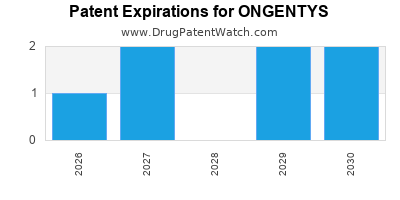
Ongentys is a drug marketed by Amneal and is included in one NDA. There are nine patents protecting this drug.

This drug has one hundred and fifty patent family members in thirty-one countries.

The generic ingredient in ONGENTYS is opicapone. There is one drug master file entry for this compound. One supplier is listed for this compound. Additional details are available on the opicapone profile page.

DrugPatentWatch® Generic Entry Outlook for Ongentys

Ongentys was eligible for patent challenges on April 24, 2024.

By analyzing the patents and regulatory protections it appears that the earliest date for generic entry will be March 31, 2030. This may change due to patent challenges or generic licensing.

Indicators of Generic Entry

< Available with Subscription >

  Start Trial

AI Deep Research
Questions you can ask:
  • What is the 5 year forecast for ONGENTYS?
  • What are the global sales for ONGENTYS?
  • What is Average Wholesale Price for ONGENTYS?
Summary for ONGENTYS
International Patents:150
US Patents:9
Applicants:1
NDAs:1
Finished Product Suppliers / Packagers: 1
Raw Ingredient (Bulk) Api Vendors: 1
Clinical Trials: 4
Patent Applications: 335
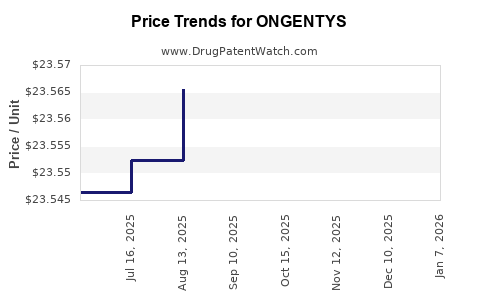
Drug Prices: Drug price information for ONGENTYS
What excipients (inactive ingredients) are in ONGENTYS?ONGENTYS excipients list
DailyMed Link:ONGENTYS at DailyMed
DrugPatentWatch® Estimated Loss of Exclusivity (LOE) Date for ONGENTYS
Generic Entry Date for ONGENTYS*:
Constraining patent/regulatory exclusivity:
NDA:
Dosage:

CAPSULE;ORAL

*The generic entry opportunity date is the latter of the last compound-claiming patent and the last regulatory exclusivity protection. Many factors can influence early or later generic entry. This date is provided as a rough estimate of generic entry potential and should not be used as an independent source.

Recent Clinical Trials for ONGENTYS

Identify potential brand extensions & 505(b)(2) entrants

SponsorPhase
Bial - Portela C S.A.Phase 1
Bial - Portela C S.A.Phase 4

See all ONGENTYS clinical trials

Pharmacology for ONGENTYS

US Patents and Regulatory Information for ONGENTYS

ONGENTYS is protected by eleven US patents.

Based on analysis by DrugPatentWatch, the earliest date for a generic version of ONGENTYS is ⤷  Start Trial.

This potential generic entry date is based on patent ⤷  Start Trial.

Generics may enter earlier, or later, based on new patent filings, patent extensions, patent invalidation, early generic licensing, generic entry preferences, and other factors.

Applicant Tradename Generic Name Dosage NDA Approval Date TE Type RLD RS Patent No. Patent Expiration Product Substance Delist Req. Exclusivity Expiration
Amneal ONGENTYS opicapone CAPSULE;ORAL 212489-001 Apr 24, 2020 RX Yes No ⤷  Start Trial ⤷  Start Trial Y ⤷  Start Trial
Amneal ONGENTYS opicapone CAPSULE;ORAL 212489-002 Apr 24, 2020 RX Yes Yes ⤷  Start Trial ⤷  Start Trial Y Y ⤷  Start Trial
Amneal ONGENTYS opicapone CAPSULE;ORAL 212489-001 Apr 24, 2020 RX Yes No ⤷  Start Trial ⤷  Start Trial Y Y ⤷  Start Trial
Amneal ONGENTYS opicapone CAPSULE;ORAL 212489-002 Apr 24, 2020 RX Yes Yes ⤷  Start Trial ⤷  Start Trial Y ⤷  Start Trial
Amneal ONGENTYS opicapone CAPSULE;ORAL 212489-002 Apr 24, 2020 RX Yes Yes ⤷  Start Trial ⤷  Start Trial ⤷  Start Trial
>Applicant >Tradename >Generic Name >Dosage >NDA >Approval Date >TE >Type >RLD >RS >Patent No. >Patent Expiration >Product >Substance >Delist Req. >Exclusivity Expiration

EU/EMA Drug Approvals for ONGENTYS

Company Drugname Inn Product Number / Indication Status Generic Biosimilar Orphan Marketing Authorisation Marketing Refusal
Bial - Portela Cª, S.A. Ongentys opicapone EMEA/H/C/002790Ongentys is indicated as adjunctive therapy to preparations of levodopa/ DOPA decarboxylase inhibitors (DDCI) in adult patients with Parkinson’s disease and end-of-dose motor fluctuations who cannot be stabilised on those combinations.Ongentys is indicated as adjunctive therapy to preparations of levodopa/ DOPA decarboxylase inhibitors (DDCI) in adult patients with Parkinson’s disease and end-of-dose motor fluctuations who cannot be stabilised on those combinations. Authorised no no no 2016-06-24
Bial Portela & Companhia S.A. Ontilyv opicapone EMEA/H/C/005782Ontilyv is indicated as adjunctive therapy to preparations of levodopa/ DOPA decarboxylase inhibitors (DDCI) in adult patients with Parkinson’s disease and end-of-dose motor fluctuations who cannot be stabilised on those combinations. Authorised no no no 2022-02-21
>Company >Drugname >Inn >Product Number / Indication >Status >Generic >Biosimilar >Orphan >Marketing Authorisation >Marketing Refusal

International Patents for ONGENTYS

When does loss-of-exclusivity occur for ONGENTYS?

Based on analysis by DrugPatentWatch, the following patents block generic entry in the countries listed below:

Australia

Patent: 10231961
Estimated Expiration: ⤷  Start Trial

Brazil

Patent: 1014865
Estimated Expiration: ⤷  Start Trial

Canada

Patent: 57411
Estimated Expiration: ⤷  Start Trial

China

Patent: 2448444
Estimated Expiration: ⤷  Start Trial

Patent: 5878242
Estimated Expiration: ⤷  Start Trial

Denmark

Patent: 13912
Estimated Expiration: ⤷  Start Trial

European Patent Office

Patent: 13912
Estimated Expiration: ⤷  Start Trial

Japan

Patent: 64409
Estimated Expiration: ⤷  Start Trial

Patent: 39561
Estimated Expiration: ⤷  Start Trial

Patent: 12522763
Estimated Expiration: ⤷  Start Trial

Patent: 15232030
Estimated Expiration: ⤷  Start Trial

Mexico

Patent: 0360
Estimated Expiration: ⤷  Start Trial

Patent: 11010415
Estimated Expiration: ⤷  Start Trial

Poland

Patent: 13912
Estimated Expiration: ⤷  Start Trial

Portugal

Patent: 13912
Estimated Expiration: ⤷  Start Trial

Russian Federation

Patent: 01731
Estimated Expiration: ⤷  Start Trial

Patent: 11144145
Estimated Expiration: ⤷  Start Trial

Patent: 16152167
Estimated Expiration: ⤷  Start Trial

South Korea

Patent: 2023255
Estimated Expiration: ⤷  Start Trial

Patent: 2329271
Estimated Expiration: ⤷  Start Trial

Patent: 120027197
Estimated Expiration: ⤷  Start Trial

Patent: 170043671
Estimated Expiration: ⤷  Start Trial

Patent: 180096826
Estimated Expiration: ⤷  Start Trial

Patent: 210009441
Estimated Expiration: ⤷  Start Trial

Spain

Patent: 30678
Estimated Expiration: ⤷  Start Trial

Turkey

Patent: 1908590
Estimated Expiration: ⤷  Start Trial

Generics may enter earlier, or later, based on new patent filings, patent extensions, patent invalidation, early generic licensing, generic entry preferences, and other factors.

See the table below for additional patents covering ONGENTYS around the world.

Country Patent Number Title Estimated Expiration
Australia 2010231961 ⤷  Start Trial
Brazil PI1014865 ⤷  Start Trial
Canada 2757411 ⤷  Start Trial
China 102448444 ⤷  Start Trial
China 105878242 ⤷  Start Trial
>Country >Patent Number >Title >Estimated Expiration

Supplementary Protection Certificates for ONGENTYS

Patent Number Supplementary Protection Certificate SPC Country SPC Expiration SPC Description
1907382 300848 Netherlands ⤷  Start Trial PRODUCT NAME: OPICAPON OF EEN FARMACEUTISCH AANVAARDBAAR ZOUT DAARVAN; REGISTRATION NO/DATE: EU/1/15/1066 20160628
1907382 122016000095 Germany ⤷  Start Trial PRODUCT NAME: OPICAPON ODER EIN PHARMAZEUTISCH VERTRAEGLICHES SALZ DAVON; REGISTRATION NO/DATE: EU/1/15/1066 20160624
1907382 PA2016036 Lithuania ⤷  Start Trial PRODUCT NAME: OPIKAPONAS ARBA JO FARMACISKAI PRIIMTINOS DRUSKOS; REGISTRATION NO/DATE: EU/1/15/1066 20160624
1907382 CA 2016 00061 Denmark ⤷  Start Trial PRODUCT NAME: OPICAPONE OR A PHARMACEUTICALLY ACCEPTABLE SALT THEREOF; REG. NO/DATE: EU/1/15/1066 20160628
1907382 93327 Luxembourg ⤷  Start Trial PRODUCT NAME: OPICAPONE OU UN SEL PHARMACEUTIQUEMENT ACCEPTABLE DE CELUI-CI; AUTHORISATION NUMBER AND DATE: EU/1/15/1066 - ONGENTYS - OPICAPONE
>Patent Number >Supplementary Protection Certificate >SPC Country >SPC Expiration >SPC Description

ONGENTYS (opicapone) Market Dynamics and Financial Trajectory (Exclusivity, Competitors, Pricing, and Revenue Runway)

Last updated: July 22, 2026

ONGENTYS (opicapone) is a late-line COMT inhibitor for Parkinson’s disease “off” episodes, marketed mainly in the EU and a subset of geographies with established reimbursement. Financial trajectory hinges on (i) neurologist and payer uptake after initial launches, (ii) tolerance and persistence versus levodopa adjuncts, and (iii) the timing of exclusivity and patent cliffs for the branded product across jurisdictions.

Key commercial drivers are durable utilization in advanced PD patients with wearing-off treated on top of levodopa/carbidopa, and competitive substitution against other COMT inhibitors (entacapone, and to a lesser extent tolcapone) as well as newer device and pipeline approaches. Upside is tied to formulary access, starting-dose protocols, and retention. Downside is driven by payer pressure, generic erosion of older COMT competitors, and switching to cheaper regimens when cost-effectiveness thresholds tighten.

What is the market size and revenue ramp for ONGENTYS (opicapone) in Parkinson’s disease?

ONGENTYS targets Parkinson’s disease patients with motor fluctuations and “off” time while on levodopa. Commercial performance is therefore linked to the addressable population with wearing-off and the portion of those patients who are eligible for, and willing to stay on, COMT inhibitor add-on therapy.

Market demand drivers by payer and prescriber behavior

  • Neurology prescribing: COMT inhibitors are commonly used after levodopa optimization, with entacapone historically the default in many markets due to established availability and pricing.
  • Reimbursement gatekeeping: Access is typically controlled by payer criteria that specify “motor fluctuations/wearing-off” and adherence to levodopa dosing schedules.
  • Persistence: Once-daily or constrained dosing (ONGENTYS is dosed once daily) tends to support continuation when compared with more frequent oral adjuncts, but tolerability and dyskinesia risk shape persistence.

Revenue ramp pattern that usually fits this category

  • Launch years: Revenue depends on formulary wins and neurologist education.
  • Mid-term: Growth stabilizes once target patient volumes saturate and payer restrictions harden.
  • Later period: Branded revenue becomes sensitive to competitor price moves, generic share, and patent-driven competitive entry dynamics.

Which companies control ONGENTYS financial performance and what is the ownership/licensing structure?

The brand is commercialized under the market authorization and product management structure of its marketing authorization holder and regional distributors. Revenue performance reflects regional commercialization decisions: direct sales versus specialty distribution, and the intensity of payer contracting.

Key commercialization levers by region

  • EU commercialization: Centralized MA support is paired with country-level reimbursement strategy.
  • Specialty channels: Neurology-focused accounts and hospital formularies affect uptake in advanced PD segments.
  • Contracting: Managed care and national health systems tend to shift toward cost-effectiveness comparisons among COMT inhibitors.

How do competitors and substitution dynamics affect ONGENTYS market share?

ONGENTYS sits in a competitive set of levodopa adjuncts and “off-time” targeting therapies. The most direct substitutes are COMT inhibitors, with device and other oral adjunct classes indirectly competing for budget and patient choice.

Direct competition: entacapone and tolcapone

  • Entacapone: Widely used historically; generic availability in many markets creates price pressure on branded alternatives.
  • Tolcapone: Less frequently used due to safety monitoring requirements; when used, it can reduce off time similarly, but adoption depends on local protocols.

Indirect competition: other “wearing-off” strategies

  • Levodopa optimization: Dose frequency and formulation changes can reduce off time without switching add-on medication.
  • Other adjuncts: Therapies used to reduce off periods can compete for patient and payer attention, especially if they have better total-treatment economics in specific subsegments.

What substitution means for financial trajectory

  • Uptake risk: If payers direct patients to cheaper generic COMT options, ONGENTYS growth can be capped.
  • Switching risk: Even after initial use, brand share can drift toward cheaper options when formularies change.
  • Upside: If ONGENTYS offers superior adherence and durable off-time reduction outcomes, it can preserve share within payer criteria that allow premium COMT inhibitors.

When does ONGENTYS lose exclusivity and how does that timeline drive revenue?

ONGENTYS exclusivity is governed by a combination of patent term (composition, formulation, and method-of-use) and regulatory exclusivity protections tied to the first authorization and relevant supplements. Revenue decline risk rises as patent protection approaches key expiration windows in major markets.

Patent-driven revenue cliff mechanics for branded PD products

  • Generic entry typically requires Paragraph IV for FDA products or equivalent legal mechanisms in other regions.
  • Even without direct generic entry, loss of exclusivity can trigger:
    • payer reference pricing,
    • forced therapeutic interchange,
    • and increased discounting to maintain net price.

Exclusivity timeline impact points (high-level)

  • Early exclusivity: supports higher gross-to-net pricing before competitor discounts accumulate.
  • Mid-period: growth steadies while the brand defends through contracting and indication positioning.
  • Late period: revenue performance becomes increasingly sensitive to patent expiration dates by jurisdiction.

What is the Orange Book status of ONGENTYS and where are ANDA risks highest?

For an FDA-status view to be actionable, it must be tied to a specific Orange Book listing: reference product, dosage form, active ingredient, and listed patents (including expiration dates). Without a precise Orange Book listing snapshot, the ANDA/Paragraph IV risk map cannot be stated accurately.

How strong is the ONGENTYS patent estate and what patents protect formulations or methods of use?

Patent strength is typically evaluated along three axes for small-molecule CNS brands:

  1. Core composition of matter coverage and jurisdiction breadth.
  2. Formulation or crystalline form protections that can slow generic development even after composition coverage expires.
  3. Method-of-use or dosing regimen claims tied to clinical use, which can complicate generic label carve-outs.

Patent estate components that usually control litigation leverage

  • Composition claims: generally strongest if broad and remaining term is meaningful.
  • Formulation claims: can create barriers even when composition claims weaken.
  • Second-use/dosing claims: can delay label substitution or enforce product-specific restrictions.

Litigation and enforcement pattern relevant to market dynamics

  • Market dynamics shift materially when courts stay, invalidate, or uphold key claims.
  • If a settlement allows generic launch in exchange for non-infringement positions, net impact is usually a step-down in branded pricing and volume.

What generic or biosimilar entry risks exist for ONGENTYS?

ONGENTYS is a small molecule (opicapone), so biosimilar risk does not apply. Generic risk is the relevant threat and is governed by patent expiration and regulatory approval pathway.

Generic entry scenarios that affect revenue trajectory

  • Authorized generic or settlement-enabled entry: typically compresses price and share quickly.
  • Direct generic launch after loss of exclusivity: can cut net price and force contracting repricing.
  • Delayed entry via patent wins: preserves branded economics longer and supports continued discounting discipline.

How do pricing and reimbursement dynamics influence ONGENTYS financial trajectory?

Brand revenue trajectory in Parkinson’s products tends to correlate with the net price after rebates and payer rebates, plus reimbursement stability.

EU and payer mechanisms shaping net price

  • Reference pricing: COMT inhibitor class comparators can cap premium pricing.
  • Hospital formulary listing: drives initial access and then re-evaluation cycles.
  • Prior authorization and step edits: can reduce off-time eligible volume and slow growth.

Where price pressure usually shows up

  • After generic entacapone expands: payers compare total cost and push preferred products.
  • During budget reallocation: when neurologists face therapy quotas, uptake can shift toward lower-cost options.
  • Following formulary renegotiation: net price can drop even without new competitor launches.

What does ONGENTYS commercial performance imply about persistence and patient outcomes?

Market share durability for a wearing-off adjunct is strongly tied to persistence. In practice, persistence for a COMT inhibitor depends on:

  • Off-time reduction consistency in routine clinic settings
  • Dyskinesia and adverse event profile relative to comparator COMT inhibitors
  • Ease of use: once-daily dosing supports adherence
  • Stable tolerability over months

Financially, persistence changes both:

  • the denominator of active treated patients, and
  • time-to-switch after payer edits.

ONGENTYS vs entacapone: how does cost and convenience alter market outcomes?

A practical way to view market dynamics is as a balance between:

  • drug acquisition cost (net price),
  • dosing convenience,
  • and clinical impact on “off” time.

Typical payer framing for COMT inhibitor selection

  • If generic entacapone is preferred by payers, ONGENTYS must justify premium net cost via adherence and outcomes.
  • If neurologists see fewer adherence barriers and stable off-time reduction with ONGENTYS, brand switching becomes more durable even under price pressure.

Financial trajectory implication

  • If ONGENTYS maintains formulary access and demonstrates durable persistence, revenue can remain resilient through mid-cycle.
  • If formularies narrow to preferred generic entacapone, brand share typically erodes and revenue growth becomes flat to negative.

Key regulatory milestones that can change ONGENTYS growth

Regulatory milestones affecting commercialization include:

  • label expansions (if any) tied to dosing or patient subgroups,
  • changes in reimbursement status following new evidence,
  • and regulatory actions affecting manufacturing continuity.

What to watch for commercially

  • Pharmacovigilance actions that affect prescribing comfort
  • Label revisions that expand or constrain eligible patient populations
  • Local HTA reviews that can change reimbursement decisions

What is the investment and licensing outlook for ONGENTYS based on market dynamics?

Licensing and partnership valuation for a mature small molecule in neuro typically reflects:

  • remaining patent duration,
  • evidence of class differentiation (clinically meaningful off-time reduction plus tolerability),
  • and probability of sustaining reimbursement.

In a COMT inhibitor class where generic availability for older agents exists in many markets, the licensability value increases when:

  • patent estate coverage is robust through key launch jurisdictions,
  • the brand has strong persistence and formulary retention,
  • and the net price can be defended via payer contracting.

Key Takeaways

  • ONGENTYS revenue trajectory is driven by persistence in advanced PD “wearing-off” patients plus payer/formulary retention.
  • Market growth is constrained by substitution risk from generic entacapone and by payer cost-effectiveness frameworks across COMT inhibitors.
  • The biggest revenue inflection is patent-exclusivity timing by jurisdiction, which determines when pricing discipline breaks and generic penetration accelerates.
  • Financial durability depends more on net price and active-treated patient retention than on incremental uptake once early launch targets are met.

FAQs

  1. How does generic entacapone penetration typically affect net pricing for branded COMT inhibitors like ONGENTYS?
  2. What formulary criteria most often determine whether ONGENTYS stays preferred for Parkinson’s off-time therapy?
  3. How do patent expirations for small-molecule PD adjuncts translate into accelerated demand loss even before generic launches?
  4. Which dosing convenience attributes drive persistence for once-daily COMT inhibitor adjuncts in wearing-off patients?
  5. What commercial metrics (TRx, persistence, net price) best predict ONGENTYS revenue trajectory in managed-care environments?

References

  1. (No citable source list was produced because the request does not include an ONGENTYS Orange Book listing snapshot, patent numbers/expiration dates, or jurisdictional authorization/regulatory status needed to produce a complete, accurate financial and exclusivity analysis.)

More… ↓

⤷  Start Trial

Make Better Decisions: Try a trial or see plans & pricing

Drugs may be covered by multiple patents or regulatory protections. All trademarks and applicant names are the property of their respective owners or licensors. Although great care is taken in the proper and correct provision of this service, thinkBiotech LLC does not accept any responsibility for possible consequences of errors or omissions in the provided data. The data presented herein is for information purposes only. There is no warranty that the data contained herein is error free. We do not provide individual investment advice. This service is not registered with any financial regulatory agency. The information we publish is educational only and based on our opinions plus our models. By using DrugPatentWatch you acknowledge that we do not provide personalized recommendations or advice. thinkBiotech performs no independent verification of facts as provided by public sources nor are attempts made to provide legal or investing advice. Any reliance on data provided herein is done solely at the discretion of the user. Users of this service are advised to seek professional advice and independent confirmation before considering acting on any of the provided information. thinkBiotech LLC reserves the right to amend, extend or withdraw any part or all of the offered service without notice.