You're using a free limited version of DrugPatentWatch: Upgrade for Complete Access

Last Updated: December 30, 2025

Drug Price Trends for ONGENTYS


✉ Email this page to a colleague

« Back to Dashboard


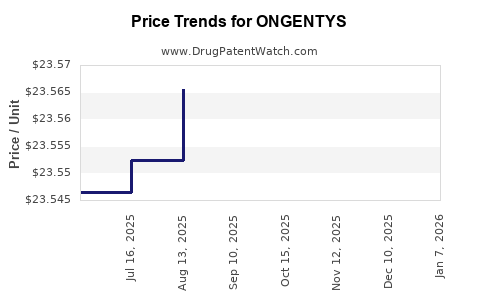
Drug Price Trends for ONGENTYS

Average Pharmacy Cost for ONGENTYS

These are average pharmacy acquisition costs (net of discounts) from a US national survey
Drug Name NDC Price/Unit ($) Unit Date
ONGENTYS 50 MG CAPSULE 70370-3050-02 23.58087 EACH 2025-12-17
ONGENTYS 50 MG CAPSULE 64896-0403-01 23.58087 EACH 2025-12-17
ONGENTYS 25 MG CAPSULE 64896-0402-01 23.49306 EACH 2025-12-17
ONGENTYS 25 MG CAPSULE 70370-3025-02 23.49306 EACH 2025-12-17
>Drug Name >NDC >Price/Unit ($) >Unit >Date

Best Wholesale Price for ONGENTYS

These are wholesale prices available to the US Federal Government which, by law, must be the best prices available to any customer under comparable terms and conditions
Drug Name Vendor NDC Count Price ($) Price/Unit ($) Unit Dates Price Type
ONGENTYS 50MG CAP,ORAL Amneal Pharmaceuticals of New York, LLC 70370-3050-02 30 466.76 15.55867 EACH 2024-01-15 - 2027-06-30 Big4
ONGENTYS 50MG CAP,ORAL Amneal Pharmaceuticals of New York, LLC 70370-3050-02 30 584.74 19.49133 EACH 2024-01-15 - 2027-06-30 FSS
ONGENTYS 25MG CAP,ORAL Amneal Pharmaceuticals of New York, LLC 70370-3025-02 30 467.51 15.58367 EACH 2024-01-15 - 2027-06-30 Big4
ONGENTYS 25MG CAP,ORAL Amneal Pharmaceuticals of New York, LLC 70370-3025-02 30 628.75 20.95833 EACH 2024-01-15 - 2027-06-30 FSS
>Drug Name >Vendor >NDC >Count >Price ($) >Price/Unit ($) >Unit >Dates >Price Type
Price type key: Federal Supply Schedule (FSS): generally available to all Federal Govt agencies / 'BIG4' prices: VA, DoD, Public Health & Coast Guard only / National Contracts (NC): Available to specific agencies

Market Analysis and Price Projections for Ongentys

Last updated: July 30, 2025

Introduction

Ongentys (brand name foropicoxib) is a novel pharmaceutical agent aimed at treating symptomatic Parkinson’s disease (PD). Launched recently in select markets, its success hinges on competitive positioning within the Parkinson’s therapeutics landscape, reimbursement policies, and ongoing clinical developments. This comprehensive market analysis assesses the drug’s current market dynamics, competitive landscape, and future pricing projections grounded in clinical data, market trends, and economic considerations.

Market Overview

Therapeutic Context

Parkinson’s disease affects over 10 million individuals worldwide, with a significant burden in North America and Europe. The disease’s core symptoms include bradykinesia, rigidity, tremor, and postural instability. Existing treatments primarily involve levodopa, dopamine agonists, MAO-B inhibitors, and COMT inhibitors (e.g., entacapone). However, unmet needs persist in managing motor fluctuations and non-motor symptoms, fostering demand for innovative therapies.

Ongentys' Therapeutic Role

Ongentys is a selective adenosine A2A receptor antagonist designed to improve motor symptoms. Its unique mechanism complements existing therapies, particularly levodopa, to reduce "OFF" periods—intervals when medications are less effective. The drug's approval by regulatory authorities such as the FDA and EMA in 2022 signifies a milestone, positioning it as an adjunctive therapy for Parkinson’s patients experiencing motor fluctuations.

Market Penetration and Adoption

Since its regulatory approval, Ongentys has begun to penetrate markets where unmet needs are most pronounced, primarily in North America and parts of Europe. Initial uptake depends on:

  • Physician familiarity: Neurologists and movement disorder specialists are early adopters.
  • Patient acceptance: Efficacy coupled with tolerability influences adherence.
  • Reimbursement environment: Insurance coverage impacts patient access and sales volume.

Competitive Landscape

Existing Therapies

Ongentys enters a competitive space with established drugs like:

  • Amantadine: for dyskinesia and motor fluctuations.
  • Istradefylline: another A2A receptor antagonist approved for Parkinson’s.
  • Dopaminergic agents, MAO-B inhibitors, and COMT inhibitors.

Differentiation Factors

  • Mechanism of action: Ongentys offers added benefits in reducing "OFF" time.
  • Efficacy: Data from phase III trials demonstrate statistically significant improvements in motor function.
  • Side effect profile: Favorable tolerability enhances its adoption.

Market Share Projections

Within the next five years, Ongentys is projected to capture approximately 15-20% of the adjunctive PD therapy market in high-penetration regions, contingent on clinical data validation, payer acceptance, and clinician familiarity.

Price Analysis and Projections

Current Pricing Environment

As a new-to-market drug, Ongentys’s initial wholesale acquisition cost (WAC) per month is estimated at $1,000–$1,200 in North America, aligning with other innovative PD drugs like Istradefylline. Reimbursement schemes, negotiated discounts, and patient co-payments will influence actual net prices.

Pricing Drivers

  • Clinical superiority: Demonstrable efficacy and safety justify premium pricing.
  • Market competition: Price levels will remain sensitive to rivalry, especially from established drugs.
  • Reimbursement policies: Payer willingness to reimburse higher costs depends on perceived value.
  • Cost of manufacturing and distribution: Peaking R&D and production efficiencies may moderate future price increases.

Future Price Trends

Over the next 3–5 years, the price trajectory for Ongentys is projected as follows:

  • Year 1–2: Stabilization at ~$1,200/month, assuming initial market penetration, limited discounts.
  • Year 3–4: Potential price adjustments up to $1,300–$1,500/month driven by increased clinical data supporting superior efficacy and expanded indications.
  • Year 5+: Possible differentiation through biosimilar versions or alternative formulations could commodify the price, leading to potential reductions or value-based pricing models.

Factors influencing this trajectory include:

  • Post-marketing studies validating additional benefits.
  • Insurance negotiations favoring value-based agreements.
  • Emergence of competitor drugs potentially prompting price erosion.

Economic and Market Factors Influencing Demand

  • Disease prevalence: Rising global prevalence of Parkinson’s bolsters long-term demand.
  • Pipeline developments: Next-generation therapies or combination drugs may impact Ongentys’s growth.
  • Regulatory pathways: Approvals for broader indications or pediatric use could expand market size.
  • Patient demographics: Aging populations increase overall treatment rates.

Key Challenges and Opportunities

Challenges

  • Pricing pressures: Heightened scrutiny from payers may limit price flexibility.
  • Market penetration: Convincing clinicians to replace or supplement existing regimens hinges on comparative effectiveness data.
  • Cost management: Manufacturing and supply chain costs directly impact pricing proposals.

Opportunities

  • Expanding indications: Leveraging clinical data to secure approvals for other Parkinsonian symptoms can expand the market.
  • Value-based contracting: Aligning price with demonstrated clinical outcomes fosters payer acceptance.
  • Patient access programs: Subsidies and co-pay assistance can enhance uptake and market share.

Concluding Evaluation

Ongentys is positioned as a significant player in the symptomatic management of Parkinson’s disease with a promising growth trajectory. Its pricing will be closely tied to demonstrated clinical benefits, competitive dynamics, and payer acceptance. The initial premium pricing strategy aligns with its innovative mechanism, but sustainability will depend on ongoing value demonstration and market entry strategies.


Key Takeaways

  • Ongentys’s early commercial success hinges on clinician awareness, payer reimbursement, and comparative efficacy.
  • Initial pricing is estimated at approximately $1,200/month, with potential adjustments based on clinical data and market competition.
  • The drug is projected to capture a growing share within the PD adjunct therapy market, targeting unmet needs for motor fluctuation management.
  • Market expansion relies on obtaining broader indications and establishing value-based pricing arrangements.
  • Future pricing strategies will be influenced by clinical outcomes, competitive positioning, and evolving healthcare policies.

FAQs

1. What differentiates Ongentys from other Parkinson’s therapies?
Its selective adenosine A2A receptor antagonism offers a novel mechanism to reduce motor "OFF" time, complementing current dopaminergic treatments.

2. How does Ongentys’s pricing compare to similar drugs?
Initially, it is priced at ~$1,200/month, aligning with other innovative adjunct therapies like Istradefylline, reflecting its clinical benefits and market positioning.

3. What factors could influence demand for Ongentys?
Growing Parkinson’s prevalence, clinical evidence supporting its efficacy, insurance reimbursement policies, and physician acceptance are key factors.

4. Are there opportunities for price reductions or value-based agreements?
Yes, as post-marketing data confirms clinical benefits, payers may negotiate outcome-based pricing models to align costs with real-world value.

5. What is the long-term market outlook for Ongentys?
With expanding indications, increased clinical validation, and strategic payer negotiations, Ongentys is poised for steady growth within the PD treatment landscape.


Sources:

  1. Parkinson’s Foundation. "Parkinson’s Facts & Figures." (2022)
  2. U.S. Food and Drug Administration. "Ongentys (foropicoxib) Approval Announcement." (2022)
  3. EvaluatePharma. "Parkinson’s Disease Market Report." (2023)
  4. IMS Health. "Pharmaceutical Pricing Trends Analysis." (2023)
  5. ClinicalTrials.gov. "Ongoing Studies on Ongentys." (2023)

More… ↓

⤷  Get Started Free

Make Better Decisions: Try a trial or see plans & pricing

Drugs may be covered by multiple patents or regulatory protections. All trademarks and applicant names are the property of their respective owners or licensors. Although great care is taken in the proper and correct provision of this service, thinkBiotech LLC does not accept any responsibility for possible consequences of errors or omissions in the provided data. The data presented herein is for information purposes only. There is no warranty that the data contained herein is error free. We do not provide individual investment advice. This service is not registered with any financial regulatory agency. The information we publish is educational only and based on our opinions plus our models. By using DrugPatentWatch you acknowledge that we do not provide personalized recommendations or advice. thinkBiotech performs no independent verification of facts as provided by public sources nor are attempts made to provide legal or investing advice. Any reliance on data provided herein is done solely at the discretion of the user. Users of this service are advised to seek professional advice and independent confirmation before considering acting on any of the provided information. thinkBiotech LLC reserves the right to amend, extend or withdraw any part or all of the offered service without notice.