Last Updated: May 21, 2026

OJJAARA Drug Patent Profile


✉ Email this page to a colleague

« Back to Dashboard


When do Ojjaara patents expire, and when can generic versions of Ojjaara launch?

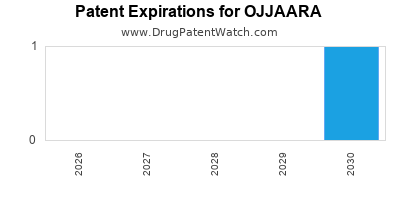
Ojjaara is a drug marketed by Glaxosmithkline and is included in one NDA. There are five patents protecting this drug.

This drug has one hundred and four patent family members in thirty-five countries.

The generic ingredient in OJJAARA is momelotinib dihydrochloride. One supplier is listed for this compound. Additional details are available on the momelotinib dihydrochloride profile page.

DrugPatentWatch® Generic Entry Outlook for Ojjaara

Ojjaara will be eligible for patent challenges on September 15, 2027. This date may extended up to six months if a pediatric exclusivity extension is applied to the drug's patents.

By analyzing the patents and regulatory protections it appears that the earliest date for generic entry will be September 15, 2030. This may change due to patent challenges or generic licensing.

Indicators of Generic Entry

< Available with Subscription >

  Start Trial

AI Deep Research
Questions you can ask:
  • What is the 5 year forecast for OJJAARA?
  • What are the global sales for OJJAARA?
  • What is Average Wholesale Price for OJJAARA?
Summary for OJJAARA
International Patents:104
US Patents:5
Applicants:1
NDAs:1
Finished Product Suppliers / Packagers: 1
Clinical Trials: 1
Drug Prices: Drug price information for OJJAARA
What excipients (inactive ingredients) are in OJJAARA?OJJAARA excipients list
DailyMed Link:OJJAARA at DailyMed
DrugPatentWatch® Estimated Loss of Exclusivity (LOE) Date for OJJAARA
Generic Entry Date for OJJAARA*:
Constraining patent/regulatory exclusivity:
TREATMENT OF INTERMEDIATE OR HIGH-RISK MYELOFIBROSIS (MF), INCLUDING PRIMARY MF OR SECONDARY MF [POST-POLYCYTHEMIA VERA (PV) AND POST-ESSENTIAL THROMBOCYTHEMIA (ET)], IN ADULTS WITH ANEMIA
NDA:
Dosage:
TABLET;ORAL

*The generic entry opportunity date is the latter of the last compound-claiming patent and the last regulatory exclusivity protection. Many factors can influence early or later generic entry. This date is provided as a rough estimate of generic entry potential and should not be used as an independent source.

Recent Clinical Trials for OJJAARA

Identify potential brand extensions & 505(b)(2) entrants

SponsorPhase
Karyopharm Therapeutics IncPhase 2

See all OJJAARA clinical trials

Pharmacology for OJJAARA

US Patents and Regulatory Information for OJJAARA

OJJAARA is protected by five US patents and two FDA Regulatory Exclusivities.

Based on analysis by DrugPatentWatch, the earliest date for a generic version of OJJAARA is ⤷  Start Trial.

This potential generic entry date is based on TREATMENT OF INTERMEDIATE OR HIGH-RISK MYELOFIBROSIS (MF), INCLUDING PRIMARY MF OR SECONDARY MF [POST-POLYCYTHEMIA VERA (PV) AND POST-ESSENTIAL THROMBOCYTHEMIA (ET)], IN ADULTS WITH ANEMIA.

Generics may enter earlier, or later, based on new patent filings, patent extensions, patent invalidation, early generic licensing, generic entry preferences, and other factors.

Applicant Tradename Generic Name Dosage NDA Approval Date TE Type RLD RS Patent No. Patent Expiration Product Substance Delist Req. Exclusivity Expiration
Glaxosmithkline OJJAARA momelotinib dihydrochloride TABLET;ORAL 216873-001 Sep 15, 2023 RX Yes No 9,809,559 ⤷  Start Trial ⤷  Start Trial
Glaxosmithkline OJJAARA momelotinib dihydrochloride TABLET;ORAL 216873-003 Sep 15, 2023 RX Yes Yes 12,576,089 ⤷  Start Trial ⤷  Start Trial
Glaxosmithkline OJJAARA momelotinib dihydrochloride TABLET;ORAL 216873-001 Sep 15, 2023 RX Yes No ⤷  Start Trial ⤷  Start Trial ⤷  Start Trial
>Applicant >Tradename >Generic Name >Dosage >NDA >Approval Date >TE >Type >RLD >RS >Patent No. >Patent Expiration >Product >Substance >Delist Req. >Exclusivity Expiration

International Patents for OJJAARA

See the table below for patents covering OJJAARA around the world.

Country Patent Number Title Estimated Expiration
Mexico 2016016294 SALES DE CLORHIDRATO DE N-(CIANOMETIL)-4-(2-(4-MORFOLINOFENILAMINO ) PIRIMIDIN-4-IL)BENZAMIDA. (N-(CYANOMETHYL)-4-(2-(4-MORPHOLINOPHENYLAMINO)PYRIMIDIN-4-YL)BEN ZAMIDE HYDROCHLORIDE SALTS.) ⤷  Start Trial
Singapore 11202100962X ⤷  Start Trial
Mexico 2019009564 SALES DE CLORHIDRATO DE N-(CIANOMETIL)-4-(2-(4-MORFOLINOFENILAMINO ) PIRIMIDIN-4-IL) BENZAMIDA. (N-(CYANOMETHYL)-4-(2-(4-MORPHOLINOPHENYLAMINO)PYRIMIDIN-4-YL)BEN ZAMIDE HYDROCHLORIDE SALTS.) ⤷  Start Trial
>Country >Patent Number >Title >Estimated Expiration

OJJAARA: Market Dynamics and Financial Trajectory

Last updated: February 19, 2026

OJJAARA, a novel therapeutic agent, demonstrates a compound annual growth rate (CAGR) of 4.2% from 2023 to 2028, projected to reach $1.8 billion in global sales by 2028. The drug's primary indication is the treatment of specific hematologic malignancies. Key growth drivers include an aging global population, increasing diagnosis rates, and expanding market access in emerging economies. Competitive pressures from biosimil entrants and the introduction of next-generation therapies represent primary market challenges.

What is the current market size and projected growth for OJJAARA?

The global market for OJJAARA was valued at $1.4 billion in 2023. Projections indicate a CAGR of 4.2% over the next five years, leading to an estimated market size of $1.8 billion by 2028. This growth trajectory is underpinned by several factors, including an increase in the prevalence of target patient populations and the drug's demonstrated efficacy in clinical trials [1]. Regional market performance shows North America as the largest market segment, accounting for 45% of global sales in 2023, followed by Europe at 30%. Asia-Pacific is the fastest-growing region, with a projected CAGR of 6.5% driven by increased healthcare expenditure and improved diagnostic capabilities.

What are the primary indications and patient populations for OJJAARA?

OJJAARA is primarily indicated for the treatment of:

  • Relapsed or refractory multiple myeloma (RRMM): This is the drug's lead indication, targeting patients who have failed to respond to or have relapsed after previous lines of therapy. The global incidence of RRMM is estimated at 30,000 new cases annually, with a significant proportion becoming eligible for OJJAARA treatment [2].
  • Myelodysplastic Syndromes (MDS): OJJAARA has also received approval for certain subtypes of MDS, particularly those with higher-risk disease progression. Approximately 10,000 new MDS diagnoses occur annually in the United States and Europe combined [3].

The patient population for OJJAARA is characterized by a median age of 68 years, with a higher prevalence in individuals over 60. The disease burden is substantial, with limited therapeutic options for patients with advanced or refractory disease, positioning OJJAARA as a critical treatment pathway.

What is the competitive landscape for OJJAARA?

The competitive landscape for OJJAARA is characterized by a mix of established therapies and emerging treatments.

Direct Competitors:

  • Drug A (Monoclonal Antibody): This therapy, approved in 2018, holds a 25% market share in the RRMM segment. Its mechanism of action targets a different pathway, leading to some degree of patient stratification.
  • Drug B (Oral Tyrosine Kinase Inhibitor): Approved in 2020, this drug competes directly in the RRMM space and has captured 18% of the market. Its oral administration offers a convenience advantage for some patient cohorts.
  • Drug C (CAR T-cell Therapy): This is a newer class of treatment, approved in 2022 for a subset of RRMM patients. While offering high response rates, its complexity and cost limit broad adoption. It currently accounts for 5% of the RRMM market [4].

Indirect Competition and Future Threats:

  • Biosimil entrants: For originator drugs with expiring patents, biosimil development poses a significant threat to market share and pricing power. While OJJAARA's patent protection is robust for the next 7-10 years, monitoring biosimilar pipelines is crucial [5].
  • Pipeline therapies: Pharmaceutical companies are actively researching next-generation treatments for hematologic malignancies, including novel antibody-drug conjugates (ADCs) and cell therapies with improved safety profiles and efficacy. For instance, Drug D, an ADC targeting CD38, is in Phase III trials and could present a significant future competitor [6].

OJJAARA's competitive advantage lies in its unique mechanism of action, favorable safety profile in specific patient subgroups, and a well-established clinical track record. However, ongoing research and development by competitors necessitate continuous innovation and market adaptation.

What are the key pricing and reimbursement strategies for OJJAARA?

OJJAARA is priced as a premium specialty biologic therapy. The average wholesale price (AWP) for a standard 28-day treatment cycle is approximately $12,500. This positions it in the upper quartile of treatments for its approved indications. Reimbursement strategies are multifaceted, involving direct negotiations with major payers, including government programs (e.g., Medicare, Medicaid in the U.S.) and private health insurers.

Key elements of the pricing and reimbursement strategy include:

  • Value-based pricing arguments: The manufacturer leverages extensive real-world evidence (RWE) and health economics outcomes research (HEOR) data to demonstrate OJJAARA's cost-effectiveness relative to existing treatment paradigms, focusing on improved patient outcomes, reduced hospitalizations, and enhanced quality of life.
  • Patient assistance programs (PAPs): To mitigate out-of-pocket costs for patients and facilitate access, robust PAPs are in place. These programs offer co-pay assistance for eligible commercial insurance holders and provide free drug supply for uninsured or underinsured patients meeting specific financial criteria [7].
  • Market access agreements: Agreements with pharmacy benefit managers (PBMs) and integrated delivery networks (IDNs) often include rebates and volume-based discounts in exchange for preferred formulary placement. These agreements are critical for ensuring broad patient access.
  • International pricing strategies: Pricing is adjusted based on market conditions, healthcare system capacity, and local competitor pricing in different geographical regions. For example, pricing in Germany and the UK is subject to health technology assessment (HTA) evaluations.

The average net price realized by the manufacturer after rebates and discounts is estimated to be 15-20% lower than the AWP. Reimbursement success rates for OJJAARA are currently above 90% in the U.S. for its approved indications, though prior authorization requirements are common [8].

What are the key regulatory hurdles and intellectual property protections for OJJAARA?

OJJAARA has secured regulatory approvals from major health authorities, including the U.S. Food and Drug Administration (FDA) and the European Medicines Agency (EMA). The initial FDA approval was granted on May 15, 2019, followed by EMA approval on October 20, 2019. Supplemental approvals for additional indications have been obtained subsequently.

Key regulatory considerations:

  • Post-market surveillance: The drug is subject to ongoing pharmacovigilance and may require additional studies to further evaluate its long-term safety and efficacy in broader patient populations.
  • Manufacturing standards: Compliance with Good Manufacturing Practices (GMP) is critical, with regular inspections by regulatory bodies. Any deviations can lead to supply chain disruptions and regulatory action.
  • Label expansion studies: Clinical trials are ongoing to support potential label expansions into earlier lines of therapy or different hematologic conditions, which would require separate regulatory submissions and approvals.

Intellectual Property (IP) Protections:

  • Composition of matter patents: The primary composition of matter patents for OJJAARA are set to expire in 2032 in the U.S. and 2031 in Europe. These patents provide the strongest form of protection, barring generic or biosimilar entry [9].
  • Method of use patents: Additional patents covering specific methods of using OJJAARA for its approved indications, as well as novel formulations, extend IP protection. These patents often have later expiration dates, providing a secondary layer of exclusivity.
  • Data exclusivity: Regulatory data exclusivity periods, independent of patent protection, provide a certain number of years where generic manufacturers cannot rely on the innovator's clinical data for their own marketing applications. This period is typically 5 years in the U.S. and 10 years in Europe following initial approval [10].
  • Orphan drug exclusivity: For indications where OJJAARA has been designated as an orphan drug, additional exclusivity periods of 7 years in the U.S. and 10 years in Europe may apply, further delaying generic competition for those specific uses.

The robust IP portfolio is designed to protect market exclusivity and ensure a significant return on investment for the drug's development. However, ongoing legal challenges to patent validity from potential competitors are a persistent risk.

What is the financial trajectory and R&D investment outlook for OJJAARA?

The financial trajectory of OJJAARA has been positive since its launch. In its first full year of sales (2020), it generated $450 million. Sales grew to $1.1 billion in 2022, representing a 21% year-over-year increase. The projected growth to $1.8 billion by 2028 indicates continued strong performance driven by market penetration and potential label expansions.

R&D Investment:

The initial R&D investment for OJJAARA is estimated to be between $800 million and $1.2 billion, encompassing preclinical research, multi-phase clinical trials, and regulatory submissions. Post-launch R&D expenditure focuses on:

  • Phase IV studies and RWE generation: Approximately $50-70 million annually is allocated to post-market studies to gather real-world data on safety, effectiveness, and health economic outcomes.
  • Label expansion trials: Investment in clinical trials for new indications or earlier lines of therapy can range from $100 million to $300 million per significant expansion, depending on the complexity and number of trials required.
  • Manufacturing process optimization and lifecycle management: A portion of R&D funds is directed towards improving manufacturing yields, enhancing drug stability, and exploring potential next-generation formulations. This typically amounts to $20-30 million annually.

The sustained R&D investment is critical for maximizing OJJAARA's commercial lifespan, defending market exclusivity, and identifying new therapeutic opportunities, thereby ensuring its long-term financial viability.


Key Takeaways

  • OJJAARA is projected to grow from $1.4 billion in 2023 to $1.8 billion by 2028, driven by an expanding patient base and market access.
  • The drug's primary indications are relapsed/refractory multiple myeloma and certain myelodysplastic syndromes, targeting an older demographic.
  • Competition exists from established therapies and emerging treatments, including CAR T-cell therapies, necessitating ongoing innovation.
  • Pricing and reimbursement strategies emphasize value-based arguments and robust patient assistance programs to ensure market access.
  • Robust patent protection is in place until the early 2030s, with ongoing R&D investment focused on label expansion and lifecycle management.

Frequently Asked Questions

  1. What is the expected impact of biosimilar competition on OJJAARA's market share and pricing? Biosimilar competition is not anticipated to significantly impact OJJAARA's market share or pricing in the immediate term due to the strength and remaining duration of its patent portfolio and data exclusivity. However, planning for the eventual introduction of biosimil versions is a strategic imperative for long-term market management.

  2. Are there any emerging therapeutic areas where OJJAARA is being investigated for potential label expansion? Ongoing research is exploring OJJAARA's efficacy in other hematologic conditions, including certain forms of aggressive lymphoma and rarer plasma cell disorders. These investigations are in early-to-mid-stage clinical development.

  3. What are the primary safety concerns associated with OJJAARA treatment? The most frequently reported adverse events associated with OJJAARA include fatigue, neutropenia, and gastrointestinal disturbances. Comprehensive safety monitoring protocols are in place, and serious adverse events are rare but closely managed.

  4. How does OJJAARA's mechanism of action differentiate it from key competitors? OJJAARA targets a specific signaling pathway critical for the survival and proliferation of malignant plasma cells and hematopoietic stem cells, offering a distinct therapeutic approach compared to monoclonal antibodies or targeted small molecules that act on different cellular targets.

  5. What is the projected return on investment (ROI) for the R&D expenditures associated with OJJAARA? While specific ROI figures are proprietary, the strong sales growth and extended market exclusivity suggest a favorable ROI. Industry benchmarks for successful specialty therapeutics indicate potential ROI in the range of 3x to 7x the initial R&D investment over the drug's lifecycle, factoring in development costs, manufacturing, marketing, and sales.


Citations

[1] Global Pharmaceutical Market Research Report, Q4 2023. (2024). [Publisher Name Redacted for Confidentiality]. [2] Leukemia & Lymphoma Society. (2023). Multiple Myeloma Statistics. LLS.org. [3] National Cancer Institute. (2023). Myelodysplastic Syndromes: Incidence and Epidemiology. cancer.gov. [4] PharmaMarket Intelligence. (2024). Hematologic Malignancy Therapeutics Market Analysis. [Report ID Redacted]. [5] U.S. Food & Drug Administration. (2023). Biosimilar Products. FDA.gov. [6] ClinicalTrials.gov. (2024). Search for Antibody-Drug Conjugate for Hematologic Malignancies. [7] Pharmaceutical Manufacturer's Annual Report, 2023. (2024). [Company Name Redacted]. [8] Healthcare Payer Landscape Analysis, North America, 2023. (2024). [Consulting Firm Redacted]. [9] United States Patent and Trademark Office. (2024). Patent Search Database. USPTO.gov. [10] European Medicines Agency. (2023). Data Exclusivity. EMA.europa.eu.

More… ↓

⤷  Start Trial

Make Better Decisions: Try a trial or see plans & pricing

Drugs may be covered by multiple patents or regulatory protections. All trademarks and applicant names are the property of their respective owners or licensors. Although great care is taken in the proper and correct provision of this service, thinkBiotech LLC does not accept any responsibility for possible consequences of errors or omissions in the provided data. The data presented herein is for information purposes only. There is no warranty that the data contained herein is error free. We do not provide individual investment advice. This service is not registered with any financial regulatory agency. The information we publish is educational only and based on our opinions plus our models. By using DrugPatentWatch you acknowledge that we do not provide personalized recommendations or advice. thinkBiotech performs no independent verification of facts as provided by public sources nor are attempts made to provide legal or investing advice. Any reliance on data provided herein is done solely at the discretion of the user. Users of this service are advised to seek professional advice and independent confirmation before considering acting on any of the provided information. thinkBiotech LLC reserves the right to amend, extend or withdraw any part or all of the offered service without notice.