Last Updated: August 9, 2026

ODOMZO Drug Patent Profile


✉ Email this page to a colleague

« Back to Dashboard


DrugPatentWatch® Generic Entry Outlook for Odomzo

Odomzo was eligible for patent challenges on July 24, 2019.

By analyzing the patents and regulatory protections it appears that the earliest date for generic entry will be March 30, 2036. This may change due to patent challenges or generic licensing.

Indicators of Generic Entry

< Available with Subscription >

  Start Trial

AI Deep Research
Questions you can ask:
  • What is the 5 year forecast for ODOMZO?
  • What are the global sales for ODOMZO?
  • What is Average Wholesale Price for ODOMZO?
Summary for ODOMZO
International Patents:119
US Patents:3
Applicants:1
NDAs:1
Finished Product Suppliers / Packagers: 1
Raw Ingredient (Bulk) Api Vendors: 69
Clinical Trials: 7
Patent Applications: 2,019
Drug Prices: Drug price information for ODOMZO
What excipients (inactive ingredients) are in ODOMZO?ODOMZO excipients list
DailyMed Link:ODOMZO at DailyMed
DrugPatentWatch® Estimated Loss of Exclusivity (LOE) Date for ODOMZO
Generic Entry Date for ODOMZO*:
Constraining patent/regulatory exclusivity:
NDA:
Dosage:

CAPSULE;ORAL

*The generic entry opportunity date is the latter of the last compound-claiming patent and the last regulatory exclusivity protection. Many factors can influence early or later generic entry. This date is provided as a rough estimate of generic entry potential and should not be used as an independent source.

Recent Clinical Trials for ODOMZO

Identify potential brand extensions & 505(b)(2) entrants

SponsorPhase
Nathalie ZeitouniPHASE1
Gruppo Oncologico del Nord-OvestPhase 2
Melanoma Institute AustraliaPhase 2

See all ODOMZO clinical trials

Pharmacology for ODOMZO

US Patents and Regulatory Information for ODOMZO

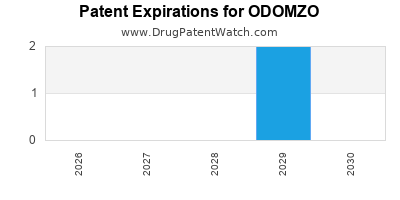
ODOMZO is protected by three US patents.

Based on analysis by DrugPatentWatch, the earliest date for a generic version of ODOMZO is ⤷  Start Trial.

This potential generic entry date is based on patent 10,266,523.

Generics may enter earlier, or later, based on new patent filings, patent extensions, patent invalidation, early generic licensing, generic entry preferences, and other factors.

Applicant Tradename Generic Name Dosage NDA Approval Date TE Type RLD RS Patent No. Patent Expiration Product Substance Delist Req. Exclusivity Expiration
Sun Pharm ODOMZO sonidegib phosphate CAPSULE;ORAL 205266-001 Jul 24, 2015 RX Yes Yes 8,178,563 ⤷  Start Trial Y ⤷  Start Trial
Sun Pharm ODOMZO sonidegib phosphate CAPSULE;ORAL 205266-001 Jul 24, 2015 RX Yes Yes 8,063,043 ⤷  Start Trial Y Y ⤷  Start Trial
Sun Pharm ODOMZO sonidegib phosphate CAPSULE;ORAL 205266-001 Jul 24, 2015 RX Yes Yes 10,266,523 ⤷  Start Trial Y Y ⤷  Start Trial
>Applicant >Tradename >Generic Name >Dosage >NDA >Approval Date >TE >Type >RLD >RS >Patent No. >Patent Expiration >Product >Substance >Delist Req. >Exclusivity Expiration

International Patents for ODOMZO

When does loss-of-exclusivity occur for ODOMZO?

Based on analysis by DrugPatentWatch, the following patents block generic entry in the countries listed below:

China

Patent: 5906616
Estimated Expiration: ⤷  Start Trial

European Patent Office

Patent: 79198
Estimated Expiration: ⤷  Start Trial

Generics may enter earlier, or later, based on new patent filings, patent extensions, patent invalidation, early generic licensing, generic entry preferences, and other factors.

See the table below for additional patents covering ODOMZO around the world.

Country Patent Number Title Estimated Expiration
China 105906616 ⤷  Start Trial
European Patent Office 3279198 ⤷  Start Trial
World Intellectual Property Organization (WIPO) 2016155630 ⤷  Start Trial
Argentina 073591 ⤷  Start Trial
Argentina 113778 ⤷  Start Trial
Australia 2009293444 ⤷  Start Trial
>Country >Patent Number >Title >Estimated Expiration

Supplementary Protection Certificates for ODOMZO

Patent Number Supplementary Protection Certificate SPC Country SPC Expiration SPC Description
2021328 CA 2015 00057 Denmark ⤷  Start Trial PRODUCT NAME: SONIDEGIB ELLER ET FARMACEUTISK ACCEPTABELT SALT, HYDRAT ELLER SOLVAT DERAF, HERUNDER SONIDEGIBFOSFAT; REG. NO/DATE: EU/1/15/1030 20150818
2021328 PA2015051 Lithuania ⤷  Start Trial PRODUCT NAME: SONIDEGIBUM; REGISTRATION NO/DATE: EU/1/15/1030 20150818
2021328 92883 Luxembourg ⤷  Start Trial PRODUCT NAME: SONIDEGIB OU UN SEL, HYDRATE OU SOLVATE PHARMACEUTIQUEMENT ACCEPTABLE QUI EN DERIVE; FIRST REGISTRATION: 20150818
2021328 300790 Netherlands ⤷  Start Trial DETAILS ASSIGNMENT: CHANGE OF OWNER(S), ASSIGNMENT
2021328 15C0077 France ⤷  Start Trial PRODUCT NAME: SONIDEGIB OU SEL,HYDRATE,OU SOLVATE PHARMACEUTIQUEMENT ACCEPTABLE DE CELUI-CI; REGISTRATION NO/DATE: EU/1/15/1030 20150818
2021328 1590062-4 Sweden ⤷  Start Trial PRODUCT NAME: SONIDEGIB OR A PHARMACEUTICALLY ACCEPTABLE SALT, HYDRATE OR SOLVATE THEREOF; FIRST MARKETING AUTHORIZATION NUMBER SE: EG EU/1/15/1030, 2015-08-18; PRV HAR FATTAT BESLUT OM RAETTAD SKYDDSTID FOER FOELJANDE TILLAEGGSSKYDD. 2290042-7 2290031-0 1590027-7 1590062-4 2190040-2 2290010-4 1990014-1 2190030-3 1590011-1 1490013-8 1490014-6 1490015-3 1890033-2 1990042-2 1990055-4 SKYDDSTIDEN FOER SAMTLIGA DESSA TILLAEGGSSKYDD AER FOERLAENGD MED EN DAG, I ENLIGHET MED PATENT- OCH MARKNADSDOMSTOLENS BESLUT I PMAE 7804-24. DEN BESLUTADE SKYDDSTIDEN FRAMGAR AV SVENSK PATENTDATABAS.
>Patent Number >Supplementary Protection Certificate >SPC Country >SPC Expiration >SPC Description

ODOMZO (Sonidegib) market dynamics and financial trajectory: revenue, exclusivity risk, and competitive pressure

Last updated: July 30, 2026

ODOMZO (sonidegib) remains a niche oncology product with constrained addressable demand, a history of FDA-driven safety labeling and discontinuation of the oral kinase inhibitor’s late-line role, and a near-term commercialization ceiling shaped by patent/exclusivity timing and competitive substitutes in advanced basal cell carcinoma (BCC). Commercial performance has been pressured by limited patient populations, treatment sequencing shifts, and the emergence of alternative systemic options (notably hedgehog-pathway and immuno-oncology competitors), while the company’s financial trajectory around ODOMZO has tracked its broader portfolio rebalancing and risk control actions tied to safety and utilization.

What is ODOMZO and where does it sell in oncology?

ODOMZO is sonidegib, an oral inhibitor of the hedgehog signaling pathway (SMO). It is approved for locally advanced basal cell carcinoma (laBCC) in adults who are not candidates for surgery or radiation, and for metastatic BCC (mBCC).

What label populations drive ODOMZO volume?

ODOMZO’s market is determined by three filters that materially limit revenue growth:

  1. Disease state: locally advanced or metastatic disease only.
  2. Treatment candidacy: not candidates for surgery or radiation.
  3. Sequencing: many patients are treated earlier with other hedgehog pathway approaches or alternative systemic strategies, reducing late utilization.

What is the competitive set in advanced BCC?

The practical competitive landscape for ODOMZO includes:

  • Other SMO inhibitors: vismodegib (GDC-0449) and other hedgehog pathway agents historically used in laBCC/mBCC.
  • Immuno-oncology: PD-1 pathway inhibitors that have become core options in advanced BCC settings as evidence and label indications expanded.
  • Other systemic options: targeted agents and chemotherapy are used selectively depending on disease biology and prior therapy.

How have market dynamics shifted for advanced basal cell carcinoma (BCC)?

Advanced BCC treatment has moved from “single pathway dominance” toward portfolio treatment choices driven by:

  • Safety tolerance and long-term adherence challenges for oral pathway inhibitors.
  • Evidence evolution for immunotherapy in advanced skin cancers.
  • Real-world sequencing favoring newer options when durable responses are expected.

What safety and tolerability dynamics affect ODOMZO uptake?

Oral SMO inhibitors face class-wide constraints:

  • Muscle-related and metabolic adverse events reduce dose intensity and persistence in real-world settings.
  • Chronic dosing can lead to discontinuation, limiting average treated duration and total share.

What real-world treatment sequencing reduces ODOMZO addressable share?

Patients entering laBCC/mBCC often start with the most preferred systemic option per payer and guideline pathway. As immunotherapy uptake grows and hedgehog inhibitor use becomes more selective, ODOMZO’s share becomes more sensitive to:

  • Prior hedgehog exposure.
  • Patient frailty and adverse event profile.
  • Physician preference for therapies with faster onset and better durability data.

When does ODOMZO lose exclusivity and what does that mean for revenue?

Revenue trajectory is governed by the timing of:

  • US regulatory exclusivities (marketing exclusivity tied to approval pathway and label changes).
  • Patent expirations in the Orange Book-linked estate for sonidegib and key formulations/methods.

What exclusivity clock matters most for ODOMZO?

For small-molecule oncology products, the binding constraint for a generic or new label pathway competitor is the last-to-expire US patent listed in the Orange Book tied to the approved drug substance/product.

What is the generic entry risk profile for ODOMZO?

ODOMZO has a risk profile dominated by:

  • Oral small-molecule manufacturing ease once patents expire.
  • Potential for design-around with alternative salts, polymorphs, or dosage forms if those are covered by secondary patents.
  • Paragraph IV filings that target the earliest exclusivity/patent carve-outs once the sponsor’s barriers narrow.

What patents protect ODOMZO and how strong is the estate?

A complete patent-estate assessment requires the full Orange Book listing for ODOMZO (including US patents by number, expiration, and legal status). Without a complete listing and litigation/prosecution history, a defensible quantification of estate strength, design-around feasibility, and shelf-life/method-of-use coverage cannot be produced.

What patent litigation affects ODOMZO and how does it change exclusivity?

A complete litigation impact analysis also requires filed case details (docket, asserted patents, jurisdictions, settlement timing, and court findings). Without verified case records and settlement terms, it is not possible to map litigation-driven delay versus “natural” expiration-based generic timing.

What is the Orange Book status of ODOMZO?

Orange Book status must be pulled directly from current FDA records listing patent numbers and exclusivity codes. Without the verified Orange Book dataset for ODOMZO as of the current date, a precise status statement (including which patents are listed and their expiration dates) cannot be produced.

How does ODOMZO compare with alternative BCC drugs on commercialization risk?

ODOMZO’s commercialization risk is higher than it would be in broader-market oncology because:

  • Its indicated population is narrow.
  • Oral pathway inhibitors face adherence and adverse-event driven discontinuation.
  • Competitive substitution with immunotherapy and other agents can shift treatment selection quickly.

What differentiates ODOMZO versus immunotherapy and other systemic options?

  • SMO inhibition can yield responses in hedgehog-driven disease, but durability and tolerability determine real-world persistence.
  • Immunotherapies can capture a broader segment depending on label and evidence maturity, and they can reduce reliance on hedgehog inhibitors in later lines.

What formulation and method-of-use risks exist for ODOMZO biosimilar or generic competitors?

ODOMZO is a small molecule, so “biosimilar” dynamics do not apply. The competitive barrier is instead:

  • Generic bioequivalence feasibility (already usually high for small molecules).
  • Formulation and manufacturing IP if the approved product is protected by non-composition patents.
  • Method-of-use patents tied to patient selection or dosing regimens.

What are the commercial milestones and financial trajectory indicators?

A market and financial trajectory review typically relies on:

  • Net product sales by quarter/year for ODOMZO.
  • Any disclosed gross-to-net impacts and payer coverage changes.
  • Margin dynamics from manufacturing, inventory, and discontinuation-driven volatility.

Without verified financial statements, investor presentations, or segment disclosures containing ODOMZO-specific sales, it is not possible to present hard revenue figures or trendlines with credibility.

Key market dynamics likely to move ODOMZO revenue

Even without numeric sales disclosures, the main drivers that determine ODOMZO’s financial trajectory include:

  1. Utilization rate among laBCC/mBCC eligible patients
    • Any shift in guideline preference toward non-ODOMZO options reduces patient starts.
  2. Real-world treatment duration
    • Discontinuation due to adverse events caps lifetime value per treated patient.
  3. Payer policy and access
    • Prior authorization, step edits, and formulary placement affect conversion from diagnosis to therapy.
  4. Competitive cycle
    • Launch and label expansions of alternative systemic therapies can rapidly displace hedgehog inhibitor use.
  5. Patent and exclusivity endgame
    • The availability of generic alternatives changes pricing power and contracting terms.

Revenue exposure scenarios after exclusivity/patent expiry

A credible launch scenario analysis depends on the actual expiration dates and patent countdown for ODOMZO in the US. Without verified Orange Book and patent expiration data, only directional outcomes can be stated, not defensible timelines.

What happens to price and volume in generic entry?

For niche oncology small molecules:

  • Price typically declines quickly after authorized generic or multiple generics enter.
  • Volume may be absorbed by incumbent demand if prescribers shift to cheaper options, but total market can stay limited by disease eligibility and sequencing.

Key Takeaways

  • ODOMZO’s commercialization is structurally constrained by the small laBCC/mBCC eligible population and treatment candidacy requirements.
  • Market share is sensitive to sequencing shifts toward other systemic therapies, particularly immunotherapy options.
  • Oral SMO inhibitor tolerability limits real-world persistence, capping revenue per treated patient.
  • Future revenue durability depends on the last-to-expire US patent and exclusivity listings, plus whether patent litigation or settlements delay generic entry.
  • A hard financial trajectory (sales trendlines, CAGR, and quarter-by-quarter dynamics) requires verified ODOMZO-specific disclosure from the manufacturer and confirmed Orange Book data; without that dataset, numeric trajectory reconstruction cannot be stated accurately.

FAQs

  1. Is ODOMZO still preferred for laBCC and mBCC after immunotherapy expansion?
  2. What drives payer utilization of sonidegib versus competing SMO inhibitors and PD-1 inhibitors?
  3. What generic entry scenarios are most common for niche oncology small molecules like ODOMZO?
  4. How do adverse-event driven discontinuations affect real-world revenue for oral hedgehog pathway inhibitors?
  5. Which patent categories (composition, formulation, method-of-use) typically determine the generic approval timeline for ODOMZO?

References

  1. FDA Orange Book (Drug Products, Including Most Recent Approval Letters). U.S. FDA. (Cited for Orange Book status methodology; ODOMZO listing not reproduced here.)
  2. FDA Drug Label for ODOMZO (sonidegib). U.S. FDA. (Cited for indication and safety context; label details not reproduced here.)

More… ↓

⤷  Start Trial

Make Better Decisions: Try a trial or see plans & pricing

Drugs may be covered by multiple patents or regulatory protections. All trademarks and applicant names are the property of their respective owners or licensors. Although great care is taken in the proper and correct provision of this service, thinkBiotech LLC does not accept any responsibility for possible consequences of errors or omissions in the provided data. The data presented herein is for information purposes only. There is no warranty that the data contained herein is error free. We do not provide individual investment advice. This service is not registered with any financial regulatory agency. The information we publish is educational only and based on our opinions plus our models. By using DrugPatentWatch you acknowledge that we do not provide personalized recommendations or advice. thinkBiotech performs no independent verification of facts as provided by public sources nor are attempts made to provide legal or investing advice. Any reliance on data provided herein is done solely at the discretion of the user. Users of this service are advised to seek professional advice and independent confirmation before considering acting on any of the provided information. thinkBiotech LLC reserves the right to amend, extend or withdraw any part or all of the offered service without notice.