You're using a free limited version of DrugPatentWatch: Upgrade for Complete Access

Last Updated: December 17, 2025

NULIBRY Drug Patent Profile


✉ Email this page to a colleague

« Back to Dashboard


When do Nulibry patents expire, and when can generic versions of Nulibry launch?

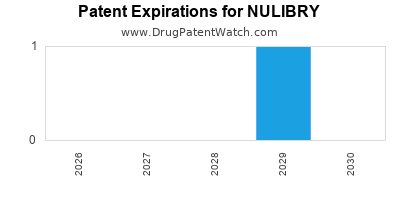
Nulibry is a drug marketed by Sentynl Theraps Inc and is included in one NDA. There is one patent protecting this drug.

This drug has ten patent family members in ten countries.

The generic ingredient in NULIBRY is fosdenopterin hydrobromide. One supplier is listed for this compound. Additional details are available on the fosdenopterin hydrobromide profile page.

DrugPatentWatch® Generic Entry Outlook for Nulibry

Nulibry was eligible for patent challenges on February 26, 2025.

By analyzing the patents and regulatory protections it appears that the earliest date for generic entry will be April 9, 2029. This may change due to patent challenges or generic licensing.

Indicators of Generic Entry

< Available with Subscription >

  Get Started Free

AI Deep Research
Questions you can ask:
  • What is the 5 year forecast for NULIBRY?
  • What are the global sales for NULIBRY?
  • What is Average Wholesale Price for NULIBRY?
Summary for NULIBRY
International Patents:10
US Patents:1
Applicants:1
NDAs:1
Finished Product Suppliers / Packagers: 1
Drug Prices: Drug price information for NULIBRY
What excipients (inactive ingredients) are in NULIBRY?NULIBRY excipients list
DailyMed Link:NULIBRY at DailyMed
Drug patent expirations by year for NULIBRY
Drug Prices for NULIBRY

See drug prices for NULIBRY

DrugPatentWatch® Estimated Loss of Exclusivity (LOE) Date for NULIBRY
Generic Entry Date for NULIBRY*:
Constraining patent/regulatory exclusivity:
NDA:
Dosage:
POWDER;INTRAVENOUS

*The generic entry opportunity date is the latter of the last compound-claiming patent and the last regulatory exclusivity protection. Many factors can influence early or later generic entry. This date is provided as a rough estimate of generic entry potential and should not be used as an independent source.

Pharmacology for NULIBRY

US Patents and Regulatory Information for NULIBRY

NULIBRY is protected by one US patents and three FDA Regulatory Exclusivities.

Based on analysis by DrugPatentWatch, the earliest date for a generic version of NULIBRY is ⤷  Get Started Free.

This potential generic entry date is based on patent ⤷  Get Started Free.

Generics may enter earlier, or later, based on new patent filings, patent extensions, patent invalidation, early generic licensing, generic entry preferences, and other factors.

Applicant Tradename Generic Name Dosage NDA Approval Date TE Type RLD RS Patent No. Patent Expiration Product Substance Delist Req. Exclusivity Expiration
Sentynl Theraps Inc NULIBRY fosdenopterin hydrobromide POWDER;INTRAVENOUS 214018-001 Feb 26, 2021 RX Yes Yes ⤷  Get Started Free ⤷  Get Started Free Y ⤷  Get Started Free
Sentynl Theraps Inc NULIBRY fosdenopterin hydrobromide POWDER;INTRAVENOUS 214018-001 Feb 26, 2021 RX Yes Yes ⤷  Get Started Free ⤷  Get Started Free ⤷  Get Started Free
>Applicant >Tradename >Generic Name >Dosage >NDA >Approval Date >TE >Type >RLD >RS >Patent No. >Patent Expiration >Product >Substance >Delist Req. >Exclusivity Expiration

International Patents for NULIBRY

See the table below for patents covering NULIBRY around the world.

Country Patent Number Title Estimated Expiration
Poland 1664317 ⤷  Get Started Free
Slovenia 1664317 ⤷  Get Started Free
European Patent Office 1664317 Utilisation du précurseur Z pour produire un agent servant à traiter la déficience humaine en cofacteur molybdène (Use of precursor Z for the production of a means for therapy of human molybdenum cofactor deficiency) ⤷  Get Started Free
Denmark 1664317 ⤷  Get Started Free
Germany 102004004642 Produktion, Gewinnung und therapeutischer Einsatz des Molybdopterin-Derivats Precursor Z zur Therapie der Stoffwechselerkrankung humaner Molybdäncofaktor-Defizienz und anderer assoziierter Krankheiten ⤷  Get Started Free
World Intellectual Property Organization (WIPO) 2005073387 ⤷  Get Started Free
Portugal 1664317 ⤷  Get Started Free
>Country >Patent Number >Title >Estimated Expiration

Market Dynamics and Financial Trajectory for the Pharmaceutical Drug: NULIBRY (Fosdenopterin)

Last updated: July 27, 2025

Introduction

NULIBRY (fosdenopterin) represents a groundbreaking therapeutic intervention for patients suffering from molybdenum cofactor deficiency (MoCD), a rare and often fatal genetic disorder. Approved by the FDA in 2023, NULIBRY’s market trajectory is shaped by a confluence of clinical efficacy, regulatory approvals, competitive landscape, and evolving healthcare policies. This analysis explores the prevailing market dynamics, forecasted financial trajectory, and strategic considerations that influence NULIBRY's commercial prospects within the niche of ultra-rare disease therapeutics.


Market Overview and Unmet Medical Need

Molybdenum cofactor deficiency (MoCD) is an autosomal recessive disorder characterized by severe neurological impairment and early mortality. Current management strategies are limited, focusing mainly on supportive care rather than disease modification. The rare nature of MoCD—estimated prevalence below 1 per 1 million—positions NULIBRY within the ultra-orphan drug category, which often features high development costs but limited patient populations.

The therapeutic landscape prior to NULIBRY’s approval lacked FDA-approved pharmacological options, creating a significant unmet medical need. The disease's rapid progression and severe prognosis underscore high demand for innovative therapies capable of altering disease trajectory.


Market Dynamics Influencers

1. Regulatory Approvals and Adoption Timeline

The FDA's approval of NULIBRY in early 2023 marked a pivotal moment, positioning it as the first disease-modifying therapy for MoCD. European and other regulatory agencies are expected to follow suit, contingent upon submissions and data review, but the initial market adoption will predominantly hinge on U.S. prescriber acceptance.

The orphan drug designation grants NULIBRY benefits such as market exclusivity (seven years in the U.S.), which is crucial for recouping R&D investments amid limited sales volumes.

2. Pricing and Reimbursement Strategies

Pricing strategies for ultra-rare disease drugs are inherently high, reflecting the small patient base. NULIBRY’s pricing is projected in the range of $1 million annually per patient, aligning with other orphan drugs that deliver transformative benefits. Reimbursement will depend on negotiations with payers, supported by robust health-economic data on clinical benefits and quality-of-life improvements.

In the U.S., payer coverage likely to be facilitated by the rarity-based policy frameworks under programs like Medicare and Medicaid. Globally, market access may be restricted initially due to financial constraints and regulatory hurdles, limiting immediate global revenue streams.

3. Market Penetration Challenges

Despite regulatory approval, the ultra-rare prevalence constrains patient access, restricting sales volume. Additional market entry barriers include:

  • Diagnosis Delay: Newborn screening for MoCD is not universally implemented, delaying diagnosis and treatment initiation.

  • Clinician Awareness: Limited familiarity among healthcare providers necessitates targeted education to facilitate early treatment.

  • Supply Chain and Manufacturing: Production complexities for biologics like fosdenopterin may influence distribution capacity and pricing tiers.

4. Competitive Landscape and Pipeline Developments

Currently, no direct competitors exist for MoCD-specific therapy, accentuating NULIBRY’s market exclusivity. However, ongoing research into alternative therapies—such as gene therapy and enzyme replacement—may emerge as future competitors, although these are likely years away. The absence of rivals enhances NULIBRY’s market power but underscores the need for sustained post-market surveillance and real-world evidence generation.


Financial Trajectory and Sales Forecast

1. Revenue Projections

Initial sales are projected to be modest, reflecting the small patient population and early adoption phase. Industry estimates suggest:

  • Year 1-2: Approximate sales of 20–40 patients, resulting in $20–$40 million in revenues.

  • Year 3-5: Increased patient access via improved diagnosis and clinician awareness, scaling revenues to $100 million by year five, assuming penetration of around 100–150 patients globally.

2. Factors Driving Revenue Growth

  • Market Expansion: As awareness of MoCD increases, and newborn screening improves, diagnosis rates are expected to rise.

  • Pricing and Reimbursement: Successful negotiations and evidence of clinical benefit will support optimal pricing strategies, maintaining high per-patient revenue margins.

  • Geographical Expansion: Entry into Europe, Asia, and other regions—pending regulatory approval—can substantially augment revenues.

3. Cost and Margin Considerations

Manufacturing biologics like fosdenopterin entails high R&D, complexity in production, and logistics costs. Gross margins are anticipated to be favorable post-market, given the high pricing and low marginal costs per dose, but initial investment recovery will be slow given limited patient numbers.


Strategic Outlook and Market Expansion Opportunities

Long-term growth hinges on:

  • Broadened diagnosis through newborn screening programs.
  • Development of combination therapies or next-generation formulations to improve efficacy.
  • Geographic expansion with strategic collaborations and licensing agreements.
  • Academic and clinical advocacy to heighten disease awareness.

The potential introduction of gene therapies or other innovative modalities in the future could threaten NULIBRY’s market share if they demonstrate superior efficacy or safety profiles. Nevertheless, current strategic focus is on establishing NULIBRY as the standard of care for MoCD.


Regulatory and Commercial Risks

  • Limited patient populations intensify market risk.
  • Pricing pressures from payers amid high therapy costs.
  • Potential delays in expanding diagnosis and awareness.
  • Risks associated with supply chain disruptions or manufacturing failures, especially given biologic complexities.
  • Future scientific developments that could introduce competing or complementary therapies.

Conclusion

NULIBRY’s market dynamics revolve around servicing a rare, life-threatening condition with no existing pharmacological options. The drug’s financial trajectory is expected to be incremental initially but with promising growth prospects, anchored in high unmet medical needs, strategic pricing, and exclusive market positioning. Sustained success depends on improving diagnosis pathways, expanding global access, and demonstrating long-term clinical benefits through real-world evidence.


Key Takeaways

  • NULIBRY faces unparalleled market exclusivity in the ultra-rare MoCD space, providing a competitive advantage.
  • Growth prospects depend heavily on improving diagnosis rates through newborn screening and clinician education.
  • High per-patient pricing, coupled with limited patient populations, results in modest top-line forecasts initially but aligns with orphan drug financial models.
  • Market expansion efforts into Europe and Asia can significantly augment revenues, subject to regulatory approvals.
  • Long-term sustainability will be driven by innovative pipeline development, expanding awareness, and payer acceptance.

FAQs

1. What is NULIBRY (fosdenopterin), and how does it work?
NULIBRY is a gene-targeted biologic therapy that supplies the molybdenum cofactor necessary for enzymatic activity in patients with MoCD, thereby preventing the accumulation of toxic metabolites and halting disease progression.

2. How significant is the market for NULIBRY?
Given the ultra-rare prevalence of MoCD (~1 in 1 million), the potential patient pool in the U.S. is approximately 30-50 newborns annually, with global figures similarly limited. Despite the small market, its unmet need justifies high therapy pricing.

3. When is NULIBRY expected to expand into international markets?
Pending regulatory submissions and approvals, initial launches are anticipated in Europe and select markets within 1-2 years post-FDA approval, with further expansion contingent on market access strategies.

4. What challenges could hinder NULIBRY's market growth?
Challenges include diagnosis delays, limited physician familiarity, high treatment costs, and evolving scientific research introducing alternative therapies.

5. How does the orphan drug designation impact NULIBRY’s commercial prospects?
It grants exclusivity, potential tax incentives, and streamlined regulatory pathways, all of which facilitate market entry and protect revenues in the initial years.


Sources:

[1] U.S. Food & Drug Administration. NULIBRY (fosdenopterin) Approval Announcement. 2023.
[2] Industry Reports on Rare Disease Drug Market. 2022.
[3] FDA Orphan Drug Designation Data. 2022.
[4] Pharmaceutical Pricing Benchmarks for Orphan Drugs. 2023.
[5] Global Market Analysis for Ultra-Rare Disease Therapies. 2023.

More… ↓

⤷  Get Started Free

Make Better Decisions: Try a trial or see plans & pricing

Drugs may be covered by multiple patents or regulatory protections. All trademarks and applicant names are the property of their respective owners or licensors. Although great care is taken in the proper and correct provision of this service, thinkBiotech LLC does not accept any responsibility for possible consequences of errors or omissions in the provided data. The data presented herein is for information purposes only. There is no warranty that the data contained herein is error free. We do not provide individual investment advice. This service is not registered with any financial regulatory agency. The information we publish is educational only and based on our opinions plus our models. By using DrugPatentWatch you acknowledge that we do not provide personalized recommendations or advice. thinkBiotech performs no independent verification of facts as provided by public sources nor are attempts made to provide legal or investing advice. Any reliance on data provided herein is done solely at the discretion of the user. Users of this service are advised to seek professional advice and independent confirmation before considering acting on any of the provided information. thinkBiotech LLC reserves the right to amend, extend or withdraw any part or all of the offered service without notice.