Last updated: July 31, 2026
NUCYNTA ER is an extended-release tapentadol product used for severe chronic pain and neuropathic pain associated with diabetic peripheral neuropathy. Its commercial trajectory has been shaped by three forces: opioid prescribing restrictions, differentiated dual-mechanism pharmacology, and the transfer of U.S. commercialization rights from Janssen to Depomed, now Assertio Holdings.
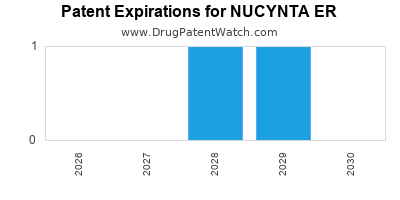
The product generated substantial revenue for Assertio after the 2015 acquisition, but sales later declined as payer controls, opioid scrutiny, and competitive pressure reduced branded volume. Its principal U.S. patent protection was scheduled to expire in 2025, creating a material generic-entry risk for the extended-release franchise.
What is NUCYNTA ER and who owns the product?
NUCYNTA ER contains tapentadol hydrochloride in an extended-release oral tablet. Tapentadol is a centrally acting analgesic with two primary mechanisms: mu-opioid receptor agonism and norepinephrine reuptake inhibition.
The FDA approved NUCYNTA ER in August 2011 for:
- Management of severe and persistent pain requiring an around-the-clock, long-term opioid treatment
- Management of neuropathic pain associated with diabetic peripheral neuropathy in adults when continuous, around-the-clock opioid treatment is required
NUCYNTA ER is a Schedule II controlled substance in the United States. It is marketed in multiple strengths, including 50 mg, 100 mg, 150 mg, 200 mg, and 250 mg tablets. The product carries opioid-class warnings relating to respiratory depression, addiction, misuse, abuse, and neonatal opioid withdrawal syndrome.[1]
Which companies developed and commercialized NUCYNTA ER?
Grünenthal developed tapentadol and retained rights outside the United States. Janssen Pharmaceuticals commercialized NUCYNTA and NUCYNTA ER in the U.S. under a license and collaboration arrangement with Grünenthal.
In 2015, Depomed acquired U.S. rights to NUCYNTA immediate-release and extended-release products from Janssen. The transaction included an upfront payment of $240 million and potential milestone payments, with Depomed assuming U.S. commercialization responsibilities.[2]
Depomed changed its name to Assertio Holdings in 2019. Assertio remained the principal U.S. commercial company for NUCYNTA after the transaction.
| Item |
Detail |
| Active ingredient |
Tapentadol hydrochloride |
| Dosage form |
Extended-release oral tablet |
| FDA approval |
August 2011 |
| U.S. commercial rights acquired by Depomed |
2015 |
| Current U.S. commercial owner after corporate rebranding |
Assertio Holdings |
| Drug class |
Opioid analgesic with norepinephrine reuptake inhibition |
| Controlled-substance status |
Schedule II |
| Primary competitors |
OxyContin, Xtampza ER, Hysingla ER, Exalgo, generic opioid products |
How did NUCYNTA ER sales develop after Assertio acquired the product?
NUCYNTA became the core revenue asset in Depomed’s post-2015 portfolio. The acquisition shifted the company from a diversified specialty-pharmaceutical model toward a franchise centered on branded pain products.
Depomed reported approximately $147.8 million in NUCYNTA net product sales in 2016. Sales increased in subsequent years as Depomed expanded the commercial infrastructure and consolidated the product’s U.S. economics.[3]
Reported NUCYNTA revenue later weakened. Assertio’s filings attributed pressure to lower prescription volume, opioid-market restrictions, payer management, and broader changes in prescribing behavior. The company’s financial exposure also became more concentrated because NUCYNTA represented a large portion of total product revenue.
| Period |
Financial trajectory |
Principal driver |
| 2011-2014 |
Janssen-led commercialization |
Launch and physician adoption |
| 2015 |
Depomed acquired U.S. rights |
$240 million upfront transaction |
| 2016 |
About $147.8 million in NUCYNTA net sales |
First full period under Depomed ownership |
| 2017-2018 |
Higher revenue contribution |
Expanded commercial focus and product concentration |
| 2019-2020 |
Declining commercial momentum |
Opioid scrutiny, payer controls, lower prescriptions |
| 2021 onward |
Mature and pressured franchise |
Generic risk, controlled-substance restrictions, and reduced branded demand |
The financial profile was commercially attractive because NUCYNTA had an established prescription base and did not require the development investment associated with a new molecular entity. Its limitations were concentration risk and dependence on a tightly regulated therapeutic category.
What market dynamics affect NUCYNTA ER demand?
NUCYNTA ER competes in a shrinking and heavily managed long-term opioid market. The relevant market is not defined only by branded extended-release opioids. It includes immediate-release opioids, non-opioid analgesics, interventional pain procedures, physical therapy, antidepressants, anticonvulsants, and other treatments for diabetic neuropathic pain.
Opioid prescribing restrictions
The CDC opioid prescribing guideline, state prescribing limits, prescription-monitoring programs, prior authorization, quantity controls, and risk-management requirements have reduced long-term opioid utilization. These measures affect NUCYNTA ER even when prescribers consider tapentadol clinically differentiated.[4]
Dual-mechanism pharmacology
Tapentadol’s norepinephrine reuptake inhibition distinguishes it from traditional mu-opioid analgesics. That differentiation supported positioning in neuropathic pain, particularly diabetic peripheral neuropathy. It did not eliminate the product’s opioid-related risks or regulatory controls.
Payer management
Commercial payers and government plans commonly require step therapy, prior authorization, quantity limits, or use of lower-cost alternatives. NUCYNTA ER competes against generic oxycodone extended-release products, generic immediate-release opioids, and lower-cost neuropathic-pain medicines.
Product-level limitations
NUCYNTA ER is an extended-release opioid, but its labeling does not establish it as an FDA abuse-deterrent formulation. The absence of an abuse-deterrent claim reduces differentiation against products that have obtained such labeling, including certain oxycodone formulations.
How does NUCYNTA ER compare with competing extended-release opioids?
NUCYNTA ER has a differentiated mechanism but faces stronger generic competition than many branded specialty products.
| Product |
Active ingredient |
Release type |
Key competitive issue |
| NUCYNTA ER |
Tapentadol |
Extended release |
Differentiated mechanism but opioid restrictions |
| OxyContin |
Oxycodone |
Extended release |
Large historical prescriber base and generic competition |
| Xtampza ER |
Oxycodone |
Extended release |
Abuse-deterrent formulation labeling |
| Hysingla ER |
Hydrocodone |
Extended release |
Abuse-deterrent formulation labeling |
| Exalgo |
Hydromorphone |
Extended release |
Generic and limited-volume market |
| Gralise and other neuropathic-pain products |
Various |
Extended or immediate release |
Non-opioid substitution for neuropathic pain |
NUCYNTA ER’s strongest commercial argument is its tapentadol pharmacology and its use in patients who may not respond adequately to conventional opioid therapy. Its weakest commercial position is cost relative to generic alternatives and the continuing contraction of chronic opioid prescribing.
What patents protect NUCYNTA ER?
NUCYNTA ER’s U.S. patent estate included patents covering tapentadol compositions, extended-release formulations, and methods of treatment. Public Orange Book records historically associated NUCYNTA ER with patents including U.S. Patent Nos. 7,994,364 and 8,252,788, among other listings and related patent-family rights.[5]
The principal listed protection was scheduled to expire in 2025, subject to the specific patent, pediatric exclusivity, patent-term adjustment, and regulatory status applicable to each listing.
| Patent or patent family |
General subject matter |
Expected U.S. relevance |
| U.S. Patent No. 7,994,364 |
Tapentadol pharmaceutical composition and formulation technology |
Core product protection |
| U.S. Patent No. 8,252,788 |
Extended-release tapentadol formulation or related product protection |
Core NUCYNTA ER protection |
| Related family patents |
Formulation, dosing, and manufacturing claims |
Potential secondary barriers, depending on claim scope and expiration |
Patent analysis must distinguish Orange Book-listed patents from broader patent-family rights. A patent may cover a formulation or method of use without blocking every generic product design. Conversely, an ANDA applicant can challenge listed patents through a Paragraph IV certification before actual expiration.
When does NUCYNTA ER lose exclusivity?
The main U.S. patent cliff was expected in 2025. The practical generic-entry date depends on:
- The specific expiration date of each Orange Book-listed patent
- Any pediatric exclusivity attached to the product
- The first filer’s 180-day exclusivity rights
- FDA approval timing for abbreviated new drug applications
- Whether a Paragraph IV lawsuit triggered a 30-month approval stay
- Whether a generic applicant designs around formulation claims
NUCYNTA ER did not receive the type of biologic exclusivity that applies to reference biologics, and biosimilar regulation is not relevant because tapentadol is a small-molecule drug. The expected challenge pathway is an ANDA with Paragraph III or Paragraph IV certifications, not a biosimilar application.
Which companies are challenging NUCYNTA ER patents?
Generic drug manufacturers have a commercial incentive to pursue tapentadol ER once the remaining patent barriers become economically attractive. Publicly disclosed litigation and ANDA activity should be evaluated by applicant, dosage strength, certification, and court docket.
The competitive field is likely to include large generic manufacturers and specialty suppliers that already market controlled-release analgesics. Potential entrants must address:
- Tapentadol active-ingredient sourcing
- Controlled-substance registration
- Extended-release dissolution specifications
- FDA bioequivalence requirements
- Abuse, diversion, and manufacturing controls
- Distribution-system compliance
- Formulation patent claims
The absence of a broadly publicized high-value settlement does not establish that no Paragraph IV activity exists. Patent certifications, ANDA litigation, and tentative approvals can change the timing of entry.
What generic entry risks exist for NUCYNTA ER?
Generic entry would likely produce a rapid price decline, although the magnitude would depend on the number of approved suppliers and payer substitution rules. Extended-release opioids can have a slower conversion rate than ordinary tablets because prescribers may be cautious when changing controlled-release products. That factor can delay full erosion but does not preserve branded pricing indefinitely.
Base-case launch scenario
The most likely commercial pattern after final patent expiry is:
- Initial entry by one or more approved generic suppliers
- Mandatory or preferred payer substitution
- Rapid reduction in branded prescription volume
- Lower net price for remaining NUCYNTA ER prescriptions
- Continued use in patients whose physicians prefer branded tapentadol
- Declining contribution to Assertio revenue
Upside scenario for the branded product
Branded NUCYNTA ER could retain a limited niche if:
- Generic supply is constrained
- Prescribers value tapentadol’s dual mechanism
- Payers maintain exceptions for stable patients
- Generic entrants obtain approval for only selected strengths
- Patent litigation delays approval
Downside scenario
Revenue could decline before nominal patent expiry if payers anticipate generic entry, wholesalers reduce inventory, or generic manufacturers obtain tentative or final approvals earlier than expected.
How strong is the NUCYNTA ER patent estate?
The estate was commercially meaningful but not structurally strong enough to create long-duration exclusivity. Its value rested primarily on formulation and product patents rather than a broad platform covering an irreplaceable biologic or complex delivery system.
Patent strengths included:
- Established Orange Book linkage
- Multiple patent-family members
- Formulation claims relevant to extended release
- Commercially valuable controlled-release dosage forms
Patent weaknesses included:
- A small-molecule active ingredient
- Expected 2025 expiration of principal U.S. protection
- Potential design-around opportunities
- No biosimilar-style barrier
- A therapeutic market with substantial generic substitution
The strongest litigation position would depend on whether the listed claims cover the precise release profile, excipient system, particle characteristics, and manufacturing process used by the proposed generic.
What is the FDA regulatory status of NUCYNTA ER?
NUCYNTA ER is FDA-approved and remains a marketed prescription product in the United States. It is regulated as a Schedule II opioid and is subject to FDA labeling requirements, postmarketing safety obligations, controlled-substance rules, and opioid risk-management measures.[1]
The FDA approval does not prevent generic substitution after approval of an ANDA. Generic applicants must demonstrate pharmaceutical equivalence and bioequivalence to the reference listed drug, while satisfying applicable controlled-substance and manufacturing requirements.
What litigation and settlement issues affect NUCYNTA ER?
The principal legal risks are patent litigation, opioid-related product-liability exposure, controlled-substance compliance, and commercial disputes associated with licensing or distribution.
A Paragraph IV lawsuit could delay FDA approval for up to 30 months if filed within the statutory period after notice of the certification. A settlement could establish an agreed generic-entry date earlier than patent expiration. The financial impact would depend on the number of entrants, the timing of launch, and whether the settlement included a licensed or authorized generic arrangement.
NUCYNTA ER also carries industry-wide opioid litigation exposure. State, municipal, insurer, and private-party opioid claims can affect manufacturers, marketers, distributors, and corporate successors. Such litigation is separate from patent exclusivity and can create cash, insurance, and disclosure risks.[6]
How important is NUCYNTA ER to Assertio’s revenue?
NUCYNTA was one of Assertio’s largest commercial assets and a major source of concentration risk. The company’s exposure was higher than that of a diversified pharmaceutical manufacturer because its portfolio included a limited number of branded products.
The product’s financial value depends on:
- Remaining branded prescription volume
- Net price after rebates and discounts
- Generic-entry timing
- Payer coverage
- Sales-force and distribution costs
- Opioid-related legal expenses
- Assertio’s ability to replace NUCYNTA revenue with newer products
The 2015 acquisition created meaningful near-term revenue, but the 2025 patent horizon limited the duration over which Assertio could recover the purchase price and maintain premium pricing.
How does NUCYNTA ER compare with other Assertio products?
NUCYNTA ER differs from Assertio’s later portfolio products because it is a controlled opioid with substantial regulatory and payer constraints. Products such as CAMBIA, SPRIX, and Zipsor addressed different pain segments and had different prescribing economics.
NUCYNTA had greater historical revenue potential than many smaller specialty products, but it also carried greater compliance, litigation, and generic-substitution exposure. The portfolio trade-off was therefore high revenue concentration against high regulatory and patent risk.
Key Takeaways
- NUCYNTA ER is an FDA-approved extended-release tapentadol product for severe chronic pain and diabetic peripheral neuropathic pain.
- Depomed acquired U.S. rights from Janssen in 2015 for $240 million upfront; Depomed later became Assertio Holdings.
- NUCYNTA generated approximately $147.8 million in net product sales in 2016 and became a major Assertio revenue asset.
- Opioid prescribing restrictions, payer controls, and non-opioid alternatives weakened long-term market growth.
- The product’s principal U.S. patent protection was expected to expire in 2025.
- Generic applicants can challenge Orange Book patents through Paragraph IV certifications, potentially triggering litigation and a 30-month stay.
- Tapentadol is a small molecule, so biosimilar competition is not relevant.
- The product’s commercial value is concentrated in branded demand, physician preference, payer exceptions, and the timing of generic entry.
- NUCYNTA ER has formulation differentiation but lacks the long exclusivity profile of biologics or complex delivery platforms.
- Generic entry would likely cause substantial price and volume erosion, although controlled-release prescribing may slow substitution in selected patients.
Frequently Asked Questions
Is NUCYNTA ER the same drug as tapentadol ER?
Yes. NUCYNTA ER is the branded extended-release formulation of tapentadol hydrochloride.
Does NUCYNTA ER have abuse-deterrent labeling?
NUCYNTA ER is an extended-release opioid, but its U.S. labeling does not establish an FDA abuse-deterrent formulation claim comparable to certain oxycodone and hydrocodone products.
Can NUCYNTA ER be substituted with immediate-release tapentadol?
No automatic substitution should be assumed. Extended-release and immediate-release tapentadol products have different dosing, release profiles, and labeling.
Is NUCYNTA ER protected by orphan-drug exclusivity?
No. Its commercial protection is based primarily on patents and regulatory approval, not orphan-drug exclusivity.
What is the main investment risk associated with NUCYNTA ER?
The main risk is accelerated revenue erosion from generic tapentadol ER after expiration of the principal U.S. patents, compounded by declining chronic-opioid utilization and Assertio’s historical revenue concentration.
References
- U.S. Food and Drug Administration. (2024). NUCYNTA ER prescribing information. FDA.
- Depomed, Inc. (2015). Depomed acquires U.S. rights to NUCYNTA products from Janssen Pharmaceuticals. Company press release.
- Depomed, Inc. (2017). 2016 annual report. U.S. Securities and Exchange Commission.
- Centers for Disease Control and Prevention. (2022). CDC clinical practice guideline for prescribing opioids for pain. U.S. Department of Health and Human Services.
- U.S. Food and Drug Administration. (2024). Approved drug products with therapeutic equivalence evaluations, Orange Book. FDA.
- Assertio Holdings, Inc. (2023). Annual report on Form 10-K. U.S. Securities and Exchange Commission.