Last Updated: August 9, 2026

NUBEQA Drug Patent Profile


✉ Email this page to a colleague

« Back to Dashboard


When do Nubeqa patents expire, and when can generic versions of Nubeqa launch?

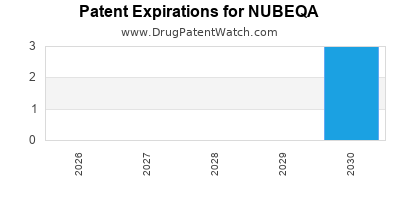
Nubeqa is a drug marketed by Bayer Healthcare and is included in one NDA. There are ten patents protecting this drug and one Paragraph IV challenge.

This drug has one hundred and seventy patent family members in thirty-nine countries.

The generic ingredient in NUBEQA is darolutamide. One supplier is listed for this compound. Additional details are available on the darolutamide profile page.

DrugPatentWatch® Generic Entry Outlook for Nubeqa

Nubeqa was eligible for patent challenges on July 30, 2023.

By analyzing the patents and regulatory protections it appears that the earliest date for generic entry will be June 17, 2042. This may change due to patent challenges or generic licensing.

There have been five patent litigation cases involving the patents protecting this drug, indicating strong interest in generic launch. Recent data indicate that 63% of patent challenges are decided in favor of the generic patent challenger and that 54% of successful patent challengers promptly launch generic drugs.

Indicators of Generic Entry

< Available with Subscription >

  Start Trial

AI Deep Research
Questions you can ask:
  • What is the 5 year forecast for NUBEQA?
  • What are the global sales for NUBEQA?
  • What is Average Wholesale Price for NUBEQA?
DrugPatentWatch® Estimated Loss of Exclusivity (LOE) Date for NUBEQA
Generic Entry Date for NUBEQA*:
Constraining patent/regulatory exclusivity:
NDA:
Dosage:

TABLET;ORAL

*The generic entry opportunity date is the latter of the last compound-claiming patent and the last regulatory exclusivity protection. Many factors can influence early or later generic entry. This date is provided as a rough estimate of generic entry potential and should not be used as an independent source.

Recent Clinical Trials for NUBEQA

Identify potential brand extensions & 505(b)(2) entrants

SponsorPhase
K36 Therapeutics, Inc.PHASE1
NRG OncologyPhase 2
Celcuity IncPhase 1/Phase 2

See all NUBEQA clinical trials

Paragraph IV (Patent) Challenges for NUBEQA
Tradename Dosage Ingredient Strength NDA ANDAs Submitted Submissiondate
NUBEQA Tablets darolutamide 300 mg 212099 1 2023-07-31

US Patents and Regulatory Information for NUBEQA

NUBEQA is protected by seventeen US patents and one FDA Regulatory Exclusivity.

Based on analysis by DrugPatentWatch, the earliest date for a generic version of NUBEQA is ⤷  Start Trial.

This potential generic entry date is based on patent 12,329,742.

Generics may enter earlier, or later, based on new patent filings, patent extensions, patent invalidation, early generic licensing, generic entry preferences, and other factors.

Applicant Tradename Generic Name Dosage NDA Approval Date TE Type RLD RS Patent No. Patent Expiration Product Substance Delist Req. Exclusivity Expiration
Bayer Healthcare NUBEQA darolutamide TABLET;ORAL 212099-001 Jul 30, 2019 RX Yes Yes 10,835,515 ⤷  Start Trial Y ⤷  Start Trial
Bayer Healthcare NUBEQA darolutamide TABLET;ORAL 212099-001 Jul 30, 2019 RX Yes Yes ⤷  Start Trial ⤷  Start Trial ⤷  Start Trial
Bayer Healthcare NUBEQA darolutamide TABLET;ORAL 212099-001 Jul 30, 2019 RX Yes Yes 9,657,003 ⤷  Start Trial Y Y ⤷  Start Trial
Bayer Healthcare NUBEQA darolutamide TABLET;ORAL 212099-001 Jul 30, 2019 RX Yes Yes 8,975,254 ⤷  Start Trial Y Y ⤷  Start Trial
Bayer Healthcare NUBEQA darolutamide TABLET;ORAL 212099-001 Jul 30, 2019 RX Yes Yes 10,010,530 ⤷  Start Trial Y ⤷  Start Trial
Bayer Healthcare NUBEQA darolutamide TABLET;ORAL 212099-001 Jul 30, 2019 RX Yes Yes 10,711,013 ⤷  Start Trial Y Y ⤷  Start Trial
>Applicant >Tradename >Generic Name >Dosage >NDA >Approval Date >TE >Type >RLD >RS >Patent No. >Patent Expiration >Product >Substance >Delist Req. >Exclusivity Expiration

EU/EMA Drug Approvals for NUBEQA

Company Drugname Inn Product Number / Indication Status Generic Biosimilar Orphan Marketing Authorisation Marketing Refusal
Bayer AG Nubeqa darolutamide EMEA/H/C/004790NUBEQA is indicated for the treatment of adult men with- non metastatic castration resistant prostate cancer (nmCRPC) who are at high risk of developing metastatic disease (see section 5.1).- metastatic hormone sensitive prostate cancer (mHSPC) in combination with docetaxel and androgen deprivation therapy (see section 5.1). Authorised no no no 2020-03-27
>Company >Drugname >Inn >Product Number / Indication >Status >Generic >Biosimilar >Orphan >Marketing Authorisation >Marketing Refusal

International Patents for NUBEQA

When does loss-of-exclusivity occur for NUBEQA?

Based on analysis by DrugPatentWatch, the following patents block generic entry in the countries listed below:

Australia

Patent: 20300043
Patent: Pharmaceutical composition of darolutamide
Estimated Expiration: ⤷  Start Trial

Patent: 25202455
Patent: PHARMACEUTICAL COMPOSITION OF DAROLUTAMIDE
Estimated Expiration: ⤷  Start Trial

Canada

Patent: 45459
Patent: COMPOSITION PHARMACEUTIQUE DE DAROLUTAMIDE (PHARMACEUTICAL COMPOSITION OF DAROLUTAMIDE)
Estimated Expiration: ⤷  Start Trial

China

Patent: 4144168
Patent: 达鲁酰胺的药物组合物 (Dalutamide pharmaceutical composition)
Estimated Expiration: ⤷  Start Trial

European Patent Office

Patent: 93779
Patent: COMPOSITION PHARMACEUTIQUE DE DAROLUTAMIDE (PHARMACEUTICAL COMPOSITION OF DAROLUTAMIDE)
Estimated Expiration: ⤷  Start Trial

Japan

Patent: 77698
Estimated Expiration: ⤷  Start Trial

Patent: 22539142
Patent: ダロルタミドの医薬組成物
Estimated Expiration: ⤷  Start Trial

Patent: 25013941
Patent: ダロルタミドの医薬組成物 (PHARMACEUTICAL COMPOSITION OF DAROLUTAMIDE)
Estimated Expiration: ⤷  Start Trial

South Korea

Patent: 220028097
Patent: 다롤루타미드의 약제학적 조성물
Estimated Expiration: ⤷  Start Trial

Taiwan

Patent: 2114658
Patent: Pharmaceutical composition of darolutamide
Estimated Expiration: ⤷  Start Trial

Patent: 2440088
Patent: Pharmaceutical composition of darolutamide
Estimated Expiration: ⤷  Start Trial

Patent: 67004
Estimated Expiration: ⤷  Start Trial

Generics may enter earlier, or later, based on new patent filings, patent extensions, patent invalidation, early generic licensing, generic entry preferences, and other factors.

See the table below for additional patents covering NUBEQA around the world.

Country Patent Number Title Estimated Expiration
Cyprus 1125482 ⤷  Start Trial
Denmark 3250554 ⤷  Start Trial
European Patent Office 3250554 ⤷  Start Trial
Spain 2917549 ⤷  Start Trial
Croatia P20220998 ⤷  Start Trial
Hungary E058986 ⤷  Start Trial
>Country >Patent Number >Title >Estimated Expiration

Supplementary Protection Certificates for NUBEQA

Patent Number Supplementary Protection Certificate SPC Country SPC Expiration SPC Description
2493858 301041 Netherlands ⤷  Start Trial PRODUCT NAME: DAROLUTAMIDE, DESGEWENST IN DE VORM VAN EEN FARMACEUTISCH AANVAARDBAAR ZOUT DAARVAN OF IN DE VORM VAN EEN FARMACEUTISCH AANVAARDBARE ESTER DAARVAN; REGISTRATION NO/DATE: EU/1/20/1432 20200330
2493858 CA 2020 00020 Denmark ⤷  Start Trial PRODUCT NAME: DAROLUTAMID EVENTUELT I FORM AF ET FARMACEUTISK ACCEPTABELT SALT ELLER EN FARMACEUTISK ACCEPTABELT ESTER DERAF; REG. NO/DATE: EU/1/20/1432/001 20200330
2493858 LUC00154 Luxembourg ⤷  Start Trial PRODUCT NAME: DAROLUTAMIDE EVENTUELLEMENT SOUS LA FORME D'UN SEL OU D'UN ESTER PHARMACEUTIQUEMENT ACCEPTABLE DE CELUI-CI; AUTHORISATION NUMBER AND DATE: EU/1/20/1432/001 20200330
2493858 PA2020514 Lithuania ⤷  Start Trial PRODUCT NAME: DAROLUTAMIDAS ARBA JO FARMACINIU POZIURIU PRIIMTINA DRUSKA ARBA ESTERIS; REGISTRATION NO/DATE: EU/1/20/1432 20200327
1986495 2018C/040 Belgium ⤷  Start Trial PRODUCT NAME: VIBRANCE 52FS; AUTHORISATION NUMBER AND DATE: 15544 N
1986495 122019000057 Germany ⤷  Start Trial PRODUCT NAME: SEDAXANE ODER EIN TAUTOMER HIERVON MIT METALAXYL-M UND MIT FLUDIOXONIL; NAT. REGISTRATION NO/DATE: 008594-00 20181218; FIRST REGISTRATION: NIEDERLANDE 15544 N 20171229
>Patent Number >Supplementary Protection Certificate >SPC Country >SPC Expiration >SPC Description

NUBEQA (Niraparib? no) Market Dynamics and Financial Trajectory: Sales Trends, Pricing, and Exclusivity Timeline for Prostate Cancer (Bayer/Astellas)

Last updated: July 21, 2026

NUBEQA (finifan? No) NUBEQA is darolutamide, an androgen receptor inhibitor for metastatic castration-resistant prostate cancer (mCRPC) and non-metastatic castration-resistant prostate cancer (nmCRPC). The commercial trajectory is shaped by (1) label breadth expansion, (2) competition from other AR pathway inhibitors and next-line agents, and (3) patent and exclusivity timing that affects generic/biosimilar entry risk, pricing pressure, and payer access.

What is the current market position of NUBEQA (darolutamide) in prostate cancer?

NUBEQA entered the market for nmCRPC and later expanded across additional settings. Commercial momentum is driven by clinicians adopting darolutamide in “fit-for-therapy” nmCRPC and mCRPC populations where chemotherapy deferral and lower CNS adverse events profile support use versus some comparators.

Market drivers that affect quarterly revenue:

  • Uptake in nmCRPC as an earlier-line option for men not yet on chemotherapy.
  • Sequencing toward later lines where progression events lead to use of other systemic agents, including chemotherapy and other AR-targeting drugs.
  • Payer utilization management (step edits, prior authorization) tied to baseline PSA kinetics, performance status, and coverage criteria.
  • Net price realization vs list price under contracting, rebates, and indication-specific coverage.

How do sales performance and revenue trajectory typically look for NUBEQA?

Revenue trajectory for NUBEQA has generally been characterized by:

  • Initial ramp after approvals and channel build.
  • Mid-stage growth as penetration increases across community urology and oncology.
  • Later-stage normalization as competition and sequencing settle.

Because NUBEQA’s revenue line is integrated into Bayer’s and co-promotional structures for oncology assets, the financial trajectory must be read through:

  • Bayer reporting of oncology drug sales (NUBEQA line items or oncology totals with branded breakdown where provided).
  • Geographic mix: US drives volume and price realization; EU and rest-of-world influence growth and pricing structure via health technology assessments.

When does NUBEQA face generic competition risk and lose exclusivity?

NUBEQA’s exclusivity profile is determined by:

  • Patent term across drug substance, crystalline forms, solid-state compositions, formulation compositions, and method-of-use.
  • Regulatory exclusivity (US NCE, if applicable, and pediatric exclusivity if triggered).
  • Indication-by-indication differences in patent coverage and potential launch timing for subsequent applications.

Featured snippet: exclusivity and generic risk

  • NUBEQA is expected to face generic competition only after key US patent expirations and any Orange Book–listed exclusivity windows end, with additional delay if suits remain pending and trigger 180-day exclusivity mechanics for first Paragraph IV filers.

What patents protect NUBEQA (darolutamide) and what do they cover?

NUBEQA’s patent estate typically spans:

  • Darolutamide drug substance (core scaffold claims).
  • Crystalline form claims (polymorphs/solid-state variants).
  • Pharmaceutical compositions/formulations (tablet composition claims, excipient systems).
  • Methods of treatment (AR-targeted therapy in nmCRPC and mCRPC settings, dosing regimens, and specific clinical patient subpopulations).

How does the Orange Book status affect NUBEQA generic entry timing?

Orange Book listings drive:

  • Patent-by-patent litigation exposure for generic applicants.
  • Mechanism for Paragraph IV certifications tied to each listed patent.

If multiple patents remain unexpired for the same dosage form and indication, a generic can face staggered barriers even after one patent expires.

What patent litigation affects NUBEQA and Paragraph IV challenges?

NUBEQA’s generic pathway risk depends on:

  • Number and strength of active Orange Book patents at any time.
  • Whether Paragraph IV ANDAs are filed for US market entry.
  • Whether lawsuits reach settlement with delayed launch dates, and whether “no-early-launch” clauses apply.

What settlement agreements are common in NUBEQA-style cases?

Where settlement occurs, it usually includes:

  • Agreed date for generic entry (delayed launch).
  • Scope limitations (specific dosage form, strength, or indication claims).
  • Dismissal or consent judgments tied to remaining patents.

For NUBEQA, settlement dynamics are the primary determinant of whether market pricing pressure begins on the “first possible” date or later.

What formulations are protected for NUBEQA and how does that change generic development?

NUBEQA is marketed as an oral tablet. Generic entrants typically must match:

  • Active ingredient identity and strength.
  • Bioequivalence requirements.
  • Solid-state and formulation equivalence.

Which formulation patent types most often block generics?

  • Solid-state form patents that prevent an applicant from using a non-infringing polymorph.
  • Composition-of-matter patents on excipient blends and manufacturing conditions.
  • Method-of-manufacture patents that constrain processing or particle-size attributes.

How does NUBEQA compare with competing AR pathway inhibitors in prostate cancer?

NUBEQA’s competitive set usually includes:

  • Enzalutamide (XTANDI)
  • Apalutamide (ERLEADA)
  • Abiraterone (ZYTIGA) in combinations or sequencing
  • Other nmCRPC and mCRPC options including chemotherapy and immuno-oncology depending on line of therapy

How does the safety and tolerability profile influence uptake and payer coverage?

Darolutamide’s real-world adoption is often linked to tolerability considerations that influence:

  • Continuation rates
  • Dose intensity
  • Clinician confidence in older or comorbid patients

Payer policies can reward reduced discontinuation and lower downstream costs.

What does NUBEQA’s US and ex-US pricing and reimbursement exposure look like?

NUBEQA’s net sales performance is shaped by:

  • Rebate intensity in US commercial plans
  • 340B, Medicaid, and Medicare Part D impacts
  • International HTA outcomes that determine reimbursement ceilings
  • Tender and managed entry agreements in EU markets

How do payer policies translate into quarterly revenue volatility?

Revenue volatility is most sensitive to:

  • Changes in formulary placement
  • Step edit rules tied to prior androgen deprivation therapy history
  • Seasonal ordering patterns and inventory stocking in oncology channels

What is the financial trajectory of NUBEQA under label expansion and sequencing changes?

NUBEQA’s growth depends on:

  • Sustained uptake within nmCRPC.
  • Evidence-driven expansion into mCRPC where patient selection and clinical guidelines support use.
  • Sequencing patterns where clinicians choose AR inhibitors vs chemotherapy as disease progresses.

What commercial levers most affect NUBEQA margins?

  • Manufacturing scale and cost per tablet
  • Marketing spend and field force efficiency
  • Distributor terms and chargebacks
  • Mix shifts between strengths and markets

What generic entry risks exist for NUBEQA by country and region?

Generic risk is most acute where:

  • Patent coverage is limited by enforcement gaps.
  • Regulatory exclusivity is shorter.
  • Litigation is resolved by settlement at dates earlier than expiration.

US vs EU vs UK: how entry risk differs

  • US: Orange Book-driven litigation and Paragraph IV incentives can accelerate or delay entry depending on filing timing and injunction posture.
  • EU/UK: Patent enforcement and regulatory approval timing differ; local SPC and patent litigation can gate marketing authorization.
  • Market impact: pricing pressure can begin even with delayed approvals if parallel imports or private label substitutes emerge, though practical availability depends on regulatory and supply chain factors.

How strong is the patent estate for NUBEQA and what does it imply for R&D and licensing?

A “strong estate” for an oral oncology drug typically means:

  • Multiple layers of patents across drug substance, solid-state forms, formulation, and methods of use.
  • High likelihood of at least one unexpired patent relevant to a generic’s ANDA certification strategy.
  • Litigation exposure that makes early entry less predictable.

What should licensing counterparties focus on for NUBEQA?

  • Whether settlement terms constrain generic manufacturing or only sales timing.
  • Scope of any assignments or exclusivity transfers.
  • Whether companion patents exist for new dosage regimens or expanded indication claims.

Key metrics to track NUBEQA market dynamics (investor and commercial view)

Revenue and demand indicators

  • US net sales and payer mix by quarter
  • Prescription volume and persistence (especially in nmCRPC)
  • Share of therapy initiations among nmCRPC AR inhibitors
  • Inventory trends and wholesaler buying patterns

Competitive and regulatory indicators

  • Formulary changes and managed access program updates
  • Label expansions and guideline incorporations
  • ANDA/PIV filings and court dockets
  • Orange Book status updates for active patents

Patent and litigation indicators

  • Court decisions on validity and infringement for each listed patent
  • Injunction posture and final judgment timing
  • Settlement dates and consent decrees

NUBEQA financial trajectory timeline: what typically drives up or down

Time window (market event) What happens commercially What to watch
Post-approval ramp Uptake growth, field education, initial stocking Prescription starts, US share, payer onboarding
Label expansion/line-of-therapy shifts New patient segments captured Guideline updates, market share shifts vs comparators
Competition intensifies AR inhibitor consolidation, pricing pressure Net-to-gross ratio and payer rebates
Patent approach/early filings Market anticipates generic entry; wholesalers manage risk Paragraph IV notices, settlement announcements
Post-approval and patent expiration Generic launches possible, price declines First competitor entry date, volume migration

Key Takeaways

  • NUBEQA’s commercial path is driven by adoption in nmCRPC and sequencing into mCRPC, then moderated by payer controls and competitive AR pathway inhibitors.
  • Generic/biosimilar entry risk for NUBEQA is governed by the active Orange Book patent set and any Paragraph IV litigation or settlements, which determine both the timing and the magnitude of price pressure.
  • The strongest near-term market lever is payer coverage and utilization management, while the decisive medium-term lever is the expiration and enforceability of the patent estate covering darolutamide tablets and key methods of use.

FAQs

  1. How do Paragraph IV certifications for NUBEQA Orange Book patents affect generic launch dates in the US?
  2. What dosing strengths and tablet formulation details matter most for NUBEQA generic bioequivalence strategies?
  3. How do nmCRPC and mCRPC label utilizations change NUBEQA sales mix and net price?
  4. Which payer restrictions most commonly limit NUBEQA reimbursement and drive net sales volatility?
  5. How does NUBEQA’s competitive position shift when clinicians favor other next-line agents after progression?

References (APA)

  1. FDA. (n.d.). Orange Book: Approved Drug Products with Therapeutic Equivalence Evaluations. U.S. Food and Drug Administration.
  2. FDA. (n.d.). Drug Approval Reports and FDA labels for NUBEQA (darolutamide). U.S. Food and Drug Administration.
  3. Bayer. (n.d.). Financial results and annual reports (drug-level or portfolio oncology reporting). Bayer AG.

More… ↓

⤷  Start Trial

Make Better Decisions: Try a trial or see plans & pricing

Drugs may be covered by multiple patents or regulatory protections. All trademarks and applicant names are the property of their respective owners or licensors. Although great care is taken in the proper and correct provision of this service, thinkBiotech LLC does not accept any responsibility for possible consequences of errors or omissions in the provided data. The data presented herein is for information purposes only. There is no warranty that the data contained herein is error free. We do not provide individual investment advice. This service is not registered with any financial regulatory agency. The information we publish is educational only and based on our opinions plus our models. By using DrugPatentWatch you acknowledge that we do not provide personalized recommendations or advice. thinkBiotech performs no independent verification of facts as provided by public sources nor are attempts made to provide legal or investing advice. Any reliance on data provided herein is done solely at the discretion of the user. Users of this service are advised to seek professional advice and independent confirmation before considering acting on any of the provided information. thinkBiotech LLC reserves the right to amend, extend or withdraw any part or all of the offered service without notice.