Last updated: July 28, 2025
Introduction
NORLIQVA (norepinephrine bitartrate injection), developed by Curis Pharmaceuticals, is a pharmaceutical agent primarily used for managing hypotension and shock in clinical settings. Originally approved for certain forms of acute hypotension, NORLIQVA's market landscape is shaped by evolving healthcare needs, regulatory developments, competitive dynamics, and its positioning within the broader vasopressor class. This analysis delineates current market forces influencing NORLIQVA and projects its financial trajectory over the coming years.
Market Overview
The global vasopressor market, integral to intensive care units (ICUs) and emergency medicine, tallied a valuation of approximately $2.55 billion in 2022 [1]. Expected Compound Annual Growth Rate (CAGR) is projected at around 6.2% from 2023 to 2030, driven by rising incidences of sepsis, trauma-related shock, and expanding ICU admissions [2].
NORLIQVA operates within this landscape as a niche yet critical agent. Its therapeutic role in managing life-threatening hypotension confers a consistent demand amid acute care settings. However, it faces stiff competition from established vasopressors such as norepinephrine (Levophed), dopamine, and phenylephrine, which possess broader physician familiarity and market penetration.
Regulatory and Clinical Landscape
The regulatory environment influences NORLIQVA’s market evolution considerably. Its initial approval in the United States was based on clinical protocols demonstrating efficacy in refractory shock states. Nonetheless, the drug’s adoption hinges on updates to treatment guidelines, evidence from ongoing trials, and approvals in emerging markets.
The recent emphasis on personalized medicine and improved hemodynamic monitoring has increased demand for tailored vasopressor therapies. Moreover, the emergence of novel vasopressors with improved safety profiles could challenge NORLIQVA's market share if these agents demonstrate superior outcomes.
Pricing and Reimbursement Factors
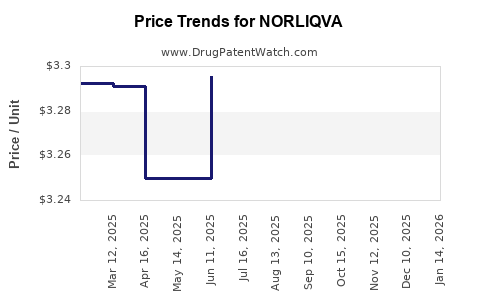
Pricing strategies significantly impact NORLIQVA's financial prospects. As a specialized injectable agent, it is generally priced higher than generic alternatives. Reimbursement policies in developed economies typically favor broad access; however, pricing pressures and the push for cost-effective therapies may restrict margins.
In the U.S., reimbursement through Medicare and commercial insurers favors established vasopressors, indirectly influencing NORLIQVA’s market penetration. Conversely, in emerging markets, pricing flexibility may enable greater adoption, particularly where healthcare budgets are constrained.
Competitive Dynamics
The dominance of norepinephrine as the first-line vasopressor presents a formidable barrier. Nonetheless, NORLIQVA’s potential as an adjunct or alternative, especially in cases of vasopressor resistance, could carve out a niche market. Its unique pharmacokinetic profile and reduced adverse effects may appeal in specific patient populations.
Key competitors include:
- Norepinephrine (leader in market share due to established efficacy and familiarity)
- Phenylephrine (used when tachyarrhythmia is a concern)
- Epinephrine (for anaphylactic shock)
Emerging agents with improved safety and ease of administration, such as vasopressin analogs, may exert downward pressure on NORLIQVA's market share over time.
Market Penetration and Adoption Trends
Current adoption rates remain modest relative to entrenched agents. However, pilot studies and ongoing clinical trials assessing NORLIQVA's efficacy in refractory shock scenarios could catalyze increased utilization. The critical care market's conservative nature could slow widespread adoption, but targeted niches are promising.
Geo-specific dynamics observed as follows:
- North America: High adoption potential due to advanced healthcare infrastructure, albeit competition and reimbursement hurdles persist.
- Europe: Similar prospects with additional regulatory hurdles.
- Asia-Pacific: Rapidly expanding ICU capacity offers growth opportunities; regulatory pathways are more varied and sometimes less restrictive.
Financial Trajectory and Forecast
Projected sales for NORLIQVA are contingent on several factors, including clinical validation, regulatory approvals in new jurisdictions, formulary inclusion, and competitive shifts.
Short-term Outlook (1-3 years):
- Stability with moderate growth driven by ongoing clinical adoption and expanded hospital formularies.
- Expected revenue in the range of $50-100 million annually in key markets, assuming no major market entry delays or setbacks.
Mid to Long-term Outlook (4-10 years):
- Growth potential hinges upon successful clinical trials demonstrating superior outcomes or safety profiles.
- If adopted as a second-line or adjunct therapy in refractory cases, revenues could escalate to $200-300 million annually.
- Expansion into emerging markets, due to lower market entry barriers and healthcare infrastructure scalability, can further augment sales.
Revenue Drivers:
- Clinical evidence supporting efficacy and safety.
- Regulatory approvals in strategic markets.
- Partnerships with healthcare providers and payers.
- Pricing strategies aligned with value-based care models.
Revenue Risks:
- Competition from generic vasopressors.
- Slow clinical adoption due to conservative ICU practices.
- Regulatory delays or rejections.
- Pricing pressures amid healthcare cost containment efforts.
Emerging Trends and Innovations
Improvements in hemodynamic monitoring technology may influence sensor-guided vasopressor therapy, potentially benefiting NORLIQVA if integrated into personalized treatment protocols. Moreover, biotech advancements focusing on vasopressor delivery systems—such as continuous infusion devices—may improve outcomes and acceptance.
The development pipeline for vasopressors also reflects a shift toward agents with fewer cardiovascular side effects and ease of titration, which could restrict NORLIQVA’s competitive edge unless it demonstrates comparable benefits.
Conclusion
NORLIQVA’s market dynamics are shaped by a complex interplay of clinical efficacy, regulatory pathways, competitive landscape, and healthcare economics. While presently operating within a saturated category, its niche potential as a safety-enhanced alternative offers opportunities for targeted growth. The forecast indicates a cautiously optimistic trajectory, contingent upon clinical validation and strategic market expansion.
Key Takeaways
- Market Growth: The vasopressor market is expanding globally, driven by increasing ICU admissions and sepsis cases, providing a supportive backdrop for NORLIQVA.
- Competitive Positioning: Entrenched agents like norepinephrine pose significant barriers; NORLIQVA’s success depends on demonstrating distinct safety or efficacy advantages.
- Regulatory and Adoption Factors: Approvals, clinical evidence, and clinician familiarity will be pivotal in driving adoption and revenue.
- Geographic Opportunities: Emerging markets present substantial growth potential, with less saturated competition and demand for advanced care.
- Strategic Focus: Building clinical evidence, forging partnerships with hospitals and payers, and optimizing pricing will be essential for long-term financial success.
FAQs
1. What are the primary clinical advantages of NORLIQVA compared to traditional vasopressors?
NORLIQVA potentially offers a safer hemodynamic profile with fewer adverse cardiovascular effects, making it suitable for patients intolerant to other vasopressors. Its pharmacokinetic properties may allow for more precise titration in refractory shock cases.
2. How does regulatory approval impact NORLIQVA’s market potential?
Regulatory approvals are crucial for broad market access. Approvals in major markets like the US and EU facilitate reimbursement and formulary placement. Delays or rejections can limit and slow adoption, affecting revenue outlooks.
3. What are the main barriers to NORLIQVA’s market penetration?
Barriers include entrenched clinician preference for established agents, limited clinical trial data compared to competitors, pricing pressures, and regulatory challenges in some regions.
4. How can NORLIQVA sustain competitive advantage amidst emerging vasopressor therapies?
By generating robust clinical evidence demonstrating superior safety or efficacy, integrating into personalized hemodynamic management protocols, and establishing strategic partnerships, NORLIQVA can differentiate itself within the vasopressor class.
5. What future developments could influence NORLIQVA’s financial outlook?
Innovations such as delivery systems for precise titration, extensive clinical trials confirming benefits, new market approvals, and favorable reimbursement policies could significantly enhance its financial trajectory.
Sources
[1] Grand View Research, "Vasopressor Market Size, Share & Trends Analysis Report," 2022.
[2] MarketsandMarkets™, "Critical Care Market by Type, Indication, and Region," 2023.