You're using a free limited version of DrugPatentWatch: Upgrade for Complete Access

Last Updated: December 12, 2025

NIZORAL Drug Patent Profile


✉ Email this page to a colleague

« Back to Dashboard


Which patents cover Nizoral, and what generic alternatives are available?

Nizoral is a drug marketed by Janssen Pharma, Janssen Pharms, and Kramer. and is included in five NDAs.

The generic ingredient in NIZORAL is ketoconazole. There are fifteen drug master file entries for this compound. Thirty suppliers are listed for this compound. Additional details are available on the ketoconazole profile page.

DrugPatentWatch® Litigation and Generic Entry Outlook for Nizoral

A generic version of NIZORAL was approved as ketoconazole by TARO on June 15th, 1999.

  Get Started Free

AI Deep Research
Questions you can ask:
  • What is the 5 year forecast for NIZORAL?
  • What are the global sales for NIZORAL?
  • What is Average Wholesale Price for NIZORAL?
Summary for NIZORAL
US Patents:0
Applicants:3
NDAs:5
Raw Ingredient (Bulk) Api Vendors: 67
Clinical Trials: 34
Patent Applications: 2,243
Drug Prices: Drug price information for NIZORAL
What excipients (inactive ingredients) are in NIZORAL?NIZORAL excipients list
DailyMed Link:NIZORAL at DailyMed
Drug patent expirations by year for NIZORAL
Drug Prices for NIZORAL

See drug prices for NIZORAL

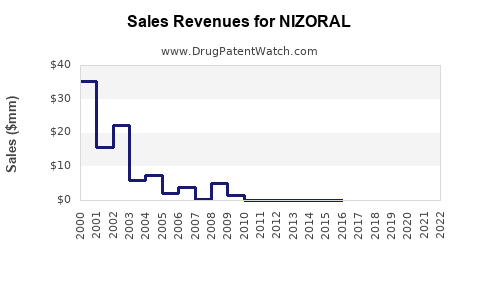
Drug Sales Revenue Trends for NIZORAL

See drug sales revenues for NIZORAL

Recent Clinical Trials for NIZORAL

Identify potential brand extensions & 505(b)(2) entrants

SponsorPhase
Hospital Universitario Dr. Jose E. GonzalezPhase 2
Fernando De la Garza SalazarPhase 2
Milton S. Hershey Medical CenterEarly Phase 1

See all NIZORAL clinical trials

US Patents and Regulatory Information for NIZORAL

Applicant Tradename Generic Name Dosage NDA Approval Date TE Type RLD RS Patent No. Patent Expiration Product Substance Delist Req. Exclusivity Expiration
Janssen Pharma NIZORAL ketoconazole CREAM;TOPICAL 019084-001 Dec 31, 1985 DISCN Yes No ⤷  Get Started Free ⤷  Get Started Free ⤷  Get Started Free
Janssen Pharms NIZORAL ketoconazole TABLET;ORAL 018533-001 Approved Prior to Jan 1, 1982 DISCN Yes No ⤷  Get Started Free ⤷  Get Started Free ⤷  Get Started Free
Janssen Pharms NIZORAL ketoconazole SHAMPOO;TOPICAL 019927-001 Aug 31, 1990 DISCN Yes No ⤷  Get Started Free ⤷  Get Started Free ⤷  Get Started Free
Janssen Pharma NIZORAL ketoconazole SUSPENSION;ORAL 070767-001 Nov 7, 1986 DISCN No No ⤷  Get Started Free ⤷  Get Started Free ⤷  Get Started Free
Kramer NIZORAL ANTI-DANDRUFF ketoconazole SHAMPOO;TOPICAL 020310-001 Oct 10, 1997 OTC Yes Yes ⤷  Get Started Free ⤷  Get Started Free ⤷  Get Started Free
>Applicant >Tradename >Generic Name >Dosage >NDA >Approval Date >TE >Type >RLD >RS >Patent No. >Patent Expiration >Product >Substance >Delist Req. >Exclusivity Expiration

Expired US Patents for NIZORAL

Applicant Tradename Generic Name Dosage NDA Approval Date Patent No. Patent Expiration
Janssen Pharma NIZORAL ketoconazole CREAM;TOPICAL 019084-001 Dec 31, 1985 ⤷  Get Started Free ⤷  Get Started Free
Janssen Pharms NIZORAL ketoconazole SHAMPOO;TOPICAL 019927-001 Aug 31, 1990 ⤷  Get Started Free ⤷  Get Started Free
Janssen Pharms NIZORAL ketoconazole TABLET;ORAL 018533-001 Approved Prior to Jan 1, 1982 ⤷  Get Started Free ⤷  Get Started Free
Janssen Pharms NIZORAL ketoconazole SHAMPOO;TOPICAL 019927-001 Aug 31, 1990 ⤷  Get Started Free ⤷  Get Started Free
Janssen Pharma NIZORAL ketoconazole CREAM;TOPICAL 019084-001 Dec 31, 1985 ⤷  Get Started Free ⤷  Get Started Free
>Applicant >Tradename >Generic Name >Dosage >NDA >Approval Date >Patent No. >Patent Expiration

EU/EMA Drug Approvals for NIZORAL

Company Drugname Inn Product Number / Indication Status Generic Biosimilar Orphan Marketing Authorisation Marketing Refusal
HRA Pharma Rare Diseases Ketoconazole HRA ketoconazole EMEA/H/C/003906Ketoconazole HRA is indicated for the treatment of endogenous Cushing’s syndrome in adults and adolescents above the age of 12 years. Authorised no no yes 2014-11-18
>Company >Drugname >Inn >Product Number / Indication >Status >Generic >Biosimilar >Orphan >Marketing Authorisation >Marketing Refusal

International Patents for NIZORAL

See the table below for patents covering NIZORAL around the world.

Country Patent Number Title Estimated Expiration
U.S.S.R. 786899 METHOD OF PREPARING DERIVATIVES OF 1-(1,3-DIOXOLAN-2-YL-METHYL)-1H-IMIDAZOLES OR -1H-1,2,4-TRIAZOLES OR THEIR ACID-ADDITIVE SALTS IN THE FORM OF MIXTURE OR INDIVIDUAL STEREOISOMERS ⤷  Get Started Free
Canada 1094559 1-(1,3 DIOXOLAN-2-YLMETHYL)-1H-IMIDAZOLES ET 1H-1,2,4- TRIAZOLES (1-(1,3-DIOXOLAN-2-YLMETHYL)-1H-IMIDAZOLES AND 1H-1,2, 4-TRIAZOLES) ⤷  Get Started Free
Hungary 177646 PROCESS FOR PRODUCING NEW 1-BRACKET-1,3-DIOXOLANE-2-YL-METHYL-BRACKET CLOSED-1H-IMIDASOLE DERIVATIVES ⤷  Get Started Free
Poland 113973 ⤷  Get Started Free
Belgium 896321 ⤷  Get Started Free
South Korea 810000675 ⤷  Get Started Free
Austria A63678 ⤷  Get Started Free
>Country >Patent Number >Title >Estimated Expiration

Market Dynamics and Financial Trajectory for NIZORAL (Ketoconazole)

Last updated: July 29, 2025


Introduction

NIZORAL, a well-established pharmaceutical product primarily containing the active ingredient ketoconazole, has occupied a significant niche within antifungal therapies since its inception. Originally marketed by Johnson & Johnson, NIZORAL has evolved from a prescription antifungal to an over-the-counter (OTC) solution in some markets. Analyzing its market dynamics and financial trajectory provides insights into competitive positioning, regulatory developments, and future growth potential within the global pharmaceutical landscape.


Market Overview of NIZORAL

Product Profile and Therapeutic Use

NIZORAL (ketoconazole) functions as a broad-spectrum antifungal agent, targeting dermatophyte infections, candidiasis, and seborrheic dermatitis. It is available in various formulations, including topical creams, shampoos, and tablets. Although systemic uses have declined due to safety concerns, topical formulations remain integral in dermatology.

Market Penetration and Evolution

Initially launched as a prescription drug in the 1980s, NIZORAL experienced widespread adoption owing to its efficacy. Its market share was reinforced through aggressive marketing and broad-spectrum activity. However, regulatory agencies like the U.S. Food and Drug Administration (FDA) and European Medicines Agency (EMA) imposed restrictions on systemic ketoconazole due to hepatotoxicity risks—impacting the drug’s market trajectory significantly.


Regulatory Landscape and Its Impact

Safety Concerns and Market Restrictions

In 2013, the FDArevoked the approval of oral ketoconazole for systemic fungal infections, citing risks of liver injury, adrenal failure, and drug interactions. Similarly, EMA restricted its systemic use within the European Union in 2014. Consequently, manufacturers, including Johnson & Johnson, shifted focus away from systemic formulations towards topical products, which remain safer and are now the primary revenue drivers.

OTC Market Expansion

In 2017, Johnson & Johnson transitioned NIZORAL shampoo to OTC availability in several geographies, including the U.S. and Europe, capitalizing on consumer demand for self-medication for dandruff and seborrheic dermatitis. This shift antiviralized the product’s market position, facilitating broader accessibility and increased sales.


Market Dynamics

Competitive Landscape

The antifungal market is highly competitive, with several brands, including Selsun, Head & Shoulders, and Nizoral (skin), vying for market dominance. NIZORAL’s unique position as a prescription and OTC product allows it to capture diverse customer segments.

Emerging Competition and Alternatives

Newer antifungal agents, such as terbinafine and ciclopirox, have gained popularity due to favorable safety profiles and efficacy. These alternatives have challenged NIZORAL’s market share, especially for systemic applications. However, NIZORAL’s safety, affordability, and established efficacy maintain its relevance.

Market Trends

The global antifungal market is projected to grow at a CAGR of approximately 4-6% over the next five years, driven by increased dermatological conditions, aging populations, and rising awareness. The OTC segment is expected to expand faster, with consumers favoring at-home treatments, which benefits NIZORAL’s OTC shampoo formulations.

Geographical Markets

Developed markets like North America and Europe are mature, with competitive pressure and regulatory restrictions influencing growth. Emerging markets in Asia-Pacific, Latin America, and the Middle East present significant growth opportunities due to rising prevalence of fungal infections and improving healthcare infrastructure.


Financial Trajectory

Historical Revenue and Market Share

Johnson & Johnson’s dermatology segment, which includes NIZORAL, reported revenues exceeding $12 billion annually (2021). NIZORAL’s contribution is predominantly from topical formulations, with estimates placing the global shampoo market segment of ketoconazole at over $700 million (2022 data). While precise revenue attribution remains proprietary, NIZORAL’s brand strength suggests it maintains a substantial share within antifungal OTC products.

Pricing and Profitability

NIZORAL maintains competitive pricing, leveraged by its brand recognition. Gross margins for topical dermatology products typically range between 60-70%, with substantial profit potential, barring market disruptions or patent cliffs. As the patent for NIZORAL expired in many regions, generic competition has emerged, exerting downward pressure on prices.

Impact of Patent Expiry and Generics

The patent expiration in key territories generally results in a rapid decline in branded sales, replaced by generics, which typically lead to 20-30% lower prices. Nonetheless, brand loyalty and OTC availability sustain a steady revenue flow, especially in markets with high awareness.

Forecasting Future Revenues

Considering safety concerns, the systemic formulation sales are unlikely to recover. The OTC shampoo segment is anticipated to grow at a CAGR of approximately 5% over the next five years, driven by consumer preference for self-care and expanding dermatological indications. If Johnson & Johnson maintains market dominance and leverages distribution channels effectively, revenues from NIZORAL topical products could grow modestly or stabilize, barring significant competitive disruptions.


Strategic Factors Influencing Market and Financial Outcomes

Regulatory Developments

Continued scrutiny of dermatological antifungals and potential restrictions could impact formulation availability and market size. Regulatory agencies may impose new safety mandates or restrict formulations with systemic exposure.

Innovation and Formulation Advancements

However, innovation in delivery systems—such as enhanced shampoos or combination therapies—can extend product lifecycles. Johnson & Johnson’s investment in such innovations could boost market share and profitability.

Market Penetration in Emerging Economies

Expanding into emerging markets, aided by increased healthcare access and rising fungal infection prevalence, could elevate revenues. Localization strategies and cost-effective formulations will be critical.

Consumer Trends

Growing consumer awareness of dandruff and fungal skin conditions sustains demand. The shifting landscape toward OTC self-treatment aids NIZORAL’s positioning as a trusted brand.


Key Takeaways

  • Regulatory shifts have curtailed systemic ketoconazole use, emphasizing topical formulations and OTC sales, transforming NIZORAL’s market dynamics.
  • Market competition from alternative antifungals, particularly oral terbinafine and topical ciclopirox, challenges NIZORAL’s market share but is offset by brand loyalty and safety perceptions.
  • Geographical expansion into emerging markets presents growth opportunities, particularly for OTC formulations.
  • Patent expiries and generic entries have moderately impacted revenue, but brand strength and OTC accessibility maintain profitability.
  • Innovation and marketing will be critical for sustaining growth amid competitive and regulatory pressures.

FAQs

1. What are the primary uses of NIZORAL today?
NIZORAL is mainly used as a topical antifungal for dandruff, seborrheic dermatitis, and superficial skin infections. Systemic uses are largely discontinued due to safety concerns.

2. How have regulatory changes influenced NIZORAL’s market?
Regulatory agencies restricted systemic ketoconazole because of hepatotoxicity risks, shifting focus to OTC topical formulations, which have expanded market access but limited systemic sales growth.

3. Is NIZORAL facing significant competition in the antifungal market?
Yes, competitors like terbinafine, clotrimazole, and newer formulations pose challenges, especially for systemic indications. However, NIZORAL maintains a strong position in scalp and skin treatments.

4. What are the growth prospects for NIZORAL in emerging markets?
Emerging economies offer substantial growth opportunities due to increasing prevalence of fungal infections and improved healthcare infrastructure, with OTC formulations facilitating easier market penetration.

5. How will patent expiries impact NIZORAL’s future revenues?
Patent expiries have led to generic competition, reducing prices and revenues. Nonetheless, strong brand recognition and OTC availability are expected to stabilize a significant portion of sales.


References

[1] Johnson & Johnson Annual Reports, 2021
[2] Market Research Future, "Global Antifungal Market Analysis," 2022
[3] FDA Updates on Ketoconazole, 2013
[4] EMA Safety Guidelines on Systemic Antifungals, 2014

More… ↓

⤷  Get Started Free

Make Better Decisions: Try a trial or see plans & pricing

Drugs may be covered by multiple patents or regulatory protections. All trademarks and applicant names are the property of their respective owners or licensors. Although great care is taken in the proper and correct provision of this service, thinkBiotech LLC does not accept any responsibility for possible consequences of errors or omissions in the provided data. The data presented herein is for information purposes only. There is no warranty that the data contained herein is error free. We do not provide individual investment advice. This service is not registered with any financial regulatory agency. The information we publish is educational only and based on our opinions plus our models. By using DrugPatentWatch you acknowledge that we do not provide personalized recommendations or advice. thinkBiotech performs no independent verification of facts as provided by public sources nor are attempts made to provide legal or investing advice. Any reliance on data provided herein is done solely at the discretion of the user. Users of this service are advised to seek professional advice and independent confirmation before considering acting on any of the provided information. thinkBiotech LLC reserves the right to amend, extend or withdraw any part or all of the offered service without notice.