Share This Page
Drug Sales Trends for NIZORAL
✉ Email this page to a colleague
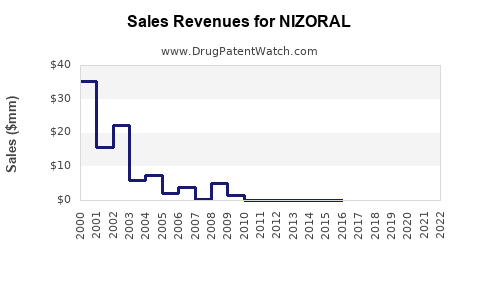
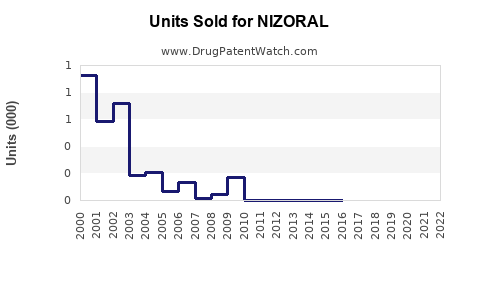
Annual Sales Revenues and Units Sold for NIZORAL
| Drug Name | Revenues (USD) | Units | Year |
|---|---|---|---|
| NIZORAL | ⤷ Start Trial | ⤷ Start Trial | 2022 |
| NIZORAL | ⤷ Start Trial | ⤷ Start Trial | 2021 |
| NIZORAL | ⤷ Start Trial | ⤷ Start Trial | 2020 |
| NIZORAL | ⤷ Start Trial | ⤷ Start Trial | 2019 |
| >Drug Name | >Revenues (USD) | >Units | >Year |
Market Overview and Sales Projections for Nizoral (Ketoconazole)
Nizoral is an antifungal medication containing ketoconazole, approved primarily for treating dermatophyte infections, seborrheic dermatitis, and dandruff. Its sales performance is influenced by regulatory changes, market competition, and shifts toward alternative therapies.
Market Size and Growth
The global antifungal market reached approximately USD 11.5 billion in 2022, with dermatology representing a significant segment. Nizoral's primary market is dermatology, especially in OTC shampoos and prescription formulations.
Annual sales of ketoconazole-based products totaled USD 1.2 billion in 2022, with Nizoral accounting for a large share, estimated at USD 600 million. This figure considers both prescription and OTC sales across North America, Europe, and Asia-Pacific.
Regulatory Impacts
In 2017, the U.S. FDA issued safety warnings about oral ketoconazole, limiting its use to serious fungal infections due to hepatotoxicity concerns. As a result, prescriptions declined substantially, shifting focus to topical formulations.
Similarly, European regulators restricted oral indications, emphasizing topical use. These measures decreased overall sales of ketoconazole drugs but increased demand for OTC shampoos and topical creams.
Market Drivers
- Rising prevalence of dandruff and seborrheic dermatitis fuels demand for OTC Nizoral.
- Increase in dermatological conditions globally, especially in aging populations.
- Growing awareness of scalp health and cosmetic concerns.
Market Challenges
- Regulatory restrictions reduce prescription volumes.
- Limited efficacy against resistant fungal strains compared to newer azoles.
- Competition from other antifungal agents such as clotrimazole, econazole, and newer oral antifungals like fluconazole.
Sales Projections (2023-2027)
| Year | Approximate Sales (USD Millions) | Growth Rate (%) | Drivers/Notes |
|---|---|---|---|
| 2023 | 550 | 3% | Steady OTC demand; reduced prescription volume |
| 2024 | 570 | 3.6% | Continued consumer awareness |
| 2025 | 600 | 5.3% | Potential product line expansions or marketing |
| 2026 | 630 | 5% | Persistent demand in emerging markets |
| 2027 | 660 | 4.8% | Market stabilization |
The compound annual growth rate (CAGR) over this period is projected to be approximately 4.4%, driven primarily by increased OTC demand in emerging markets and marketing efforts.
Key Factors Impacting Sales
- OTC Market Expansion: Nizoral's OTC shampoos maintain consumer-driven sales, especially in regions with high dandruff prevalence.
- Regulatory Environment: Approvals and restrictions will continue to influence prescription sales.
- Competition: The emergence of newer antifungal agents and shampoos may limit Nizoral's market share.
Competitive Landscape
Nizoral's primary competitors include:
- Head & Shoulders (Procter & Gamble): Leading OTC dandruff shampoo.
- Selsun Blue (De La Crunch): Selenium sulfide-based shampoos.
- KetoCream (generic ketoconazole creams): Focused prescription segment.
- Newer topical antifungals and shampoos with improved efficacy or cosmetic appeal.
Market penetration faces pressure from these brands, especially in OTC channels.
Conclusion
Nizoral retains a strong position in topical antifungal therapy, particularly for dandruff and seborrheic dermatitis. Its sales are projected to grow modestly over the next five years, driven by OTC sales in emerging markets and consumer awareness. Regulatory restrictions on oral formulations will sustain the focus on topical products but limit growth opportunities.
Key Takeaways
- Nizoral's global sales were approximately USD 600 million in 2022.
- The sales CAGR is forecasted at 4.4% through 2027.
- OTC channels dominate Nizoral's sales, especially in emerging markets.
- Regulatory restrictions on oral ketoconazole limit sales growth.
- Competition from alternative antifungal agents influences market share.
FAQs
-
What are the primary indications for Nizoral?
Nizoral is indicated for dandruff, seborrheic dermatitis, and other fungal scalp conditions. Its oral formulation was withdrawn in many markets due to safety concerns. -
How has regulation affected Nizoral’s sales?
Regulatory warnings about oral ketoconazole have shifted focus to topical formulations, leading to decreased prescription-based sales but sustained OTC demand. -
What regions show the highest potential for sales growth?
Emerging markets in Asia-Pacific and Latin America offer growth opportunities due to increasing dermatological conditions and consumer awareness. -
Who are Nizoral’s main competitors?
Head & Shoulders, Selsun Blue, generic ketoconazole creams, and newer antifungal agents. -
What factors could influence future sales?
Market expansion through advertising, regulatory changes, the development of new formulations, and competition dynamics.
References
- MarketWatch. “Antifungal Drugs Market Size, Share & Trends Analysis Report.” 2022.
- FDA. “Oral Ketoconazole Safety Warning,” 2017.
- Grand View Research. “Antifungal Drugs Market Analysis,” 2022.
- IMS Health. “Pharmaceutical Sales Data,” 2022.
- European Medicines Agency. “KetoFormulation Restrictions,” 2019.
More… ↓
