Last updated: September 5, 2026
Nicotrol is a prescription nicotine-replacement therapy sold primarily as the Nicotrol Inhaler and, historically, Nicotrol NS nasal spray. Its commercial position has weakened because nicotine-replacement therapy is dominated by lower-cost over-the-counter gums, patches, and lozenges. The brand has no meaningful disclosed product-level revenue, no identifiable remaining U.S. regulatory exclusivity, and limited patent protection capable of supporting premium pricing.
The main commercial barrier is product complexity rather than patent duration. The Nicotrol Inhaler combines a nicotine cartridge with a proprietary delivery device, which creates development, manufacturing, regulatory, and substitution challenges for potential generic entrants.
What is Nicotrol and how is it used?
Nicotrol is a nicotine-replacement product indicated to help adults stop smoking. The active ingredient is nicotine, delivered through either an oral inhalation system or nasal spray.
| Product |
Active ingredient |
Dosage form |
U.S. approval |
Prescription status |
| Nicotrol Inhaler |
Nicotine |
10 mg cartridge used with inhaler device |
1997 |
Prescription |
| Nicotrol NS |
Nicotine |
Metered nasal spray |
1996 |
Prescription |
The Nicotrol Inhaler is not a conventional pulmonary inhaler. The cartridge releases nicotine vapor in the mouth and throat when the user repeatedly puffs. The device is intended to replace some behavioral aspects of smoking while delivering nicotine more slowly than a cigarette.
Nicotrol NS delivers nicotine through the nasal mucosa. Its adverse-effect profile, including nasal irritation, reduced acceptance relative to patches and gum, and prescription-only status limited its long-term market reach.
The U.S. approved products are associated with Pfizer’s former prescription smoking-cessation portfolio. FDA approval records identify Nicotrol Inhaler under NDA 020714 and Nicotrol NS under NDA 020742 (U.S. Food and Drug Administration [FDA], n.d.-a, n.d.-b).
What is the FDA and Orange Book status of Nicotrol?
Nicotrol’s original FDA exclusivity periods have expired. The products were approved in the 1990s and do not retain new-drug exclusivity based on their original approvals.
FDA regulatory position
The FDA-approved Nicotrol products are prescription nicotine-replacement therapies. Their labels describe use as part of a smoking-cessation program that includes behavioral support and counseling (FDA, 2010a, 2010b).
Nicotrol’s commercial status has been constrained by availability and distribution issues. FDA approval of an NDA does not guarantee that a product remains continuously marketed. Drug databases can continue to display an approved NDA after commercial distribution has declined or stopped.
Orange Book listings
The Orange Book is central to any generic-entry analysis because it identifies approved products, therapeutic-equivalence information, and patent listings submitted by sponsors.
For Nicotrol, the critical point is that the original product patents and exclusivity periods are no longer the primary commercial protection. Public FDA records do not indicate a current, commercially meaningful Orange Book patent barrier comparable with the active patent estates surrounding newer branded medicines (FDA, n.d.-c).
The absence of a significant listed-patent barrier does not mean that an abbreviated new drug application would be simple. A potential entrant would still need to address:
- Device design and dose delivery.
- Cartridge composition and nicotine release.
- Human-factors engineering.
- Demonstration of pharmaceutical equivalence.
- Manufacturing controls.
- Packaging, stability, and moisture protection.
- Device-drug combination-product requirements.
When did Nicotrol lose exclusivity?
Nicotrol lost its original market exclusivity many years ago.
| Milestone |
Nicotrol Inhaler |
Nicotrol NS |
| FDA approval |
1997 |
1996 |
| Five-year new chemical entity exclusivity |
Expired |
Expired |
| Expected end of original exclusivity |
Approximately 2002 |
Approximately 2001 |
| Current exclusivity position |
None identified |
None identified |
| Core commercial protection |
Device and manufacturing complexity |
Nasal-delivery and formulation complexity |
The dates above reflect the statutory five-year exclusivity period generally available to a new chemical entity. The products’ market position was never based solely on exclusivity. Nicotine itself was an established active ingredient, and the principal differentiator was the delivery system.
What patents protect Nicotrol?
The original Nicotrol intellectual-property position likely included patents and know-how covering the nicotine delivery system, cartridge construction, nicotine formulation, and device operation. Those rights are now old relative to pharmaceutical patent terms.
Formulation patents
The Nicotrol Inhaler’s formulation uses nicotine in a cartridge designed to release nicotine vapor during puffing. The commercial value of the formulation lies in controlled release and device compatibility rather than in a novel molecular entity.
Any original formulation patents filed around the 1990s would generally have reached the end of their ordinary 20-year patent terms by approximately 2014 to 2018, depending on filing dates, patent-term adjustments, terminal disclaimers, and regulatory extensions.
Device patents
Device claims may have covered:
- Cartridge geometry.
- Airflow paths.
- Heating or vaporization components.
- Nicotine release characteristics.
- Inhaler-cartridge interaction.
- Reusable device architecture.
Device patents generally expire according to the same patent-term rules as other utility patents. The remaining barrier is therefore likely to be engineering know-how, manufacturing tolerances, and regulatory execution rather than enforceable pioneer patent protection.
Method-of-use patents
Nicotrol’s indication is smoking cessation. Broad method-of-use patents covering the use of nicotine to help stop smoking would face substantial validity and prior-art challenges because nicotine-replacement therapy was established before Nicotrol approval.
No current method-of-use patent position appears capable of restoring meaningful exclusivity for the original brand.
Are there Paragraph IV challenges to Nicotrol?
No major publicly documented Paragraph IV litigation involving a generic Nicotrol Inhaler or Nicotrol NS product is apparent in the principal public FDA and federal court records reviewed for the brand.
This does not indicate that no generic development has occurred. It indicates that Nicotrol has not generated the type of high-value patent litigation seen with blockbuster oral medicines or biologics.
A generic applicant could pursue one of several routes:
- An ANDA referencing the approved product.
- A 505(b)(2) application relying partly on FDA findings for the reference product.
- A new drug application supported by comparative pharmacokinetic, device, and usability data.
- A combination-product pathway requiring separate device and drug assessments.
A Paragraph IV certification would have limited strategic value if the Orange Book contains no enforceable, commercially relevant patent listing. The primary risk would shift from patent litigation to FDA review, formulation development, manufacturing validation, and commercial scale-up.
How strong is the Nicotrol patent estate?
Nicotrol’s current patent estate is weak as a source of exclusion but moderate as a practical barrier to substitution.
| Protection category |
Current strength |
Commercial implication |
| Active ingredient |
Low |
Nicotine is established and widely available |
| Original formulation patents |
Low |
Likely expired or near-expired |
| Device patents |
Low to moderate |
Older claims may be expired; design-around remains possible |
| Manufacturing know-how |
Moderate |
Can slow entry and increase development cost |
| Brand recognition |
Low to moderate |
Niche value among users seeking cigarette-like inhalation |
| Regulatory pathway |
Moderate |
Drug-device combination requirements raise entry cost |
| Distribution |
Low |
OTC nicotine products have broader access |
The strongest remaining protection is operational. A competitor must reproduce a consistent dose from a small nicotine cartridge, maintain product stability, satisfy device performance specifications, and obtain physician and pharmacy acceptance.
What generic entry risks exist for Nicotrol?
Generic entry risk is theoretically high because the original exclusivity period has ended. Commercial entry risk is more complex.
Generic entry advantages
A generic or follow-on entrant would benefit from:
- Expired product exclusivity.
- Established therapeutic use of nicotine.
- A large body of safety data.
- Familiarity with smoking-cessation labeling.
- Absence of a complex biologic manufacturing process.
- Potential demand from smokers seeking behavioral substitution.
Generic entry obstacles
The entrant would face:
- A relatively small prescription market.
- Competition from inexpensive OTC products.
- Device-development costs.
- Limited physician incentive to prescribe a new version.
- Potential difficulty securing reimbursement.
- Need for reliable cartridge supply and quality controls.
- Uncertain consumer willingness to switch from established nicotine products.
The economics favor a manufacturer that already has inhalation-device capabilities, nicotine manufacturing capacity, and an established smoking-cessation distribution network. The product is less attractive to a company that would need to build all three capabilities from scratch.
Which companies compete with Nicotrol?
Nicotrol competes in two different markets: prescription smoking-cessation medicines and the broader nicotine-replacement market.
| Competitor category |
Examples |
Competitive pressure |
| Nicotine patches |
Nicoderm CQ, store brands |
High |
| Nicotine gum |
Nicorette, store brands |
High |
| Nicotine lozenges |
Nicorette, store brands |
High |
| Oral nicotine products |
Pouches and emerging alternatives |
Increasing |
| Prescription varenicline |
Chantix and generic varenicline |
High |
| Prescription bupropion |
Zyban and generic bupropion SR |
Moderate |
| Electronic nicotine products |
E-cigarettes and vaping devices |
High but regulatory status varies |
The largest competitive disadvantage for Nicotrol is its prescription requirement. Patches, gum, and lozenges are widely available without a prescription and are often sold at lower prices. Generic varenicline also competes directly for prescription smoking-cessation demand.
Nicotrol retains a differentiated use case for smokers who value an inhaled ritual and want a pharmaceutical product rather than an OTC oral or transdermal product. That niche is too narrow to support material growth without expanded distribution or a meaningful repositioning strategy.
What is Nicotrol’s financial trajectory?
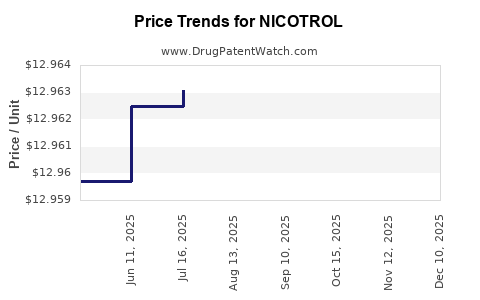
Pfizer does not publicly report Nicotrol revenue as a separate line item in its annual financial statements. The product is grouped within broader pharmaceutical or established-product categories, preventing a reliable standalone revenue series from public filings (Pfizer Inc., 2024).
The likely financial trajectory is mature to declining:
| Period |
Market position |
Financial direction |
| Late 1990s |
New prescription smoking-cessation product |
Initial commercialization |
| 2000s |
Established niche product |
Pressure from OTC NRT |
| 2010s |
Mature brand |
Declining strategic importance |
| 2020s |
Limited or inconsistent availability |
Low, undisclosed revenue contribution |
Nicotrol is unlikely to have a material effect on Pfizer’s consolidated revenue, operating margin, or valuation. Its value is more relevant in portfolio rationalization, licensing, authorized-generic strategy, and niche respiratory or drug-device transactions.
Revenue exposure
A precise Nicotrol revenue estimate is not supported by Pfizer’s public disclosures. The absence of separate reporting indicates that the product is below the company’s threshold for individual material disclosure or is included in a broader established-products portfolio.
The main financial risks are:
- Loss of pharmacy availability.
- Substitution by OTC nicotine products.
- Generic or follow-on device entry.
- Declining physician prescribing.
- Manufacturing interruptions.
- Brand discontinuation without replacement economics.
What licensing deals affect Nicotrol?
No major current licensing transaction materially affecting Nicotrol’s economics is publicly prominent in Pfizer’s recent reported transactions.
The commercial opportunity for a licensee would be limited unless the deal included one or more of the following:
- Rights to a currently manufactured inhaler device.
- Access to cartridge manufacturing technology.
- Regulatory files and stability data.
- Geographic rights outside the United States.
- An established smoking-cessation sales force.
- A pathway to OTC conversion or broader consumer distribution.
A transaction based only on the historical brand name would have limited value. A transaction including manufacturing know-how and regulatory documentation would be more commercially relevant.
What patent litigation affects Nicotrol?
No major active U.S. patent litigation involving Nicotrol is identified as a current driver of the product’s market value.
The litigation profile differs from that of newer branded drugs because:
- The key patents are old.
- The active ingredient is established.
- The product has modest revenue exposure.
- Generic entry has limited blockbuster economics.
- Device claims can often be designed around.
- FDA and manufacturing execution are more significant than patent enforcement.
Any future dispute would more likely concern trade dress, trademark use, device copying, manufacturing rights, or regulatory exclusivity than a foundational composition-of-matter patent.
How does Nicotrol compare with varenicline and OTC nicotine products?
| Factor |
Nicotrol |
Generic varenicline |
OTC nicotine replacement |
| Active ingredient |
Nicotine |
Varenicline |
Nicotine |
| Route |
Oral inhalation or nasal spray |
Oral tablet |
Patch, gum, lozenge |
| Prescription required |
Yes |
Yes |
No |
| Device complexity |
High for inhaler |
Low |
Low to moderate |
| Patent risk |
Low |
Declining, mostly expired |
Low |
| Consumer access |
Limited |
Pharmacy-based |
Broad retail access |
| Price pressure |
High |
Moderate |
High |
| Differentiation |
Behavioral inhalation experience |
Non-nicotine pharmacology |
Convenience and availability |
| Growth outlook |
Limited |
Dependent on cessation demand |
Stable to competitive |
Nicotrol’s differentiation is experiential rather than molecular. That distinction can support adherence among a narrow group of smokers but does not create strong pricing power.
What is the global and geographic coverage of Nicotrol?
Nicotrol’s commercial and regulatory relevance is primarily associated with the United States. Smoking-cessation products are regulated differently across major markets, and brand availability can vary by country.
Geographic risks include:
- Different prescription and OTC classifications.
- Separate device registrations.
- National reimbursement differences.
- Local nicotine-product competition.
- Country-specific manufacturing and pharmacovigilance obligations.
- Divergent rules for e-cigarettes and nicotine pouches.
A global license would therefore require country-by-country regulatory and commercial analysis. U.S. approval alone would not establish broad international market access.
Key Takeaways
- Nicotrol is a prescription nicotine-replacement brand centered on the Nicotrol Inhaler and historical Nicotrol NS nasal spray.
- The products were FDA-approved in the 1990s and have no remaining original new-drug exclusivity.
- The original patent estate is unlikely to provide a meaningful current U.S. exclusionary barrier.
- Device design, cartridge manufacturing, regulatory execution, and supply reliability are the main practical barriers to entry.
- Nicotrol competes against lower-cost OTC nicotine products, generic varenicline, bupropion, and nonprescription nicotine alternatives.
- Pfizer does not disclose standalone Nicotrol revenue. The product is unlikely to have material exposure to Pfizer’s consolidated financial results.
- The brand’s financial trajectory is mature to declining, with limited prospects absent a manufacturing, licensing, distribution, or regulatory repositioning strategy.
- No major active Paragraph IV litigation or patent dispute is publicly apparent as a current market driver.
FAQs About Nicotrol Patents, Generics, and Market Value
Is Nicotrol still protected by patents?
No meaningful current patent protection is apparent for the original Nicotrol products. Older formulation and device patents would generally have expired based on their 1990s filing period.
Can a generic company launch a Nicotrol Inhaler?
A follow-on company could pursue an FDA pathway, but it would need to address the drug-device combination, cartridge performance, dose delivery, manufacturing controls, and labeling requirements.
Is Nicotrol available over the counter?
Nicotrol was developed and marketed as a prescription product. Other nicotine-replacement products, including patches, gum, and lozenges, are widely available over the counter.
Does Nicotrol have biosimilar competition?
No. Nicotrol is a small-molecule nicotine product, not a biologic. Biosimilar regulations do not apply.
Is Nicotrol financially important to Pfizer?
Pfizer does not report Nicotrol revenue separately. Public disclosures support treating it as a small, mature product rather than a material contributor to Pfizer’s financial performance.
References
-
Pfizer Inc. (2024). 2023 annual report. Pfizer Inc.
-
U.S. Food and Drug Administration. (2010a). Nicotrol inhaler: Prescribing information. FDA.
-
U.S. Food and Drug Administration. (2010b). Nicotrol NS: Prescribing information. FDA.
-
U.S. Food and Drug Administration. (n.d.-a). Drugs@FDA: Nicotrol inhaler, NDA 020714. FDA.
-
U.S. Food and Drug Administration. (n.d.-b). Drugs@FDA: Nicotrol NS, NDA 020742. FDA.
-
U.S. Food and Drug Administration. (n.d.-c). Approved drug products with therapeutic equivalence evaluations, Orange Book. FDA.