You're using a free limited version of DrugPatentWatch: Upgrade for Complete Access

Last Updated: December 31, 2025

NEXPLANON Drug Patent Profile


✉ Email this page to a colleague

« Back to Dashboard


When do Nexplanon patents expire, and what generic alternatives are available?

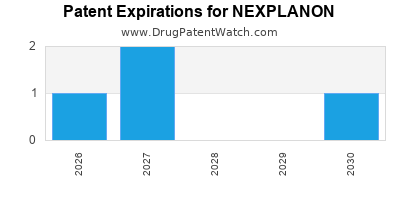
Nexplanon is a drug marketed by Organon and is included in one NDA. There are four patents protecting this drug and one Paragraph IV challenge.

This drug has one hundred and five patent family members in thirty-five countries.

The generic ingredient in NEXPLANON is etonogestrel. There are five drug master file entries for this compound. One supplier is listed for this compound. Additional details are available on the etonogestrel profile page.

DrugPatentWatch® Generic Entry Outlook for Nexplanon

There has been one patent litigation case involving the patents protecting this drug, indicating strong interest in generic launch. Recent data indicate that 63% of patent challenges are decided in favor of the generic patent challenger and that 54% of successful patent challengers promptly launch generic drugs.

Indicators of Generic Entry

< Available with Subscription >

  Get Started Free

AI Deep Research
Questions you can ask:
  • What is the 5 year forecast for NEXPLANON?
  • What are the global sales for NEXPLANON?
  • What is Average Wholesale Price for NEXPLANON?
Drug patent expirations by year for NEXPLANON
Drug Prices for NEXPLANON

See drug prices for NEXPLANON

Recent Clinical Trials for NEXPLANON

Identify potential brand extensions & 505(b)(2) entrants

SponsorPhase
Oregon Health and Science UniversityEarly Phase 1
Saskatchewan Health Authority - Regina AreaPhase 2
University of SaskatchewanPhase 2

See all NEXPLANON clinical trials

Pharmacology for NEXPLANON
Drug ClassProgestin
Paragraph IV (Patent) Challenges for NEXPLANON
Tradename Dosage Ingredient Strength NDA ANDAs Submitted Submissiondate
NEXPLANON Implant etonogestrel 68 mg 021529 1 2024-12-31

US Patents and Regulatory Information for NEXPLANON

NEXPLANON is protected by four US patents.

Applicant Tradename Generic Name Dosage NDA Approval Date TE Type RLD RS Patent No. Patent Expiration Product Substance Delist Req. Exclusivity Expiration
Organon NEXPLANON etonogestrel IMPLANT;IMPLANTATION 021529-002 May 13, 2011 RX Yes Yes 9,757,552 ⤷  Get Started Free Y ⤷  Get Started Free
Organon NEXPLANON etonogestrel IMPLANT;IMPLANTATION 021529-002 May 13, 2011 RX Yes Yes 8,722,037 ⤷  Get Started Free Y ⤷  Get Started Free
Organon NEXPLANON etonogestrel IMPLANT;IMPLANTATION 021529-002 May 13, 2011 RX Yes Yes 10,821,277 ⤷  Get Started Free Y ⤷  Get Started Free
Organon NEXPLANON etonogestrel IMPLANT;IMPLANTATION 021529-002 May 13, 2011 RX Yes Yes 8,888,745 ⤷  Get Started Free Y ⤷  Get Started Free
>Applicant >Tradename >Generic Name >Dosage >NDA >Approval Date >TE >Type >RLD >RS >Patent No. >Patent Expiration >Product >Substance >Delist Req. >Exclusivity Expiration

International Patents for NEXPLANON

See the table below for patents covering NEXPLANON around the world.

Country Patent Number Title Estimated Expiration
Slovenia 1729819 ⤷  Get Started Free
Ireland 882118 ⤷  Get Started Free
Brazil PI0606826 aplicador para inserir um implante ⤷  Get Started Free
Ireland 61730 Contraceptive implant ⤷  Get Started Free
South Korea 20070112144 APPLICATOR FOR INSERTING AN IMPLANT ⤷  Get Started Free
Hong Kong 1002020 ⤷  Get Started Free
Russian Federation 2384347 УСТРОЙСТВО ДЛЯ ДОСТАВКИ ЛЕКАРСТВЕННЫХ СРЕДСТВ, ВИДИМОЕ В РЕНТГЕНОВСКИХ ЛУЧАХ (X-RAY VISIBLE DRUG DELIVERY DEVICE) ⤷  Get Started Free
>Country >Patent Number >Title >Estimated Expiration

Supplementary Protection Certificates for NEXPLANON

Patent Number Supplementary Protection Certificate SPC Country SPC Expiration SPC Description
0303306 29/1999 Austria ⤷  Get Started Free PRODUCT NAME: ETONOGESTREL; NAT. REGISTRATION NO/DATE: 1-22964 19990330; FIRST REGISTRATION: NL 21168 19980825
0303306 SPC/GB99/044 United Kingdom ⤷  Get Started Free PRODUCT NAME: ETONOGESTREL; REGISTERED: NL RGV21168 19980825; UK 00065/0161 19990609
0303306 099C0041 Belgium ⤷  Get Started Free PRODUCT NAME: ETONOGESTREL; NATL. REGISTRATION NO/DATE: 52 IS 296 F 14 19990531; FIRST REGISTRATION: NL RVG 21168 19980825
0303306 C980027 Netherlands ⤷  Get Started Free PRODUCT NAME: ETONOGESTREL; REGISTRATION NO/DATE: RVG 21168 19980825
>Patent Number >Supplementary Protection Certificate >SPC Country >SPC Expiration >SPC Description

Market Dynamics and Financial Trajectory for NEXPLANON

Last updated: August 25, 2025


Introduction

NEXPLANON, a long-acting reversible contraceptive implant manufactured by Merck & Co., Inc., has established itself as a principal product within the contraceptive market. Its combination of efficacy, convenience, and minimally invasive administration has driven its adoption globally. Comprehending its market dynamics and financial outlook is essential for stakeholders, investors, and healthcare providers navigating the evolving reproductive health sector.


Product Overview and Market Position

NEXPLANON, a subdermal implant releasing etonogestrel over three years, was first approved by the U.S. Food and Drug Administration (FDA) in 2012. Its mechanism involves continuous hormone delivery, suppressing ovulation and thickening cervical mucus, resulting in highly effective contraception.

Key benefits underpinning NEXPLANON's market positioning include:

  • Efficacy: >99% effectiveness comparable to permanent sterilization.
  • Duration: Provides protection for up to three years.
  • User Convenience: Eliminates daily compliance, a significant advantage over oral contraceptives.
  • Reversibility: Rapid fertility return upon removal.

The implant targets a broad demographic, spanning adolescents to adults seeking reliable, low-maintenance contraception.


Market Dynamics Influencing NEXPLANON

Growing Global Demand for Long-Acting Reversible Contraceptives (LARCs)

The expanding preference for LARCs is a critical driver. WHO reports illustrate that LARCs' global usage has increased over the past decade, especially in developing nations due to urbanization, improved healthcare access, and heightened awareness of family planning options.

According to the Guttmacher Institute, approximately 24% of contraceptive users worldwide rely on LARCs, a figure projected to rise owing to concerted governmental and NGO initiatives. This trend benefits NEXPLANON's market growth, especially in emerging markets where surgical sterilization remains less accessible.

Regulatory Landscape and Market Expansion

The approval of NEXPLANON across various jurisdictions enhances its market potential. Notably:

  • United States: FDA approval in 2012 catalyzed widespread adoption.
  • Europe: CE marking facilitated access within the EU.
  • Asia-Pacific & Africa: Emerging approvals are expanding reach, supported by partnerships with governments and non-profit agencies aimed at reducing unintended pregnancy rates.

Regulatory developments often align with increased insurance coverage and inclusion in national family planning programs, further boosting adoption rates.

Competitive Landscape

NEXPLANON faces competition from other LARCs, such as:

  • hormonal intrauterine devices (IUDs): Mirena, Kyleena
  • other implants: Norplant, Jadelle

Despite competitors, NEXPLANON's unique profile—such as ease of insertion/removal and robust efficacy—maintains its market share. The advent of newer delivery systems and formulations poses potential challenges however.

Market Penetration and Adoption Barriers

Barriers include:

  • Cost considerations: High upfront costs, often borne by healthcare systems or patients.
  • Cultural and provider biases: Preference for short-term methods in some regions.
  • Limited awareness: Educational gaps may hinder adoption, especially in low-resource settings.

Efforts to address these barriers include subsidization programs, provider training, and patient education.


Financial Trajectory and Revenue Outlook

Historical Revenue Performance

Since its launch, NEXPLANON's sales have steadily increased, driven by expanding indications and global market penetration. Merck's fiscal reports estimate that NEXPLANON contributed significantly to the contraceptive revenue segment.

For example, in 2021, global sales from NEXPLANON and similar devices surpassed $1.2 billion, representing a compounded annual growth rate (CAGR) of approximately 5-7% over the previous five years, when accounting for market expansion and innovation.

Forecasted Growth and Contributing Factors

Analysts project sustained growth in the coming years, leveraging:

  • Expanding markets: Adoption in Asia-Pacific, Latin America, and Africa.
  • Product enhancements: Variants with adjusted hormone doses and improved insertion tools.
  • Healthcare policies: Increasing emphasis on family planning initiatives.

According to industry reports, the contraceptive implant market is expected to grow at a CAGR of around 6% until 2030, with NEXPLANON poised to capture a substantial share due to its established position and ongoing product pipeline.

Impact of Patent Expiry and Generics

While Merck retains exclusivity in key markets, patent expirations and biosimilar entries could influence pricing and revenues, necessitating strategies like product line extensions and market diversification.

Pricing and Reimbursement Trends

Pricing strategies vary globally, influenced by regulatory policies and insurance reimbursements. Regions with universal healthcare tend to offer favorable reimbursement, bolstering sales. Conversely, high out-of-pocket costs in some markets may limit access, affecting revenue growth.


Future Market Drivers and Challenges

Innovation and Pipeline Development

Merck and competitors continue developing next-generation implants, aiming to:

  • Enhance duration (e.g., 5-year implants).
  • Reduce insertion/removal discomfort.
  • Incorporate alternative hormone formulations.

Such innovations are anticipated to revitalize interest and extend the product lifecycle, positively impacting revenue streams.

Potential Disruptors

Emerging contraceptive methods—such as injectable hormonal agents, non-hormonal options, and digital fertility tracking—may reshape the niche market of LARCs, posing future challenges.

Market Risks

Key risks include:

  • Regulatory hurdles in developing markets.
  • Political or cultural opposition.
  • Supply chain disruptions.
  • Healthcare provider biases.

Mitigating these risks involves strategic partnerships, targeted educational campaigns, and adaptive pricing models.


Conclusion and Outlook

NEXPLANON’s market dynamics are characterized by favorable demographic trends, expanding global access to LARCs, and ongoing innovation within contraceptive technology. Financially, it remains a lucrative segment for Merck, with forecasts indicating steady growth driven by emerging markets and product enhancements.

However, competitive pressures, patent considerations, and evolving consumer preferences necessitate continual innovation and market adaptation. Stakeholders that prioritize educational initiatives, market diversification, and product pipeline investments are best positioned to capitalize on the forecasted trajectory.


Key Takeaways

  • Growth Catalysts: Rising demand for long-term, reversible contraception globally ensures strong demand for NEXPLANON.
  • Market Expansion: Increasing approvals and healthcare initiatives in emerging markets will boost sales.
  • Revenue Stability: NEXPLANON’s established efficacy and convenience secure its role as a high-margin product for Merck.
  • Innovation Drive: Next-gen implants and formulation improvements will sustain competitive advantage.
  • Strategic Risks: Patent expirations, regulatory challenges, and cultural barriers must be proactively managed.

FAQs

1. How does NEXPLANON compare to other contraceptive methods in terms of efficacy?
NEXPLANON boasts over 99% effectiveness, matching the efficacy of sterilization but offering reversibility and long-term use, making it highly competitive among contraceptive options.

2. What are the primary barriers to NEXPLANON's widespread adoption?
Cost, lack of awareness, provider training constraints, and cultural factors influence adoption, particularly in resource-limited regions.

3. How might patent expirations affect NEXPLANON's financial outlook?
Patent expirations could introduce biosimilars, potentially reducing prices and margins. Merck’s response involves product innovation and diversification.

4. What markets hold the most promise for NEXPLANON’s growth over the next decade?
Asia-Pacific, Africa, and Latin America are pivotal due to demographic trends, increasing healthcare access, and rising contraceptive demand.

5. Are there any upcoming innovations that could influence NEXPLANON’s competitive landscape?
Yes, upcoming longer-duration implants, hormone-free options, and user-friendly insertion technologies are in development, likely shaping future market dynamics.


Sources

  1. Guttmacher Institute. (2021). Global Trends in Contraceptive Use.
  2. FDA. (2012). FDA Approval Letter for NEXPLANON.
  3. Merck & Co., Inc.. (2022). Annual Reports and Market Data.
  4. World Health Organization. (2020). Family Planning/Contraceptive Use Reports.
  5. Industry Reports. (2022). Contraceptive Devices Market Forecast.

More… ↓

⤷  Get Started Free

Make Better Decisions: Try a trial or see plans & pricing

Drugs may be covered by multiple patents or regulatory protections. All trademarks and applicant names are the property of their respective owners or licensors. Although great care is taken in the proper and correct provision of this service, thinkBiotech LLC does not accept any responsibility for possible consequences of errors or omissions in the provided data. The data presented herein is for information purposes only. There is no warranty that the data contained herein is error free. We do not provide individual investment advice. This service is not registered with any financial regulatory agency. The information we publish is educational only and based on our opinions plus our models. By using DrugPatentWatch you acknowledge that we do not provide personalized recommendations or advice. thinkBiotech performs no independent verification of facts as provided by public sources nor are attempts made to provide legal or investing advice. Any reliance on data provided herein is done solely at the discretion of the user. Users of this service are advised to seek professional advice and independent confirmation before considering acting on any of the provided information. thinkBiotech LLC reserves the right to amend, extend or withdraw any part or all of the offered service without notice.