NEXLIZET Drug Patent Profile
✉ Email this page to a colleague
When do Nexlizet patents expire, and when can generic versions of Nexlizet launch?
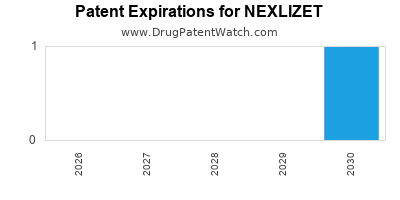
Nexlizet is a drug marketed by Esperion Theraps Inc and is included in one NDA. There are eight patents protecting this drug and one Paragraph IV challenge.
This drug has eighty-one patent family members in twenty-four countries.
The generic ingredient in NEXLIZET is bempedoic acid; ezetimibe. One supplier is listed for this compound. Additional details are available on the bempedoic acid; ezetimibe profile page.
DrugPatentWatch® Generic Entry Outlook for Nexlizet
Nexlizet was eligible for patent challenges on February 21, 2024.
By analyzing the patents and regulatory protections it appears that the earliest date
for generic entry will be June 19, 2040. This may change due to patent challenges or generic licensing.
There have been five patent litigation cases involving the patents protecting this drug, indicating strong interest in generic launch. Recent data indicate that 63% of patent challenges are decided in favor of the generic patent challenger and that 54% of successful patent challengers promptly launch generic drugs.
Indicators of Generic Entry
AI Deep Research
Questions you can ask:
- What is the 5 year forecast for NEXLIZET?
- What are the global sales for NEXLIZET?
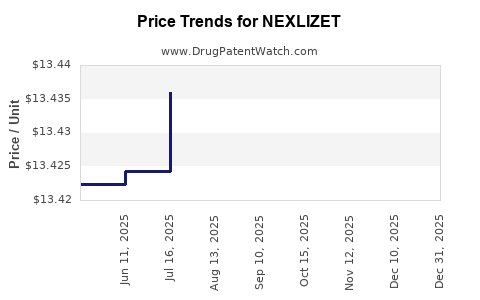
- What is Average Wholesale Price for NEXLIZET?
Summary for NEXLIZET
| International Patents: | 81 |
| US Patents: | 8 |
| Applicants: | 1 |
| NDAs: | 1 |
| Finished Product Suppliers / Packagers: | 1 |
| Clinical Trials: | 2 |
| Drug Prices: | Drug price information for NEXLIZET |
| Patent Litigation and PTAB cases: | See patent lawsuits and PTAB cases for NEXLIZET |
| What excipients (inactive ingredients) are in NEXLIZET? | NEXLIZET excipients list |
| DailyMed Link: | NEXLIZET at DailyMed |
DrugPatentWatch® Estimated Loss of Exclusivity (LOE) Date for NEXLIZET
Generic Entry Date for NEXLIZET*:
Constraining patent/regulatory exclusivity:
NDA:
Dosage:
TABLET;ORAL |
*The generic entry opportunity date is the latter of the last compound-claiming patent and the last regulatory exclusivity protection. Many factors can influence early or later generic entry. This date is provided as a rough estimate of generic entry potential and should not be used as an independent source.
Recent Clinical Trials for NEXLIZET
Identify potential brand extensions & 505(b)(2) entrants
| Sponsor | Phase |
|---|---|
| University of Louisville | PHASE4 |
| Kaiser Permanente | Phase 4 |
| Esperion Therapeutics, Inc. | Phase 4 |
Pharmacology for NEXLIZET
| Drug Class | Adenosine Triphosphate-Citrate Lyase Inhibitor Dietary Cholesterol Absorption Inhibitor |
| Mechanism of Action | Adenosine Triphosphate-Citrate Lyase Inhibitors |
| Physiological Effect | Decreased Cholesterol Absorption |
Paragraph IV (Patent) Challenges for NEXLIZET
| Tradename | Dosage | Ingredient | Strength | NDA | ANDAs Submitted | Submissiondate |
|---|---|---|---|---|---|---|
| NEXLIZET | Tablets | bempedoic acid; ezetimibe | 180 mg/10 mg | 211617 | 3 | 2024-02-21 |
US Patents and Regulatory Information for NEXLIZET
NEXLIZET is protected by ten US patents and two FDA Regulatory Exclusivities.
Based on analysis by DrugPatentWatch, the earliest date for a generic version of NEXLIZET is ⤷ Start Trial.
This potential generic entry date is based on patent ⤷ Start Trial.
Generics may enter earlier, or later, based on new patent filings, patent extensions, patent invalidation, early generic licensing, generic entry preferences, and other factors.
| Applicant | Tradename | Generic Name | Dosage | NDA | Approval Date | TE | Type | RLD | RS | Patent No. | Patent Expiration | Product | Substance | Delist Req. | Exclusivity Expiration |
|---|---|---|---|---|---|---|---|---|---|---|---|---|---|---|---|
| Esperion Theraps Inc | NEXLIZET | bempedoic acid; ezetimibe | TABLET;ORAL | 211617-001 | Feb 26, 2020 | RX | Yes | Yes | ⤷ Start Trial | ⤷ Start Trial | ⤷ Start Trial | ||||
| Esperion Theraps Inc | NEXLIZET | bempedoic acid; ezetimibe | TABLET;ORAL | 211617-001 | Feb 26, 2020 | RX | Yes | Yes | ⤷ Start Trial | ⤷ Start Trial | Y | ⤷ Start Trial | |||
| Esperion Theraps Inc | NEXLIZET | bempedoic acid; ezetimibe | TABLET;ORAL | 211617-001 | Feb 26, 2020 | RX | Yes | Yes | ⤷ Start Trial | ⤷ Start Trial | Y | ⤷ Start Trial | |||
| >Applicant | >Tradename | >Generic Name | >Dosage | >NDA | >Approval Date | >TE | >Type | >RLD | >RS | >Patent No. | >Patent Expiration | >Product | >Substance | >Delist Req. | >Exclusivity Expiration |
Expired US Patents for NEXLIZET
| Applicant | Tradename | Generic Name | Dosage | NDA | Approval Date | Patent No. | Patent Expiration |
|---|---|---|---|---|---|---|---|
| Esperion Theraps Inc | NEXLIZET | bempedoic acid; ezetimibe | TABLET;ORAL | 211617-001 | Feb 26, 2020 | ⤷ Start Trial | ⤷ Start Trial |
| Esperion Theraps Inc | NEXLIZET | bempedoic acid; ezetimibe | TABLET;ORAL | 211617-001 | Feb 26, 2020 | ⤷ Start Trial | ⤷ Start Trial |
| Esperion Theraps Inc | NEXLIZET | bempedoic acid; ezetimibe | TABLET;ORAL | 211617-001 | Feb 26, 2020 | ⤷ Start Trial | ⤷ Start Trial |
| >Applicant | >Tradename | >Generic Name | >Dosage | >NDA | >Approval Date | >Patent No. | >Patent Expiration |
EU/EMA Drug Approvals for NEXLIZET
| Company | Drugname | Inn | Product Number / Indication | Status | Generic | Biosimilar | Orphan | Marketing Authorisation | Marketing Refusal |
|---|---|---|---|---|---|---|---|---|---|
| Daiichi Sankyo Europe GmbH | Nustendi | bempedoic acid, ezetimibe | EMEA/H/C/004959Nustendi is indicated in adults with primary hypercholesterolaemia (heterozygous familial and non-familial) or mixed dyslipidaemia, as an adjunct to diet:in combination with a statin in patients unable to reach LDL-C goals with the maximum tolerated dose of a statin in addition to ezetimibealone in patients who are either statin-intolerant or for whom a statin is contraindicated, and are unable to reach LDL-C goals with ezetimibe alone,in patients already being treated with the combination of bempedoic acid and ezetimibe as separate tablets with or without statin | Authorised | no | no | no | 2020-03-27 | |
| >Company | >Drugname | >Inn | >Product Number / Indication | >Status | >Generic | >Biosimilar | >Orphan | >Marketing Authorisation | >Marketing Refusal |
International Patents for NEXLIZET
When does loss-of-exclusivity occur for NEXLIZET?
Based on analysis by DrugPatentWatch, the following patents block generic entry in the countries listed below:
Australia
Patent: 20295503
Estimated Expiration: ⤷ Start Trial
Patent: 20296094
Estimated Expiration: ⤷ Start Trial
Patent: 25203232
Estimated Expiration: ⤷ Start Trial
Brazil
Patent: 2021025928
Estimated Expiration: ⤷ Start Trial
Patent: 2021025964
Estimated Expiration: ⤷ Start Trial
Canada
Patent: 44371
Estimated Expiration: ⤷ Start Trial
Patent: 44372
Estimated Expiration: ⤷ Start Trial
Patent: 43601
Estimated Expiration: ⤷ Start Trial
China
Patent: 2437765
Estimated Expiration: ⤷ Start Trial
Patent: 2437766
Patent: 制备贝派地酸及其组合物的方法 (METHODS OF MAKING BEMPEDOIC ACID AND COMPOSITIONS OF THE SAME)
Estimated Expiration: ⤷ Start Trial
Patent: 5429784
Patent: 制备贝派地酸及其组合物的方法 (Method for preparing bepiridic acid and composition thereof)
Estimated Expiration: ⤷ Start Trial
European Patent Office
Patent: 86859
Patent: PROCÉDÉS DE PRÉPARATION D'ACIDE BEMPÉDOÏQUE ET COMPOSITIONS DE CELUI-CI (METHODS OF MAKING BEMPEDOIC ACID AND COMPOSITIONS OF THE SAME)
Estimated Expiration: ⤷ Start Trial
Patent: 86860
Patent: FORMES SALINES D'ACIDE BEMPEDOÏQUE ET LEURS PROCÉDÉS D'UTILISATION (SALT FORMS OF BEMPEDOIC ACID AND METHODS FOR USING THE SAME)
Estimated Expiration: ⤷ Start Trial
Patent: 38114
Patent: PROCÉDÉS DE FABRICATION D'ACIDE BEMPÉDOÏQUE ET COMPOSITIONS ASSOCIÉES (METHODS OF MAKING BEMPEDOIC ACID AND COMPOSITIONS OF THE SAME)
Estimated Expiration: ⤷ Start Trial
Hungary
Patent: 72061
Estimated Expiration: ⤷ Start Trial
Israel
Patent: 8909
Patent: שיטות להכנה של חומצה במפדואית ותכשירים המכילים אותה (Methods of making bempedoic acid and compositions of the same)
Estimated Expiration: ⤷ Start Trial
Patent: 8997
Patent: צורות מלח של חומצה במפדואית ושיטות לשימוש בהם (Salt forms of bempedoic acid and methods for using the same)
Estimated Expiration: ⤷ Start Trial
Patent: 4076
Patent: שיטות להכנה של חומצה במפדואית ותכשירים המכילים אותה (Methods of making bempedoic acid and compositions of the same)
Estimated Expiration: ⤷ Start Trial
Japan
Patent: 22536979
Patent: 塩形態のベンペド酸及びそれを使用する方法
Estimated Expiration: ⤷ Start Trial
Patent: 22537049
Patent: ベンペド酸の製造方法及びその組成物
Estimated Expiration: ⤷ Start Trial
Patent: 25032197
Patent: ベンペド酸を含む製薬材料、医薬製剤及び医薬組成物 (PHARMACEUTICAL MATERIAL, MEDICINAL PREPARATION AND PHARMACEUTICAL COMPOSITION THAT CONTAIN BEMPEDOIC ACID)
Estimated Expiration: ⤷ Start Trial
Mexico
Patent: 21015935
Patent: FORMAS DE SAL DE ACIDO BEMPEDOICO Y METODOS PARA UTILIZAR EL MISMO. (SALT FORMS OF BEMPEDOIC ACID AND METHODS FOR USING THE SAME.)
Estimated Expiration: ⤷ Start Trial
Patent: 21015936
Patent: METODOS PARA PREPARAR ACIDO BEMPEDOICO Y COMPOSICIONES DEL MISMO. (METHODS OF MAKING BEMPEDOIC ACID AND COMPOSITIONS OF THE SAME.)
Estimated Expiration: ⤷ Start Trial
South Korea
Patent: 220024815
Patent: 벰페도산의 염 형태 및 그의 사용 방법
Estimated Expiration: ⤷ Start Trial
Patent: 220024816
Patent: 벰페도산 및 그의 조성물을 제조하는 방법
Estimated Expiration: ⤷ Start Trial
Patent: 250143358
Patent: 벰페도산 및 그의 조성물을 제조하는 방법 (METHODS OF MAKING BEMPEDOIC ACID AND COMPOSITIONS OF THE SAME)
Estimated Expiration: ⤷ Start Trial
Spain
Patent: 32779
Estimated Expiration: ⤷ Start Trial
Generics may enter earlier, or later, based on new patent filings, patent extensions, patent invalidation, early generic licensing, generic entry preferences, and other factors.
See the table below for additional patents covering NEXLIZET around the world.
| Country | Patent Number | Title | Estimated Expiration |
|---|---|---|---|
| South Africa | 201706919 | FIXED DOSE COMBINATIONS AND FORMULATIONS COMPRISING ETC1002 AND EZETIMIBE AND METHODS OF TREATING OR REDUCING THE RISK OF CARDIOVASCULAR DISEASE | ⤷ Start Trial |
| Mexico | 392182 | ⤷ Start Trial | |
| Australia | 2024202106 | ⤷ Start Trial | |
| >Country | >Patent Number | >Title | >Estimated Expiration |
Supplementary Protection Certificates for NEXLIZET
| Patent Number | Supplementary Protection Certificate | SPC Country | SPC Expiration | SPC Description |
|---|---|---|---|---|
| 2404890 | C02404890/01 | Switzerland | ⤷ Start Trial | PRODUCT NAME: BEMPEDOINSAEURE; REGISTRATION NO/DATE: SWISSMEDIC-ZULASSUNG 67583 14.12.2020 |
| 2404890 | 122020000048 | Germany | ⤷ Start Trial | PRODUCT NAME: BEMPEDOINSAEURE ODER EIN PHARMAZEUTISCH VERTRAEGLICHES SALZ, HYDRAT, SOLVAT ODER EIN GEMISCH DAVON; REGISTRATION NO/DATE: EU/1/20/1424 20200327 |
| 2404890 | 2020C/534 | Belgium | ⤷ Start Trial | PRODUCT NAME: ACIDE BEMPEDOIQUE OU UN SEL, HYDRATE, PRODUIT DE SOLVATATION OU MELANGE DE CEUX-CI, PHARMACEUTIQUEMENT ACCEPTABLES; AUTHORISATION NUMBER AND DATE: EU/1/20/1424 20200331 |
| >Patent Number | >Supplementary Protection Certificate | >SPC Country | >SPC Expiration | >SPC Description |
More… ↓
Make Better Decisions: Try a trial or see plans & pricing
Drugs may be covered by multiple patents or regulatory protections. All trademarks and applicant names are the property of their respective owners or licensors. Although great care is taken in the proper and correct provision of this service, thinkBiotech LLC does not accept any responsibility for possible consequences of errors or omissions in the provided data. The data presented herein is for information purposes only. There is no warranty that the data contained herein is error free. We do not provide individual investment advice. This service is not registered with any financial regulatory agency. The information we publish is educational only and based on our opinions plus our models. By using DrugPatentWatch you acknowledge that we do not provide personalized recommendations or advice. thinkBiotech performs no independent verification of facts as provided by public sources nor are attempts made to provide legal or investing advice. Any reliance on data provided herein is done solely at the discretion of the user. Users of this service are advised to seek professional advice and independent confirmation before considering acting on any of the provided information. thinkBiotech LLC reserves the right to amend, extend or withdraw any part or all of the offered service without notice.
ISSN: 2162-2639

Privacy and Cookies
Terms & Conditions
Site Map
DrugPatentWatch Alternatives
LOE / Major Patent Expirations 2026 - 2027
NCE-1 Patent Challenge Dates 2026 - 2027
Friedman, Yali. "DrugPatentWatch" DrugPatentWatch, thinkBiotech, 2026, www.DrugPatentWatch.com.
See Primary Research Papers Citing DrugPatentWatch