Last updated: August 25, 2026
Naloxone is a mature generic medicine undergoing rapid demand expansion because of fentanyl-related overdoses, broader take-home distribution, and the shift from prescription-only access to over-the-counter sales. The active ingredient has little practical composition-of-matter protection. Commercial differentiation is concentrated in nasal delivery devices, branded distribution, government contracts, manufacturing scale, and regulatory access.
The market is moving from a hospital-centered injectable model to a mixed market dominated by community nasal sprays. Emergent BioSolutions’ Narcan remains the leading branded product, but Teva, Hikma, Sandoz, and Harm Reduction Therapeutics have increased competitive pressure. Revenue growth is likely to continue in unit terms while average selling prices decline.
What is driving the naloxone market?
The primary demand driver is the increase in opioid mortality, particularly deaths involving illicit fentanyl and fentanyl analogues. Naloxone distribution has expanded beyond emergency departments and ambulances into pharmacies, schools, shelters, correctional facilities, workplaces, public-health programs, and household medicine cabinets.
The Centers for Disease Control and Prevention reported more than 80,000 drug-overdose deaths involving opioids in the 12-month period ending in late 2023, although the overall overdose trend began to moderate in 2023 and 2024. The continuing prevalence of fentanyl supports persistent demand for multiple naloxone doses and repeat distribution programs. [1]
Key demand channels
| Channel |
Product formats |
Commercial characteristics |
| Emergency medical services |
Prefilled syringes, vials, autoinjectors, nasal spray |
Volume contracts and institutional purchasing |
| Hospitals |
Injectable naloxone and nasal products |
Generic price competition |
| Retail pharmacies |
OTC nasal spray and prescription nasal spray |
Brand recognition and consumer price sensitivity |
| Public-health agencies |
Nasal spray and injectable products |
Government tenders, grants, and opioid-settlement funds |
| Schools and workplaces |
Mostly nasal spray |
Institutional safety purchasing |
| Harm-reduction organizations |
Nasal spray and injectable products |
Often subsidized or free to the end user |
| Correctional facilities |
Injectable and nasal products |
State and local procurement |
The U.S. opioid-settlement funds create a multiyear source of procurement capacity, but the timing and product allocation differ by state and local authority. Naloxone manufacturers that can satisfy public-sector packaging, shelf-life, delivery, and documentation requirements have an advantage over companies competing only through retail sales.
How large is the naloxone market and how is it changing financially?
Public market estimates vary because they combine different products and channels. Some estimates include only naloxone hydrochloride products; others include global hospital use, consumer nasal sprays, government stockpiles, and opioid-overdose response programs. Company filings provide more reliable information for branded sales but do not disclose the entire market.
The financial trajectory has four phases:
- Pre-2015: Injectable generic naloxone dominated, with low prices and limited commercial differentiation.
- 2015-2020: Branded nasal delivery expanded the market and increased gross margins.
- 2021-2023: Fentanyl-related demand, expanded public distribution, and additional nasal competitors increased unit volumes.
- 2023 onward: OTC conversion accelerated consumer access but increased price competition and may reduce prescription-channel margins.
Emergent’s Narcan became the most visible commercial naloxone franchise after Adapt Pharma commercialized the product and Emergent acquired Adapt in 2018. Narcan revenue has been affected by government orders, retail stocking, public-health contracts, and the transition from prescription to OTC distribution. Emergent’s filings identify Narcan as a material commercial product but also show exposure to uneven government demand and pricing pressure. [2]
Pricing structure
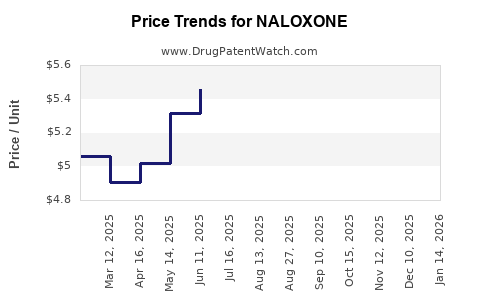
Retail pricing has historically been high relative to the cost of the active ingredient because the value resides in the nasal device, packaging, regulatory approvals, distribution, and channel services.
Representative U.S. pricing positions include:
| Product |
Company |
U.S. status |
Commercial positioning |
| Narcan nasal spray |
Emergent BioSolutions |
OTC since March 2023 |
Leading consumer brand |
| Generic naloxone nasal spray |
Teva |
Prescription generic |
Lower-cost alternative |
| Kloxxado nasal spray |
Hikma Pharmaceuticals |
Prescription product |
Higher-dose nasal format |
| RiVive nasal spray |
Harm Reduction Therapeutics |
Prescription product, nonprofit model |
Public-health and affordability focus |
| Injectable naloxone |
Multiple manufacturers |
Generic |
Institutional and EMS use |
Emergent announced a $44.99 suggested retail price for a two-dose Narcan package in 2023. Harm Reduction Therapeutics has promoted RiVive as a lower-cost product, with publicized pricing below the Narcan retail price. Actual acquisition prices vary materially by payer, government contract, wholesaler, and nonprofit procurement arrangement. [3][4]
The OTC transition expands the addressable customer base but shifts the economics. Prescription reimbursement can support higher transaction prices through Medicaid, commercial insurance, and government programs. OTC sales depend more heavily on cash-pay consumers, pharmacy placement, employer programs, and institutional procurement.
What is the FDA regulatory status of naloxone?
FDA regulation has moved naloxone toward broad nonprescription access.
| Date |
Regulatory milestone |
| 2015 |
FDA approved Narcan 4 mg naloxone hydrochloride nasal spray |
| 2019 |
FDA approved Teva’s generic naloxone hydrochloride nasal spray |
| 2021 |
FDA approved Hikma’s Kloxxado 8 mg nasal spray |
| 2023 |
FDA approved Narcan for OTC use |
| 2023 |
FDA approved RiVive 3 mg naloxone nasal spray |
| 2024 |
FDA continued to support wider naloxone access through OTC and public-health initiatives |
FDA’s OTC approval of Narcan was based on the agency’s determination that consumers could understand the labeling and use the product safely without a prescription. The decision removed a major access barrier and established a regulatory pathway for future OTC naloxone products. [5]
FDA has also supported naloxone availability through pharmacy standing orders, automatic dispensing arrangements, and educational efforts. State-level rules remain important because distribution, pharmacist authority, Medicaid reimbursement, and public-health purchasing are not uniform.
What patents protect naloxone products?
Naloxone hydrochloride itself is a long-established active ingredient. Its core chemical composition is not protected by a commercially meaningful U.S. composition-of-matter patent. Generic competition is therefore legally feasible once product-specific regulatory requirements are satisfied.
The principal IP value has historically been associated with:
- Intranasal delivery systems.
- Device geometry and actuation mechanisms.
- Dose-metering technology.
- Formulation stability.
- Packaging and unit-dose presentation.
- Manufacturing processes.
- Labeling and method-of-use claims.
For U.S. prescription products, the FDA Orange Book can identify patents and regulatory exclusivities associated with an approved NDA. Orange Book protection for a nasal product does not create broad protection over naloxone. It may instead affect a particular device, formulation, or approved presentation. [6]
How strong is the naloxone patent estate?
The overall estate is weak against ordinary injectable generic competition and stronger against certain nasal presentations where device or formulation claims remain enforceable.
| IP category |
Practical strength |
| Naloxone active ingredient |
Very weak; mature generic molecule |
| Injectable formulation |
Weak, subject to manufacturing and regulatory controls |
| Nasal spray formulation |
Moderate where claims cover concentration, excipients, or stability |
| Delivery device |
Moderate to potentially strong for a specific design |
| OTC labeling |
Regulatory exclusivity is limited and does not block all generic products |
| Manufacturing process |
Variable; difficult to enforce if process is not publicly observable |
| Brand and trade dress |
Relevant commercially but narrower than patent protection |
The principal generic risk is design-around. A competitor can use a different nasal device, dose, formulation, or manufacturing process while relying on the same active ingredient.
When did naloxone lose exclusivity and when can generics launch?
Naloxone’s basic molecule lost exclusivity decades ago. The commercial exclusivity contest concerns individual drug-device products rather than naloxone as a therapeutic class.
Teva’s generic nasal spray approval in 2019 established that branded intranasal naloxone could face abbreviated approval competition. The generic pathway remains dependent on FDA requirements for device performance, human factors, bioavailability or pharmacodynamic bridging where applicable, manufacturing controls, and labeling.
OTC status does not automatically make every naloxone product OTC. Each product requires an FDA determination, appropriate labeling, and manufacturing compliance. Prescription generic products can continue to coexist with OTC branded products.
Which companies are competing in naloxone?
Emergent BioSolutions
Emergent has the strongest consumer brand through Narcan and benefits from first-mover recognition, pharmacy distribution, and public-health awareness. Its risks are price compression, dependence on government orders, inventory variability, and competition from lower-priced products.
Teva Pharmaceutical Industries
Teva introduced a generic naloxone nasal spray and competes through generic infrastructure, payer relationships, and established pharmacy distribution. Its product is strategically important because it demonstrates that branded nasal naloxone does not have exclusive control of the route of administration.
Hikma Pharmaceuticals
Hikma’s Kloxxado uses an 8 mg dose and competes on product differentiation rather than simple low-price substitution. The higher dose may appeal to institutional purchasers responding to potent synthetic opioids, although dose selection depends on clinical and operational protocols. [7]
Harm Reduction Therapeutics
RiVive uses a nonprofit-oriented commercial model. Its strategic value is strongest in public-health procurement, harm-reduction distribution, and price-sensitive channels. Its expansion could pressure branded pricing even when it does not capture the entire retail market.
Generic injectable manufacturers
Hospira, Pfizer, Sandoz, Fresenius Kabi, Hikma, and other manufacturers participate in injectable naloxone supply. Injectable products remain important because of hospital, EMS, and institutional protocols. Their economics are more exposed to generic contracting and periodic supply disruptions than to consumer branding.
What litigation and Paragraph IV risks affect naloxone?
Naloxone litigation risk is product-specific rather than molecule-wide. Potential disputes can involve:
- Paragraph IV certifications against Orange Book-listed nasal-spray patents.
- ANDA litigation over device or formulation claims.
- Patent infringement claims involving nasal actuators.
- Trade dress and trademark disputes involving OTC packaging.
- Government-contract disputes over supply and pricing.
- Product-liability claims related to administration failure or delayed emergency response.
A Paragraph IV challenge could create an early generic-entry opportunity if the branded patent holder does not obtain a preliminary injunction or if the patents are invalidated. For a mature product, the commercial value of a challenge depends on whether the patent covers a high-volume presentation and whether the challenger can obtain FDA approval without using the protected device.
Publicly available information does not indicate a molecule-level patent barrier capable of preventing broad naloxone competition. The more material risk is a temporary dispute over a specific nasal product.
What generic launch scenarios exist for naloxone?
Scenario 1: Continued branded OTC leadership
Narcan retains the strongest consumer recognition, while generics capture institutional and price-sensitive accounts. Emergent preserves substantial revenue but accepts lower margins.
Scenario 2: Rapid OTC price compression
Multiple OTC or quasi-OTC products enter retail channels. Consumers and pharmacies substitute based on price, availability, and insurance coverage. Narcan unit share declines faster than total market demand.
Scenario 3: Government-led volume growth
States and local agencies direct opioid-settlement funds toward large naloxone purchases. Unit volume rises, but contract prices fall. Manufacturers with scale and reliable supply gain share.
Scenario 4: Supply-constrained market
A manufacturing interruption or regulatory issue reduces supply from one or more producers. Remaining suppliers gain temporary volume and pricing leverage. This scenario is more relevant to injectable products, where shortages have historically affected hospital procurement.
How does naloxone compare with other mature generic drugs?
Naloxone differs from ordinary mature generics because demand is policy-driven and public-health driven rather than determined only by diagnosis volume. The active ingredient is inexpensive, but access programs, emergency preparedness, device technology, and consumer education create commercial value.
Compared with an established tablet generic, naloxone has:
- Higher device and packaging costs.
- Greater government procurement exposure.
- More prominent brand value.
- Stronger demand growth.
- More limited differentiation at the active-ingredient level.
- Greater sensitivity to public-health funding.
- A larger gap between retail price and active-ingredient cost.
What is the revenue exposure for naloxone manufacturers?
Revenue exposure is highest for companies with a branded nasal product and concentrated government or retail channels. The main variables are:
- Number of doses distributed.
- Average realized price per dose.
- Government versus retail mix.
- Product substitution.
- Manufacturing utilization.
- Public-health funding.
- Reimbursement and OTC cash-pay behavior.
For Emergent, Narcan is strategically important but the company’s overall financial performance also depends on other pharmaceutical and medical countermeasure products. A Narcan revenue increase does not translate directly into equivalent earnings growth because public-sector contracts can carry lower margins, demand can be uneven, and production and distribution costs vary by channel. [2]
What is the geographic outlook for naloxone?
The United States is the most commercially developed naloxone market because of its opioid mortality burden, standing-order policies, public-health purchasing, and OTC conversion.
Canada, the United Kingdom, Australia, and parts of Europe have expanded community naloxone programs, but reimbursement, prescription rules, procurement structures, and overdose patterns differ. International growth is more likely to come from government and harm-reduction programs than from large retail OTC markets.
Manufacturing and IP barriers are limited at the molecule level. The more important geographic barriers are local registration, pharmacovigilance, language-specific labeling, device validation, tender qualification, and supply reliability.
Key Takeaways
- Naloxone demand is expanding because of fentanyl exposure, public-health distribution, and OTC access.
- The core molecule is a mature generic with no meaningful composition-of-matter barrier.
- Nasal-device, formulation, packaging, and manufacturing IP provide narrower product-level protection.
- Narcan has the strongest consumer brand, but Teva, Hikma, Harm Reduction Therapeutics, and injectable generic suppliers increase price pressure.
- OTC conversion expands demand while weakening prescription-channel pricing power.
- Government and opioid-settlement procurement can drive volume but usually compress average selling prices.
- The strongest competitive advantage is reliable supply, public-sector contracting, retail distribution, and device approval rather than fundamental chemistry.
- The market’s likely trajectory is higher unit volume, lower average prices, and greater separation between consumer-branded and institutional generic channels.
FAQs About Naloxone Market and Patent Competition
Is naloxone still profitable for pharmaceutical companies?
Yes. Profitability is strongest in branded nasal products, government contracts with efficient manufacturing, and differentiated devices. Injectable products face substantially greater generic price pressure.
Can a generic company launch a nasal naloxone product without infringing Narcan patents?
Potentially. A challenger can design around device, formulation, or packaging claims, but it must satisfy FDA approval requirements and address any Orange Book-listed patents through the ANDA process.
Will Narcan lose market share after becoming OTC?
Narcan faces greater substitution risk because consumers can compare products directly. Its brand recognition and pharmacy placement can preserve share, but lower-priced competitors are likely to gain institutional and price-sensitive accounts.
Do biosimilar rules apply to naloxone?
No. Naloxone is a chemically synthesized small molecule, not a biologic. Competition proceeds through generic drug pathways rather than the biosimilar framework.
Can opioid-settlement funds materially increase naloxone sales?
Yes. Settlement funds can finance large state and local purchases, but the financial benefit depends on procurement timing, contract pricing, distribution eligibility, and whether products are supplied free to end users.
References
-
Centers for Disease Control and Prevention. (2024). Understanding the opioid overdose epidemic. https://www.cdc.gov/overdose-prevention/about/understanding-the-opioid-overdose-epidemic.html
-
Emergent BioSolutions Inc. (2024). Annual report pursuant to Section 13 or 15(d) of the Securities Exchange Act of 1934. U.S. Securities and Exchange Commission.
-
Emergent BioSolutions Inc. (2023, September 20). Emergent announces availability of over-the-counter Narcan nasal spray. https://investors.emergentbiosolutions.com
-
Harm Reduction Therapeutics. (2023). RiVive naloxone nasal spray. https://www.rivive.com
-
U.S. Food and Drug Administration. (2023, March 29). FDA approves first over-the-counter naloxone nasal spray. https://www.fda.gov/news-events/press-announcements/fda-approves-first-over-counter-naloxone-nasal-spray
-
U.S. Food and Drug Administration. (2024). Approved drug products with therapeutic equivalence evaluations: Orange Book. https://www.accessdata.fda.gov/scripts/cder/ob/
-
U.S. Food and Drug Administration. (2021, April 30). FDA approves higher-dose naloxone nasal spray to treat opioid overdose. https://www.fda.gov/news-events/press-announcements/fda-approves-higher-dose-naloxone-nasal-spray-treat-opioid-overdose