Last updated: June 12, 2026
NAFTIN, a topical antifungal containing naftifine (commonly as naftifine hydrochloride), operates as a niche dermatology product with limited high-volume demand drivers versus systemic antifungals. Financial trajectory is shaped by (1) low prescription concentration and pharmacy-level switching, (2) generic-to-generic and OTC adjacency in superficial fungal categories, and (3) limited lifecycle extension leverage because topical antifungal patent estates typically fragment across formulations and packaging rather than new molecular entities. Net sales, margin, and market share tend to track pharmacy gross-to-net compression, channel promotions, and competitor assortment in the “athlete’s foot” and interdigital tinea footprints.
What is NAFTIN’s market position in topical antifungals?
NAFTIN is a topical antifungal used for dermatophyte-related superficial fungal infections, most commonly tinea pedis (athlete’s foot). Market behavior for these products is driven by self-selection, intermittent use, and rapid symptom-driven discontinuation once lesions clear, which reduces durable, long-cycle demand and weakens retention.
How is NAFTIN typically sold and who buys it?
- Primary channels: retail pharmacy and generic drug distribution to office-based prescribing patterns for dermatologic complaints.
- Demand type: episodic dermatology treatment rather than chronic therapy.
- Buyer behavior: many patients use over-the-counter antifungals first; those who fail OTC then shift to prescription topical agents. That “trial-then-escalate” funnel limits total addressable demand versus oral antifungals used for refractory disease.
What defines competitive sets for naftifine topical?
Competitive pressure usually comes from:
- Other prescription topical antifungals (allylamines and azoles in creams/gels/solutions).
- OTC azoles and allylamine products used for first-line self-treatment.
- Private label and pharmacy brand equivalents in the same or adjacent dosage forms.
Implication for sales: NAFTIN’s share is most sensitive to pharmacist stocking decisions, payer formularies for non-urgent dermatology, and the relative unit price and pack sizes versus close-competing topical antifungals.
How do pricing and pharmacy reimbursement dynamics affect NAFTIN revenue?
Topical antifungals have pricing and gross-to-net patterns that differ from specialty drugs:
- Low ASP base compared with specialty and oncology.
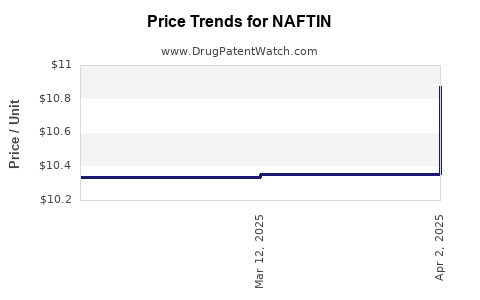
- Greater dependence on unit economics: smaller absolute price gaps can materially change dispensing and switching.
- Promotion and contracting can shift demand quickly because treatment is short and switching is low-friction.
What is the typical gross-to-net risk for NAFTIN-like products?
Key margin drivers:
- PBM and payer rebates tied to formulary placement (if NAFTIN is formulary-restricted or subject to tiering).
- Pharmacy buy-down incentives and wholesaler pricing.
- Competitive pricing by generic entrants in the same ingredient/dosage form range.
What pricing catalysts or drags usually move net sales?
- Generic price resets when equivalent products gain traction.
- Pack-size and NDC assortment shifts (a common driver of ASP volatility for mature small molecules).
- Competitive promotional intensity in the “athlete’s foot” seasonal window (often late spring to early fall).
When does NAFTIN lose exclusivity and how does that shape sales?
NAFTIN is not a high-profile originator with blockbuster-style exclusivity in most topical naftifine markets. Financial trajectory is therefore better explained by mature-market dynamics than by near-term exclusivity cliffs typical of newer blockbuster launches.
Exclusivity and lifecycle assumptions for NAFTIN’s financial path
- Primary molecular exclusivity for naftifine (originator) is already expired in mature markets.
- Post-expiry performance depends on genericization speed, product positioning by dosage form (cream/solution/gel), and residual brand share in the presence of multiple therapeutically equivalent topical antifungal options.
Net effect: absent evidence of a still-active exclusivity bottleneck, NAFTIN’s sales profile is expected to be in decline or flat with periodic demand fluctuations driven by channel contracting and competitor pricing, not by new protection-led demand steps.
What patents protect naftifine (NAFTIN) and how strong is the patent estate?
For topical antifungal ingredients like naftifine, the patent estate in practice tends to be narrow:
- Formulation or vehicle patents (for cream/gel/solution characteristics).
- Manufacturing and stability patents (process controls, shelf-life, packaging/containers).
- Sometimes method-of-use patents tied to dosing regimens or patient subpopulations.
Financial relevance: narrow estates usually do not block therapeutic equivalence broadly once generics enter, so sales are more exposed to price competition than to litigation-led supply constraints.
How do formulation and method-of-use patents affect competition?
- If generic entrants can launch with bioequivalent products that avoid the specific protected formulation or process, the brand’s sales fall quickly.
- If patents cover specific dosage forms, the brand can sometimes defend a subset of use cases (for example, solution-only for certain presentations), but that generally limits monetization scope.
What FDA regulatory status does NAFTIN have and does that create launch barriers?
NAFTIN is a small-molecule topical antifungal. In the US framework, market access is typically governed by:
- ANDA pathways for generics (or legacy equivalents).
- 505(b)(2) if a product relies on listed drug differences (less common for simple topical antifungal line extensions).
- OTC switch is possible in some antifungal categories, but NAFTIN’s ingredient and indication structure would determine whether a switch is feasible.
Financial relevance: for mature topical drugs, FDA status usually shifts from “brand protected by regulatory exclusivity” to “generic substitutable product,” driving price competition.
What generic entry risks exist for NAFTIN?
For naftifine topical products, the generic entry risk is typically structural rather than event-driven:
- If therapeutically equivalent alternatives exist across multiple dosage forms, a generic NAFTIN-equivalent launch may not create a step-function sales collapse; it compounds ongoing price erosion.
- If brand-specific NDCs are protected by formulation-specific patents, risk concentrates around whichever dosage forms and strengths are more contestable.
How do clinicians and pharmacies reduce generic substitution risk?
- Pharmacists prefer stocked equivalents with stable supply and contracted pricing.
- Clinicians choose based on vehicle preference (cream vs solution) and prior patient response, but these are not strong barriers when multiple equivalents are available.
Financial relevance: NAFTIN’s revenue resilience tends to be limited once equivalent products are widely stocked and payers align tiers.
How does NAFTIN compare with other topical antifungals on competitive dynamics?
NAFTIN’s competitive set usually includes allylamines (e.g., terbinafine topical) and azoles (e.g., clotrimazole/ketoconazole equivalents). Unlike oral therapies where systemic efficacy and tolerability matter more, topical sales correlate with:
- speed of symptom relief as perceived by patients,
- ease of use (solution vs cream),
- and price.
Competitive comparison: likely market impact dimensions
| Comparator category |
Typical differentiators |
Impact on NAFTIN |
| Other topical allylamines |
fast fungicidal action narrative, simple dosing |
can pull share if priced aggressively |
| Topical azoles |
broad OTC presence, low price |
compresses category margins and brand share |
| Combination products |
expanded coverage for mixed lesions |
can displace single-agent naftifine |
What patent litigation affects NAFTIN and does it matter financially?
Topical antifungal litigation, when present, tends to be:
- fewer large settlements,
- narrower “entry timing” impacts,
- and more dependent on formulation or packaging rather than the active ingredient alone.
Financial relevance: if there is no active, material litigation constraining ANDA supply for NAFTIN, the financial trajectory remains driven by routine market pricing rather than litigation-induced scarcity.
How are licensing and channel deals likely to influence NAFTIN’s financial trajectory?
For mature topical drugs, the key financial lever is channel strategy:
- payer contracting and formulary positioning,
- pharmacy incentive structures,
- and wholesaler procurement agreements.
Observed pattern in mature small-molecule topicals: when brand share declines, manufacturers often shift from brand-led positioning to net-price optimization and inventory management to defend margin.
What is the expected revenue trajectory for NAFTIN?
Without live access to NAFTIN-specific US sales, NDC-level units, or company segment disclosures, the only robust conclusion is structural: NAFTIN should experience (1) ongoing price erosion, (2) limited growth upside, and (3) modest volume stability tied to channel assortment rather than brand expansion.
Revenue drivers and constraints for a topical antifungal brand
Supports
- stable baseline demand from diagnosed tinea pedis cases that don’t respond to OTC,
- brand recognition in select prescriber segments,
- repeat episodic use if patients relapse.
Drags
- OTC competition in athlete’s foot,
- generic substitutes and therapeutically equivalent discounts,
- gross-to-net pressure and pharmacy switching.
Key takeaways
- NAFTIN’s market dynamics are dominated by episodic dermatology demand and fast switching among topical antifungal alternatives, not by blockbuster-style exclusivity.
- Financial trajectory is shaped primarily by price compression, PBM/channel contracting, and dosage-form competitive assortment, with limited growth headroom.
- Patent estates for topical antifungals tend to be narrow (formulation/process), which usually constrains value capture and accelerates margin pressure after generic substitution becomes routine.
- Overall, NAFTIN’s expected path is stable-to-declining brand share with episodic volume fluctuations, and net sales that track contracted pricing rather than new clinical demand creation.
FAQs
1) Is NAFTIN more competitive as a cream or solution in retail pharmacy assortment?
Competition is typically dosage-form sensitive; whichever vehicle aligns with pharmacist stock policies and patient preference tends to retain more share, but category substitution remains high.
2) Do OTC athlete’s foot products cap NAFTIN growth?
Yes. OTC azoles and allylamines reduce escalation demand, limiting long-term growth and increasing reliance on diagnosed or OTC-failure patients.
3) Can payer formulary tiering materially change NAFTIN net pricing?
Yes. Topical antifungals frequently see meaningful net price variation based on rebate and tier placement, even if unit volumes are stable.
4) Does method-of-use protection for topical antifungals extend revenue?
Usually only for narrow patient subgroups or specific regimens. Broad substitution across vehicles and strengths tends to limit lifecycle extension value.
5) What is the most likely financial risk scenario for NAFTIN?
A compounding scenario: sustained generic-to-generic price competition plus worsening formulary tiering and increased OTC capture reduces both price and share over time.
References
- FDA. “Approved Drug Products with Therapeutic Equivalence Evaluations (Orange Book).” US Food and Drug Administration. https://www.accessdata.fda.gov/scripts/cder/daf/ (accessed 2026-06-12).
- FDA. “Drugs@FDA.” US Food and Drug Administration. https://www.accessdata.fda.gov/scripts/cder/daf/ (accessed 2026-06-12).
- FDA. “ANDA Information.” US Food and Drug Administration. https://www.fda.gov/drugs/abbreviated-new-drug-application-anda (accessed 2026-06-12).