Share This Page
MYORISAN Drug Patent Profile
✉ Email this page to a colleague
Which patents cover Myorisan, and when can generic versions of Myorisan launch?
Myorisan is a drug marketed by Upsher Smith Labs and is included in one NDA.
The generic ingredient in MYORISAN is isotretinoin. There is one drug master file entry for this compound. Fourteen suppliers are listed for this compound. Additional details are available on the isotretinoin profile page.
DrugPatentWatch® Litigation and Generic Entry Outlook for Myorisan
A generic version of MYORISAN was approved as isotretinoin by AMNEAL PHARMS NY on September 29th, 2017.
AI Deep Research
Questions you can ask:
- What is the 5 year forecast for MYORISAN?
- What are the global sales for MYORISAN?
- What is Average Wholesale Price for MYORISAN?
Summary for MYORISAN
| US Patents: | 0 |
| Applicants: | 1 |
| NDAs: | 1 |
| Finished Product Suppliers / Packagers: | 2 |
| Raw Ingredient (Bulk) Api Vendors: | 67 |
| Clinical Trials: | 9 |
| Patent Applications: | 7,488 |
| Drug Prices: | Drug price information for MYORISAN |
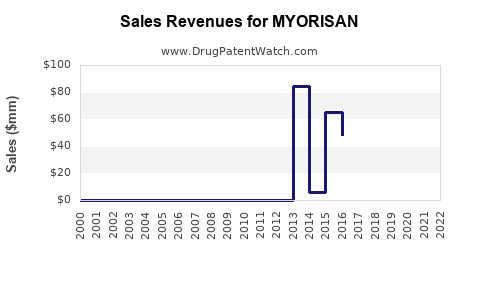
| Drug Sales Revenues: | Drug sales revenues for MYORISAN |
| DailyMed Link: | MYORISAN at DailyMed |

Recent Clinical Trials for MYORISAN
Identify potential brand extensions & 505(b)(2) entrants
| Sponsor | Phase |
|---|---|
| Children's Oncology Group | Phase 2 |
| National Cancer Institute (NCI) | Phase 2 |
| National Cancer Institute (NCI) | Phase 1 |
Pharmacology for MYORISAN
| Drug Class | Retinoid |
US Patents and Regulatory Information for MYORISAN
| Applicant | Tradename | Generic Name | Dosage | NDA | Approval Date | TE | Type | RLD | RS | Patent No. | Patent Expiration | Product | Substance | Delist Req. | Exclusivity Expiration |
|---|---|---|---|---|---|---|---|---|---|---|---|---|---|---|---|
| Upsher Smith Labs | MYORISAN | isotretinoin | CAPSULE;ORAL | 076485-001 | Jan 19, 2012 | AB1 | RX | No | No | ⤷ Start Trial | ⤷ Start Trial | ⤷ Start Trial | |||
| Upsher Smith Labs | MYORISAN | isotretinoin | CAPSULE;ORAL | 076485-003 | Jan 19, 2012 | AB1 | RX | No | No | ⤷ Start Trial | ⤷ Start Trial | ⤷ Start Trial | |||
| Upsher Smith Labs | MYORISAN | isotretinoin | CAPSULE;ORAL | 076485-002 | Jan 19, 2012 | AB1 | RX | No | No | ⤷ Start Trial | ⤷ Start Trial | ⤷ Start Trial | |||
| Upsher Smith Labs | MYORISAN | isotretinoin | CAPSULE;ORAL | 076485-004 | Aug 25, 2015 | AB1 | RX | No | No | ⤷ Start Trial | ⤷ Start Trial | ⤷ Start Trial | |||
| >Applicant | >Tradename | >Generic Name | >Dosage | >NDA | >Approval Date | >TE | >Type | >RLD | >RS | >Patent No. | >Patent Expiration | >Product | >Substance | >Delist Req. | >Exclusivity Expiration |
Myorisan Market Dynamics, Patent Position, and Financial Trajectory
Myorisan is an oral isotretinoin product used for severe recalcitrant nodular acne. Its commercial trajectory has shifted from branded prescription competition to generic-market economics. The product has no publicly reported standalone revenue, no meaningful current patent moat, and faces substitution from generic isotretinoin capsules, newer formulations such as Absorica, and alternative acne therapies. Sun Pharmaceutical Industries, which acquired Ranbaxy, does not separately disclose Myorisan sales in its public financial reports.[1]
What is Myorisan and who manufactures it?
Myorisan contains isotretinoin, a retinoid approved for severe nodular acne that has not responded adequately to conventional therapy. The product was marketed in 10 mg, 20 mg, 30 mg, and 40 mg soft gelatin capsules.[2]
| Product | Active ingredient | Dosage forms | Original U.S. manufacturer or sponsor | Current commercial category |
|---|---|---|---|---|
| Myorisan | Isotretinoin | 10, 20, 30, 40 mg capsules | Ranbaxy Pharmaceuticals Inc. | Generic or discontinued branded isotretinoin product |
| Accutane | Isotretinoin | Capsules | Hoffmann-La Roche | Original branded product; no longer the principal U.S. market product |
| Claravis | Isotretinoin | Capsules | Barr Pharmaceuticals, later Teva-related operations | Generic-era branded isotretinoin |
| Amnesteem | Isotretinoin | Capsules | Mylan | Generic-era branded isotretinoin |
| Absorica | Isotretinoin | Capsules | Cipher Pharmaceuticals, later Sun Pharmaceutical-related commercial operations | Formulation-differentiated branded product |
Myorisan entered a market in which the original Accutane franchise had already lost exclusivity. Its commercial position depended on manufacturing scale, pharmacy access, wholesaler distribution, physician familiarity, and compliance with the FDA-mandated iPLEDGE risk-management program.
Ranbaxy was acquired by Sun Pharmaceutical Industries in 2015. Sun’s filings report revenue by broad geographic and business categories rather than by individual mature generic products such as Myorisan.[1]
What is the FDA regulatory status of Myorisan?
Myorisan is regulated as an isotretinoin prescription product subject to stringent pregnancy-prevention and risk-management controls. Isotretinoin products are distributed under the iPLEDGE REMS, which governs prescriber, patient, pharmacy, and wholesaler participation.[3]
The principal regulatory requirements include:
- Prescription use for severe recalcitrant nodular acne.
- Pregnancy testing and contraception requirements for patients who can become pregnant.
- Restricted pharmacy dispensing.
- Patient enrollment and authorization procedures.
- Monitoring for psychiatric, fetal, hepatic, lipid, and other safety risks.
- Dispensing limitations tied to the iPLEDGE authorization process.
The iPLEDGE system creates operational friction for every isotretinoin manufacturer. This friction can reduce prescription completion, increase pharmacy workload, and raise patient-support costs. It also limits the extent to which price competition alone can expand demand.
FDA-approved isotretinoin products are therapeutically similar but are not entirely interchangeable from a commercial perspective. Formulation differences can affect food requirements, absorption, payer coverage, physician selection, and patient adherence.
What patents protect Myorisan and isotretinoin?
Myorisan has no publicly material patent barrier comparable to a recently launched specialty drug. Isotretinoin’s core composition-of-matter and original branded-product protections expired years before the modern generic market developed.
The relevant intellectual-property position is:
| IP category | Myorisan position | Commercial effect |
|---|---|---|
| Isotretinoin composition patent | Expired | No barrier to generic entry |
| Original Accutane patents | Expired | Enabled multiple competing products |
| Myorisan formulation patents | No publicly material active estate identified | Limited differentiation |
| Method-of-use patents | No material patent barrier identified for acne treatment | No meaningful market exclusivity |
| Manufacturing know-how | Potentially relevant at the supplier level | Can affect cost, quality, and supply continuity |
| iPLEDGE compliance systems | Regulatory requirement, not exclusivity | Raises operating costs for all manufacturers |
The FDA Orange Book historically provided the principal reference point for approved drug applications and listed patents. The commercial market for isotretinoin is now driven primarily by approved-product status, supply, pricing, and distribution rather than by enforceable product patents.[4]
Does Myorisan have Orange Book exclusivity?
Myorisan does not have a meaningful period of remaining regulatory exclusivity. Its market position is not protected by new chemical entity exclusivity, pediatric exclusivity, or a currently relevant patent term.
The product’s historical Orange Book significance came from its approved NDA and associated product listing, not from a durable patent estate. Generic isotretinoin products entered the U.S. market after the loss of Accutane exclusivity, leaving multiple suppliers able to compete.[4]
When did Myorisan lose exclusivity?
Myorisan did not lose exclusivity through a single recent patent cliff. Its commercial exposure was structural from launch because isotretinoin was already an established, off-patent active ingredient.
The relevant sequence is:
| Period | Market event | Impact on Myorisan |
|---|---|---|
| 1980s | Accutane established isotretinoin as a major acne treatment | Created the reference product and clinical market |
| 1990s to early 2000s | Core Accutane protections expired or became commercially ineffective | Opened the market to competing isotretinoin products |
| Early 2000s | Multiple generic and branded-generic products entered | Reduced pricing power |
| 2000s | Myorisan entered the isotretinoin market | Competed on supply, distribution, and brand recognition |
| 2010s | Ranbaxy acquired by Sun Pharmaceutical | Integrated Myorisan into a larger generic portfolio |
| Current market | Generic isotretinoin dominates demand | Limits standalone revenue potential |
There is no credible basis for treating Myorisan as a product with a future patent-expiration event capable of generating a new generic wave. Generic competition is already embedded in the market.
How large is the Myorisan market?
The total U.S. isotretinoin market is larger than the Myorisan brand market because prescriptions are distributed across several branded and unbranded products. Public companies generally do not report prescription volume, net sales, or gross margin for individual isotretinoin brands.
Myorisan’s addressable market is constrained by four factors:
- Severe acne represents a narrower population than the broader acne-treatment market.
- Isotretinoin is generally reserved for patients who fail or cannot tolerate other treatments.
- Treatment is finite rather than chronic for most patients.
- iPLEDGE requirements create administrative and clinical barriers.
Demand is relatively resilient because isotretinoin remains one of the most effective treatments for severe nodular acne. The product category benefits from continued dermatology demand, but its revenue pool is limited by treatment duration and generic pricing.
What drives isotretinoin prescription demand?
The main demand drivers are:
- Incidence of severe nodular acne.
- Dermatologist prescribing patterns.
- Failure of antibiotics, topical retinoids, hormonal therapy, or other systemic treatments.
- Patient willingness to complete iPLEDGE requirements.
- Insurance coverage and copayment levels.
- Availability of specific strengths and package sizes.
- Manufacturer supply reliability.
Demand is less sensitive to consumer advertising than branded chronic medicines because isotretinoin is prescribed through specialist and primary-care channels and requires extensive monitoring.
What is the financial trajectory for Myorisan?
Myorisan’s standalone revenue trajectory is not publicly quantifiable from Sun Pharmaceutical’s financial statements. Sun reports consolidated revenue and broad segment performance, but it does not identify Myorisan sales, operating profit, prescription volume, or market share as separate line items.[1]
The economically supportable trajectory is:
| Financial phase | Expected commercial profile |
|---|---|
| Initial launch | Revenue supported by branded-generic positioning and limited supplier competition |
| Expansion phase | Volume growth as physicians and pharmacies adopt the product |
| Mature generic phase | Lower prices, greater substitution, and margin compression |
| Portfolio-integration phase | Product value determined by manufacturing efficiency and channel retention |
| Late-life phase | Potentially low-margin or supply-dependent product with limited strategic visibility |
Myorisan’s value to a large generic company would be measured through portfolio contribution rather than standalone growth. Relevant metrics would include net price per capsule, annual prescription volume, manufacturing cost, product availability, returns, regulatory compliance costs, and pharmacy substitution rates.
A mature isotretinoin product can remain commercially viable without patent protection if it has low manufacturing cost and dependable supply. It can also become unattractive if production costs, quality requirements, or iPLEDGE-related support expenses rise faster than net pricing.
Which companies compete with Myorisan?
Myorisan competes with both generic isotretinoin suppliers and differentiated branded formulations.
Generic competitors
Generic competition has historically included products associated with Barr, Mylan, Ranbaxy, Teva, and other FDA-approved manufacturers. The exact active supplier set can change as companies discontinue products, transfer approvals, or alter commercial distribution.
Generic competitors compete primarily through:
- Wholesale acquisition price.
- Pharmacy and wholesaler contracts.
- Inventory availability.
- Product quality and manufacturing reliability.
- Ability to maintain all required regulatory controls.
- Strength availability.
Formulation-differentiated competitors
Absorica is the most commercially relevant differentiated competitor because its formulation was designed to improve absorption without the same dependence on a high-fat meal as conventional isotretinoin capsules. That positioning can support a higher price than standard generic isotretinoin, subject to payer restrictions and clinical selection.[5]
The competitive distinction is therefore not based on the isotretinoin molecule itself. It is based on formulation, absorption characteristics, food requirements, reimbursement, and physician preference.
| Competitive factor | Myorisan or conventional generic | Absorica-type differentiated product |
|---|---|---|
| Active ingredient | Isotretinoin | Isotretinoin |
| Core patent protection | No meaningful current barrier | Formulation-related protection may be more relevant |
| Price position | Lower | Higher |
| Food requirements | Conventional administration considerations | Designed for less dependence on high-fat food intake |
| Payer scrutiny | High substitution pressure | Prior authorization and step-edit risk |
| Main commercial advantage | Cost and availability | Formulation differentiation |
Are there Paragraph IV challenges involving Myorisan?
Paragraph IV litigation is not a central current risk for Myorisan. A Paragraph IV certification challenges the validity, enforceability, or infringement of a listed patent when a generic applicant seeks approval before patent expiration.
Because isotretinoin’s principal patents expired long ago and Myorisan has no publicly material active patent estate, the commercial exposure is the reverse: Myorisan is exposed to generic substitution rather than protected from it.
Historical litigation in the isotretinoin field involved the original Accutane franchise, generic entry, product liability, and regulatory matters. Those disputes do not create a current exclusivity position for Myorisan.
What litigation and regulatory risks affect Myorisan?
The most relevant risks are operational and product-liability risks rather than patent litigation.
Product liability
Isotretinoin carries serious fetal-risk warnings and other safety concerns. Litigation exposure can arise from alleged inadequate warnings, pregnancy-prevention failures, psychiatric adverse events, inflammatory bowel disease allegations, or other claimed injuries. The iPLEDGE program reduces but does not eliminate these risks.
Manufacturing and quality
Isotretinoin manufacturers must maintain control over:
- Potency and content uniformity.
- Capsule integrity.
- Impurities and degradation products.
- Stability and shelf life.
- Packaging and labeling.
- Good manufacturing practice compliance.
A regulatory warning, recall, import alert, or manufacturing interruption can rapidly shift market share to competing suppliers.
Distribution controls
Failure to comply with iPLEDGE-related distribution requirements can produce product delays, dispensing failures, patient complaints, and regulatory scrutiny. These requirements increase the cost of serving the market and make supply-chain execution commercially important.
What manufacturing and intellectual-property barriers remain?
The active ingredient is off patent, so manufacturing know-how is more relevant than molecule ownership. Barriers include validated soft-gelatin capsule production, handling of a teratogenic active ingredient, specialized packaging, quality systems, regulatory documentation, and reliable supply of pharmaceutical-grade isotretinoin.
Manufacturers also face scale disadvantages. A supplier with low volume may have higher per-unit costs and less leverage with wholesalers. A large generic company can use shared manufacturing, regulatory, and distribution infrastructure to preserve a product that would not justify standalone commercial investment.
No biosimilar risk exists because Myorisan is a small-molecule drug, not a biologic. The relevant substitution risk is generic isotretinoin competition.
What generic launch scenarios exist for Myorisan?
Three scenarios define the product’s commercial outlook.
Continued low-margin availability
Myorisan remains available as part of a broad generic portfolio. Revenue is stable or slowly declines, while profitability depends on manufacturing cost and supply reliability.
Brand withdrawal and generic replacement
The branded Myorisan presentation is discontinued or commercially deemphasized, with patients and pharmacies shifting to other isotretinoin products. This is consistent with mature generic-market economics.
Supply-driven share gains
A competitor experiences shortage, quality problems, or distribution disruption. Myorisan or another available product temporarily gains volume. These gains are usually tactical and may reverse when supply normalizes.
A major price-led growth scenario is unlikely. Off-patent isotretinoin has limited ability to support sustained premium pricing unless the product offers a meaningful formulation, reimbursement, or supply advantage.
How strong is the Myorisan patent estate?
The patent estate is weak from an investment or licensing perspective. Myorisan lacks the characteristics that typically support a strong pharmaceutical patent valuation:
- No active composition-of-matter exclusivity.
- No clear long-duration formulation moat.
- No material method-of-use exclusivity.
- No biosimilar barrier.
- Multiple historical competitors.
- High generic substitution pressure.
- Limited public disclosure of product-level revenue.
Its residual value is commercial and operational. A buyer would assess manufacturing economics, regulatory status, supply contracts, distribution access, and product liability exposure rather than patent term.
Key Takeaways
- Myorisan is an isotretinoin product for severe nodular acne.
- Its commercial market is mature, genericized, and highly price competitive.
- Sun Pharmaceutical Industries does not publicly disclose Myorisan-specific revenue or profit.
- The product has no material current patent or regulatory exclusivity position.
- Generic substitution, not Paragraph IV litigation, is the principal competitive threat.
- Absorica-type formulations compete through absorption and administration advantages rather than molecule ownership.
- iPLEDGE compliance, product liability, manufacturing quality, and supply continuity are the main operating risks.
- Myorisan’s financial trajectory is likely flat to declining unless temporary supply disruptions shift volume to the product.
- The product’s value is better analyzed as part of a generic portfolio than as an independent branded asset.
FAQs
Is Myorisan still available in the United States?
Myorisan has been marketed as an isotretinoin capsule product, but commercial availability can change as manufacturers discontinue or transfer mature generic products. Pharmacy-level availability is distinct from FDA approval status.
Is Myorisan stronger than Claravis or Amnesteem?
No. Myorisan, Claravis, and Amnesteem contain the same active ingredient, isotretinoin, in comparable capsule strengths. Differences may involve excipients, manufacturer, supply, payer coverage, and patient tolerance.
Does Myorisan require the iPLEDGE program?
Yes. Isotretinoin products dispensed in the United States are subject to the FDA’s isotretinoin risk-management requirements, including iPLEDGE-related controls.[3]
Can a company obtain a new patent on a Myorisan formulation?
A new patent would require a patentable formulation, manufacturing process, delivery system, or use that satisfies novelty, non-obviousness, and other legal requirements. The underlying isotretinoin molecule is not available for new composition-of-matter exclusivity.
Is Myorisan a good pharmaceutical licensing target?
Myorisan is generally a weak patent-licensing target but may have value in a generic portfolio if the product has reliable supply, favorable manufacturing economics, regulatory continuity, or access to distribution channels.
References
- Sun Pharmaceutical Industries Limited. (2024). Annual report 2023-24. https://www.sunpharma.com
- U.S. Food and Drug Administration. (n.d.). Myorisan isotretinoin capsules prescribing information. https://www.accessdata.fda.gov
- U.S. Food and Drug Administration. (2023). iPLEDGE risk evaluation and mitigation strategy. https://www.fda.gov
- U.S. Food and Drug Administration. (n.d.). Approved drug products with therapeutic equivalence evaluations: Orange Book. https://www.accessdata.fda.gov
- U.S. Food and Drug Administration. (n.d.). Absorica isotretinoin capsules prescribing information. https://www.accessdata.fda.gov
More… ↓
