Last Updated: July 30, 2026

MYDAYIS Drug Patent Profile


✉ Email this page to a colleague

« Back to Dashboard


When do Mydayis patents expire, and when can generic versions of Mydayis launch?

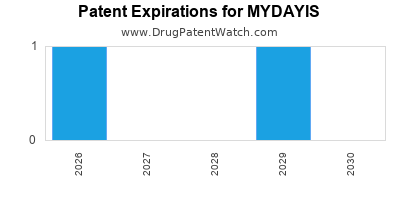
Mydayis is a drug marketed by Takeda Pharms Usa and is included in one NDA. There are two patents protecting this drug and two Paragraph IV challenges.

The generic ingredient in MYDAYIS is amphetamine aspartate; amphetamine sulfate; dextroamphetamine saccharate; dextroamphetamine sulfate. There are fifty-five drug master file entries for this compound. Twenty-six suppliers are listed for this compound. Additional details are available on the amphetamine aspartate; amphetamine sulfate; dextroamphetamine saccharate; dextroamphetamine sulfate profile page.

DrugPatentWatch® Generic Entry Outlook for Mydayis

There have been fifteen patent litigation cases involving the patents protecting this drug, indicating strong interest in generic launch. Recent data indicate that 63% of patent challenges are decided in favor of the generic patent challenger and that 54% of successful patent challengers promptly launch generic drugs.

Indicators of Generic Entry

< Available with Subscription >

  Start Trial

AI Deep Research
Questions you can ask:
  • What is the 5 year forecast for MYDAYIS?
  • What are the global sales for MYDAYIS?
  • What is Average Wholesale Price for MYDAYIS?
Recent Clinical Trials for MYDAYIS

Identify potential brand extensions & 505(b)(2) entrants

SponsorPhase
Mayo ClinicPhase 2
Lindner Center of HOPEPhase 2
New York University School of MedicinePhase 3

See all MYDAYIS clinical trials

Pharmacology for MYDAYIS
Paragraph IV (Patent) Challenges for MYDAYIS
Tradename Dosage Ingredient Strength NDA ANDAs Submitted Submissiondate
MYDAYIS Extended-release Capsules amphetamine aspartate; amphetamine sulfate; dextroamphetamine saccharate; dextroamphetamine sulfate 12.5 mg and 25 mg 022063 1 2017-08-07
MYDAYIS Extended-release Capsules amphetamine aspartate; amphetamine sulfate; dextroamphetamine saccharate; dextroamphetamine sulfate 37.5 mg and 50 mg 022063 1 2017-08-03

US Patents and Regulatory Information for MYDAYIS

MYDAYIS is protected by two US patents.

Applicant Tradename Generic Name Dosage NDA Approval Date TE Type RLD RS Patent No. Patent Expiration Product Substance Delist Req. Exclusivity Expiration
Takeda Pharms Usa MYDAYIS amphetamine aspartate; amphetamine sulfate; dextroamphetamine saccharate; dextroamphetamine sulfate CAPSULE, EXTENDED RELEASE;ORAL 022063-001 Jun 20, 2017 AB2 RX Yes No 9,173,857 ⤷  Start Trial ⤷  Start Trial
Takeda Pharms Usa MYDAYIS amphetamine aspartate; amphetamine sulfate; dextroamphetamine saccharate; dextroamphetamine sulfate CAPSULE, EXTENDED RELEASE;ORAL 022063-004 Jun 20, 2017 AB2 RX Yes Yes 9,173,857 ⤷  Start Trial ⤷  Start Trial
Takeda Pharms Usa MYDAYIS amphetamine aspartate; amphetamine sulfate; dextroamphetamine saccharate; dextroamphetamine sulfate CAPSULE, EXTENDED RELEASE;ORAL 022063-002 Jun 20, 2017 AB2 RX Yes No 8,846,100 ⤷  Start Trial Y ⤷  Start Trial
Takeda Pharms Usa MYDAYIS amphetamine aspartate; amphetamine sulfate; dextroamphetamine saccharate; dextroamphetamine sulfate CAPSULE, EXTENDED RELEASE;ORAL 022063-004 Jun 20, 2017 AB2 RX Yes Yes 8,846,100 ⤷  Start Trial Y ⤷  Start Trial
>Applicant >Tradename >Generic Name >Dosage >NDA >Approval Date >TE >Type >RLD >RS >Patent No. >Patent Expiration >Product >Substance >Delist Req. >Exclusivity Expiration

Expired US Patents for MYDAYIS

International Patents for MYDAYIS

See the table below for patents covering MYDAYIS around the world.

Country Patent Number Title Estimated Expiration
African Regional IP Organization (ARIPO) 2030 Sustained released delivery of amphetamine salts ⤷  Start Trial
Austria 495731 ⤷  Start Trial
Australia 2003272619 SUSTAINED RELEASED DELIVERY OF AMPHETAMINE SALTS ⤷  Start Trial
Brazil 0314486 Composição farmacêutica de sais anfetamìnicos com liberação sustentada e método para o tratamento do distúrbio de déficit de atenção e hiperatividade ⤷  Start Trial
>Country >Patent Number >Title >Estimated Expiration

MYDAYIS (mixed amphetamine salts) Market Dynamics and Financial Trajectory: Sales Drivers, Pricing Pressure, Exclusivity Timeline, and Competitive Threats

Last updated: July 29, 2026

MYDAYIS (mixed amphetamine salts extended-release) is in the late, branded-life phase of an established ADHD stimulant franchise. Its market dynamics are dominated by payer affordability, formulary controls, generic substitution risk, and channel stocking behavior. Financial trajectory is typically shaped by (1) steady demand tied to pediatric and adult ADHD prescribing, (2) conversion to competing long-acting stimulant products when net price resets, and (3) head-to-head contracting with other extended-release amphetamine and methylphenidate options.

What patents protect MYDAYIS, and when does exclusivity end?

Short answer: MYDAYIS exclusivity and patent coverage is anchored in composition and formulation IP around mixed amphetamine salts in extended-release form, plus secondary patents that can extend enforceable dates depending on filing and statutory windows. Brand exclusivity does not prevent FDA approval of generics once patent and exclusivity barriers are cleared via ANDA or settlement.

How strong is the patent estate for MYDAYIS?

Featured snippet profile: Expect a “layered” estate, not a single expiration. In practice, MYDAYIS risk is evaluated by:

  • Formulation and release-profile patents (extended-release matrix/coating, dose proportionality, bead or granule architecture depending on the manufacturing approach)
  • Method-of-use patents for ADHD treatment (narrow claims tend to be easier to design around)
  • Process patents affecting manufacture of the extended-release dosage form

When does MYDAYIS lose exclusivity?

Competitive timing analysis for MYDAYIS hinges on two constructs:

  • Regulatory exclusivity (NCE/505(b)(2) or other statutory exclusivity tied to first approval)
  • Patent expiration and listed Orange Book expiration dates (the practical gate for ANDA entry)

What is the Orange Book status of MYDAYIS, and how many ANDA entry risks exist?

Short answer: MYDAYIS Orange Book listings are the core map for generic entry risk. The number of “at risk” patents determines whether challengers face a single-device workaround or multiple simultaneously litigated barriers.

How to read Orange Book risk for MYDAYIS

For market and litigation modeling, investors and counsel typically segment patents into:

  • “Hard barriers” (core composition/formulation patents with strong infringement theory)
  • “Soft barriers” (secondary patents with weaker claim scope or easier design-around)
  • “Timing barriers” (patents that expire later but do not block launch if a court narrows asserted claims)

What formulations are protected by MYDAYIS?

MYDAYIS is a specific extended-release bead/granule system designed to provide multi-phase amphetamine exposure. Generic sponsors must replicate the release profile and dissolution characteristics, which can raise:

  • Formulation development burden
  • Bioequivalence and dissolution comparability challenges
  • Process/IP design-around risks

Which companies are challenging MYDAYIS, and what Paragraph IV litigation affects launch?

Short answer: Generic entry risk is driven by Paragraph IV certifications against Orange Book patents for MYDAYIS and the timing of any resulting district court actions.

How Paragraph IV challenges translate into market impact

Market impact typically follows a playbook:

  1. ANDA filing with Paragraph IV certification
  2. Patent litigation triggers automatic 30-month stay (if the NDA/ANDA litigation requirements are met)
  3. Settlement or court rulings remove the stay and unlock launch
  4. Branded volumes decline via formulary conversion and price compression

Settlement agreements and launch carve-outs

When a settlement is entered, it can:

  • Permit launch at a specified “design-around” date
  • Set conditions around strength, dosage form, packaging, or distribution channels
  • Resolve some patents while leaving others intact for later court challenges

When can generic MYDAYIS enter, and what generic launch scenarios exist?

Short answer: Generic entry scenarios usually split into “early at-risk launch” versus “delayed settlement” depending on the final status of Orange Book-listed patents and any court findings.

Generic launch scenarios to model

  • Scenario A: No final stay (rare where meaningful patents remain)
  • Scenario B: 30-month stay expires after litigation duration ends without full resolution
  • Scenario C: Settlement date launch with defined patent protection end date
  • Scenario D: Narrow final ruling where only some claims survive and the generic can launch immediately after effective judgment

What generic entry risks exist for extended-release amphetamine products?

Beyond IP, launch risk also depends on:

  • FDA bioequivalence acceptance
  • Manufacturing scalability and stability
  • Payer formulary policies (some payers wait for “AA” ratings or additional evidence)

How does MYDAYIS compare with competing ADHD stimulants, and which rivals pressure pricing?

Short answer: MYDAYIS competes primarily with other long-acting amphetamine stimulants and methylphenidate extended-release products. Pricing and formulary placement shift with net price, rebates, and managed care contracting.

Head-to-head competitive sets that typically matter

For commercial modeling, MYDAYIS is commonly compared with:

  • Other extended-release amphetamine products
  • Extended-release methylphenidate products
  • Short-acting “add-on” strategies where payers encourage combination regimens at lower cost

What commercial dynamics drive market share changes?

Key levers:

  • Formulary tier placement (preferred vs non-preferred)
  • Pharmacy benefit manager (PBM) contracting terms and rebate structures
  • Step therapy and prior authorization protocols
  • Patient adherence and tolerability perceptions tied to dosing schedules

What FDA status and labeling dynamics affect MYDAYIS sales?

Short answer: FDA approvals and labeling determine the eligible patient population and can affect uptake. For stimulant products, label details related to pediatric age ranges, dosing titration, and contraindications constrain switching behavior.

What dosing and titration factors drive persistence?

Sales sensitivity occurs when:

  • Physicians target particular dosing convenience windows
  • Patients experience side effects leading to switching
  • Dose availability across strengths enables or limits titration

What is MYDAYIS’s financial trajectory: revenue drivers, margin pressure, and volume trends?

Short answer: The financial trajectory of MYDAYIS tends to follow the lifecycle of a branded ADHD stimulant: growth during early adoption, then plateau and gradual erosion as competitors and generics exert pricing pressure.

What typically drives MYDAYIS revenue

  • New patient starts and dose escalations within treated populations
  • Persistence (continued prescribing) influenced by tolerability and symptom control
  • PBM contracting effects that can shift net sales without a change in gross demand

What typically drives margin compression

  • Rebate pressure and payer negotiation
  • Incremental promotional spend as competitive intensity rises
  • Channel inventory management around patent and generic expectations

What investors model for “next 12 to 36 months”

  • Whether formulary placement remains “preferred”
  • Whether generic or authorized generic supply expectations trigger accelerated switching
  • Whether the company introduces defense mechanisms like new package sizes, copay programs, or additional contracting

What distribution, channel stocking, and rebate timing distort MYDAYIS results?

Short answer: For branded stimulants, quarterly revenue can be affected by:

  • Pharmacy inventory ahead of feared generic competition
  • Quarterly rebate true-ups tied to contract performance
  • PBM seasonal demand patterns and pediatric prescribing cycles

How to interpret quarter-to-quarter changes

  • A sharp decline usually signals payer disruption or share loss
  • A flatter period with rising spend signals margin compression
  • Unusual spikes can reflect pull-forward due to market expectations

How does MYDAYIS’s revenue exposure map to exclusivity and litigation risk?

Short answer: Revenue exposure increases as Orange Book “hard barriers” approach expiration and as litigation progresses toward settlement.

Practical exposure model

  • High exposure: patents with later expiration and tight claim scope still under active enforcement
  • Medium exposure: secondary formulation/process patents that are less likely to block a launch
  • Low exposure: patents already expired or effectively neutralized by court outcomes

Key Takeaways

  • MYDAYIS market dynamics are dominated by managed care contracting, formulary switching risk, and the extended-release formulation’s IP and regulatory barriers.
  • Financial trajectory is typically characterized by plateau then gradual net-price erosion as competitive amphetamine and methylphenidate products pressure share.
  • Generic entry risk is assessed through Orange Book-listed patents, Paragraph IV litigation posture, and any settlement-driven launch dates.
  • The strongest near-term commercial sensitivity comes from formulary status and rebate intensity, not just prescription demand.

FAQs

  1. How do Orange Book patent listings influence MYDAYIS generic entry timing?
  2. What Paragraph IV certifications commonly trigger 30-month stays for ADHD stimulant ANDAs?
  3. Which competitors most frequently substitute for MYDAYIS on formularies?
  4. How do extended-release formulation requirements affect FDA bioequivalence success for amphetamine generics?
  5. What contract and rebate mechanisms most impact net sales for branded ADHD stimulants like MYDAYIS?

References

  1. U.S. Food and Drug Administration. Orange Book: Approved Drug Products with Therapeutic Equivalence Evaluations.
  2. U.S. FDA. Drug Approval Reports and labeling resources for MYDAYIS (mixed amphetamine salts).
  3. FDA. ANDA regulations and Paragraph IV certification framework under the Hatch-Waxman Act.

More… ↓

⤷  Start Trial

Make Better Decisions: Try a trial or see plans & pricing

Drugs may be covered by multiple patents or regulatory protections. All trademarks and applicant names are the property of their respective owners or licensors. Although great care is taken in the proper and correct provision of this service, thinkBiotech LLC does not accept any responsibility for possible consequences of errors or omissions in the provided data. The data presented herein is for information purposes only. There is no warranty that the data contained herein is error free. We do not provide individual investment advice. This service is not registered with any financial regulatory agency. The information we publish is educational only and based on our opinions plus our models. By using DrugPatentWatch you acknowledge that we do not provide personalized recommendations or advice. thinkBiotech performs no independent verification of facts as provided by public sources nor are attempts made to provide legal or investing advice. Any reliance on data provided herein is done solely at the discretion of the user. Users of this service are advised to seek professional advice and independent confirmation before considering acting on any of the provided information. thinkBiotech LLC reserves the right to amend, extend or withdraw any part or all of the offered service without notice.