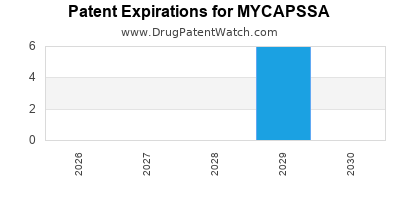
Last updated: July 29, 2026
Executive summary: MYCAPSSA is an oral, extended-release octreotide acetate capsule (Active ingredient: octreotide acetate) built to compete in the long-acting somatostatin analog (SSA) space with injectable products. Market dynamics are shaped by (1) payer coverage of oral SSA vs injectable octreotide/lanreotide, (2) maintenance dosing convenience and adherence outcomes, and (3) patent and regulatory exclusivity timing that gates generic entry. Financial trajectory depends on incremental share capture after launch, persistence, and whether insurers treat oral octreotide as a preferred alternative or as a restricted step-therapy product.
What is MYCAPSSA’s market positioning in the somatostatin analog market?
Quick answer: MYCAPSSA competes within the SSA treatment paradigm for neuroendocrine tumors (NETs) and other approved indications for octreotide. The commercial model is typically premium-priced relative to injectables, with adoption driven by convenience (oral dosing), patient preference, and formulary access.
Where does MYCAPSSA fit clinically and commercially?
- Therapeutic category: somatostatin analog (octreotide acetate)
- Formulation / route: oral, extended-release capsule
- Competitive set (commercial substitution):
- Long-acting injectable SSAs (octreotide LAR, lanreotide depot)
- Short-acting octreotide in specific transition settings (less direct for chronic maintenance)
- Buying behavior drivers:
- Oral dosing and reduced clinic administration burden
- Patient mobility and adherence considerations
- Payer restrictions and step therapy tied to injectable trial history
How do payers typically evaluate oral SSA vs injectables?
Oral SSAs face distinct payer scrutiny:
- Budget impact: oral products can be priced above injectable comparators even when administration costs drop
- Clinical evidence interpretation: payer committees weight response durability and safety relative to established long-acting injectables
- Formulary tiering: oral products often land on specialty tier with prior authorization (PA)
- Switching barriers: evidence requirements for “appropriate use,” including prior exposure to SSAs
How strong is MYCAPSSA’s patent and exclusivity protection versus generic competition?
Quick answer: MYCAPSSA’s ability to sustain pricing and limit generic entry depends on the scope and remaining term of patents listed for the product and any periods of pediatric exclusivity, if applicable, as well as non-patent regulatory barriers that slow substitution.
What patents protect MYCAPSSA?
The protective estate for MYCAPSSA typically spans:
- Composition of matter for octreotide acetate (where applicable)
- Extended-release formulation patents (polymer matrix and release-rate control)
- Method-of-use patents tied to SSA therapy regimens
- Manufacturing and capsule/process patents for controlled-release performance
When does MYCAPSSA lose exclusivity?
Key commercial gating point: the earliest date on which:
- all listed Orange Book patents (or relevant regulatory exclusivity) expire, and
- there is no remaining statutory exclusivity preventing ANDA/505(b)(2) substitution.
Market impact: until that date, generics rely on challenging patents via Paragraph IV where legally feasible.
What is the FDA regulatory status of MYCAPSSA and how does it affect timing for generic entry?
Quick answer: MYCAPSSA’s FDA status determines the legal pathway for competitors and the speed of substitution.
Regulatory pathways that matter for MYCAPSSA competition
- 505(b)(2): can be used for modified formulations where reliance on published data is accepted; often enables faster entry for “next-gen” delivery forms
- ANDA: requires demonstrating bioequivalence and legal clearance from relevant exclusivity/patents
- Labeling carve-outs: competitors can attempt narrower labeling that still captures market share via physician discretion
Does MYCAPSSA have Orange Book listed patents?
If listed, the Orange Book listing controls the patent-by-patent framework used for generic challenges and settlement dynamics. Those listings also dictate whether a competitor can launch upon expiry or must clear active injunction risk.
What patent litigation and Paragraph IV challenges shape MYCAPSSA’s competitive risk?
Quick answer: In complex specialty markets, even when exclusivity nears end, litigation and settlement can delay launch or narrow competitive impact.
How Paragraph IV strategies affect launch timing
Competitors typically aim to:
- invalidate or design around formulation and process patents,
- secure a settlement enabling early launch at risk,
- or force payers to switch based on “at launch” pricing dynamics.
How settlements change revenue trajectories
A settlement can:
- define an “at-risk” launch date,
- impose royalties,
- limit labeling scope,
- or include market-share protection clauses for the reference product.
Commercial consequence: the company’s revenue curve often shows a step-change around settlement-triggered launch dates, even if regulatory exclusivity ends later.
How many competitors does MYCAPSSA face and how are they positioned?
Quick answer: MYCAPSSA faces a smaller universe of direct oral octreotide options than injectable SSAs. Competitive pressure typically comes from injectable LA SSA incumbents that already have payer infrastructure and clinician familiarity.
Competitive landscape map (commercial substitutes)
- Primary substitute class: long-acting injectable octreotide/lanreotide
- Adjacency risks: oral SSA development programs and reformulations of existing injectable SSAs
- Channel competition: specialty pharmacy fulfillment vs clinic administration embedded workflows
How does prescriber behavior drive adoption?
- Clinicians adopt oral octreotide when:
- patient convenience and adherence are clear,
- injection burden is reduced,
- and insurance coverage is stable
- Adoption slows when:
- PA approvals are inconsistent,
- patients require frequent monitoring for tolerability,
- or payers restrict use to specific lines of therapy
What formulation patents and delivery-system barriers could delay MYCAPSSA copycats?
Quick answer: Extended-release delivery-system patents can be more consequential than composition-of-matter for oral octreotide substitution.
Typical barriers in extended-release octreotide systems
- Release profile targets that preserve pharmacokinetic “plateau” behavior
- Polymer matrix composition and thickness constraints
- Capsule geometry and fill formulation contributing to dose release kinetics
- Manufacturing controls for uniformity and stability across lots
Impact on bioequivalence and design-around
Copycats must replicate:
- exposure metrics within acceptance limits,
- safety/tolerability across a wide patient population, and
- consistency across manufacturing scales.
These constraints create:
- higher development costs,
- slower timelines for ANDA/505(b)(2) candidates, and
- increased risk of litigation around formulation scope.
How does MYCAPSSA revenue typically evolve in the first years post-launch?
Quick answer: Early-stage revenue depends on formulary access, physician adoption, and persistence. In SSA categories, revenue trajectory often depends on long-term treatment cycles rather than episodic demand.
Commercial curve drivers
- Adoption curve: number of initiating physicians and oncology/NET centers adopting oral SSA
- Continuation/persistence: durability of response and tolerability under extended-release dosing
- Exclusivity-driven pricing power: constrained only by competitive behavior and upcoming patent cliffs
- Channel expansion: shift from hospital-based dispensing to specialty pharmacy networks
What to watch in financial trajectory
- Net product sales growth vs injectable comparators
- Share of prescriptions within SSA class
- Discounts and rebates trajectory driven by payer negotiations
- Inventory and supply stability, which affects revenue recognition consistency in specialty products
How do payer coverage and contracting decisions impact MYCAPSSA financial performance?
Quick answer: In high-cost specialty drugs, contracting structure can dominate unit economics.
Payer levers that influence net revenue
- Prior authorization requirements
- Step therapy forcing a trial of injectable SSAs before oral coverage
- Center-of-excellence policies and narrow criteria
- Outcomes-based or adherence-based contracting (where used)
- Formulary tier placement and exclusion risks
Patient access effects on unit volume
- Coverage constraints reduce initiation volume.
- Stability of PA approvals supports persistence and reduces turnover to injectables.
What generic entry risks exist for MYCAPSSA?
Quick answer: Generic entry risk is a function of how hard it is to clear formulation patents and whether Paragraph IV challengers succeed in early settlements.
Key generic entry scenarios
- Launch at expiry without litigation: limited disruption if competitor launch is delayed by patent listings.
- Early entry after successful Paragraph IV: revenue impact can be immediate if launch pricing is aggressive and payers switch rapidly.
- Settlement delaying launch: prevents or slows substitution; reference product revenue holds longer.
- Design-around reformulation: competitor enters with a similar but not identical product, sometimes with label limitations.
How does MYCAPSSA compare with octreotide injectable LA and lanreotide depot?
Quick answer: MYCAPSSA’s advantage is convenience and route preference; injectables have established payer comfort, clinic administration workflows, and long history of outcomes data.
Where MYCAPSSA can outperform
- Patients who prefer oral therapy or cannot easily attend for injections
- Settings where reducing injection burden increases adherence and reduces missed doses
- Plans that have negotiated competitive oral SSA access
Where injectables retain share
- When oral products face restricted PA criteria
- When outcomes and safety are considered “standard” for injectables due to entrenched use
- Where injection-admin cost is covered and oral copays deter adherence
Key financial trajectory checklist for MYCAPSSA (investment and licensing use)
Quick answer: Build a model around (1) formulary coverage growth, (2) persistence, (3) pricing discipline under rebate evolution, and (4) the timing of patent/exclusivity gates.
Metrics that determine revenue path
- Script starts and net sales per treated patient
- Rebate rate changes due to payer contracting
- Persistence curves (e.g., time to discontinuation)
- Specialty pharmacy channel share
- Evidence of share shift from injectables into oral therapy
Risk factors that drive downside
- Narrowing of coverage criteria through PA tightening
- Patent litigation adverse outcome or earlier-than-expected clearance for competitors
- Competitors with superior access negotiations (better formulary position)
- Supply constraints that reduce fulfillable demand
Key Takeaways
- MYCAPSSA competes in a premium specialty segment where payer contracting and access rules are primary determinants of unit volume and net revenue.
- Patent and formulation-delivery barriers are central to the speed and scale of generic substitution; extended-release formulation patents can matter as much as composition-of-matter.
- Revenue trajectory is likely to follow an adoption curve driven by formulary inclusion and persistence, then face stepwise pressure around exclusivity/patent cliffs and any Paragraph IV litigation outcomes.
- The most material downside risk is an earlier-than-expected clearance path for substitution, plus payer restrictions that cap initiation and reduce persistence.
FAQs
- How do prior authorization criteria for oral octreotide affect MYCAPSSA uptake?
- What is the difference between MYCAPSSA and injectable octreotide LAR in payer substitution practices?
- Which formulation attributes of oral extended-release octreotide most influence bioequivalence disputes?
- What settlement structures most commonly protect reference products when Paragraph IV challenges settle?
- How should investors model MYCAPSSA revenue around patent expiration and expected generic launch dates?
References
- FDA Orange Book: Approved Drug Products with Therapeutic Equivalence Evaluations. U.S. Food and Drug Administration.
- FDA Drug Approval Packages and labeling for MYCAPSSA (octreotide acetate). U.S. Food and Drug Administration.