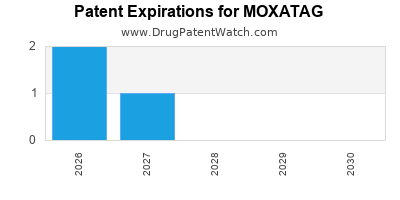
Last updated: September 7, 2026
Moxatag is an extended-release amoxicillin product approved by the U.S. Food and Drug Administration in 2008 for once-daily treatment of tonsillitis and pharyngitis caused by Streptococcus pyogenes. Its commercial thesis was based on improving adherence versus immediate-release amoxicillin, not on a new antibacterial mechanism.
The product achieved limited commercial scale. Its market was constrained by low-cost generic amoxicillin, the narrow labeled indication, physician familiarity with inexpensive immediate-release alternatives, and the absence of a durable reimbursement premium. Moxatag is now best viewed as a legacy branded antibiotic with limited current revenue relevance and no material biosimilar issue.
What is Moxatag and how does it differ from generic amoxicillin?
Moxatag contains amoxicillin, a penicillin-class antibacterial. Each tablet contains 775 mg of extended-release amoxicillin and is administered once daily for 10 days in patients aged 12 years and older for group A streptococcal tonsillitis and pharyngitis.[1]
| Attribute |
Moxatag |
Immediate-release generic amoxicillin |
| Active ingredient |
Amoxicillin |
Amoxicillin |
| Dosage form |
Extended-release tablet |
Capsule, tablet, or suspension |
| Strength |
775 mg |
Multiple strengths |
| Typical administration for streptococcal pharyngitis |
Once daily for 10 days |
Often two or three times daily |
| FDA approval |
2008 |
Long-established generic product |
| Differentiation |
Reduced dosing frequency |
Lower price and broad prescribing familiarity |
| Main commercial barrier |
Premium pricing against inexpensive generics |
None comparable |
The clinical value proposition was adherence. The economic challenge was that physicians could prescribe generic amoxicillin at a fraction of the cost, while the infection was generally short-course, uncomplicated, and treated in a highly competitive primary-care market.
When did Moxatag receive FDA approval?
FDA approved Moxatag under NDA 50-813 on December 11, 2008. The original sponsor was MiddleBrook Pharmaceuticals, Inc.[2]
The approved labeling limited the product to tonsillitis and pharyngitis caused by S. pyogenes. It did not create a broad commercial platform for all amoxicillin-treated infections. Moxatag was not approved as a general replacement for immediate-release amoxicillin in otitis media, sinusitis, pneumonia, urinary tract infections, or other common indications.
What was Moxatag’s FDA regulatory status?
The product was approved through the traditional NDA pathway as a reformulated version of an established active ingredient. Its regulatory differentiation came from the extended-release delivery system rather than a new chemical entity.
The FDA label identified common beta-lactam risks, including hypersensitivity reactions, Clostridioides difficile-associated diarrhea, and gastrointestinal adverse events. The product also carried the usual penicillin contraindication related to serious hypersensitivity to beta-lactam antibiotics.[1]
The commercial implication was limited regulatory exclusivity. Reformulation approval did not provide the long exclusivity period associated with a new molecular entity.
What patents protect Moxatag?
Moxatag’s intellectual-property position was based primarily on formulation and controlled-release technology rather than composition-of-matter protection for amoxicillin.
Public patent records associated with the Moxatag development program include patents directed to controlled-release amoxicillin formulations and dosage forms. The principal patent family associated with the product included U.S. Patent No. 6,544,555, assigned to Advancis Pharmaceutical Corporation, the predecessor organization linked to the Moxatag program.[3]
| IP category |
Moxatag position |
Commercial effect |
| Active ingredient |
Amoxicillin was already off-patent |
No composition-of-matter moat |
| Extended-release formulation |
Core protection for controlled release |
Potential barrier to identical formulation |
| Method of use |
Treatment of streptococcal tonsillitis and pharyngitis |
Narrow use protection |
| Manufacturing know-how |
Tablet design, release profile, and production controls |
Possible practical barrier |
| Biologic protection |
None |
No biosimilar framework applies |
Patent protection for a reformulated antibiotic is structurally weaker than protection for a new chemical entity. Competitors can avoid a formulation patent by using immediate-release amoxicillin, another extended-release design, or a different dosage regimen, subject to FDA approval and patent constraints.
When does Moxatag lose exclusivity?
Moxatag’s meaningful market exclusivity has expired. The product did not retain the commercial protection associated with a new molecular entity, and any formulation patents that supported the original launch were subject to finite terms beginning from their filing dates.
The FDA Orange Book is the principal source for determining whether an approved generic may rely on an ANDA and whether listed patents remain relevant to Paragraph IV certification.[4] The original Moxatag estate should be analyzed as an expired or commercially exhausted formulation estate rather than as an active barrier to broad generic amoxicillin competition.
There is no known remaining regulatory exclusivity capable of supporting a premium branded market. Any residual protection would depend on the specific patent claims, expiration adjustments, listing status, and the formulation used by a challenger.
Are there Paragraph IV challenges to Moxatag?
Moxatag was not a major Paragraph IV litigation product. Publicly visible commercial competition was dominated by the existing generic amoxicillin market rather than by a large wave of ANDA filings targeting a high-value branded product.
The economic reason is straightforward. A generic company did not need to reproduce Moxatag’s formulation to compete for most amoxicillin prescriptions. Immediate-release amoxicillin was already available, inexpensive, and widely accepted. That reduced the expected return from an expensive formulation-specific ANDA and patent litigation campaign.
What was Moxatag’s financial trajectory?
Moxatag’s financial trajectory followed the typical pattern of a niche branded reformulation: an initial launch opportunity, limited uptake, and rapid erosion of commercial leverage.
MiddleBrook Pharmaceuticals depended heavily on Moxatag as its lead commercial product. Public company filings described the product as the company’s principal marketed asset and emphasized risks tied to physician adoption, payer coverage, manufacturing, and competition from generic amoxicillin.[5]
The product faced four financial constraints:
- Generic substitution kept the reference price low.
- The indication covered a short-course infection with limited treatment duration.
- Primary-care prescribers had strong familiarity with immediate-release amoxicillin.
- Payers had little incentive to reimburse a premium for lower dosing frequency.
Moxatag therefore lacked the characteristics of a high-growth specialty pharmaceutical. It had no chronic-use revenue base, no hospital formulary advantage, and no substantial prescriber lock-in. Revenue depended on relatively small prescription volumes multiplied by a price premium that insurers and pharmacy benefit managers could challenge.
Why did Moxatag fail to reach large-scale commercial revenue?
The product solved a modest adherence problem in a market where the conventional treatment was cheap, effective, and familiar. Once-daily dosing can improve convenience, but the economic value is limited when the alternative costs very little and is prescribed for only 10 days.
The product also competed against pediatric suspensions, capsules, and standard tablets. Although Moxatag was positioned for patients aged 12 and older, adolescents and young adults often could receive standard amoxicillin formulations without a clinically material disadvantage.
For a branded reformulation to sustain premium pricing, it generally needs one or more of the following:
- A major reduction in adverse events
- A significant improvement in clinical outcomes
- A meaningful improvement in adherence
- A high-value specialty indication
- Strong reimbursement support
- Limited therapeutic substitution
Moxatag’s principal advantage was convenience. That was insufficient to overcome its price and substitution disadvantages.
What companies marketed or controlled Moxatag?
MiddleBrook Pharmaceuticals was the original sponsor and commercial developer. The company’s business was closely tied to Moxatag and its other development programs. Public filings show that MiddleBrook faced substantial financial pressure as it attempted to commercialize the product and fund continued operations.[5]
The product’s commercial history is associated with the following entities:
| Company |
Role |
| Advancis Pharmaceutical Corporation |
Earlier company associated with the controlled-release amoxicillin technology |
| MiddleBrook Pharmaceuticals |
Original sponsor and commercial developer |
| Contract manufacturers and commercial partners |
Production, supply, and distribution support |
| Later rights holders or marketers |
Potentially relevant to post-launch distribution, depending on the period and territory |
Moxatag did not generate the type of strategic competition seen with major oncology, immunology, diabetes, or rare-disease products. There was no comparable large-company licensing contest, major co-promotion alliance, or global franchise around the product.
What patent litigation affects Moxatag?
Moxatag did not become a major Hatch-Waxman litigation platform. Its patent risk was more relevant to the economics of launching the product than to a long-running litigation franchise.
A challenger would likely evaluate:
- Whether the asserted claims cover the specific extended-release profile
- Whether the product can be designed around the formulation claims
- Whether the patent claims remain listed in the Orange Book
- Whether the indication is protected by a method-of-use patent
- Whether a proposed label would require a section viii carve-out
- Whether the remaining market is large enough to justify litigation
Because immediate-release amoxicillin remains an effective substitute, a challenger would have limited incentive to incur major litigation costs solely to reproduce Moxatag.
Does Moxatag face biosimilar risk?
No. Biosimilars apply to biologic products regulated under the Public Health Service Act. Moxatag is a small-molecule amoxicillin product and is subject to the Abbreviated New Drug Application framework, not the biosimilar pathway.[6]
The relevant competitive risks are:
- Generic amoxicillin substitution
- Generic extended-release formulation competition
- Therapeutic substitution with other antibiotics
- Prescriber preference for immediate-release dosing
- Payer exclusion or non-preferred formulary placement
How does Moxatag compare with other oral antibiotics?
Moxatag occupies a weak commercial position relative to broad-use branded antibiotics and a weak cost position relative to generic antibiotics.
| Product category |
Clinical breadth |
Pricing power |
Generic pressure |
Commercial outlook |
| Moxatag |
Narrow |
Low |
High |
Legacy or limited |
| Generic immediate-release amoxicillin |
Broad |
Minimal |
Mature |
Stable volume, low margin |
| Branded broad-spectrum antibiotics |
Moderate to broad |
Variable |
High |
Depends on differentiation |
| New branded oral antibiotics |
Targeted |
Higher at launch |
Lower initially |
Potentially stronger, with access risk |
Moxatag’s market was not protected by treatment complexity. It was prescribed in outpatient settings where substitution is easy and pharmacy-level price sensitivity is high.
What generic launch scenarios exist for Moxatag?
The most likely competitive scenarios are:
Immediate-release substitution
This is the dominant form of competition. Prescribers and pharmacists can use generic amoxicillin without reproducing Moxatag’s extended-release formulation.
Extended-release generic entry
A generic company could seek approval for an equivalent extended-release product if the market opportunity supports development and any remaining patents can be cleared or challenged.
Therapeutic substitution
Other antibiotics may be used when penicillin allergy, treatment failure, local resistance patterns, or clinical judgment affects prescribing. Moxatag therefore competes beyond the amoxicillin category.
Limited branded continuation
A marketer could retain the product for a small adherence-focused niche, but the economics would depend on supply continuity, payer acceptance, and a low commercial overhead structure.
What is the geographic coverage of Moxatag’s patent estate?
Moxatag’s commercial significance was concentrated in the United States, where the FDA approval, Orange Book listing, and U.S. patent system shaped market access. Patent rights outside the United States would require separate country-by-country analysis.
European and other international markets generally have different regulatory approvals, patent terms, reimbursement systems, and generic substitution rules. A U.S. Moxatag approval does not establish equivalent rights or commercial status abroad.
How strong is the Moxatag patent estate?
The estate is weak as a current commercial barrier and moderate only in the historical context of protecting a proprietary extended-release formulation.
Its strengths were:
- Protection of a differentiated dosage form
- Early filing around controlled-release amoxicillin technology
- Ability to support a branded reformulation launch
Its weaknesses were:
- No new chemical entity protection
- No biologic exclusivity
- Narrow labeled indication
- Easy therapeutic substitution
- Low-value underlying molecule
- Limited commercial incentive for formulation-specific litigation
The patent estate could delay an identical extended-release competitor, but it could not prevent competition from standard amoxicillin.
Key Takeaways
- Moxatag is extended-release amoxicillin approved by FDA in 2008 for once-daily treatment of streptococcal tonsillitis and pharyngitis.
- Its commercial differentiation was dosing convenience, not superior antibacterial activity.
- Generic immediate-release amoxicillin imposed structural price and substitution pressure.
- The product’s patent protection centered on formulation technology, including the controlled-release amoxicillin estate associated with U.S. Patent No. 6,544,555.
- Moxatag had no biosimilar risk because it is a small-molecule drug.
- The product did not develop into a significant Hatch-Waxman litigation franchise.
- MiddleBrook Pharmaceuticals’ financial position was closely tied to Moxatag, but the product did not establish a durable high-revenue platform.
- Moxatag is best analyzed as a legacy reformulated antibiotic with limited current market value.
FAQs
Is Moxatag still commercially available?
Moxatag has limited current commercial significance in the United States. Generic amoxicillin products dominate the relevant treatment market.
Is Moxatag more effective than regular amoxicillin?
Moxatag uses an extended-release formulation and once-daily dosing, but it contains the same active antibacterial ingredient. Its principal proposed benefit was convenience rather than superior antibacterial efficacy.
Can a generic company launch extended-release amoxicillin?
Yes, subject to FDA approval, formulation equivalence requirements, and any unexpired patents listed for the reference product. Generic companies can also compete without copying Moxatag by marketing immediate-release amoxicillin.
Did Moxatag have new-drug exclusivity?
Moxatag received approval as a reformulated amoxicillin product. It did not receive the type of long-term new molecular entity exclusivity associated with a newly discovered active ingredient.
Is Moxatag relevant to current antibiotic investment analysis?
Only as a case study in reformulation economics. Its history illustrates the difficulty of sustaining premium pricing when a reformulated product competes against a low-cost, clinically familiar generic active ingredient.
References
- U.S. Food and Drug Administration. (2008). Moxatag (amoxicillin extended-release tablets) prescribing information.
- U.S. Food and Drug Administration. (2008). Approval package for NDA 50-813: Moxatag. Drugs@FDA.
- U.S. Patent and Trademark Office. (2003). U.S. Patent No. 6,544,555, controlled-release amoxicillin formulation.
- U.S. Food and Drug Administration. (n.d.). Approved drug products with therapeutic equivalence evaluations: Orange Book.
- MiddleBrook Pharmaceuticals, Inc. (2009-2011). Annual reports and Securities and Exchange Commission filings.
- U.S. Food and Drug Administration. (2020). Biosimilar and interchangeable biosimilar products.