Last Updated: August 15, 2026

MONOFERRIC Drug Patent Profile


✉ Email this page to a colleague

« Back to Dashboard


Which patents cover Monoferric, and when can generic versions of Monoferric launch?

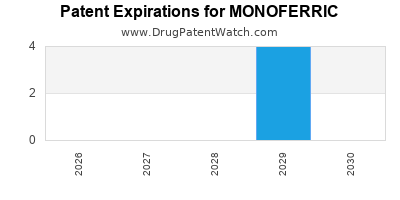
Monoferric is a drug marketed by Pharmacosmos and is included in one NDA. There are five patents protecting this drug.

This drug has sixty-three patent family members in twenty-five countries.

The generic ingredient in MONOFERRIC is ferric derisomaltose. There are twenty drug master file entries for this compound. One supplier is listed for this compound. Additional details are available on the ferric derisomaltose profile page.

DrugPatentWatch® Generic Entry Outlook for Monoferric

By analyzing the patents and regulatory protections it appears that the earliest date for generic entry will be March 25, 2029. This may change due to patent challenges or generic licensing.

There has been one patent litigation case involving the patents protecting this drug, indicating strong interest in generic launch. Recent data indicate that 63% of patent challenges are decided in favor of the generic patent challenger and that 54% of successful patent challengers promptly launch generic drugs.

Indicators of Generic Entry

< Available with Subscription >

  Start Trial

AI Deep Research
Questions you can ask:
  • What is the 5 year forecast for MONOFERRIC?
  • What are the global sales for MONOFERRIC?
  • What is Average Wholesale Price for MONOFERRIC?
Summary for MONOFERRIC
DrugPatentWatch® Estimated Loss of Exclusivity (LOE) Date for MONOFERRIC
Generic Entry Date for MONOFERRIC*:
Constraining patent/regulatory exclusivity:
NDA:
Dosage:

SOLUTION;INTRAVENOUS

*The generic entry opportunity date is the latter of the last compound-claiming patent and the last regulatory exclusivity protection. Many factors can influence early or later generic entry. This date is provided as a rough estimate of generic entry potential and should not be used as an independent source.

Recent Clinical Trials for MONOFERRIC

Identify potential brand extensions & 505(b)(2) entrants

SponsorPhase
University of SaskatchewanPHASE3
Oregon Health and Science UniversityEarly Phase 1
Alberta Health Services, CalgaryPhase 3

See all MONOFERRIC clinical trials

US Patents and Regulatory Information for MONOFERRIC

MONOFERRIC is protected by five US patents.

Based on analysis by DrugPatentWatch, the earliest date for a generic version of MONOFERRIC is ⤷  Start Trial.

This potential generic entry date is based on patent 12,030,962.

Generics may enter earlier, or later, based on new patent filings, patent extensions, patent invalidation, early generic licensing, generic entry preferences, and other factors.

Applicant Tradename Generic Name Dosage NDA Approval Date TE Type RLD RS Patent No. Patent Expiration Product Substance Delist Req. Exclusivity Expiration
Pharmacosmos MONOFERRIC ferric derisomaltose SOLUTION;INTRAVENOUS 208171-003 Jan 16, 2020 RX Yes Yes 11,633,489 ⤷  Start Trial ⤷  Start Trial
Pharmacosmos MONOFERRIC ferric derisomaltose SOLUTION;INTRAVENOUS 208171-001 Jan 16, 2020 DISCN Yes No 11,633,489 ⤷  Start Trial ⤷  Start Trial
Pharmacosmos MONOFERRIC ferric derisomaltose SOLUTION;INTRAVENOUS 208171-003 Jan 16, 2020 RX Yes Yes 10,414,831 ⤷  Start Trial Y Y ⤷  Start Trial
>Applicant >Tradename >Generic Name >Dosage >NDA >Approval Date >TE >Type >RLD >RS >Patent No. >Patent Expiration >Product >Substance >Delist Req. >Exclusivity Expiration

International Patents for MONOFERRIC

When does loss-of-exclusivity occur for MONOFERRIC?

Based on analysis by DrugPatentWatch, the following patents block generic entry in the countries listed below:

Australia

Patent: 09342799
Patent: A stable iron oligosaccharide compound
Estimated Expiration: ⤷  Start Trial

Brazil

Patent: 0924653
Patent: composto de ferro-oligossacarídeo estável
Estimated Expiration: ⤷  Start Trial

Canada

Patent: 56580
Patent: COMPOSE OLIGOSACCHARIDE STABLE ASSOCIE AU FER (A STABLE IRON OLIGOSACCHARIDE COMPOUND)
Estimated Expiration: ⤷  Start Trial

China

Patent: 2361651
Patent: Stable iron oligosaccharide compound
Estimated Expiration: ⤷  Start Trial

Patent: 8752395
Patent: 稳定的铁寡糖复合物 (Stable iron oligosaccharide complex)
Estimated Expiration: ⤷  Start Trial

Patent: 9700828
Patent: 稳定的铁寡糖复合物 (Stable iron oligosaccharide compound)
Estimated Expiration: ⤷  Start Trial

Croatia

Patent: 0170230
Estimated Expiration: ⤷  Start Trial

Patent: 0201903
Estimated Expiration: ⤷  Start Trial

Patent: 0250214
Estimated Expiration: ⤷  Start Trial

Cyprus

Patent: 18725
Estimated Expiration: ⤷  Start Trial

Patent: 23651
Estimated Expiration: ⤷  Start Trial

Denmark

Patent: 11053
Estimated Expiration: ⤷  Start Trial

Patent: 56075
Estimated Expiration: ⤷  Start Trial

Eurasian Patent Organization

Patent: 3917
Patent: СТАБИЛЬНОЕ ЖЕЛЕЗО-ОЛИГОСАХАРИДНОЕ СОЕДИНЕНИЕ (STABLE IRON OLIGOSACCHARIDE COMPOUND)
Estimated Expiration: ⤷  Start Trial

Patent: 1190214
Patent: СТАБИЛЬНОЕ ЖЕЛЕЗО-ОЛИГОСАХАРИДНОЕ СОЕДИНЕНИЕ (STABLE IRON OLIGOSACCHARIDE COMPOUND)
Estimated Expiration: ⤷  Start Trial

European Patent Office

Patent: 11053
Patent: COMPOSÉ OLIGOSACCHARIDE STABLE ASSOCIÉ AU FER (A STABLE IRON OLIGOSACCHARIDE COMPOUND)
Estimated Expiration: ⤷  Start Trial

Patent: 56075
Patent: OLIGOSIDE ET SON PROCÉDÉ DE PRÉPARATION (AN OLIGOSACCHARIDE AND A PROCESS FOR PREPARATION THEREOF)
Estimated Expiration: ⤷  Start Trial

Patent: 21910
Patent: OLIGOSIDE ET SON PROCÉDÉ DE PRÉPARATION (AN OLIGOSACCHARIDE AND A PROCESS FOR PREPARATION THEREOF)
Estimated Expiration: ⤷  Start Trial

Patent: 45137
Patent: COMPOSÉ OLIGOSACCHARIDE STABLE DE FER (A STABLE IRON OLIGOSACCHARIDE COMPOUND)
Estimated Expiration: ⤷  Start Trial

Hong Kong

Patent: 64138
Patent: 穩定的鐵寡糖複合物 (A STABLE IRON OLIGOSACCHARIDE COMPOUND)
Estimated Expiration: ⤷  Start Trial

Hungary

Patent: 30866
Estimated Expiration: ⤷  Start Trial

Patent: 52617
Estimated Expiration: ⤷  Start Trial

Japan

Patent: 26010
Estimated Expiration: ⤷  Start Trial

Patent: 12521369
Estimated Expiration: ⤷  Start Trial

Lithuania

Patent: 11053
Estimated Expiration: ⤷  Start Trial

Patent: 56075
Estimated Expiration: ⤷  Start Trial

Mexico

Patent: 11009936
Patent: UN COMPUESTO DE OLIGOSACARIDO DE HIERRO ESTABLE. (A STABLE IRON OLIGOSACCHARIDE COMPOUND.)
Estimated Expiration: ⤷  Start Trial

New Zealand

Patent: 5597
Patent: A STABLE IRON OLIGOSACCHARIDE COMPOUND
Estimated Expiration: ⤷  Start Trial

Philippines

Patent: 015500891
Patent: A STABLE IRON OLIGOSACCHARIDE COMPOUND
Estimated Expiration: ⤷  Start Trial

Poland

Patent: 11053
Estimated Expiration: ⤷  Start Trial

Patent: 56075
Estimated Expiration: ⤷  Start Trial

Patent: 21910
Estimated Expiration: ⤷  Start Trial

Portugal

Patent: 11053
Estimated Expiration: ⤷  Start Trial

Patent: 56075
Estimated Expiration: ⤷  Start Trial

Serbia

Patent: 700
Patent: STABILNO JEDINJENJE GVOŽĐA I OLIGOSAHARIDA (A STABLE IRON OLIGOSACCHARIDE COMPOUND)
Estimated Expiration: ⤷  Start Trial

Slovenia

Patent: 11053
Estimated Expiration: ⤷  Start Trial

Patent: 56075
Estimated Expiration: ⤷  Start Trial

South Africa

Patent: 1107431
Patent: A STABLE IRON OLIGOSACCHARIDE COMPOUND
Estimated Expiration: ⤷  Start Trial

South Korea

Patent: 1580348
Estimated Expiration: ⤷  Start Trial

Patent: 120016063
Patent: 안정한 철 올리고당 화합물 (A STABLE IRON OLIGOSACCHARIDE COMPOUND)
Estimated Expiration: ⤷  Start Trial

Spain

Patent: 17658
Estimated Expiration: ⤷  Start Trial

Patent: 40074
Estimated Expiration: ⤷  Start Trial

Patent: 09818
Estimated Expiration: ⤷  Start Trial

Ukraine

Patent: 3373
Patent: СТАБИЛЬНОЕ СОЕДИНЕНИЕ ФЕРРУМА ОЛИГОСАХАРИДА (STABLE IRON OLIGOSACCHARIDE COMPOUND)
Estimated Expiration: ⤷  Start Trial

Generics may enter earlier, or later, based on new patent filings, patent extensions, patent invalidation, early generic licensing, generic entry preferences, and other factors.

See the table below for additional patents covering MONOFERRIC around the world.

Country Patent Number Title Estimated Expiration
Australia 2009342799 ⤷  Start Trial
Brazil PI0924653 ⤷  Start Trial
Canada 2756580 ⤷  Start Trial
>Country >Patent Number >Title >Estimated Expiration

Supplementary Protection Certificates for MONOFERRIC

Patent Number Supplementary Protection Certificate SPC Country SPC Expiration SPC Description
2411053 C02411053/01 Switzerland ⤷  Start Trial PRODUCT NAME: FERRUM (III) UT FERRI ISOMALTOSIDUM; REGISTRATION NO/DATE: SWISSMEDIC-ZULASSUNG 67001 26.08.2019
>Patent Number >Supplementary Protection Certificate >SPC Country >SPC Expiration >SPC Description

MONOFERRIC (ferric derisomaltose) Market Dynamics and Financial Trajectory (Revenue, Pricing, Competition, and Patent-Driven Risk)

Last updated: July 28, 2026

What is Monoferric’s market position and revenue trajectory in iron deficiency anemia?

Monoferric (ferric derisomaltose; FDA: injectables) has competed in the intravenous (IV) iron deficiency anemia (IDA) segment where treatment speed, dosing convenience, and administered dose per visit drive clinician and payer selection. Market dynamics are shaped by three forces: (1) IV iron dosing schedules and maximum dose per infusion, (2) safety/tolerability and post-administration monitoring burden, and (3) formulary and contracting across hospital and outpatient infusion channels.

Competitive context. Monoferric’s main commercial rivals include older IV iron products (notably iron sucrose and ferric carboxymaltose) and newer IV iron alternatives in various geographies. Decision-making is often payer- and site-of-care specific because infusion center drug acquisition cost and administration workflow are priced differently than pharmacy benefit claims.

Financial trajectory drivers.

  • Utilization expansion depends on guideline uptake for IV replacement in patients with poor oral response, intolerance, or need for rapid repletion.
  • Channel mix (hospital outpatient vs inpatient vs clinic infusion) strongly affects realized net revenue due to rebates, distribution terms, and tendering.
  • Contracting and switch rates depend on tender cycles, safety perceptions, and administration time.
  • Switching risks rise when competitors gain favorable formulary placement or when procurement favors lower acquisition cost regardless of dosing convenience.

How do dosing schedule, infusion time, and administration convenience shape Monoferric’s market share?

In IV iron, dosing design impacts both throughput and costs per treated patient. Monoferric’s clinical positioning is typically anchored on ability to deliver larger single-visit doses under labeling, reducing the number of infusions versus regimens that require multiple shorter administrations.

Site-of-care economics.

  • Fewer visits lower infusion chair time, nursing time, and observation overhead.
  • Shorter administration pathways support higher patient throughput, which can be decisive in outpatient infusion centers.
  • Supply reliability and distribution lead times affect tender outcomes.

What that means for share. Even when list price differs, procurement committees often compare “total treatment episode cost,” which bundles drug acquisition with administration workflow. Monoferric’s commercial performance has therefore been tied to how payers and providers price convenience and throughput, not only to per-mg acquisition.

What pricing and reimbursement dynamics affect Monoferric net revenue?

Net revenue is driven by reimbursement structure and contracting mechanics:

  • Hospital and outpatient tendering: pricing is negotiated through group purchasing organizations and procurement contracts.
  • Rebate intensity: depends on formulary status and whether volume commitments exist.
  • ASP volatility: IV iron has pricing pressure because multiple products compete for the same infusions and procurement decisions can switch quickly between brands.

Realization pressure typically increases when:

  • a competitor gains a broader formulary footprint in a hospital system;
  • a tender bundles multiple IV iron products at a pooled discounted rate;
  • biosafety or monitoring protocols are standardized across IV iron brands, reducing differentiation.

Which competitors are most likely to pressure Monoferric, and how does competition play out?

Monoferric competes in a crowded IV iron landscape. The most market-relevant competitive comparisons are against:

  • Ferric carboxymaltose (strong competition in dosing convenience and fast repletion)
  • Iron sucrose (dominant historically but often requires multiple administrations)
  • Other IV iron formulations that gain traction via procurement or guideline reinforcement in specific indications

Competition mechanics in practice

  • Formulary placement is often the biggest share driver. Once placed on formulary, switching can require new safety evidence, tighter tender pricing, or procurement renegotiation.
  • Tender cycles can reset share quickly at contract renewal.
  • Indication and patient subpopulations (chronic kidney disease, inflammatory bowel disease-related anemia, postpartum anemia, heart failure cohorts where IV iron use is common) can drive targeted adoption.

How do indication coverage and guideline use translate into demand for Monoferric?

Demand for IV iron is created by clinical need plus guideline adoption. Monoferric’s growth potential is tied to:

  • expansion in label-relevant patient populations and care settings,
  • clinician familiarity and trust in IV iron workflows,
  • adoption in outpatient infusion with throughput constraints.

Key demand levers

  • Physician preference: product selection in IDA often follows institutional experience and infusion protocols.
  • Hospital pathways: standardized anemia pathways influence which IV iron is stocked and how orders are placed.
  • Patient throughput targets: products enabling higher single-visit dosing can win contracts even with higher per-unit acquisition cost.

What is the patent and exclusivity landscape for Monoferric that shapes its financial trajectory?

Monoferric’s financial runway is governed by:

  • composition-of-matter and formulation protection,
  • method-of-use protection for IDA indications and specific dosing regimens (where claimed),
  • exclusivity (if applicable to the specific jurisdiction and regulatory status),
  • device/infusion protocol claims if present (less common for IV generics but sometimes relevant).

Commercial impact of the IP wall.

  • If the patent estate is dense and includes formulation or dosing method claims, generic entry risk is reduced or delayed.
  • If key claims are narrow or close to expiration, biosimilar-like substitution patterns can occur through “design-around” and litigation settlements.

When does Monoferric lose exclusivity, and what generic entry risks exist?

The market impact of exclusivity loss depends on:

  • the jurisdiction (US vs EU vs UK),
  • whether Orange Book-style listed patents exist for each relevant formulation/dosage,
  • whether paragraph IV-style challenges are filed (US) or equivalent challenges occur in other jurisdictions,
  • the settlement pattern (launch design-around, delayed launch date, or market-sharing).

Generic entry risk is highest when:

  • the active substance has no broad method-of-use coverage remaining;
  • formulation patents are weak or easy to design around;
  • regulatory pathways allow rapid demonstration of bioequivalence/identity for complex IV iron products.

What Orange Book status applies to Monoferric in the US, and what patents are listed?

US market access and litigation timing typically hinge on the FDA Orange Book listings (for the specific brand, strengths, dosage forms, and manufacturer). The Orange Book determines which patents attach to the NDA and therefore which patents can be challenged via US-specific mechanisms.

How strong is the Monoferric patent estate against generic or biosimilar-style challenges?

Strength is evaluated via:

  • claim breadth (composition vs process vs method-of-use),
  • number of remaining active listed patents at each code,
  • litigation history (if any) and how courts have treated similar IV iron patents,
  • whether patents are vulnerable on obviousness or lack of written description/enabling disclosure.

Financial translation. A “thick” remaining estate tends to sustain price and volume retention and can support premium contracting. A thin estate increases the likelihood of price resets and faster volume migration to lower-cost entrants.

What patent litigation and settlement dynamics affect Monoferric revenue risk?

Litigation affects revenue through:

  • entry delays via injunctions or settlement timing,
  • switching behavior during litigation (some systems wait, others keep inventory),
  • uncertainty discounts (providers may limit procurement of the challenged product near an expected entry date).

The practical revenue exposure is tied to:

  • whether competitors can launch at risk if patents are not enjoined,
  • how quickly payers and procurement systems switch post-launch.

What is the FDA regulatory status of Monoferric and how does it impact commercial scale-up?

Regulatory status influences:

  • approved indications and dose administration frameworks,
  • manufacturing scale readiness and batch release cadence,
  • post-marketing requirements that can affect supply continuity and cost.

Commercial scale-up is constrained when:

  • manufacturing capacity is limited relative to demand spikes,
  • additional stability or manufacturing controls increase cost or slow release,
  • label restrictions reduce real-world adoption.

How does Monoferric compare with ferric carboxymaltose and iron sucrose on market adoption and uptake?

From a business perspective, IV iron comparisons are usually reduced to three decision points:

  • maximum dose per visit and implied number of administrations,
  • safety monitoring burden and infusion center workflow,
  • payer contracting preference and realized net price.

Typical pattern in adoption:

  • multi-infusion regimens face switch pressure where single-visit dosing is valued,
  • brands with better contracting outcomes can outperform even if perceived clinical advantages are similar.

What formulation and manufacturing/IP barriers could block or slow generic competition for Monoferric?

For complex IV iron products, barriers can include:

  • manufacturing process controls tied to specific complex formation or stability profiles,
  • specification windows and impurity profiles,
  • need for consistent particle/complex characteristics,
  • analytical comparability requirements that increase development cost and time.

Effect on financial trajectory. Higher development friction tends to delay entry and reduce the number of competitors that can successfully launch, sustaining pricing power longer.

How do channel strategy and distribution structure affect Monoferric sales stability?

IV iron sales often correlate with distribution relationships and tender execution:

  • hospital group purchasing agreements can dominate volumes,
  • outpatient infusion centers have faster switching but also more frequent tender turnover,
  • supply chain disruptions can temporarily reduce fill and create short-term revenue volatility.

Stability factors

  • multi-site contracting reduces customer churn,
  • strong hospital pharmacy and infusion pharmacy relationships improve ordering consistency,
  • reliable lead time reduces stockouts and avoids missed treatment cycles.

Key commercial timeline: what milestones typically move Monoferric revenue?

Monoferric’s financial path is generally moved by:

  • label expansions that widen eligible patient populations,
  • formulary placements in large hospital networks,
  • tender awards or renewals in major procurement groups,
  • competitive launches that reset acquisition economics,
  • IP expiration or litigation outcomes that change expected switching timing.

(Note: the precise milestone dates and revenue figures for Monoferric are jurisdiction- and period-specific and must be sourced from the company’s financial disclosures and regulator/Orange Book records.)

Key Takeaways

  • Monoferric’s market dynamics are primarily driven by IV iron contracting economics tied to dosing convenience, visit count, and infusion-center throughput.
  • Net revenue is sensitive to hospital tendering cycles, rebate intensity, and channel mix between inpatient and outpatient infusion.
  • Competitive pressure is centered on ferric carboxymaltose and other IV iron formulations that can match workflow needs or win procurement pricing.
  • Financial trajectory risk increases as patent and exclusivity protections narrow and as generic entry timing becomes predictable via regulatory listings and litigation outcomes.

FAQs

  1. What factors most influence IV iron procurement decisions in hospital outpatient settings?
  2. How do FDA regulatory status and labeling changes affect Monoferric real-world adoption?
  3. What Orange Book patent listings determine whether a generic can file a US paragraph IV challenge to Monoferric?
  4. Which patient subgroups drive the highest incremental demand for IV iron products like Monoferric?
  5. How does tender timing affect switching risk and near-term revenue for IV iron brands?

References

  1. FDA. Orange Book: Approved Drug Products with Therapeutic Equivalence Evaluations. https://www.accessdata.fda.gov/scripts/cder/daf/
  2. FDA. Drug Approval Reports and Drug Trials Snapshots (for approved products and regulatory history). https://www.fda.gov/drugs/development-approval-process-drugs/
  3. FDA. Access data for labeling and drug approval information. https://www.accessdata.fda.gov/

More… ↓

⤷  Start Trial

Make Better Decisions: Try a trial or see plans & pricing

Drugs may be covered by multiple patents or regulatory protections. All trademarks and applicant names are the property of their respective owners or licensors. Although great care is taken in the proper and correct provision of this service, thinkBiotech LLC does not accept any responsibility for possible consequences of errors or omissions in the provided data. The data presented herein is for information purposes only. There is no warranty that the data contained herein is error free. We do not provide individual investment advice. This service is not registered with any financial regulatory agency. The information we publish is educational only and based on our opinions plus our models. By using DrugPatentWatch you acknowledge that we do not provide personalized recommendations or advice. thinkBiotech performs no independent verification of facts as provided by public sources nor are attempts made to provide legal or investing advice. Any reliance on data provided herein is done solely at the discretion of the user. Users of this service are advised to seek professional advice and independent confirmation before considering acting on any of the provided information. thinkBiotech LLC reserves the right to amend, extend or withdraw any part or all of the offered service without notice.