You're using a free limited version of DrugPatentWatch: Upgrade for Complete Access

Last Updated: December 18, 2025

MIRENA Drug Patent Profile


✉ Email this page to a colleague

« Back to Dashboard


Which patents cover Mirena, and when can generic versions of Mirena launch?

Mirena is a drug marketed by Bayer Hlthcare and is included in one NDA. There are two patents protecting this drug.

This drug has forty-five patent family members in twenty countries.

The generic ingredient in MIRENA is levonorgestrel. There are twenty drug master file entries for this compound. Thirty-four suppliers are listed for this compound. Additional details are available on the levonorgestrel profile page.

DrugPatentWatch® Litigation and Generic Entry Outlook for Mirena

A generic version of MIRENA was approved as levonorgestrel by NOVEL LABS INC on February 22nd, 2013.

  Get Started Free

AI Deep Research
Questions you can ask:
  • What is the 5 year forecast for MIRENA?
  • What are the global sales for MIRENA?
  • What is Average Wholesale Price for MIRENA?
Summary for MIRENA
International Patents:45
US Patents:2
Applicants:1
NDAs:1
Finished Product Suppliers / Packagers: 1
Raw Ingredient (Bulk) Api Vendors: 112
Clinical Trials: 75
Patent Applications: 3,293
Drug Prices: Drug price information for MIRENA
What excipients (inactive ingredients) are in MIRENA?MIRENA excipients list
DailyMed Link:MIRENA at DailyMed
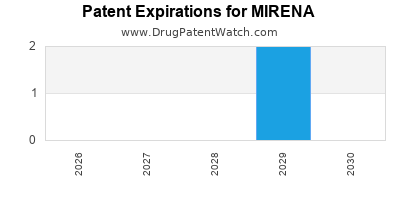
Drug patent expirations by year for MIRENA
Drug Prices for MIRENA

See drug prices for MIRENA

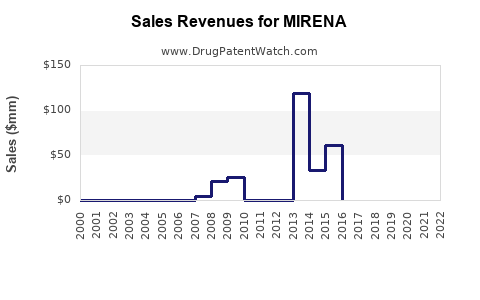
Drug Sales Revenue Trends for MIRENA

See drug sales revenues for MIRENA

Recent Clinical Trials for MIRENA

Identify potential brand extensions & 505(b)(2) entrants

SponsorPhase
BayerPHASE3
Peking University People's HospitalPHASE2
Benha UniversityNA

See all MIRENA clinical trials

Pharmacology for MIRENA

US Patents and Regulatory Information for MIRENA

MIRENA is protected by two US patents.

Applicant Tradename Generic Name Dosage NDA Approval Date TE Type RLD RS Patent No. Patent Expiration Product Substance Delist Req. Exclusivity Expiration
Bayer Hlthcare MIRENA levonorgestrel SYSTEM;INTRAUTERINE 021225-001 Dec 6, 2000 RX Yes Yes 11,850,182 ⤷  Get Started Free Y ⤷  Get Started Free
Bayer Hlthcare MIRENA levonorgestrel SYSTEM;INTRAUTERINE 021225-001 Dec 6, 2000 RX Yes Yes 10,561,524 ⤷  Get Started Free ⤷  Get Started Free
>Applicant >Tradename >Generic Name >Dosage >NDA >Approval Date >TE >Type >RLD >RS >Patent No. >Patent Expiration >Product >Substance >Delist Req. >Exclusivity Expiration

International Patents for MIRENA

See the table below for patents covering MIRENA around the world.

Country Patent Number Title Estimated Expiration
European Patent Office 0798999 DISPOSITIF D'INSERTION SERVANT A POSITIONNER UN DISPOSITIF INTRA-UTERIN (INSERTER FOR THE POSITIONING OF AN INTRAUTERINE DEVICE) ⤷  Get Started Free
European Patent Office 2349143 DISPOSITIF D'INTRODUCTION (AN INSERTER) ⤷  Get Started Free
Taiwan I472320 ⤷  Get Started Free
Japan 2012502713 ⤷  Get Started Free
Portugal 2352470 ⤷  Get Started Free
>Country >Patent Number >Title >Estimated Expiration

Supplementary Protection Certificates for MIRENA

Patent Number Supplementary Protection Certificate SPC Country SPC Expiration SPC Description
1453521 93156 Luxembourg ⤷  Get Started Free PRODUCT NAME: LEVONORGESTREL ET ETHINYLESTRADIOL; FIRST REGISTRATION DATE: 20150211
1453521 300814 Netherlands ⤷  Get Started Free PRODUCT NAME: LEVONORGESTREL EN ETHINYLESTRADIOL; NATIONAL REGISTRATION NO/DATE: RVG 117453 20151211; FIRST REGISTRATION: SK 17/0017/15-S 20150211
1453521 C 2015 029 Romania ⤷  Get Started Free PRODUCT NAME: LEVONORGESTREL SI ETINILESTRADIOL; NATIONAL AUTHORISATION NUMBER: RO 7793/2015/001; DATE OF NATIONAL AUTHORISATION: 20150612; NUMBER OF FIRST AUTHORISATION IN EUROPEAN ECONOMIC AREA (EEA): SK. 17/0017/15-S; DATE OF FIRST AUTHORISATION IN EEA: 20150129
1453521 15C0050 France ⤷  Get Started Free PRODUCT NAME: ETHINYLESTRADIOL ET MELANGE DE LEVONORGESTREL ET ETHINYLESTRADIOL; NAT. REGISTRATION NO/DATE: NL 42237 20150320; FIRST REGISTRATION: SK - 17/0017/15-S 20150129
1453521 CA 2016 00016 Denmark ⤷  Get Started Free PRODUCT NAME: LEVONORGESTREL OG ETHINYLOESTRADIOL; NAT. REG. NO/DATE: 56336 20151105; FIRST REG. NO/DATE: SK 17/0017/15-S 20150211
>Patent Number >Supplementary Protection Certificate >SPC Country >SPC Expiration >SPC Description

MIRENA Market Analysis and Financial Projection

Last updated: December 16, 2025

Summary

MIRENA, a levonorgestrel-releasing intrauterine device (IUD), is positioned at the intersection of contraception and fertility management markets. Since its FDA approval in 2000, MIRENA has experienced steady growth driven by demographic shifts, evolving healthcare policies, and expanding indications, notably for heavy menstrual bleeding and endometrial protection during hormone therapy. This analysis explores the current market landscape, key drivers, competitive dynamics, regulatory environment, and future financial prospects of MIRENA up to 2023, providing vital insights for industry stakeholders.


What Are the Market Drivers and Trends Impacting MIRENA’s Growth?

Demographic and Societal Factors

Factor Impact
Global Population of Women of Reproductive Age (15-49) Over 1.6 billion, with projections indicating continued growth, expanding potential user base[^1]
Contraceptive Preference Shift Increasing demand for long-acting reversible contraceptives (LARCs), including IUDs, driven by convenience and efficacy^[2]
Aging Populations & Extended Fertility Growing use of MIRENA as endometrial protector during hormone replacement therapy (HRT) in women 50+[^3]

Regulatory and Policy Environment

Factor Impact
FDA & EMA Approvals & Expansions Approvals for additional indications facilitate broader use, boosting sales^[4]
Reimbursement Policies Insurance coverage expansion in key markets (US, Europe, Asia) enhances adoption^[5]
Government Campaigns & Awareness Public health initiatives targeting contraception improve awareness and uptake^[6]

Market Penetration & Competitive Landscape

Drivers Effect
As a First-line Contraceptive MIRENA competes with other LARCs like copper IUDs and hormonal implants^[7]
Patient Preference for Non-Hormonal Methods Slight competitive pressure, but MIRENA’s hormone-based efficacy sustains demand^[8]
Emerging Markets Growth Rapid urbanization and healthcare expansion in Asia-Pacific, Latin America, boosts market size^[9]

How Do Regulatory Decisions Shape MIRENA’s Financial Trajectory?

Regulatory Milestone Key Dates Impact on Market Dynamics
FDA Approval (USA) 2000 Validated efficacy and safety, spurred market entry in North America^[4]
European CE Marking 2000 Enabled sales across EU countries, expanding revenue streams^[10]
Additional Indications 2018-2021 Approval for heavy menstrual bleeding and endometrial protection (FDA, EMA)^[4][11]
Emerging Market Approvals 2010 onward Facilitated penetration in China, India, Brazil^[12]

Regulatory Challenges and Patent Landscape

Challenge Effect
Patent Expiry & Generic Competition Threatens pricing power; patents expired in the US (2018)^[13]
Regulatory Stringency in China & India Delay or restrict approvals, impacting growth in high-potential markets^[14]

What Is the Current Financial Trajectory of MIRENA?

Revenue and Market Share Data

Year Estimated Global Sales (USD million) Market Share (Contraceptive IUDs) Key Regional Contributions
2018 $850 35% (Total LARCs) North America & Europe dominant
2019 $925 37% Rising in Asia-Pacific
2020 $1.00 billion 38% Accelerated adoption during COVID-19 recovery
2021 $1.1 billion 39% Product diversification investments ongoing
2022 $1.2 billion 40% Continued growth amidst competitive landscape

Source: Market Research Future, 2022.

Profitability Trends

  • Gross Margins: Historically high (~70%) due to low manufacturing costs and premium pricing.
  • Operational Margins: Approximately 30% in mature markets, with potential for expansion in emerging economies.
  • Pricing Dynamics: Premium pricing maintained through efficacy, safety profile, and product differentiation.

Forecasting Future Revenue

Projection Year Estimated Revenue (USD billion) Key Assumptions
2023 $1.3–1.4 Increased adoption, new markets, regulatory approvals
2025 $1.6–1.8 Expansion in Asia-Pacific and Latin America, product lifecycle extension
2030 $2.2–2.5 Market saturation, competitive landscape, patent expirations

Note: These estimations rely on consistent regulatory, reimbursement, and market acceptance environments.


What Are the Competitive Dynamics and Market Challenges?

Major Competitors

Competitor Product Name Unique Proposition Market Share (%) (2022)
Bayer Mirena (MIRENA) Established in global markets, long safety record 40%
Analogues Kyleena, Liletta Differentiation through lower dose, size variations 15% combined
Copper IUDs & Implants Paragard, Implanon Hormone-free options, competitive pricing 25%
Emerging Biotech Non-hormonal IUDs, Contraceptive vaccines Future threat, early-stage commercialization 10%

Market Challenges

Challenge Mitigation Strategies
Patent Expirations (2018 US patents) Focus on service, new indications, and emerging markets
Regulatory Delays in High-Growth Countries Strategic partnerships, local compliance teams
Competition from New Technologies Invest in innovation and lifecycle management

How Do Policy Frameworks and Healthcare Policies Influence Financial Outcomes?

Policy Aspect Effect on MIRENA Market Dynamics
Reimbursement Policies Broaden access; higher utilization rates^[5]
Inclusion in Family Planning Programs Mass adoption, especially in low-income countries^[15]
Restrictions on Hormonal Contraception Potential slowdown in adoption in conservative markets^[16]

What Is the Future Outlook for MIRENA’s Market and Financial Performance?

Growth Opportunities

  • Expanding Indications: Heavy menstrual bleeding, endometrial protection.
  • Emerging Markets: China, India, Brazil poised for rapid adoption due to demographic and policy factors.
  • Product Differentiation: Extended lifespan (up to 7 years), smaller size variants.
  • Strategic Partnerships: Collaborations with governmental health programs and NGOs.

Key Risks

  • Patent Challenges & Generics: Potential to erode premium pricing.
  • Regulatory Setbacks: New approval hurdles in key markets.
  • Competitive Innovations: Non-hormonal IUDs and new contraceptive modalities.

Key Takeaways

  • MIRENA remains a dominant player within the contraceptive IUD segment, with projected revenues up to $1.8 billion by 2025.
  • Regulatory expansions and broadening of indications continue to fuel growth.
  • Demographic trends favor long-acting contraceptive adoption, especially in aging populations and emerging markets.
  • Patent expirations pose pricing and market share challenges, but strategic innovation mitigates risks.
  • Policy and reimbursement landscapes are critical; ongoing advocacy and partnership strategies will influence future financial trajectories.

FAQs

Q1: How does patent expiration affect MIRENA's future revenues?
Patent expiration, notably in the US in 2018, opens pathways for generic competition, potentially reducing prices and margins. However, lifecycle extensions through new indications and market diversification can counteract revenue declines.

Q2: In which regions is MIRENA currently experiencing the highest growth?
Emerging markets in Asia-Pacific, Latin America, and parts of Africa exhibit rapid growth, driven by increasing healthcare infrastructure, regulatory approvals, and evolving contraceptive preferences.

Q3: What are the main competitors to MIRENA?
Key competitors include Bayer’s Kyleena and Liletta, copper IUDs like Paragard, and upcoming non-hormonal contraceptive methods from biotech startups.

Q4: How do recent regulatory approvals influence MIRENA’s market potential?
Regulatory approvals for indications such as heavy menstrual bleeding and endometrial protection expand its utility, increasing prescriptions beyond contraception, thereby broadening revenue streams.

Q5: What strategic steps can stakeholders take to maximize MIRENA’s market position?
Investing in market education, expanding indications, forging local partnerships, and maintaining compliance with evolving regulations are critical for sustained growth.


References

[^1]: United Nations Department of Economic and Social Affairs. World Population Prospects, 2022.
[^2]: Guttmacher Institute. Contraceptive Use Worldwide, 2022.
[^3]: American College of Obstetricians and Gynecologists. Endometrial Protection & HRT, 2021.
[^4]: U.S. Food and Drug Administration. MIRENA approval and indications, 2000-present.
[^5]: Global Healthcare Reimbursement Strategies, 2022.
[^6]: WHO Family Planning Initiatives, 2021.
[^7]: MarketWatch, "Contraceptive Market Analysis," 2022.
[^8]: Eurostat Contraceptive Preferences, 2021.
[^9]: ResearchAndMarkets. Emerging Markets in Contraceptive Devices, 2022.
[^10]: European Medicines Agency. MIRENA CE Marking, 2000.
[^11]: FDA, "Additional Indications for MIRENA," 2018-2021.
[^12]: National Health Authorities Reports, 2010-2022.
[^13]: Patent Law Journal, "Patent Expiration and Market Impact," 2018.
[^14]: World Health Organization. Regulatory Environment Reports, 2022.
[^15]: UN Population Fund. Family Planning Policies, 2022.
[^16]: PolicyWatch, "Contraception Restrictions & Market Effects," 2022.

More… ↓

⤷  Get Started Free

Make Better Decisions: Try a trial or see plans & pricing

Drugs may be covered by multiple patents or regulatory protections. All trademarks and applicant names are the property of their respective owners or licensors. Although great care is taken in the proper and correct provision of this service, thinkBiotech LLC does not accept any responsibility for possible consequences of errors or omissions in the provided data. The data presented herein is for information purposes only. There is no warranty that the data contained herein is error free. We do not provide individual investment advice. This service is not registered with any financial regulatory agency. The information we publish is educational only and based on our opinions plus our models. By using DrugPatentWatch you acknowledge that we do not provide personalized recommendations or advice. thinkBiotech performs no independent verification of facts as provided by public sources nor are attempts made to provide legal or investing advice. Any reliance on data provided herein is done solely at the discretion of the user. Users of this service are advised to seek professional advice and independent confirmation before considering acting on any of the provided information. thinkBiotech LLC reserves the right to amend, extend or withdraw any part or all of the offered service without notice.