You're using a free limited version of DrugPatentWatch: Upgrade for Complete Access

Last Updated: March 26, 2026

MICONAZOLE 3 Drug Patent Profile


✉ Email this page to a colleague

« Back to Dashboard


When do Miconazole 3 patents expire, and what generic alternatives are available?

Miconazole 3 is a drug marketed by Sun Pharma Canada and Perrigo and is included in two NDAs.

The generic ingredient in MICONAZOLE 3 is miconazole nitrate. There are twenty-eight drug master file entries for this compound. Forty-six suppliers are listed for this compound. Additional details are available on the miconazole nitrate profile page.

DrugPatentWatch® Litigation and Generic Entry Outlook for Miconazole 3

A generic version of MICONAZOLE 3 was approved as miconazole nitrate by ACTAVIS PHARMA on November 19th, 1993.

  Start Trial

AI Deep Research
Questions you can ask:
  • What is the 5 year forecast for MICONAZOLE 3?
  • What are the global sales for MICONAZOLE 3?
  • What is Average Wholesale Price for MICONAZOLE 3?
Summary for MICONAZOLE 3
US Patents:0
Applicants:2
NDAs:2
Finished Product Suppliers / Packagers: 3
Raw Ingredient (Bulk) Api Vendors: 101
Clinical Trials: 33
Patent Applications: 3,368
What excipients (inactive ingredients) are in MICONAZOLE 3?MICONAZOLE 3 excipients list
DailyMed Link:MICONAZOLE 3 at DailyMed
Drug patent expirations by year for MICONAZOLE 3
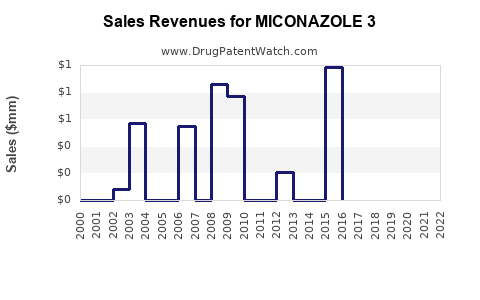
Drug Sales Revenue Trends for MICONAZOLE 3

See drug sales revenues for MICONAZOLE 3

Recent Clinical Trials for MICONAZOLE 3

Identify potential brand extensions & 505(b)(2) entrants

SponsorPhase
Cairo UniversityPHASE3
Ain Shams UniversityPhase 3
Assistance Publique - Hôpitaux de ParisPHASE2

See all MICONAZOLE 3 clinical trials

Pharmacology for MICONAZOLE 3
Drug ClassAzole Antifungal

US Patents and Regulatory Information for MICONAZOLE 3

Applicant Tradename Generic Name Dosage NDA Approval Date TE Type RLD RS Patent No. Patent Expiration Product Substance Delist Req. Exclusivity Expiration
Sun Pharma Canada MICONAZOLE 3 miconazole nitrate CREAM;VAGINAL 076773-001 Mar 2, 2005 OTC No No ⤷  Start Trial ⤷  Start Trial ⤷  Start Trial
Perrigo MICONAZOLE 3 COMBINATION PACK miconazole nitrate CREAM;TOPICAL, VAGINAL 076357-001 Mar 30, 2004 OTC No No ⤷  Start Trial ⤷  Start Trial ⤷  Start Trial
>Applicant >Tradename >Generic Name >Dosage >NDA >Approval Date >TE >Type >RLD >RS >Patent No. >Patent Expiration >Product >Substance >Delist Req. >Exclusivity Expiration

Market Dynamics and Financial Trajectory for Miconazole 3%

Last updated: August 13, 2025

Introduction

Miconazole 3% emerges as a prominent antifungal agent used primarily for the treatment of superficial fungal infections. Its broad-spectrum activity against dermatophytes, yeasts, and moulds positions it as a key asset within the topical antifungal market. As the pharmaceutical industry navigates evolving regulatory environments, competitive landscapes, and growing consumer demand for effective skin infection remedies, understanding the market dynamics and projecting the financial trajectory of Miconazole 3% is essential for stakeholders.


Market Overview and Clinical Applications

Miconazole 3% is indicated for the treatment of conditions such as tinea corporis, tinea cruris, tinea pedis, and candidiasis. Its efficacy, safety profile, and ease of topical application underpin its widespread acceptance among clinicians and patients. The global antifungal market, valued at approximately USD 11 billion in 2022, is projected to grow at a compound annual growth rate (CAGR) of 4-6% over the next five years, driven by increasing incidences of fungal infections and expanding dermatological healthcare awareness [1].

In particular, the topical antifungal segment is gaining traction owing to advantages like reduced systemic side effects and targeted therapy. Miconazole, being a well-established molecule, enjoys a dominant position within this segment, especially in over-the-counter (OTC) formulations.


Market Dynamics Influencing Miconazole 3%

1. Increasing Prevalence of Fungal Infections

The elevated rate of dermatophyte infections globally, fueled by climate factors, urbanization, and lifestyle changes, bolsters demand for effective antifungal treatments. The World Health Organization estimates that dermatophyte infections affect over 20-25% of the global population at some point in life [2]. This demographic trend sustains steady demand for Miconazole 3%, particularly in emerging markets.

2. Competitive Landscape and Market Penetration

Miconazole faces competition from other topical antifungals such as clotrimazole, terbinafine, and econazole. However, Miconazole’s longstanding clinical reputation, affordability, and availability as an OTC medication confer advantages. In developed markets, formulations combining Miconazole with corticosteroids or additional antifungal agents—e.g., Miconazole-Nitric oxide complexes—are expanding its therapeutic scope.

3. Formulation Innovations and Delivery Mechanisms

Innovations such as gels, creams, sprays, and long-acting formulations improve patient compliance and treatment efficacy. Additionally, nanoparticle-based delivery systems and bioadhesive formulations are under research, potentially enhancing absorption and providing competitive edge.

4. Regulatory and Patent Landscape

Most Miconazole formulations are off-patent, enabling significant OTC availability and price competition. Nonetheless, patent extensions for specific formulations or combination therapies could influence market exclusivity and pricing strategies temporarily, impacting revenue streams.

5. Regulatory Approvals and Market Variability

Regulatory authorities worldwide have approved Miconazole for OTC and prescription use, with some regional restrictions. The approval process for new formulations or combination therapies influences product lifecycle and market entry timing.

6. Impact of the COVID-19 Pandemic

The pandemic’s effects on healthcare utilization have temporarily slowed prescription rates but increased demand for OTC antifungals, especially in private and retail channels. Post-pandemic recovery is expected to restore growth momentum.


Financial Trajectory and Revenue Projections

Current Revenue Status

Existing data indicates that Miconazole-based products generate annual revenues exceeding USD 1 billion globally, with Europe and North America contributing approximately 50% of the revenue share [1]. The majority of these revenues are derived from OTC formulations, which benefit from widespread accessibility.

Growth Drivers and Forecasts

  • Market Penetration in Emerging Economies: Rapid urbanization, rising healthcare awareness, and improving healthcare infrastructure facilitate increased OTC sales; forecasts suggest a 7-9% CAGR in emerging markets over 2023-2028.
  • Formulation Diversification: The introduction of combination products with corticosteroids and other antifungal agents enhances therapeutic options, prompting premium pricing and expanding per-unit revenue.
  • E-commerce and Digital Marketing: Rising online sales channels broaden reach, especially in non-traditional markets, potentially adding USD 200-300 million annually to revenues.

Potential Revenue Impact of Key Factors

Factor Impact Estimated Effect
Patent expiry of certain formulations Price competition increases 10-15% revenue decline in mature markets
New formulation approvals or combination therapies Market expansion and premium pricing 15-25% revenue increase
Entry into untapped geographic markets Revenue diversification USD 100-200 million incremental annually
Regulatory restrictions or approval delays Market access limitations 5-10% revenue decrease in affected regions

Projected Financial Trajectory (2023-2028)

Assuming a blended CAGR of 5-6%, revenues could reach USD 1.5-2 billion globally by 2028. The trajectory depends critically on market penetration strategies, formulation innovations, and competitive responses.


Market Challenges and Risk Factors

  • Price Competition and Genericization: As patents expire and generics proliferate, downward pressure on prices could constrain profitability.
  • Regulatory Changes: Stricter quality standards and labeling requirements may delay product launches or increase compliance costs.
  • Emerging Resistance: Rising resistance among dermatophytes to antifungal agents could diminish Miconazole’s effectiveness, necessitating formulation modifications or combination use.
  • Market Saturation: Mature markets may experience saturation, limiting growth potentials unless new formulations or indications are introduced.

Conclusion and Future Outlook

Miconazole 3% maintains a robust position within the topical antifungal segment, driven by a high prevalence of fungal infections and consumer preference for OTC options. Its financial success depends on strategic formulation innovation, effective regulatory navigation, and expansion into underserved markets. Emerging trends such as nanoparticle delivery and combination therapies offer avenues for growth and margin enhancement.


Key Takeaways

  • The global antifungal market, valued at over USD 11 billion, is projected to grow steadily, with Miconazole 3% poised to benefit from rising dermatophyte infection rates.
  • Market dynamics favor Miconazole due to its established efficacy, affordability, OTC availability, and ongoing innovation.
  • Revenue projections indicate a potential rise to USD 1.5-2 billion by 2028, contingent on strategic expansion and product development.
  • Challenges include patent expirations, increasing competition, and resistance patterns, which require proactive adaptation.
  • Stakeholders should focus on formulation diversification, geographic expansion, and regulatory compliance to sustain growth.

FAQs

1. How does Miconazole 3% compare to other antifungal agents in efficacy?
Miconazole 3% demonstrates comparable effectiveness to other topical antifungals like clotrimazole and terbinafine in treating superficial fungal infections, with a favorable safety profile. Its broad-spectrum activity and extensive clinical history make it a preferred option.

2. What are the main markets driving Miconazole sales?
The United States, Europe, and increasingly, Asia-Pacific, especially China and India, are primary markets driven by high dermatophyte infection prevalence and OTC product consumption.

3. How might formulation innovations impact Miconazole’s market position?
Innovative formulations such as gels, long-acting applications, or combination therapies can enhance patient compliance and treatment efficacy, potentially capturing market share from traditional creams.

4. What role does OTC availability play in Miconazole’s financial performance?
OTC availability broadens consumer access, promotes higher sales volumes, and sustains revenue growth, especially in markets where prescription requirements restrict access.

5. What are the primary risks to Miconazole’s future growth?
Key risks include patent expirations leading to generic competition, evolving resistance patterns, regulatory hurdles, and market saturation in developed regions.


References

[1] MarketWatch. "Global Antifungal Market Size, Share & Trends Analysis Report," 2022.
[2] World Health Organization. "Dermatophyte Infections Fact Sheet," 2021.

More… ↓

⤷  Start Trial

Make Better Decisions: Try a trial or see plans & pricing

Drugs may be covered by multiple patents or regulatory protections. All trademarks and applicant names are the property of their respective owners or licensors. Although great care is taken in the proper and correct provision of this service, thinkBiotech LLC does not accept any responsibility for possible consequences of errors or omissions in the provided data. The data presented herein is for information purposes only. There is no warranty that the data contained herein is error free. We do not provide individual investment advice. This service is not registered with any financial regulatory agency. The information we publish is educational only and based on our opinions plus our models. By using DrugPatentWatch you acknowledge that we do not provide personalized recommendations or advice. thinkBiotech performs no independent verification of facts as provided by public sources nor are attempts made to provide legal or investing advice. Any reliance on data provided herein is done solely at the discretion of the user. Users of this service are advised to seek professional advice and independent confirmation before considering acting on any of the provided information. thinkBiotech LLC reserves the right to amend, extend or withdraw any part or all of the offered service without notice.